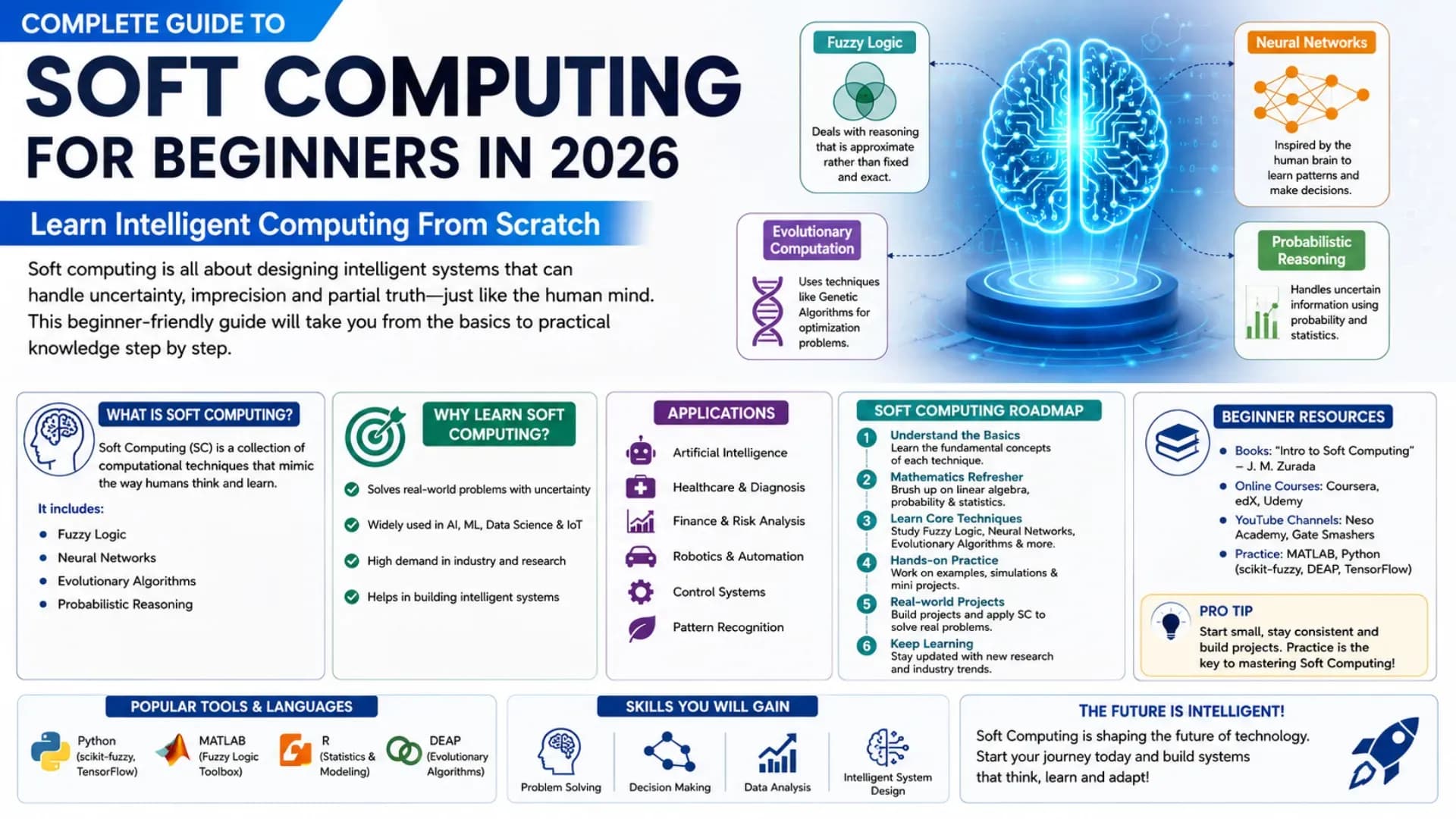
Classical computing is built on precision — binary logic, exact rules, deterministic outcomes. But the real world is not precise. Human decisions tolerate ambiguity. Natural systems adapt without being programmed to do so. Language is approximate. Patterns are noisy. Soft Computing is the family of computational techniques designed to work effectively in this imprecise, uncertain, real-world environment — not by eliminating uncertainty but by computing with it. This complete Soft Computing tutorial takes beginners from first principles through the four core paradigms of intelligent computing: fuzzy logic (computing with vague concepts), artificial neural networks (computing by learning from data), genetic algorithms (computing by simulated evolution), and probabilistic reasoning (computing with uncertainty). This Soft Computing guide 2026 is your entry point to all four — with code examples, visual explanations, and a clear path to deeper study. Every concept taught here connects directly to AI fundamentals and machine learning basics that power the systems you interact with every day. Let's begin.
Related Article:
Top BTech Colleges in India 2026
Table of Contents
- What Is Soft Computing? Hard vs Soft
- Fuzzy Logic — Computing with Vague Concepts
- Artificial Neural Networks — Learning from Data
- Genetic Algorithms — Computing by Evolution
- Probabilistic Reasoning and Bayesian Methods
- Hybrid Systems — Combining Paradigms
- Real-World Applications of Soft Computing
- Next Steps — Learning Path for 2026
What Is Soft Computing? Hard vs Soft
Soft Computing is an umbrella term coined by Lotfi Zadeh (creator of fuzzy logic) for computational approaches that tolerate imprecision, uncertainty, partial truth, and approximation — in contrast to hard computing, which requires precise models, exact inputs, and deterministic outputs. The distinction is not about hardware but about the mathematical philosophy of computation.
# Hard Computing vs Soft Computing — the key philosophical divide:
#
# HARD COMPUTING                    SOFT COMPUTING
# ----------------------------------------
# Requires precise input             Tolerates imprecise/noisy input
# Exact, deterministic output        Approximate, probabilistic output
# Fixed, pre-programmed rules        Adaptive, learned rules
# Fails with ambiguity               Handles ambiguity gracefully
# Examples: sorting, encryption,     Examples: face recognition, spam
#           database queries          filtering, route optimization
#
# Classic example of the divide:
# Q: Is a 35-year-old person "young"?
#
# Hard computing (Boolean):  True or False — must pick one
# Soft computing (Fuzzy):    0.6 "young" — partially true, which matches
#                            how humans actually think about the question
The four main constituents of Soft Computing for beginners to understand are:
- Fuzzy Logic (FL): Handles vagueness and linguistic variables — "hot", "fast", "tall" — with degrees of membership rather than binary true/false
- Artificial Neural Networks (ANN): Learn patterns from data by simulating the brain's interconnected neuron structure; the foundation of deep learning
- Genetic Algorithms (GA): Optimise solutions by simulating biological evolution — selection, crossover, mutation — over many generations
- Probabilistic Reasoning: Handles uncertainty using probability theory; Bayesian networks, hidden Markov models, and related methods
Why does Soft Computing matter in 2026? Every major AI system you interact with — recommendation engines, voice assistants, autonomous vehicles, medical diagnosis tools — uses one or more soft computing paradigms. Learning Soft Computing is learning the conceptual substrate of modern AI. It is the most practically useful theoretical framework in the AI curriculum for engineering students.
Fuzzy Logic — Computing with Vague Concepts
Fuzzy logic extends classical Boolean logic from binary {0, 1} to continuous [0, 1] — allowing any degree of truth between "completely false" and "completely true". It was introduced by Lotfi Zadeh in 1965 and remains one of the most practically deployed Soft Computing techniques in consumer electronics, industrial control, and expert systems.
# Fuzzy Set vs Crisp Set:
#
# Crisp set "Young" (hard boundary, age < 30):
#   Age 25 → IN set (member = 1.0)
#   Age 30 → OUT of set (member = 0.0)  ← abrupt cut-off
#   Age 29 → IN (1.0)  |  Age 31 → OUT (0.0)
#
# Fuzzy set "Young" (gradual membership, more realistic):
#   Age 20 → 1.0  (fully young)
#   Age 25 → 0.9
#   Age 30 → 0.7
#   Age 35 → 0.4
#   Age 45 → 0.1
#   Age 55 → 0.0  (not young at all)
#
# The membership function maps each value to [0, 1]
# Common shapes: triangular, trapezoidal, Gaussian
# Fuzzy Logic System — three stages:
#
# 1. FUZZIFICATION: crisp input → fuzzy membership values
# Temperature = 72°F
# → μ_cold(72) = 0.0
# → μ_comfortable(72) = 0.8
# → μ_hot(72) = 0.2
#
# 2. RULE EVALUATION: apply fuzzy IF-THEN rules
# Rule 1: IF temperature is comfortable THEN fan_speed is medium
# Rule 2: IF temperature is hot THEN fan_speed is high
# Rule 3: IF temperature is cold THEN fan_speed is low
#
# Rule 1 fires with strength 0.8
# Rule 2 fires with strength 0.2
# Rule 3 fires with strength 0.0
#
# 3. DEFUZZIFICATION: fuzzy output → crisp value
# Combine fired rules → fan_speed = 55% (centroid method)
# This crisp value controls the actual fan motor# Python implementation of a triangular membership function:
def triangular_mf(x, a, b, c):
"""
Triangular membership function.
a = left foot (μ = 0), b = peak (μ = 1), c = right foot (μ = 0)
"""
if x <= a or x >= c:
return 0.0
elif a < x <= b:
return (x - a) / (b - a)
else: # b < x < c
return (c - x) / (c - b)
# Define fuzzy sets for temperature (0-100°F range):
def cold(temp): return triangular_mf(temp, 0, 40, 65)
def comfort(temp): return triangular_mf(temp, 55, 70, 85)
def hot(temp): return triangular_mf(temp, 75, 100, 110)
# Fuzzify a temperature reading:
temp = 72
print(f"Temperature {temp}°F:")
print(f" Cold: {cold(temp):.2f}") # 0.00
print(f" Comfortable: {comfort(temp):.2f}") # 0.80
print(f" Hot: {hot(temp):.2f}") # 0.00 (just outside range)Fuzzy Logic Applications
Fuzzy logic is deployed in air conditioners (smooth temperature control), washing machines (variable wash cycles), camera autofocus, anti-lock braking systems, stock trading systems, and medical diagnosis support tools. The Sendai subway system in Japan — one of the world's first fuzzy-logic-controlled transit systems — became the gold-standard proof of concept for industrial fuzzy control in the 1980s and remains operational today.
Also Read:
Top MTech Colleges in India 2026
Artificial Neural Networks — Learning from Data
Artificial neural networks are computational systems loosely inspired by the structure of biological brains — interconnected nodes (neurons) that process signals and learn by adjusting the strength (weights) of connections between nodes. ANNs are the foundation of deep learning and the most commercially deployed Soft Computing paradigm in 2026.
# A single artificial neuron (perceptron):
#
#  Input 1 (x1) ──[w1]──┐
#  Input 2 (x2) ──[w2]──┤ → Σ(xi·wi) + bias → activation_fn → output
#  Input 3 (x3) ──[w3]──┘
#
# Step 1: Weighted sum   z = w1·x1 + w2·x2 + w3·x3 + b
# Step 2: Activation     output = f(z)
#
# Common activation functions:
# Sigmoid:  f(z) = 1 / (1 + e^-z)        → output in (0, 1)
# ReLU:     f(z) = max(0, z)              → output ≥ 0 (most used in 2026)
# Tanh:     f(z) = (e^z - e^-z)/(e^z + e^-z) → output in (-1, 1)
# Softmax:  normalises output to probability distribution (multi-class)
# Multi-layer Neural Network (Feedforward):
#
# INPUT LAYER HIDDEN LAYER 1 HIDDEN LAYER 2 OUTPUT LAYER
#
# x1 ──────────── h11 ─────────── h21 ──────────── y1 (class prob)
# x2 ──────────── h12 ─────────── h22 ──────────── y2
# x3 ──────────── h13 ─────────── h23
# (all fully connected to all in next layer)
#
# FORWARD PASS: compute predictions layer by layer
# BACKWARD PASS (Backpropagation): compute error gradient,
# adjust weights to reduce error (gradient descent)
#
# Loss function measures prediction error:
# MSE (regression): L = (1/n) Σ(y_true - y_pred)²
# Cross-entropy (class): L = -Σ y_true · log(y_pred)# Building a minimal neural network from scratch in Python:
import numpy as np
def sigmoid(z):
return 1 / (1 + np.exp(-z))
def sigmoid_derivative(z):
s = sigmoid(z)
return s * (1 - s)
# XOR problem — not linearly separable, requires hidden layer
X = np.array([[0,0], [0,1], [1,0], [1,1]]) # inputs
y = np.array([[0], [1], [1], [0]]) # XOR outputs
# Network: 2 inputs → 4 hidden → 1 output
np.random.seed(42)
W1 = np.random.randn(2, 4) * 0.5 # input→hidden weights
W2 = np.random.randn(4, 1) * 0.5 # hidden→output weights
b1 = np.zeros((1, 4)) # hidden biases
b2 = np.zeros((1, 1)) # output bias
lr = 0.5 # learning rate
for epoch in range(10000):
# Forward pass
z1 = X @ W1 + b1
a1 = sigmoid(z1)
z2 = a1 @ W2 + b2
a2 = sigmoid(z2)
# Backward pass (backpropagation)
dL_da2 = a2 - y
dL_dz2 = dL_da2 * sigmoid_derivative(z2)
dL_dW2 = a1.T @ dL_dz2
dL_db2 = dL_dz2.sum(axis=0, keepdims=True)
dL_da1 = dL_dz2 @ W2.T
dL_dz1 = dL_da1 * sigmoid_derivative(z1)
dL_dW1 = X.T @ dL_dz1
dL_db1 = dL_dz1.sum(axis=0, keepdims=True)
# Update weights
W2 -= lr * dL_dW2; b2 -= lr * dL_db2
W1 -= lr * dL_dW1; b1 -= lr * dL_db1
print("XOR predictions after training:")
print(np.round(a2, 2))
# Expected: [[0.01], [0.99], [0.99], [0.01]] — successfully learned XORANN Architecture Types
Beyond the basic feedforward network: Convolutional Neural Networks (CNN) — specialised for images, using shared filters to detect spatial patterns; Recurrent Neural Networks (RNN) and LSTMs — for sequential data (text, time series, speech); Transformers — the architecture behind ChatGPT, BERT, and all modern large language models, based on self-attention mechanisms; and Autoencoders — for unsupervised representation learning and anomaly detection. Each is an extension of the core artificial neural networks principle taught here.
Genetic Algorithms — Computing by Evolution
Genetic algorithms are optimisation and search techniques inspired by biological evolution. Instead of analytically computing an optimal solution (which may be impossible for complex problems), GAs maintain a population of candidate solutions and iteratively improve them through selection, crossover, and mutation — mimicking how natural selection produces fit organisms over generations.
# Genetic Algorithm — the core cycle:
#
# 1. INITIALISATION: create a population of random solutions
#    Each solution = a "chromosome" (encoded as bits, numbers, or permutations)
#
# 2. FITNESS EVALUATION: score each solution using a fitness function
#    Higher fitness = better solution to the problem
#
# 3. SELECTION: choose parents for reproduction
#    Higher-fitness individuals more likely to be selected
#    Methods: Roulette wheel, Tournament, Rank-based
#
# 4. CROSSOVER: combine two parents to produce offspring
#    Parent A: [1 0 1 1 0 0 1 0]
#    Parent B: [0 1 0 1 1 0 0 1]
#    Split at position 4:
#    Child:   [1 0 1 1 | 1 0 0 1]  ← left from A, right from B
#
# 5. MUTATION: randomly flip/change some genes in offspring
#    Child:   [1 0 1 1 1 0 0 1]
#    Mutated: [1 0 1 1 1 1 0 1]  ← bit 6 flipped
#    Prevents premature convergence; maintains diversity
#
# 6. NEW GENERATION: offspring replace weaker members of population
# 7. REPEAT steps 2-6 until termination (max generations or fitness threshold)
# Python: Genetic Algorithm to maximise f(x) = x² on [0, 31]
import random
def decode(chromosome):
"""Convert 5-bit binary list to integer 0-31."""
return int("".join(str(b) for b in chromosome), 2)
def fitness(chromosome):
x = decode(chromosome)
return x ** 2 # maximise x²
def crossover(parent_a, parent_b, point=3):
return parent_a[:point] + parent_b[point:]
def mutate(chromosome, rate=0.1):
return [bit ^ 1 if random.random() < rate else bit
for bit in chromosome]
# Initialise population of 6 random 5-bit chromosomes
pop = [[random.randint(0, 1) for _ in range(5)] for _ in range(6)]
for gen in range(20):
# Sort by fitness descending
pop.sort(key=fitness, reverse=True)
# Select top 2 as parents; breed 4 children
children = []
for _ in range(4):
child = crossover(pop[0], pop[1], random.randint(1, 4))
children.append(mutate(child))
# New population: 2 parents + 4 children
pop = pop[:2] + children
best = max(pop, key=fitness)
print(f"Best solution: x={decode(best)}, f(x)={fitness(best)}")
# Expected: x=31, f(x)=961 — converges to global maximumWhen to Use Genetic Algorithms
Genetic algorithms excel at problems where the solution space is too large to search exhaustively, the fitness landscape is complex with many local optima, or the problem cannot be differentiated (ruling out gradient-based optimisation). Classic applications: Travelling Salesman Problem (route optimisation), neural network architecture search, game playing strategy evolution, portfolio optimisation, scheduling, and engineering design parameter tuning.
Probabilistic Reasoning and Bayesian Methods
Probabilistic reasoning handles uncertainty by representing degrees of belief as probabilities and updating them as evidence arrives. Intelligent computing systems that work in uncertain environments — medical diagnosis, fraud detection, speech recognition — rely heavily on probabilistic models. The foundational tool is Bayes' Theorem.
# Bayes' Theorem — the cornerstone of probabilistic reasoning:
#
# P(H|E) = P(E|H) × P(H) / P(E)
#
#   P(H|E)  = Posterior: probability of hypothesis H given evidence E
#   P(E|H)  = Likelihood: probability of seeing E if H is true
#   P(H)    = Prior: our initial belief in H before seeing E
#   P(E)    = Marginal likelihood (normalisation constant)
#
# Medical diagnosis example:
#   H = patient has Disease X
#   E = test result is positive
#
#   P(Disease X) = 0.01          (1% prevalence — prior)
#   P(positive | Disease X) = 0.95  (test sensitivity)
#   P(positive | No Disease) = 0.05 (false positive rate)
#
#   P(positive) = 0.95×0.01 + 0.05×0.99 = 0.0095 + 0.0495 = 0.059
#
#   P(Disease X | positive) = (0.95 × 0.01) / 0.059 ≈ 0.161
#
# Even with a 95%-accurate test, a positive result only means
# 16.1% probability of actually having the disease — because
# the disease is rare. This is the base rate fallacy, and
# Bayesian reasoning handles it correctly.
# Naive Bayes Classifier — simple but powerful probabilistic classifier
# Assumes features are conditionally independent given the class
#
# Spam classification example:
# P(Spam | "free money win prize") ∝ P(Spam) × P("free"|Spam)
# × P("money"|Spam)
# × P("win"|Spam)
# × P("prize"|Spam)
#
# If P(Spam) > P(Ham) after normalisation → classify as Spam
from collections import defaultdict
class NaiveBayesClassifier:
def __init__(self):
self.class_counts = defaultdict(int)
self.word_counts = defaultdict(lambda: defaultdict(int))
self.vocab = set()
def train(self, docs, labels):
for doc, label in zip(docs, labels):
self.class_counts[label] += 1
for word in doc.split():
self.word_counts[label][word] += 1
self.vocab.add(word)
def predict(self, doc):
total = sum(self.class_counts.values())
scores = {}
for label, count in self.class_counts.items():
scores[label] = count / total # P(class) prior
word_total = sum(self.word_counts[label].values())
V = len(self.vocab)
for word in doc.split():
# Laplace smoothing
scores[label] *= (self.word_counts[label][word] + 1) / (word_total + V)
return max(scores, key=scores.get)
# Quick demo:
clf = NaiveBayesClassifier()
clf.train(["free money win now", "buy cheap pills",
"meeting at noon", "project deadline reminder"],
["spam", "spam", "ham", "ham"])
print(clf.predict("free money offer")) # → "spam"
print(clf.predict("meeting deadline")) # → "ham"Hybrid Systems — Combining Soft Computing Paradigms
The most powerful Soft Computing systems in practice combine multiple paradigms — leveraging the strengths of each to compensate for the limitations of others. Three canonical hybrid architectures:
# NEURO-FUZZY SYSTEMS (combine ANN learning + Fuzzy interpretability):
#
# Problem: Fuzzy systems need expert-defined membership functions
#          ANNs learn from data but are black boxes
#
# Solution: ANFIS (Adaptive Neuro-Fuzzy Inference System)
#   - Structure: a neural network shaped like a fuzzy system
#   - Training: backpropagation learns fuzzy membership function parameters
#   - Result: interpretable fuzzy rules + data-driven parameter tuning
#
# Application: Load forecasting in power grids, robot arm control
#
#
# GENETIC ALGORITHM + NEURAL NETWORK (Neuroevolution):
#
# Problem: Backpropagation can get stuck in local minima;
#          network architecture design requires expert knowledge
#
# Solution: GA evolves neural network architectures and weights
#   - Each chromosome encodes a network topology + weight values
#   - Fitness = network accuracy on training data
#   - GA selects, crosses, mutates networks across generations
#
# Modern descendant: Neural Architecture Search (NAS)
#   used by Google to design MobileNet architectures
#
#
# FUZZY GENETIC SYSTEMS:
#
# Problem: Designing optimal fuzzy rule bases manually is tedious
# Solution: GA evolves both fuzzy rules AND membership function shapes
#   - Chromosome encodes: rule antecedents + consequents + MF parameters
#   - Fitness = system accuracy + rule interpretability
#   - Result: automatically designed fuzzy controllers for complex systems
CHECK OUT:
Top Colleges in Ranchi 2026
Real-World Applications of Soft Computing
Understanding the application landscape is essential to learn Soft Computing meaningfully — abstract techniques become concrete when you see where they operate in the real world.
# Soft Computing Applications by Paradigm:
#
# FUZZY LOGIC:
#   Consumer: AC thermostats, washing machine cycles, camera autofocus
#   Industrial: cement kiln control, blast furnace control
#   Transport: Sendai subway, anti-lock brakes, automatic transmission
#   Finance: credit risk assessment, stock trading rules
#   Medical: anaesthesia dosing control, diabetes management
#
# NEURAL NETWORKS (core AI fundamentals in 2026):
#   Vision: image classification, object detection, face recognition
#   Language: ChatGPT, Google Translate, Siri, Alexa
#   Medical: cancer detection from radiology scans
#   Finance: fraud detection, algorithmic trading
#   Science: AlphaFold protein structure prediction
#
# GENETIC ALGORITHMS:
#   Optimisation: airline crew scheduling, supply chain routing
#   Engineering: antenna design, circuit topology optimisation
#   Games: evolving game-playing agents (OpenAI's NeuroEvolution)
#   Drug discovery: molecular structure optimisation
#
# PROBABILISTIC / BAYESIAN:
#   Spam filtering: Gmail's initial spam classifier
#   Medical diagnosis: differential diagnosis support
#   Navigation: Kalman filters in GPS and robotics
#   NLP: part-of-speech tagging, language models
#   Recommender systems: collaborative filtering
The distinguishing feature of all these applications: the problem is too complex, noisy, or uncertain for exact mathematical solution. Soft Computing fills the gap between what can be solved analytically and what needs to be learned, approximated, or evolved from data.
Next Steps — Your Soft Computing Learning Path for 2026
# Recommended progression for learn Soft Computing systematically:
#
# LEVEL 1 — Foundations (this tutorial):
#   ✓ Fuzzy sets and membership functions
#   ✓ Perceptron and feedforward networks
#   ✓ Genetic algorithm fundamentals
#   ✓ Bayes' theorem and Naive Bayes
#
# LEVEL 2 — Intermediate:
#   → Implement fuzzy systems with scikit-fuzzy (Python)
#   → Build CNNs and RNNs with TensorFlow / PyTorch
#   → Use DEAP library for genetic algorithms in Python
#   → Study ANFIS for neuro-fuzzy integration
#   → Implement Hidden Markov Models
#
# LEVEL 3 — Advanced:
#   → Deep Reinforcement Learning (DRL) — combines ANN + evolutionary ideas
#   → Transformer architectures and attention mechanisms
#   → Particle Swarm Optimization (PSO) — swarm intelligence
#   → Ant Colony Optimization (ACO) — another bio-inspired technique
#   → Bayesian Optimization for hyperparameter tuning
#
# KEY PYTHON LIBRARIES for Soft Computing in 2026:
#   scikit-fuzzy   → fuzzy logic systems
#   TensorFlow 2   → neural networks (Google)
#   PyTorch        → neural networks (Meta) — preferred for research
#   scikit-learn   → machine learning basics + Naive Bayes
#   DEAP           → evolutionary algorithms
#   pgmpy          → probabilistic graphical models
Best learning resources for this Soft Computing guide 2026: "Soft Computing and Intelligent Systems Design" by Hoffmann, Waagen & Micheli-Tzanakou — the most comprehensive university textbook; "Fuzzy Logic with Engineering Applications" by Ross; "Neural Networks and Learning Machines" by Haykin; and Andrew Ng's Machine Learning Specialization on Coursera — which covers the core AI fundamentals and machine learning basics underlying modern implementations of all four Soft Computing paradigms.
Explore More
Conclusion
You now have a working foundation in all four paradigms of Soft Computing — fuzzy logic for reasoning with vagueness, artificial neural networks for learning from data, genetic algorithms for evolving optimal solutions, and probabilistic reasoning for managing uncertainty. Each of these is a complete field of study on its own — and each intersects the others in hybrid systems that represent the frontier of intelligent computing.
The code examples in this Soft Computing tutorial are starting points — each is runnable, minimal, and designed to make the core mechanism visible. Run the XOR neural network and watch the loss decrease. Run the genetic algorithm and watch the population converge. Calculate Bayes' theorem on a medical example and experience the base rate fallacy firsthand. These are not exercises in abstraction — they are experiments in AI fundamentals that illuminate how real systems make decisions.
The most important single insight from this Soft Computing guide 2026: precision is not always possible, and approximation is not failure. The ability to compute meaningfully with imprecision, uncertainty, and noise is what makes intelligent computing powerful — and what separates Soft Computing from the exact methods that preceded it. Master these four paradigms, and you have mastered the conceptual foundation of modern AI.