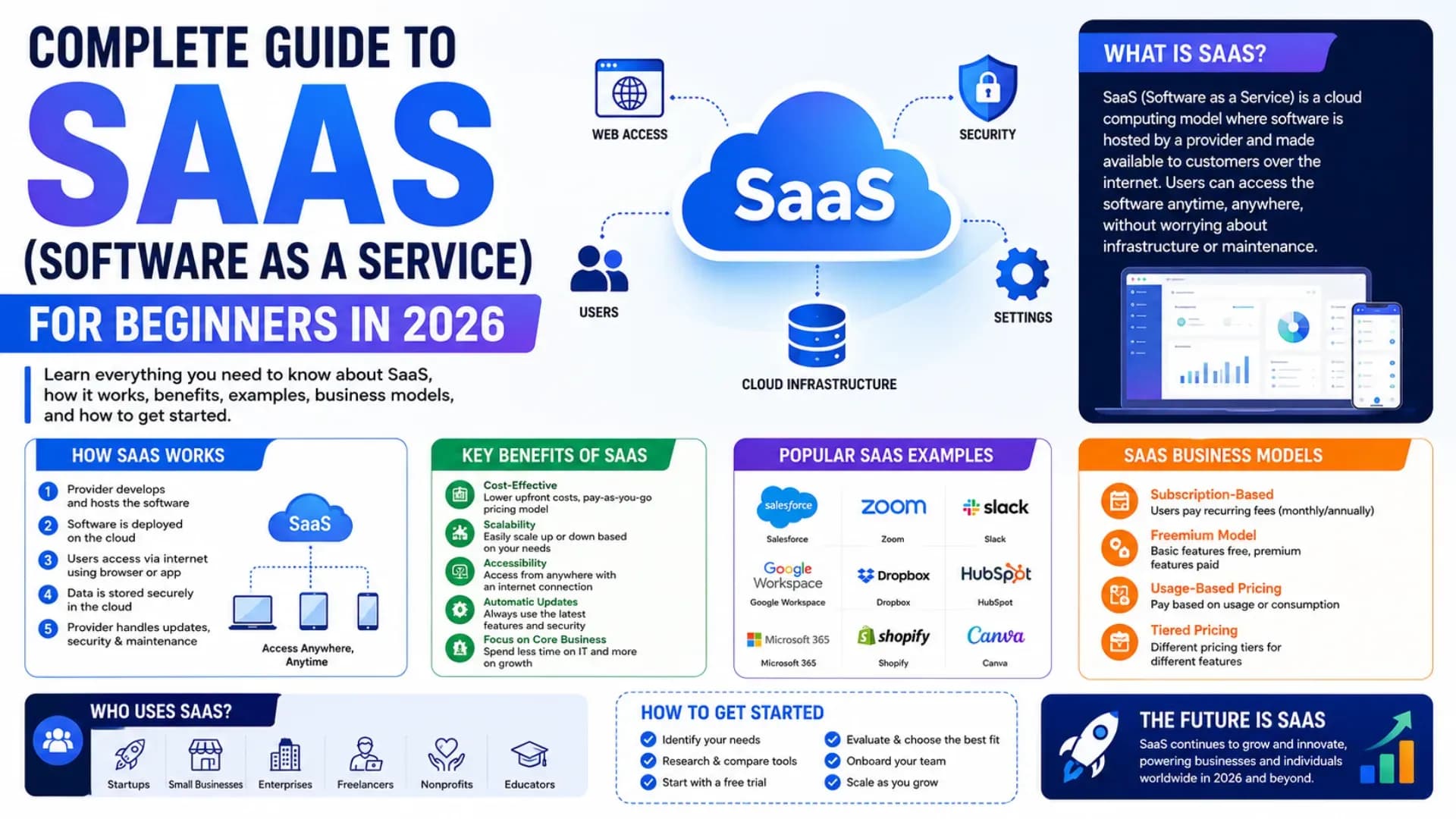
Complete Guide to SaaS (Software as a Service) for Beginners in 2026
Software as a Service is the most dominant, fastest-growing, and most misunderstood segment of the modern technology industry — and understanding it in 2026 is no longer optional for students, professionals, entrepreneurs, or anyone building a career in technology, business, or product management. This SaaS guide for beginners is designed to help complete newcomers understand what SaaS is, how it works, why it has reshaped the global software industry, and how to think about it from both a business and a technology perspective.
If you want to genuinely learn SaaS — not just memorise a definition but actually understand the mechanics — you need more than a surface-level overview. A complete introduction to Software as a Service requires understanding the SaaS business model and why it replaced perpetual licensing, the SaaS industry 2026 landscape and where it is heading, the most important SaaS metrics that determine whether a SaaS company is healthy, and how real SaaS platforms are designed and delivered using cloud software infrastructure. This SaaS tutorial covers all of it, step by step.
Whether you are a student exploring career options in the technology sector, a working professional seeking to understand the software products your organisation uses, an aspiring entrepreneur evaluating SaaS as a business model, or someone who simply wants to understand how SaaS applications that dominate daily professional life — from Zoom to Salesforce to Notion — actually work and generate revenue: this guide provides the clearest, most practical foundation available in 2026.
Related Article: Top B.Tech Colleges in India: Fees, Admission & Ranking 2026
Table of Contents
- What is SaaS (Software as a Service)?
- Why SaaS Dominates the Software Industry in 2026
- The SaaS Business Model: How It Works and Why It Wins
- SaaS Examples: The Most Important Platforms You Already Use
- Cloud Software: The Infrastructure Behind Every SaaS Product
- SaaS Metrics: How SaaS Companies Measure Health and Growth
- SaaS Applications by Category: Horizontal vs Vertical SaaS
- Careers in the SaaS Industry 2026: Roles, Skills, and Salaries
- How to Build a SaaS Product: A Beginner's Roadmap
- SaaS Trends and the Future of the SaaS Industry
- FAQs
- Conclusion
What is SaaS (Software as a Service)?
Software as a Service is a method of delivering software applications over the internet — on a subscription basis — rather than requiring users to install, maintain, or manage the software locally on their own computers or servers. In a SaaS model, the software vendor hosts the application on its own infrastructure (or on cloud infrastructure it manages), handles all updates, security patches, and scaling, and delivers access to users through a web browser or a lightweight client application. The user pays for access — typically monthly or annually — and receives the full functionality of the software without any of the infrastructure burden.
The contrast with the previous software delivery model makes Software as a Service easier to understand. In the 1990s and 2000s, software was sold as a physical product — a CD or a licence file — that you installed on a computer. The purchase was a one-time transaction, and updates required new purchases or manual download and installation. Maintenance, security, and compatibility were entirely the user's responsibility. SaaS applications eliminated all of that: the software lives in the cloud, updates automatically, scales with demand, and is accessible from any device with internet access. The user's only responsibility is logging in.
This SaaS guide for beginners builds on that simple definition to give you a genuine structural understanding of what makes Software as a Service different from traditional software, from infrastructure services, and from the other two major cloud delivery models — IaaS (Infrastructure as a Service) and PaaS (Platform as a Service). Understanding these distinctions is foundational for anyone who wants to learn SaaS with real depth rather than surface-level familiarity.
SaaS vs IaaS vs PaaS — The Cloud Delivery Model Stack
| Model | What You Manage | What the Provider Manages | Examples |
|---|---|---|---|
| IaaS | OS, runtime, apps, data | Virtualisation, servers, storage, networking | AWS EC2, Google Compute Engine, Azure VMs |
| PaaS | Applications and data | OS, runtime, middleware, infrastructure | Heroku, Google App Engine, AWS Elastic Beanstalk |
| SaaS | Data and user configuration only | Everything — application, runtime, OS, infrastructure | Salesforce, Slack, Google Workspace, Zoom |
Also Read: Top AI Skills Students Must Learn in 2026
Why SaaS Dominates the Software Industry in 2026
The shift from traditional software to Software as a Service is not a trend — it is a structural transformation that has permanently reshaped how software is built, sold, and consumed. The global SaaS market was valued at over $270 billion in 2023 and is projected to exceed $500 billion by 2028 — making it one of the largest and fastest-growing segments of the entire technology industry. Understanding why SaaS platforms have so thoroughly displaced traditional software requires looking at the advantages from both the buyer and the seller perspective.
Why Buyers Choose SaaS Applications
- Zero installation and maintenance: SaaS applications require no local installation, no server management, and no manual updates — all of that is handled by the provider. An organisation can deploy a new Software as a Service tool across a thousand employees in hours rather than weeks
- Predictable subscription costs: The subscription pricing of the SaaS business model converts large, unpredictable capital expenditures (software licences + hardware + IT staff) into predictable operating expenses that scale with usage. CFOs and finance teams overwhelmingly prefer this structure
- Accessibility from anywhere: Cloud software delivery means any authorised user can access the full application from any device with a browser — enabling remote work, mobile access, and global team collaboration that locally installed software cannot match
- Automatic updates and security patches: Every user of a SaaS product gets the latest version simultaneously — no version fragmentation, no "we're still on the old release" problems, and no delay in receiving critical security updates
- Scalability on demand: A company can add 500 users to a SaaS platform by updating a subscription tier — the underlying infrastructure scales automatically without any action required from the customer's IT team
Why Sellers Build SaaS Businesses
- Recurring revenue predictability: The subscription structure of the SaaS business model creates Annual Recurring Revenue (ARR) — a predictable, compounding revenue stream that makes SaaS businesses far more valuable and financeable than transactional software companies
- Lower distribution costs: SaaS applications are distributed digitally — no physical packaging, no reseller network, and no complex enterprise sales cycle required for lower-tier plans. Self-serve acquisition and product-led growth can drive significant revenue without large sales teams
- Direct customer relationship and data: Because the vendor hosts the application, they have continuous visibility into usage patterns, feature adoption, support needs, and churn signals — enabling far more responsive product development and customer success than boxed software ever allowed
- Expansion revenue: The SaaS business model creates natural expansion opportunities — customers who start on a basic plan grow into higher tiers as their needs evolve. This net revenue expansion means that a SaaS business's existing customer base can drive revenue growth even without adding new customers
The SaaS Business Model: How It Works and Why It Wins
The SaaS business model is at its core a subscription-based revenue model applied to software delivery — but understanding its full mechanics requires going deeper than just "you pay monthly instead of once." The economics, the growth dynamics, and the unit economics of the SaaS business model are what make it the most attractive software business structure in the history of the industry, and every serious effort to learn SaaS must start here.
How SaaS Pricing Works
- Per-seat pricing: Customers pay per user per month — the most common SaaS business model pricing structure. Slack, Microsoft 365, and Zoom all use seat-based pricing. Revenue scales directly with customer headcount growth
- Usage-based pricing: Customers pay based on consumption — API calls, data processed, emails sent, or transactions completed. Twilio, AWS, and Stripe use consumption pricing. Revenue scales with customer activity rather than headcount
- Tiered pricing: Feature-differentiated tiers (Free / Pro / Business / Enterprise) serve different customer segments at different price points — the most common structure for B2C and SMB-focused SaaS platforms. Notion, Canva, and HubSpot use tiered models
- Freemium: A permanently free tier with paid upgrades — used to reduce acquisition friction and build a large user base from which a percentage convert to paid plans. Spotify, Dropbox, and Mailchimp have built massive businesses on freemium SaaS applications
- Flat-rate pricing: A single price for full access regardless of usage or seat count — simpler to understand but less scalable. Basecamp's flat $99/month unlimited users model is a well-known example
The SaaS Growth Flywheel
The most powerful dynamic in the SaaS business model is the compounding growth flywheel: customer acquisition drives ARR, ARR funds product development and sales investment, better product reduces churn and increases expansion revenue, and lower churn means each new customer cohort adds permanent value to the revenue base. Unlike transactional models where revenue resets to zero each period, a well-run SaaS platform carries its entire historical ARR forward into every new period — making each year's growth additive rather than replacement-level.
SaaS Go-to-Market Motions
- Product-Led Growth (PLG): The product itself drives acquisition — users discover, try, and adopt the SaaS application without speaking to a salesperson. Slack, Figma, and Calendly grew primarily through PLG
- Sales-Led Growth (SLG): An outbound or inbound sales team closes deals — the dominant motion for enterprise SaaS platforms with complex buying processes and high contract values. Salesforce and Workday are classic examples
- Marketing-Led Growth: Content marketing, SEO, paid acquisition, and brand building drive inbound demand — used by HubSpot, Semrush, and most horizontal SaaS applications targeting SMB segments
SaaS Examples: The Most Important Platforms You Already Use
The most effective way to understand what Software as a Service looks like in practice is to examine the SaaS examples that professionals and students interact with every day — and understand why they are structured as SaaS rather than traditional software. Every one of the SaaS examples below represents a product category where SaaS delivery created a fundamentally better experience than the software it replaced.
Productivity and Collaboration
- Google Workspace (formerly G Suite) — Gmail, Docs, Sheets, Drive, and Meet delivered entirely as cloud software. Every document is stored, synced, and collaborated on in real time without any local installation. Replaced Microsoft Office's local installation model for tens of millions of organisations
- Microsoft 365 — Microsoft's SaaS transformation of its own Office suite — Word, Excel, PowerPoint, Teams, and OneDrive delivered via subscription with cloud sync and collaboration features layered on top of the familiar Office interface
- Slack — A workplace messaging SaaS platform that replaced internal email as the primary team communication tool for millions of organisations. Classic product-led growth SaaS — free tier drives individual and team adoption, paid tiers serve enterprise compliance and administration needs
- Notion — A collaborative workspace SaaS application combining notes, wikis, databases, and project management — a single tool that has displaced multiple single-purpose applications for teams that adopt it fully
Customer Relationship Management (CRM)
- Salesforce — The company that invented and popularised the modern SaaS business model in 1999 — its cloud-based CRM replaced on-premise Siebel Systems installations and created the template for enterprise SaaS. Now a $30 billion+ ARR business and the defining SaaS examples case study
- HubSpot — A marketing, sales, and customer service SaaS platform that democratised CRM for SMBs with a freemium model and a content marketing flywheel that remains one of the most studied examples of SaaS go-to-market execution
Development and Design Tools
- GitHub — A cloud software platform for version control and code collaboration — used by virtually every software development team in the world. Acquired by Microsoft for $7.5 billion in 2018, reflecting the value of a SaaS platform with near-total market penetration in its category
- Figma — A browser-based design SaaS application that replaced desktop design tools like Adobe XD and Sketch for millions of product designers. Its real-time collaboration — multiple designers editing simultaneously — was only possible because it was built as cloud-native SaaS from day one
- Jira and Confluence (Atlassian) — Project management and documentation SaaS platforms used by software engineering teams globally — part of Atlassian's suite of developer-focused SaaS tools
Finance and HR
- Stripe — A payments infrastructure SaaS platform enabling businesses to accept online payments without building payment processing from scratch. Classic API-first SaaS with usage-based pricing aligned to transaction volume
- Workday — Enterprise HR and financial management Software as a Service — one of the largest and most successful examples of SaaS replacing decades-old on-premise enterprise software (SAP, Oracle) in large organisations
- Zoho — An Indian-origin SaaS company offering a full suite of business SaaS applications — CRM, accounting, HR, marketing, and project management — at price points that serve SMBs in emerging markets including India
Cloud Software: The Infrastructure Behind Every SaaS Product
Every SaaS application runs on cloud software infrastructure — and understanding what that infrastructure is, how it works, and why it enables the SaaS business model is a key component of any complete SaaS tutorial. The shift to cloud software delivery was what made modern SaaS economically viable — without on-demand, pay-as-you-go cloud infrastructure, the upfront capital cost of hosting a globally scalable software product would have remained a barrier that prevented most SaaS startups from existing at all.
The Major Cloud Infrastructure Providers
- Amazon Web Services (AWS) — The largest and most feature-rich cloud software infrastructure provider — the backbone of thousands of SaaS companies. S3 (object storage), EC2 (compute), RDS (managed databases), and Lambda (serverless functions) are the most commonly used services by SaaS builders
- Google Cloud Platform (GCP) — Google's cloud infrastructure offering, particularly strong in data analytics (BigQuery), machine learning (Vertex AI), and Kubernetes container orchestration — preferred by data-intensive SaaS platforms
- Microsoft Azure — Microsoft's cloud infrastructure, dominant in enterprise markets partly due to the existing Microsoft ecosystem relationships. Azure Active Directory and integration with Microsoft 365 make it the default choice for enterprise-oriented SaaS applications
Key Cloud Software Concepts Every SaaS Beginner Should Understand
- Multi-tenancy: Most SaaS platforms serve multiple customers from a single shared infrastructure instance — each customer's data is logically isolated but the underlying servers, databases, and application code are shared. This is what makes SaaS economically efficient at scale — one codebase serves thousands of customers simultaneously
- Microservices architecture: Modern SaaS applications are increasingly built as collections of small, independent services rather than monolithic applications — enabling different parts of the product to scale, update, and fail independently without affecting the entire system
- APIs (Application Programming Interfaces): Every mature SaaS platform exposes an API — a programmatic interface that allows other software to interact with it. APIs enable integrations, automations, and the interconnected ecosystem of SaaS applications that most modern businesses run on
- CDN (Content Delivery Network): Cloud software products use CDNs to serve static assets (images, CSS, JavaScript) from servers physically close to each user — reducing load times globally and enabling the performance that makes browser-based SaaS applications feel as responsive as native desktop software
- SLA (Service Level Agreement): SaaS providers commit to uptime guarantees in their SLAs — typically 99.9% or higher. The infrastructure redundancy that enables these guarantees is one of the core reasons organisations trust Software as a Service for business-critical operations
Stop Stressing. Start Applying.
Skip the chaos of filling endless forms. Apply to your dream colleges in one go through the College Nirnay Common Application Form — built for every student navigating India's competitive education landscape.
Fill the Common Application Form →✓ Free to apply · ✓ Takes under 5 minutes · ✓ Trusted by thousands of students
SaaS Metrics: How SaaS Companies Measure Health and Growth
One of the most important things to understand when you learn SaaS — whether as a future employee, investor, or founder — is that SaaS platforms are measured by a completely different set of metrics than traditional businesses. The subscription-based, recurring-revenue nature of the SaaS business model creates distinct performance indicators that capture the health of the customer relationship over time, not just the revenue generated in a single period. This section of the SaaS tutorial defines the metrics that every SaaS professional is expected to understand.
| Metric | What It Measures | Why It Matters |
|---|---|---|
| ARR / MRR | Annual / Monthly Recurring Revenue — the predictable subscription revenue base | The primary size and growth metric for any SaaS business — tracks the compounding subscription base |
| Churn Rate | The percentage of customers or revenue lost in a given period | High churn destroys the compounding advantage of the SaaS model — reducing churn is often more valuable than acquiring new customers |
| CAC | Customer Acquisition Cost — total sales and marketing spend divided by new customers acquired | Determines the efficiency of growth — a SaaS business is only sustainable if LTV significantly exceeds CAC |
| LTV | Customer Lifetime Value — the total revenue a customer generates over their entire relationship | The LTV:CAC ratio (typically target 3:1 or higher) determines whether the unit economics of a SaaS business are viable |
| NRR | Net Revenue Retention — revenue retained from existing customers including expansions and contractions | NRR above 100% means existing customers are spending more over time — the most powerful indicator of SaaS business quality |
| DAU / MAU | Daily / Monthly Active Users — the engagement and stickiness of the product | Engagement predicts retention — a SaaS application that users rely on daily is far less likely to churn than one used occasionally |
| Gross Margin | Revenue minus cost of goods sold (primarily hosting and support) as a percentage of revenue | Best-in-class SaaS gross margins are 70–80%+ — the high margins fund the R&D and GTM investment that drives growth |
SaaS Applications by Category: Horizontal vs Vertical SaaS
One of the most important structural distinctions in the SaaS industry 2026 is between horizontal and vertical SaaS — two fundamentally different approaches to building and positioning SaaS applications that have different addressable markets, competitive dynamics, and growth strategies. Understanding this distinction is essential for anyone who wants to genuinely learn SaaS beyond surface-level definitions.
Horizontal SaaS
Horizontal SaaS platforms serve customers across all industries — they solve problems that exist in every business regardless of sector. Salesforce CRM, Slack, Google Workspace, Zoom, HubSpot, and Stripe are all horizontal SaaS — their products work equally well for a technology startup, a retail company, a healthcare provider, or a financial services firm. Horizontal SaaS has the largest total addressable market but also the most intense competition, since every company on earth is a potential customer — and every competitor is pursuing the same universe of buyers.
Vertical SaaS
Vertical SaaS applications are built for a specific industry — solving problems that are unique to that sector with features, workflows, compliance requirements, and integrations that a general-purpose horizontal tool cannot match. Veeva Systems (pharmaceutical CRM and regulatory compliance), Procore (construction project management), Toast (restaurant point-of-sale and operations), and Mindbody (fitness and wellness studio management) are all vertical SaaS companies. They have smaller total addressable markets than horizontal tools but face less competition, command stronger customer loyalty, and often achieve higher NRR because customers build deep operational dependencies on their platforms. The SaaS industry 2026 is seeing significant growth in vertical SaaS as founders increasingly identify underserved industries where generic horizontal tools are failing to solve specific operational needs.
Major SaaS Application Categories
- CRM and Sales Enablement: Salesforce, HubSpot, Pipedrive, Zoho CRM
- Communication and Collaboration: Slack, Microsoft Teams, Zoom, Loom, Notion
- HR and People Management: Workday, BambooHR, Rippling, Darwinbox (India-focused)
- Marketing Automation: HubSpot, Mailchimp, Marketo, Klaviyo, Clevertap
- Finance and Accounting: QuickBooks, Xero, Stripe, Razorpay, Zoho Books
- DevOps and Engineering: GitHub, Jira, Datadog, PagerDuty, CircleCI
- Customer Support: Zendesk, Freshdesk, Intercom, Freshworks
- Data Analytics and BI: Tableau, Looker, Mixpanel, Amplitude, Power BI
Careers in the SaaS Industry 2026: Roles, Skills, and Salaries
The SaaS industry 2026 employs millions of professionals globally across roles that span product, engineering, sales, marketing, customer success, and operations — and the career opportunities it offers are among the most well-compensated, fastest-growing, and most globally transferable in the entire technology sector. For students and professionals evaluating which industry to build a career in, understanding the role landscape of the SaaS industry 2026 is essential context for making informed decisions.
Core SaaS Career Roles
- Product Manager (PM): Defines what the SaaS platform builds — gathering customer requirements, prioritising features, writing specifications, and working with engineering to ship product. PMs are among the highest-compensated non-engineering roles at SaaS companies. Required skills: analytical thinking, stakeholder communication, data interpretation, and deep product intuition
- Software Engineer / Backend / Frontend / Full-Stack: Builds and maintains the SaaS application itself. Backend engineers work on APIs, databases, and server logic; frontend engineers build the user interface; full-stack engineers work across both. Python, JavaScript, TypeScript, Go, and Java are the most common languages in SaaS platforms
- SaaS Sales (Account Executive / SDR): Sells the Software as a Service product to prospective customers. Sales Development Representatives (SDRs) generate and qualify leads; Account Executives close deals. SaaS sales roles are highly compensated with base salary plus variable commission — enterprise AEs at top SaaS companies regularly earn ₹30–80 LPA in India
- Customer Success Manager (CSM): Ensures that customers achieve their desired outcomes using the SaaS application — onboarding new customers, monitoring usage, identifying expansion opportunities, and preventing churn. CSMs are the direct drivers of NRR — the metric that determines SaaS company valuation multiples
- Growth / Marketing Manager: Drives customer acquisition and product adoption — through content marketing, SEO, paid acquisition, product-led growth experiments, and partnership programmes. Growth roles at SaaS platforms are increasingly data-driven and require analytical skill alongside creative marketing capability
- Solutions Engineer / Pre-Sales: Technical sales support — demonstrating the SaaS platform to prospective enterprise customers, answering technical questions during the sales process, and building custom proof-of-concept integrations. The role bridges product and sales and is one of the fastest-growing in enterprise SaaS
- Data Analyst / Business Intelligence: Analyses product usage data, customer behaviour, revenue metrics, and operational performance — translating raw data from the SaaS application into insights that drive product, sales, and marketing decisions
India and SaaS: India has become a globally significant hub for SaaS industry 2026 activity — both as a consumer market (with Zoho, Freshworks, Chargebee, and Clevertap being globally recognised Indian-origin SaaS companies) and as a talent source (with a large proportion of the world's SaaS engineering and customer success workforce based in Bangalore, Pune, Hyderabad, and Chennai). Understanding SaaS is particularly high-value for Indian students and professionals targeting technology careers in 2026.
How to Build a SaaS Product: A Beginner's Roadmap
For students and professionals who want to go beyond understanding the SaaS business model and actually build a SaaS platform, this section provides the structural roadmap — from idea validation to technical architecture to go-to-market strategy. Building a SaaS application from scratch is more accessible today than at any point in the history of the industry, thanks to cloud software infrastructure that eliminates the need to own physical servers, open-source frameworks that provide most of the common functionality, and no-code and low-code tools that enable non-engineers to build functional SaaS products.
Stage 1: Problem Discovery and Validation
The most common reason SaaS startups fail is building something no one needs badly enough to pay for repeatedly. Before writing any code, validate that the problem you are solving is real, frequent, and worth paying to solve. Talk to at least 20 potential customers in your target segment — understand their current workflow, what tools they use today, where the friction is, and what they would pay for a better solution. The goal of this stage is to arrive at a validated problem statement, not a validated solution.
Stage 2: Define the Core SaaS Application
Define the minimum feature set that solves the core problem — the Minimum Viable Product (MVP) of your SaaS application. Every feature you add to the MVP delays your ability to get real customer feedback and increases the risk that you build something customers do not actually use. The most successful SaaS founders ruthlessly narrow their initial scope — Slack launched as a chat tool for teams, not a full productivity platform. Stripe launched as a payments API, not a full financial services suite.
Stage 3: Choose Your Technical Stack
- Frontend: React.js or Next.js for the user interface — the dominant choices for modern SaaS applications requiring responsive, dynamic interfaces
- Backend: Node.js, Python (Django or FastAPI), or Ruby on Rails — Python is particularly popular for data-intensive SaaS, Node.js for real-time applications
- Database: PostgreSQL for relational data (most SaaS use cases), MongoDB for document-oriented data, Redis for caching and session management
- Cloud infrastructure: AWS, GCP, or Azure — most SaaS startups begin on AWS given its breadth of services and the scale of its ecosystem
- Authentication: Auth0, Firebase Auth, or Clerk — third-party authentication services eliminate the significant security risk of building user authentication from scratch
- Payments: Stripe (global) or Razorpay (India) — both provide complete subscription billing infrastructure for the SaaS business model's recurring revenue requirements
Stage 4: Build, Launch, and Iterate
Launch to a small group of early adopters before the product is fully polished — real usage reveals problems that internal testing never finds. Instrument the product with analytics (Mixpanel, Amplitude, or PostHog) from day one so you have usage data to guide iteration decisions. Price from the beginning — even a small amount. Free users give different feedback than paying customers, and the willingness to pay is itself validation data for the SaaS business model you are building.
SaaS Trends and the Future of the SaaS Industry
The SaaS industry 2026 is undergoing its most significant transformation since the original shift from on-premise software — driven by artificial intelligence, changing pricing models, and the emergence of new categories of SaaS applications that did not exist five years ago. Understanding the direction of the industry is essential for students and professionals who want to build careers in SaaS or build SaaS products that remain relevant over the next decade.
- AI-native SaaS: The most significant trend reshaping the SaaS industry 2026 is the integration of large language models and AI capabilities directly into SaaS platforms. Products that previously required human judgment — customer support tickets, document drafting, data analysis, code review — are being partially or fully automated through AI features built into existing SaaS tools. New AI-native SaaS companies (Cursor, Glean, Perplexity) are disrupting categories that legacy SaaS players have owned for years
- Usage-based pricing growth: The SaaS business model is shifting from pure seat-based pricing toward consumption-based models — where customers pay for what they use rather than the number of users with access. This shift is driven by AI features (where cost is directly tied to token consumption) and by enterprise buyers who want pricing that scales with their actual usage rather than their headcount
- Vertical SaaS acceleration: The number and quality of vertical SaaS applications targeting specific industries is growing rapidly — particularly in healthcare (Epic on cloud software, Veeva for pharma), legal tech, construction, agriculture, and education. Founders with deep industry knowledge are building highly defensible vertical SaaS businesses that horizontal tools cannot displace
- Platform consolidation: Enterprise buyers are reducing the number of SaaS platforms in their stacks — favouring fewer, more comprehensive platforms over large portfolios of point solutions. Salesforce, Microsoft, and HubSpot are all expanding aggressively into adjacent categories to capture this consolidation preference
- Product-led growth maturation: PLG has become the default go-to-market motion for many new SaaS applications — and the discipline of product-led growth (activation metrics, in-product conversion, usage-triggered expansion) has matured into a distinct and well-defined set of practices that SaaS teams are expected to understand and execute
- India as a SaaS powerhouse: Indian-origin SaaS companies — Zoho, Freshworks, Chargebee, Clevertap, Leadsquared — are increasingly competing at the global level, and India's SaaS industry 2026 ecosystem is producing both founders and operators at a scale and quality that the global SaaS market is taking seriously
FAQs
Q1. What is the simplest definition of Software as a Service?
Software as a Service is software that you access over the internet through a browser or app and pay for on a subscription basis — rather than buying and installing it on your own computer. The software provider handles all hosting, updates, security, and maintenance. Gmail, Zoom, Spotify, and Netflix are all SaaS applications that most people use without realising they are interacting with the SaaS delivery model. The defining characteristics are: internet delivery, subscription pricing, and vendor-managed infrastructure. This SaaS guide for beginners has covered this definition in depth — but if you need the one-sentence version: SaaS is rented software that lives in the cloud and works from any device.
Q2. What is the difference between SaaS and cloud software?
Cloud software is a broader term referring to any software or service delivered via internet-connected cloud infrastructure — it includes IaaS (Infrastructure as a Service), PaaS (Platform as a Service), and SaaS (Software as a Service). Software as a Service is a specific category of cloud delivery where the complete application is managed by the vendor and delivered to end users through a browser or lightweight client. All SaaS platforms are cloud software, but not all cloud software is SaaS — AWS EC2 (virtual machines you manage yourself) is cloud software but not SaaS. When people say "cloud software" colloquially, they usually mean SaaS — the fully managed, subscription-based application model that this SaaS tutorial has described throughout.
Q3. Is SaaS a good career path for students in 2026?
Yes — the SaaS industry 2026 is one of the strongest career destinations for students across engineering, management, and commerce backgrounds. SaaS companies offer well-structured career paths in product management, engineering, sales, customer success, marketing, and data analytics — with compensation that is consistently above industry average for comparable roles. The skills developed in SaaS roles (data-driven decision making, subscription business mechanics, product thinking, customer empathy) are highly transferable and valued across the technology sector. For Indian students specifically, the growing Indian SaaS ecosystem — Freshworks, Zoho, Razorpay, Chargebee, and hundreds of Series A and Series B companies — offers strong local career opportunities without requiring international relocation. This SaaS guide for beginners has outlined the major role categories; students should research the specific function that matches their skills and interests.
Q4. What are the best SaaS examples to study to understand the business model?
The five SaaS examples most worth studying in depth are: Salesforce (the original enterprise SaaS business and the template for the entire category), Slack (the definitive product-led growth case study and community-driven adoption model), HubSpot (the content marketing and freemium flywheel at its best), Stripe (API-first SaaS and usage-based pricing done correctly), and Notion (modern product-led growth with a viral individual-to-team expansion motion). Each of these SaaS platforms illustrates a different dimension of what makes the SaaS business model powerful — studying their growth stories, pricing strategies, and market positioning gives a more complete picture of how SaaS works than any amount of theoretical reading. All five publish extensive public content about their strategies that makes them excellent self-study resources.
Q5. How do I start learning SaaS if I have no technical background?
To learn SaaS without a technical background, start with the business fundamentals — understand the SaaS business model and the key metrics (ARR, churn, CAC, LTV, NRR) well enough to read a SaaS company's investor materials intelligently. Then explore the role landscape and identify whether your skills and interests align with sales, customer success, marketing, product management, or operations — none of these require deep engineering knowledge. Resources worth using: SaaStr (the largest SaaS community and conference), Lenny's Newsletter (product and growth at SaaS companies), Kyle Poyar's writing on SaaS pricing, and the annual reports and S-1 filings of publicly listed SaaS platforms like Salesforce, HubSpot, and Freshworks. This SaaS tutorial has given you the conceptual foundation — the next step is to pick one role direction and go deep on its specific skills and entry pathways.
Explore More
Conclusion
Software as a Service is not just a technology delivery model — it is the dominant paradigm of the modern software industry, the engine behind thousands of the world's most valuable companies, and one of the most important commercial and career landscapes any student or professional can understand in 2026. This guide has taken you through everything you need to genuinely learn SaaS: from the foundational definition of Software as a Service and its advantages over traditional software, to the mechanics of the SaaS business model, the most important SaaS examples in every category, the cloud software infrastructure that powers every SaaS platform, the metrics that measure SaaS health, the career opportunities in the SaaS industry 2026, and the roadmap for building your own SaaS application.
If you want to build a meaningful career or business in the SaaS industry 2026, invest in deep understanding — not just memorising definitions but genuinely internalising why the SaaS business model works, why customers choose SaaS platforms over alternatives, and why the metrics that define SaaS business health are structured the way they are. Study real SaaS examples, read the public filings and investor letters of SaaS companies, and identify the role in the SaaS ecosystem that your skills and interests are best positioned for. That combination of conceptual clarity and deliberate role targeting is how the most successful SaaS professionals have built their careers.
By following this SaaS guide for beginners from start to finish, you now have a clear and comprehensive foundation: you understand what Software as a Service is and why it won, how the SaaS business model generates and retains value, which SaaS applications and SaaS platforms define each major category, how cloud software infrastructure enables everything, and where the SaaS industry 2026 is heading next. That is the complete, honest foundation this SaaS tutorial was built to deliver — and there is no better time to act on it than now.