
Search colleges, courses...
Ctrl K
Keep yourself updated with the latest trends and announcements
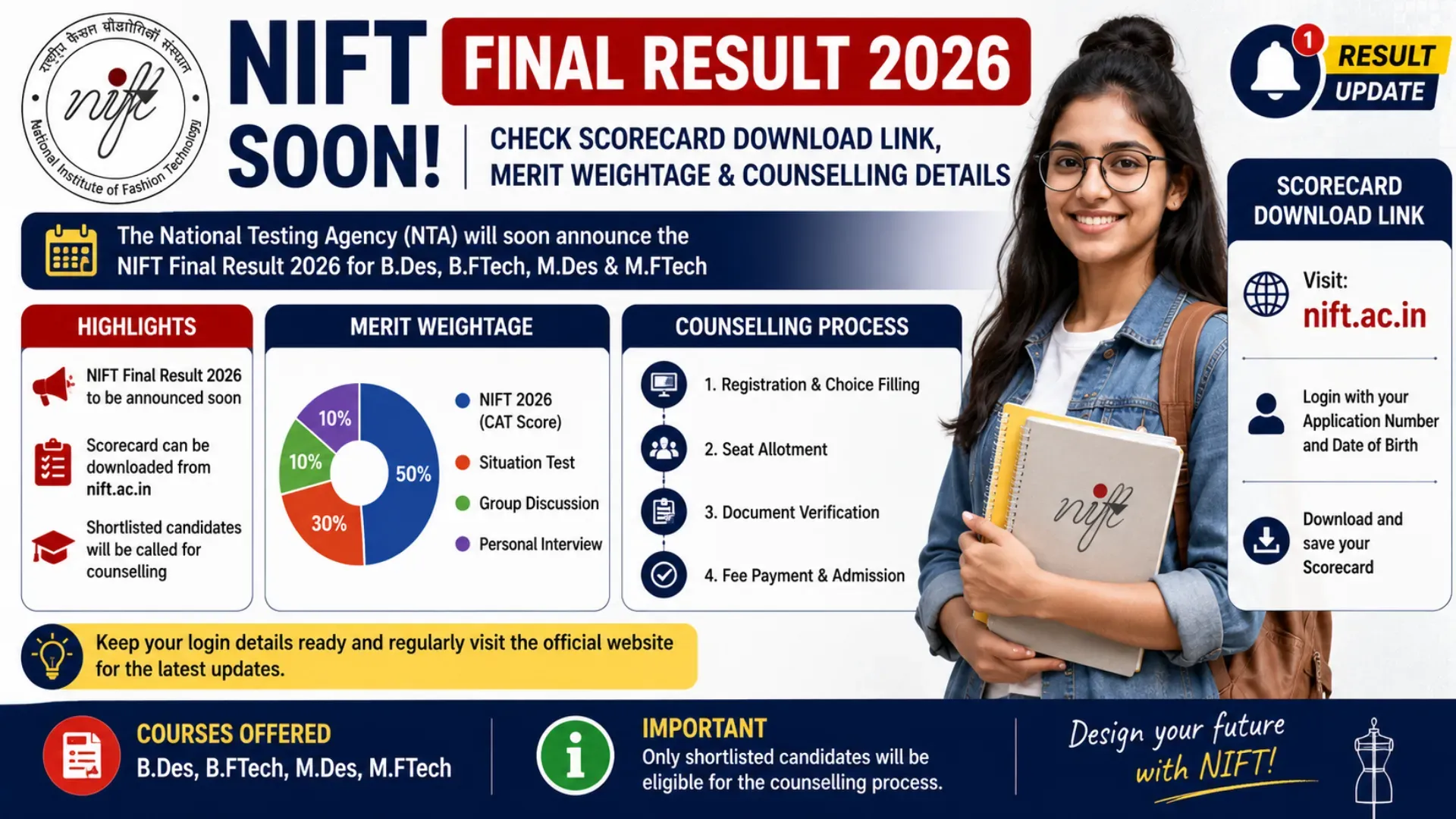
NIFT Final Result 2026 is expected to be announced soon by the National Testing Agency (NTA). Candidates can download their scorecards online and check merit calculation, weightage criteria, counselling schedule, and admission details. Get direct links and latest updates here.

JEE Advanced 2026 Topper: Gurgaon's Kabir Chillar Secured AIR 2, Aims for IIT Bombay and MIT html { scroll-behavior: smooth; } summary::-webkit-details-marker { display: none; } JEE Advanced 2026 Topper: Gurgaon's Kabir Chillar Secures AIR 2 — Aims for IIT Bombay CSE and MIT Among the most celebrated performances in the JEE Advanced 2026 Results, Gurgaon's Kabir Chillar has emerged as a standout name — securing JEE Advanced AIR 2 in the Common Rank List and earning recognition as one of the most prominent JEE Advanced 2026 Toppers of this cycle. The Kabir Chillar AIR 2 achievement places him second in the national ranking among over 1.8 lakh candidates who appeared in JEE Advanced 2026 — a result that reflects years of systematic preparation, exceptional problem-solving ability, and the kind of conceptual depth in Physics, Chemistry, and Mathematics that separates CRL top-10 performers from the rest of the qualified field. In a JEE Topper Success Story that will resonate across JEE aspirant communities, Kabir has shared his aims of pursuing Computer Science Engineering at IIT Bombay — the most competitive programme in the JEE Advanced Toppers List's typical IIT preference data — while also expressing interest in MIT (Massachusetts Institute of Technology) as a long-term academic destination. This page covers the complete profile of the JEE Advanced Rank 2 holder, his preparation strategy, and all JEE Advanced Latest Updates from the 2026 results cycle including the toppers list and what the AIR 2 performance signals about this year's examination difficulty. Key Highlights Kabir Chillar AIR 2 — JEE Advanced 2026 Common Rank List, Gurgaon, Haryana JEE Advanced AIR 2 — among the top performers in the JEE Advanced 2026 Results nationally Target: IIT Bombay Aspirant — Computer Science Engineering (CSE), IIT Bombay Long-term aspiration: MIT Aspirant — Massachusetts Institute of Technology for graduate studies JEE Advanced 2026 Topper profile — Haryana state topper and national AIR 2 holder JEE Advanced Toppers List 2026 — full CRL top performers announced at jeeadv.ac.in All JEE Advanced Latest Updates on 2026 results, toppers, and JoSAA counselling tracked here Explore This: JEE Mains Exam Guide Why It Matters The JEE Advanced 2026 Topper profiles — and particularly high performers like Kabir Chillar AIR 2 — matter to the broader JEE aspirant community for reasons that go beyond the celebratory. When students who secured the highest national ranks share their preparation strategies, study schedules, resource lists, and mindset approaches, that information is among the most reliable and empirically tested guidance available to current aspirants. A candidate who secured JEE Advanced Rank 2 has demonstrably solved JEE Advanced level problems at the highest level of accuracy and speed — their preparation method is not theoretical advice but documented practice. The JEE Topper Success Story of Kabir Chillar — his subject-wise approach, his balance between JEE Main and Advanced preparation, and his decision-making at crucial points in the two-year preparation cycle — contains actionable insights for students currently in Class 11 and Class 12 who are building their own preparation frameworks. The aspiration toward both IIT Bombay and MIT also signals something meaningful: the top performers at JEE Advanced increasingly view the IIT experience not as an endpoint but as a launchpad for global academic ambitions. JEE Advanced AIR 2 — Kabir Chillar: Profile, Performance & Preparation Kabir Chillar of Gurgaon, Haryana secured JEE Advanced AIR 2 in the 2026 Common Rank List — a performance that reflects not just exceptional raw aptitude but the systematic development of problem-solving depth across Physics, Chemistry, and Mathematics over a multi-year preparation arc. The JEE Advanced 2026 Results saw Kabir achieve near-perfect marks in the examination — a performance level that places him in the category of candidates who make very few errors across both Paper 1 and Paper 2 of the JEE Advanced examination, which is a more reliable indicator of preparation quality than raw score alone. The JEE Advanced Rank 2 holder is from Gurgaon, studied at one of the city's prominent coaching institutes alongside school, and is widely cited in this year's JEE Advanced Toppers List as the Haryana state topper. Kabir's stated aspiration — IIT Bombay CSE as his primary JoSAA choice and MIT as a long-term goal — reflects a preparation philosophy that was oriented toward computer science and technology from an early stage. IIT Bombay CSE is historically the most competitive programme in the JoSAA counselling process, with closing ranks for general category typically in the CRL top 50 to 100 — a programme that JEE Advanced AIR 2 guarantees Kabir can access comfortably. The MIT aspiration, whether for undergraduate study or a graduate programme post-IIT Bombay, reflects a generation of high-performing IIT aspirants who view MIT, Stanford, CMU, and other global institutions as natural continuation pathways after an IIT degree — a trend that has grown significantly as IIT alumni networks at these institutions have made the pathway more visible and accessible. The JEE Topper Success Story context: Kabir's preparation was characterised by — based on shared interviews and preparation accounts — a strong emphasis on conceptual understanding over formula memorisation, targeted use of standard JEE references (HC Verma for Physics, JD Lee/NCERT for Chemistry, RD Sharma and Irodov for advanced practice), and a disciplined approach to mock examination analysis. The preparation strategy of top 10 JEE Advanced performers consistently shows one common element: they spend more time reviewing wrong answers from mock tests than solving new problems — the error analysis loop is the primary mechanism through which top-rank preparation differentiates itself. Related News: CUET UG Exam Guide Key Details — Kabir Chillar, JEE Advanced AIR 2, 2026 Particulars Details NameKabir Chillar JEE Advanced 2026 RankAIR 2 — Common Rank List (CRL) City / StateGurgaon, Haryana Haryana State Rank1 (Haryana State Topper) Target CollegeIIT Bombay — Computer Science Engineering (CSE) Long-term AspirationMIT (Massachusetts Institute of Technology) ExaminationJEE Advanced 2026 JEE Advanced 2026 ResultsDeclared — Available at jeeadv.ac.in CategoryGeneral (CRL) Next StepJoSAA Counselling 2026 — Choice Filling for IIT Bombay CSE What AIR 2 Preparation Looks Like — Insights from JEE Advanced Toppers Conceptual depth over formula breadth: Top-10 JEE Advanced performers consistently report that their preparation was built on deep understanding of first principles — deriving results rather than memorising them. A Physics problem that can be approached from Newton's second law, energy conservation, and work-energy theorem simultaneously is understood correctly only when the student grasps all three approaches and knows when to use which Error analysis as the primary tool: The preparation cycle that produces AIR single-digit ranks is typically characterised by more time spent analysing wrong answers from previous tests than solving new problems. Every wrong answer represents a gap in understanding, a speed issue, or a careless error — each of which requires a different intervention Standard reference hierarchy: HC Verma (Concepts of Physics Vol. 1 and 2) for Physics foundations; Irodov for advanced Physics problem-solving; JD Lee's Concise Inorganic Chemistry and NCERT for Chemistry foundations; M.S. Chauhan for Organic Chemistry; SL Loney's Plane Trigonometry and Elements of Coordinate Geometry, Hall and Knight for Algebra, and Thomas Calculus / Apostol for Mathematics depth Mock examination discipline: Regular full-length mock examinations under timed conditions — treated as actual examinations in terms of distraction elimination, time management, and psychological preparation. The top performers take 30 to 50 full-length JEE Advanced pattern mocks in the final year of preparation Subject prioritisation based on personal strength: The most efficient preparation strategies identify the subject where the candidate has the highest ceiling potential and invest disproportionately in that subject's advanced problem-solving — rather than trying to uniformly maximise all three subjects simultaneously Also Read: KEAM 2026 Admit Card LIVE: Release Date, Physics Topics & Weightage 📋 JEE Advanced 2026 Toppers List — National and Category-wise Top Performers The complete JEE Advanced Toppers List 2026 — covering CRL top performers, category toppers, zone toppers, and female category toppers — is published at jeeadv.ac.in alongside the official JEE Advanced 2026 Results. Here is what the JEE Advanced Toppers List reveals about the 2026 examination cycle: CRL Top Performers (General Category) The JEE Advanced 2026 Results CRL list places Kabir Chillar AIR 2 among the very highest national performers. The national topper (AIR 1) and the top-10 CRL performers represent the apex of approximately 1.8 lakh candidates who qualified to appear in JEE Advanced from the JEE Main pool — a group that is itself the top 2.5 lakh out of approximately 12 lakh JEE Main candidates. The AIR 2 position in this filtered, high-performance pool represents an exceptional result. The full JEE Advanced Toppers List for CRL is available at jeeadv.ac.in. Female Topper The JEE Advanced 2026 Results also declare a separate female category topper — the highest-ranked female candidate in the CRL. The female topper's rank and profile are published at jeeadv.ac.in as part of the official JEE Advanced Toppers List. The female topper recognition reflects JEE Advanced's commitment to acknowledging top performance across gender categories in one of India's most competitive technical entrance processes. Zone-wise and State-wise Toppers JEE Advanced 2026 is conducted across seven IIT zones — IIT Bombay, Delhi, Kharagpur, Kanpur, Madras, Guwahati, and Roorkee zones. Zone-wise and state-wise toppers from the JEE Advanced Toppers List are published at jeeadv.ac.in — Kabir Chillar's Haryana state topper status (from the IIT Delhi zone) is one of the most prominent state-level achievements in this cycle's results. The complete state and zone topper data is available in the official JEE Advanced 2026 Results notification. Category Toppers (OBC-NCL, SC, ST, PwD) The JEE Advanced 2026 Results publish separate CRL top performers for OBC-NCL, SC, ST, and PwD categories — each category's topper holds the highest rank in the CRL within that reservation category. The full category-wise JEE Advanced Toppers List is published at jeeadv.ac.in and represents the most important reference for candidates who want to understand competitive benchmarks within their own category for JoSAA counselling choice filling. What's Next for Kabir Chillar and All JEE Advanced 2026 Toppers Following the JEE Advanced 2026 Results declaration, all qualified candidates — including JEE Advanced AIR 2 holder Kabir Chillar — must register for JoSAA Counselling 2026 at josaa.nic.in to secure their IIT admission. The JoSAA registration window and the JEE Advanced AAT application (for B.Arch aspirants) are both active — check the JEE Advanced Latest Updates page for the exact JoSAA schedule. For Kabir, the JoSAA process is straightforward — with an AIR 2 rank, IIT Bombay CSE is an automatic option in any realistic JoSAA scenario. His long-term MIT aspiration will likely follow the pathway that many IIT Bombay CSE graduates have taken — PhD, research internship, or MS at MIT, Stanford, or CMU following IIT Bombay graduation. This is the trajectory that has defined the most globally impactful IIT Bombay CSE alumni over the past two decades. All JEE Advanced Latest Updates on JoSAA allotment, topper interviews, and IIT admission completion will be tracked on this page. 📌 Expert Analysis Education analysts studying JEE Advanced top performer profiles across multiple years note that the JEE Advanced 2026 Topper cohort — and specifically candidates like Kabir Chillar AIR 2 — represents a generation of JEE aspirants who have grown up with significantly more preparation resources, coaching quality, and previous year paper access than any preceding JEE generation. The national AIR 2 performance in 2026 should be contextualised within this: the top candidates are better prepared, have access to higher-quality problem sets, and use more sophisticated error analysis frameworks than was standard even five years ago. This does not make the achievement less remarkable — it makes it more impressive, because the competitive field itself has also raised its quality, meaning an AIR 2 in 2026 is achieved against a stronger field than an AIR 2 in 2015. The aspiration pattern expressed by the JEE Advanced Rank 2 holder — IIT Bombay CSE as the undergraduate choice and MIT as the long-term goal — is the most commonly stated aspiration among CRL top-100 performers in the JEE Advanced Toppers List in recent cycles. This pattern reflects a meaningful shift in how top JEE performers view the IIT degree: not as a terminal qualification but as Phase 1 of a global academic career. For the broader JEE aspirant community, the takeaway from this JEE Topper Success Story is that the preparation methods that produce AIR-level results — conceptual depth, error analysis, systematic resource usage — are methods that aspiring candidates in Classes 10, 11, and 12 can adopt and develop progressively. The gap between an AIR 2 and an AIR 500 is not primarily one of innate intelligence; it is primarily one of preparation quality and consistency. FAQs Q1. Who is Kabir Chillar and what rank did he get in JEE Advanced 2026? Kabir Chillar is a student from Gurgaon, Haryana, who secured JEE Advanced AIR 2 (All India Rank 2) in the Common Rank List of JEE Advanced 2026 Results. He is the Haryana state topper and the second-highest-ranked candidate nationally in the General Category CRL. Kabir is featured prominently in the JEE Advanced Toppers List 2026 published at jeeadv.ac.in and has stated his intention to pursue Computer Science Engineering at IIT Bombay through JoSAA Counselling 2026, with a long-term aspiration toward MIT. Q2. What is Kabir Chillar's preparation strategy that led to JEE Advanced AIR 2? While the Kabir Chillar AIR 2 profile reflects individual preparation specifics, the preparation approach characterising top JEE Advanced performers like Kabir includes: conceptual first-principles understanding (deriving formulas rather than memorising them), intensive error analysis from mock tests (more time reviewing wrong answers than solving new problems), use of standard JEE references (HC Verma, Irodov for Physics; JD Lee, NCERT for Chemistry; SL Loney, Hall and Knight for Maths), systematic full-length mock testing, and targeted focus on high-ceiling subjects. This JEE Topper Success Story approach — disciplined, systematic, and analytically driven — is the consistent pattern across top-10 CRL performers in the JEE Advanced Toppers List. Q3. Where can I check the complete JEE Advanced Toppers List 2026? The complete JEE Advanced Toppers List 2026 — including CRL top performers, female topper, zone-wise and state-wise toppers, and category toppers (OBC-NCL, SC, ST, PwD) — is published at jeeadv.ac.in alongside the official JEE Advanced 2026 Results. The list includes rank, score, category, and home state for each featured topper. All JEE Advanced Latest Updates on the toppers list and result analysis are published at jeeadv.ac.in and tracked on this page. Kabir Chillar's JEE Advanced Rank 2 position places him second in the national CRL — the toppers list confirms his position and marks. Q4. Will Kabir Chillar get IIT Bombay CSE in JoSAA Counselling 2026? Yes — with JEE Advanced AIR 2, Kabir Chillar will have access to any programme at any IIT in JoSAA Counselling 2026. IIT Bombay CSE typically closes in the CRL top 50 to 100 range for the general category in JoSAA — an AIR 2 rank is comfortably within this range. If Kabir lists IIT Bombay CSE as his top preference in the JEE Advanced 2026 JoSAA choice filling, it will be his allotment in Round 1 itself. The IIT Bombay Aspirant aspiration is entirely achievable at JEE Advanced Rank 2. Kabir must register for JoSAA at josaa.nic.in and complete choice filling — all JEE Advanced Latest Updates on JoSAA are tracked on this page. Q5. What does the JEE Advanced 2026 Topper's MIT aspiration mean for Indian students? Kabir Chillar's stated aspiration as a MIT Aspirant after IIT Bombay CSE reflects a growing trend among top JEE performers who view the IIT undergraduate degree as Phase 1 of a global academic career. The IIT Bombay CSE → MIT/Stanford MS or PhD pathway is one of the most documented trajectories in Indian technology education — IIT Bombay has a substantial alumni network at MIT, Stanford, CMU, and other global institutions that has made this pathway more accessible than ever. The JEE Topper Success Story of aspiring toward both IIT Bombay and MIT simultaneously is meaningful for current aspirants: it signals that the most competitive students view JEE Advanced not as the finish line but as the starting point of a longer global academic and professional journey. Check JEE Advanced Latest Updates on this page for all further developments on Kabir Chillar's admission journey. Related News / Articles Best Free AI Tools for Students in 2026 High-Income Tech Skills Without Programming Top AI Skills Students Must Learn in 2026 Top BTech Colleges in India Explore More Karnataka 2nd PUC Result Date TS INTER RESULT DATE KEAM ADMIT CARD 2026 JEE Advanced 2026 Registration GPAT Result 2026 LIVE CUET PG Response Sheet Rajasthan BSTC 2026 Notification UGC Releases New Guidelines Kabir Chillar — MIT Aspirant and AIR 2 holder — represents the best of what JEE Advanced preparation produces in 2026. Stay with College Nirnay for all JEE Advanced Latest Updates — including the complete JEE Advanced Toppers List 2026, topper interviews, JoSAA allotment tracking, and all JEE Advanced 2026 Results analysis — as your definitive source for JEE Advanced 2026 Topper coverage and IIT Bombay Aspirant admission updates.
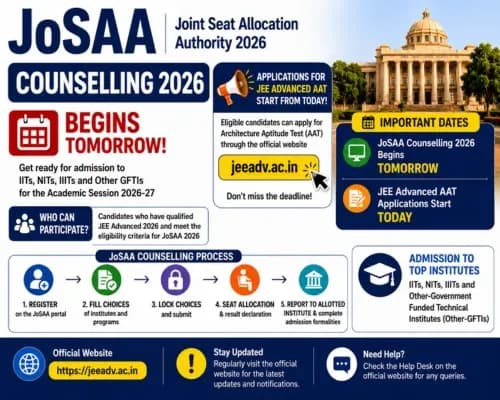
JoSAA Counselling 2026 Begins Tomorrow; JEE Advanced AAT Applications Open Today at jeeadv.ac.in html { scroll-behavior: smooth; } summary::-webkit-details-marker { display: none; } JoSAA Counselling 2026 Begins TOMORROW — JEE Advanced AAT 2026 Applications Open TODAY at jeeadv.ac.in The two most consequential events in the IIT Admission 2026 and NIT Admission 2026 cycle are launching simultaneously — JoSAA Counselling 2026 begins tomorrow and the JEE Advanced AAT 2026 (Architecture Aptitude Test) application window opens TODAY at the official portal jeeadv.ac.in. The JoSAA Registration 2026 — the mandatory first step for all JEE Advanced and JEE Main qualified candidates seeking admission to IITs, NITs, IIITs, and GFTIs — opens tomorrow at josaa.nic.in. Simultaneously, JEE Advanced qualified candidates who wish to apply for the B.Arch programme at IITs must register for the Architecture Aptitude Test 2026 at jeeadv.ac.in today — the AAT is a separate drawing and aptitude test conducted specifically for IIT B.Arch admissions, and its application window is open only for a limited period. The JoSAA Choice Filling window for institute and programme preferences will open immediately after registration — candidates who understand the IIT and NIT seat matrices, previous year closing ranks, and choice filling strategy will systematically outperform those who approach choice filling casually. This page carries all JoSAA Latest Updates on registration, AAT schedule, choice filling, and mock allotment — as the definitive guide to the JEE Advanced Counselling and JoSAA process for 2026. Key Highlights JoSAA Counselling 2026 — launches TOMORROW at josaa.nic.in; registration opens for all JEE Advanced + JEE Main qualifiers JEE Advanced AAT 2026 application opens TODAY at jeeadv.ac.in — only JEE Advanced qualified candidates eligible Architecture Aptitude Test 2026 — freehand drawing + aptitude test for IIT B.Arch admissions; register at jeeadv.ac.in before window closes JoSAA Registration 2026 — mandatory for IIT, NIT, IIIT, GFTI admission; complete tomorrow when josaa.nic.in opens JoSAA Choice Filling — opens after registration; fill all eligible programme-institute combinations strategically IIT Admission 2026 via JEE Advanced rank; NIT Admission 2026 via JEE Main rank — both processed through JoSAA All JoSAA Latest Updates on mock allotment, seat allotment rounds, and reporting tracked here Explore This: JEE Mains Exam Guide Why It Matters The simultaneous opening of JoSAA Counselling 2026 and the JEE Advanced AAT 2026 application window marks the beginning of the most consequential week in the annual IIT and NIT admission cycle. For JEE Advanced qualified candidates: tomorrow's JoSAA Registration 2026 is not the climax — it is the starting gun. The registration itself takes 15 minutes. The real work is the JoSAA Choice Filling — which requires weeks of research into previous year closing ranks, seat matrices, category-specific data, and honest self-assessment of aspirational versus realistic choices. Candidates who arrive at the choice filling window with a researched preference list of 60 to 80 options consistently achieve better outcomes than candidates who fill 15 choices based on brand name alone. For AAT candidates specifically: TODAY is the only day to register at jeeadv.ac.in — the Architecture Aptitude Test 2026 application window is narrow and there is no late registration provision. Missing today's AAT application means forgoing IIT B.Arch admission eligibility entirely this cycle. 🔴 JoSAA Latest Updates — Counselling & AAT LIVE 📋 JEE Advanced AAT 2026 — Apply NOW JEE Advanced AAT 2026 application is OPEN at jeeadv.ac.in. JEE Advanced 2026 qualified candidates who wish to apply for B.Arch programmes at IITs must register for the Architecture Aptitude Test 2026 TODAY at jeeadv.ac.in. The AAT is a pen-and-paper test of drawing ability and architectural aptitude — separate from the JEE Advanced paper. Registration is at jeeadv.ac.in; confirm the exact application deadline and AAT examination date in the official notification. Do not delay — the AAT window is narrow. 📅 JoSAA Registration 2026 — Opens TOMORROW JoSAA Counselling 2026 registration opens TOMORROW at josaa.nic.in. All JEE Advanced 2026 qualified candidates (for IIT admission) and JEE Main 2026 qualified candidates (for NIT, IIIT, and GFTI admission) must register. JoSAA Registration 2026 requires: JEE Advanced / JEE Main roll number, registration number, date of birth, email ID, and mobile number. Complete registration as soon as josaa.nic.in opens tomorrow — the JoSAA Choice Filling window opens only after registration is complete. 🏛️ Institutes Covered Under JoSAA JoSAA Counselling 2026 processes admissions for: 23 IITs (for JEE Advanced qualifiers — IIT Admission 2026), 31 NITs (for JEE Main qualifiers — NIT Admission 2026), 26 IIITs, and 33 GFTIs (Government Funded Technical Institutes). The combined seat pool across all JoSAA-participating institutions is among the largest in any single engineering admission counselling process in India. All JoSAA Latest Updates on seat matrices and opening/closing ranks are published at josaa.nic.in. 📊 Mock Allotment Before Final Rounds After JoSAA Choice Filling, JoSAA releases multiple mock allotments before the final allotment rounds — these are simulations showing what allotment a candidate would receive based on their current preference list and rank. Mock allotments are critical for refining choice lists before they are locked. Candidates should review mock allotment results carefully and adjust preferences before each lock-in deadline. All JoSAA Latest Updates on mock allotment dates will be published here. Related News: CUET UG Exam Guide Key Details — JoSAA Counselling 2026 & JEE Advanced AAT 2026 Particulars Details JEE Advanced AAT 2026 ApplicationOPEN TODAY at jeeadv.ac.in — Apply Now JoSAA Registration 2026Opens TOMORROW at josaa.nic.in JoSAA Official Portaljosaa.nic.in AAT Official Portaljeeadv.ac.in IIT Admission 2026 EligibilityJEE Advanced 2026 Qualified — All Categories NIT Admission 2026 EligibilityJEE Main 2026 Qualified — 75% Board Marks (65% for SC/ST) or Top 20 Percentile in Board IITs Under JoSAA23 IITs — Including IIT Bombay, Delhi, Madras, Kharagpur, Kanpur, Roorkee, Guwahati, Hyderabad + NITs Under JoSAA31 NITs — Including NIT Trichy, Warangal, Surathkal, Calicut, Durgapur, Kurukshetra + JoSAA Choice FillingOpens After Registration — Fill 60–80 Choices Across Aspirational, Realistic, and Safe Options Architecture Aptitude Test 2026Pen-and-Paper · Freehand Drawing + Aptitude · For IIT B.Arch Admissions Only JoSAA Allotment RoundsMultiple Mock Rounds → 6 Formal Allotment Rounds — Confirm Schedule at josaa.nic.in How to Register — JoSAA 2026 & JEE Advanced AAT 2026 JEE Advanced AAT 2026 Registration — Do This TODAY at jeeadv.ac.in Visit jeeadv.ac.in and navigate to the AAT 2026 registration section Log in with your JEE Advanced 2026 registration number and date of birth Select the Architecture Aptitude Test 2026 registration option — only JEE Advanced 2026 qualified candidates can register Choose your preferred AAT examination centre (limited centres available — select early) Submit registration and note your AAT registration confirmation — the Architecture Aptitude Test 2026 admit card will be available at jeeadv.ac.in before the examination date Do not delay — the AAT application window at jeeadv.ac.in closes on a date specified in the official notification; apply today to avoid missing the window JoSAA Registration 2026 — Do This TOMORROW at josaa.nic.in Visit josaa.nic.in tomorrow when the JoSAA Counselling 2026 portal opens Click "New Registration" and enter your JEE Advanced / JEE Main roll number, registration number, date of birth, email ID, and active mobile number Verify OTP sent to your registered email and mobile — complete the basic registration Complete your profile — academic details, category, PwD status, and state of eligibility After registration, the JoSAA Choice Filling interface becomes available — do not rush into choice filling on day one without research; the window remains open for several days Save your JoSAA registration credentials securely — you will need them for every subsequent step including choice filling, mock allotment, and formal allotment ⚡ Two Actions — Two Portals — Two Different Timelines: (1) AAT application at jeeadv.ac.in — do it TODAY if you want IIT B.Arch eligibility. (2) JoSAA registration at josaa.nic.in — do it TOMORROW when the portal opens. Both actions are mandatory for their respective pathways — do not confuse the portals. Also Read: KEAM 2026 Admit Card LIVE: Release Date, Physics Topics & Weightage 📋 JoSAA Choice Filling 2026 — Complete Strategy Guide The JoSAA Choice Filling list is the single most consequential decision in the JEE Advanced Counselling and JoSAA process. Here is the complete strategy: Step 1 — Access Previous Year Data (josaa.nic.in) Download the JoSAA 2024 and 2025 opening and closing rank data for all institutes and programmes from josaa.nic.in — these are the authoritative historical benchmarks. Use both years to identify rank trend directions (branches becoming more or less competitive) and to account for year-to-year variation. Build a spreadsheet comparing your JEE Advanced / JEE Main rank against the closing ranks in your category for every programme of interest. Step 2 — Build a Three-Tier List Aspirational (top 20% of list): IIT programmes where your rank is at or slightly above the historical closing rank — include these because rank fluctuations of 50 to 200 positions are common year-to-year, and some aspirational choices clear. IIT Bombay CSE, IIT Delhi CSE, and IIT Madras CSE top the aspirational list for most Advanced qualifiers Realistic (middle 60% of list): IIT and NIT programmes where your rank falls comfortably within the historical closing range — these are your most likely allotments and should be ordered carefully by genuine preference Safe (bottom 20% of list): IIT/NIT programmes and GFTIs where your rank clears even in historically competitive years — these ensure you receive some allotment even if realistic choices don't come through Step 3 — IIT vs NIT Branch Trade-off The most common strategic decision in JoSAA Choice Filling for mid-rank JEE Advanced qualifiers: a less preferred branch at a top IIT vs a preferred branch at a newer IIT or top NIT General guidance: IIT brand benefit is strongest for research, academia, and international opportunities; NIT in preferred branch with strong industry placement record (NIT Trichy, Warangal, Surathkal CSE) produces competitive employment outcomes. The choice depends on career intention, not just brand prestige Within IITs: do not dismiss branches like Chemical, Metallurgy, or Engineering Physics at top IITs purely because of lower perception — these departments have strong alumni networks and the IIT brand's full benefit applies regardless of branch Step 4 — Category-Specific Strategy SC, ST, OBC-NCL, and EWS candidates must analyse category-specific closing ranks — not general category ranks. The opening and closing ranks for reserved categories are published separately at josaa.nic.in and can differ dramatically from general category ranks PwD (Person with Disability) candidates should check both horizontal reservation data and PwD-specific closing ranks at josaa.nic.in State-domicile candidates applying for NIT home-state quota seats (15% of NIT seats are home-state quota): include home-state quota options in the JoSAA Choice Filling list — home-state quota closing ranks are significantly more accessible than other-state quota for the same NIT and branch Step 5 — Use Mock Allotments JoSAA releases 2 to 3 mock allotment rounds before formal allotments begin — use each one to test and refine your preference list. If a mock allotment shows you are getting a choice lower than expected, it may indicate your realistic range is different from your research estimate. Revise preferences before the choice list locks. The mock allotment is the most valuable tool available in the entire JEE Advanced Counselling process — use all rounds. What's Next — JoSAA Counselling 2026 Complete Timeline Following tomorrow's JoSAA Registration 2026 launch: the JoSAA Choice Filling window opens and remains active for several days — candidates should use the full window for research rather than submitting a rushed list. JoSAA then releases mock allotment rounds (typically 2 to 3 simulations) followed by 6 formal allotment rounds. In each formal round, candidates who receive an allotment choose one of four actions: freeze (accept and stop), float (accept provisionally and upgrade if better option available in next round), slide (retain current institute but accept a higher preferred branch if available), or reject (decline and remain in the pool). The IIT Admission 2026 and NIT Admission 2026 process concludes with physical document verification and fee payment at the allotted institute. All JoSAA Latest Updates on mock allotment dates, formal allotment rounds, and reporting schedule will be published on this page and at josaa.nic.in. 📌 Expert Analysis IIT and NIT admissions counsellors tracking the JoSAA Counselling 2026 cycle identify two systematic errors that cost candidates optimal outcomes. The first is filling too few choices — candidates who fill 10 to 15 choices in the JoSAA Choice Filling window out of the available 80 to 100 slots are self-limiting their allotment probability. Every unfilled slot is a seat that could have been available at the candidate's rank but was excluded by the candidate's own choice, not by the competitive process. The optimal strategy is to fill every eligible slot with a genuine order of preference — the system assigns the best available option within the candidate's rank capability. The second error is treating the first round allotment as the final outcome. The Freeze-Float-Slide mechanism in JEE Advanced Counselling through JoSAA is specifically designed to enable candidates to capture better options across rounds without losing their safety net. A candidate who receives a Round 1 allotment at NIT Warangal ECE but prefers IIT Hyderabad ECE should select Float — maintaining the NIT Warangal allotment while remaining eligible for the IIT Hyderabad seat if it opens in Round 2 or 3. Understanding this mechanism — and using Float and Slide strategically — is the most underutilised tool in the entire JoSAA Registration 2026 to allotment journey. Read the josaa.nic.in counselling brochure's explanation of all four response options before your first formal allotment. FAQs Q1. What is JEE Advanced AAT 2026 and who should apply today? The JEE Advanced AAT 2026 (Architecture Aptitude Test) is a separate drawing and aptitude examination conducted by IIT for candidates seeking admission to the B.Arch programme at IITs. Only JEE Advanced 2026 qualified candidates can apply. The Architecture Aptitude Test 2026 tests freehand drawing ability, spatial aptitude, and design sense — it is a pen-and-paper examination held at designated centres. Candidates who want to be considered for IIT B.Arch admissions must register at jeeadv.ac.in TODAY — the application window is limited. Passing the AAT and meeting the JEE Advanced rank criterion together determine IIT B.Arch allotment through JoSAA Counselling 2026. Q2. Who is eligible for JoSAA Counselling 2026? JoSAA Counselling 2026 is open to two categories of candidates. First: JEE Advanced 2026 qualified candidates — eligible for IIT Admission 2026 through the IIT seat pool. Second: JEE Main 2026 qualified candidates — eligible for NIT Admission 2026, IIIT admissions, and GFTI admissions. NIT and IIIT eligibility additionally requires either 75% aggregate in Class 12 (65% for SC/ST) or a position in the top 20 percentile of the respective board examination. Both categories must complete JoSAA Registration 2026 at josaa.nic.in starting tomorrow. Q3. How does JoSAA Choice Filling work and how many choices should I fill? The JoSAA Choice Filling interface at josaa.nic.in allows candidates to list their institute and programme preferences in order. The JoSAA system assigns the best available option within the candidate's rank capability based on this ordered preference list. Candidates should fill as many choices as possible — ideally 60 to 80 — covering aspirational, realistic, and safe combinations across IITs, NITs, IIITs, and GFTIs in their rank range. Filling fewer choices does not improve allotment quality — it only reduces the chance of any allotment. Use previous year opening and closing rank data at josaa.nic.in as the primary research tool for building the list. Q4. What do Freeze, Float, and Slide mean in JoSAA allotment? In each formal JEE Advanced Counselling allotment round through JoSAA, candidates who receive an allotment have four response options: Freeze — accept the allotment permanently and exit further rounds; Float — accept the allotment provisionally and remain eligible for a higher-preference choice in subsequent rounds if available; Slide — accept the current institute but remain eligible for a higher-preference branch at the same institute in subsequent rounds; Reject — decline the allotment entirely and remain in the pool (risky — not recommended without careful analysis). Float and Slide are the strategic options that allow candidates to improve their allotment without losing their current safety net — use them in early rounds when better options may still become available. All JoSAA Latest Updates on allotment round responses will be published here. Q5. What happens after JoSAA seat allotment — what are the next steps? After receiving a formal allotment in JoSAA Counselling 2026: (1) Accept the seat online within the specified window — paying the partial seat acceptance fee at josaa.nic.in; (2) Download the provisional allotment letter; (3) Report to the allotted institute on the designated reporting date with original documents — Class 10 certificate and marksheet, Class 12 marksheet and certificate, JEE Advanced / JEE Main admit card and scorecard, category certificate (if applicable), medical certificate (Class 1 physical fitness), and a set of passport photographs; (4) Pay the complete first-semester fees at the institute; (5) Receive the formal admission letter. Failing to report on the specified date results in automatic cancellation of the allotment. Confirm all reporting dates at josaa.nic.in under JoSAA Registration 2026 and allotment notifications. Related News / Articles Best Free AI Tools for Students in 2026 High-Income Tech Skills Without Programming Top AI Skills Students Must Learn in 2026 Top BTech Colleges in India Explore More Karnataka 2nd PUC Result Date TS INTER RESULT DATE KEAM ADMIT CARD 2026 JEE Advanced 2026 Registration GPAT Result 2026 LIVE CUET PG Response Sheet Rajasthan BSTC 2026 Notification UGC Releases New Guidelines Stay with College Nirnay for all JoSAA Latest Updates — including JoSAA Registration 2026 opening confirmation, JoSAA Choice Filling deadline, mock allotment dates, and all JEE Advanced Counselling formal allotment round results — as your definitive source for JoSAA Counselling 2026, IIT Admission 2026, and NIT Admission 2026 coverage.

DHSE Kerala Plus Two SAY Application 2026 Begins Today: Registration Deadlines and Exam Dates html { scroll-behavior: smooth; } summary::-webkit-details-marker { display: none; } DHSE Kerala Plus Two SAY Application 2026 Begins TODAY — Registration Deadlines, Exam Dates & Complete Guide The Directorate of Higher Secondary Education Kerala has opened the Kerala SAY Application 2026 window TODAY — and students who did not pass one or more subjects in the Kerala Plus Two Annual Examination 2026 can now register for the DHSE Kerala Supplementary Exam 2026 (Save A Year examination) at the official portal dhsekerala.gov.in. The DHSE Kerala SAY 2026 is formally known as the Save A Year examination — designed specifically to give Kerala Plus Two Supplementary examination candidates — Kerala Higher Secondary students — a second opportunity to clear failed subjects within the same academic year, enabling them to proceed to higher education admissions without losing a year. The Kerala Plus Two SAY Exam registration is a time-limited window with a defined closing deadline and late-fee deadline — both of which are now live and must be tracked immediately at dhsekerala.gov.in. This DHSE Kerala Latest Updates page covers the complete Plus Two SAY Registration process, the confirmed DHSE Kerala Exam Dates, eligibility criteria, fee structure, and what students must do immediately after registration to prepare for the SAY Exam 2026. If you or anyone you know failed one or more Plus Two subjects, the Kerala HSE SAY Exam registration window starting today is the most important deadline of the academic year — check dhsekerala.gov.in now. Key Highlights Kerala SAY Application 2026 window OPENS TODAY — register at dhsekerala.gov.in DHSE Kerala SAY 2026 (Save A Year) — for students who failed one or more subjects in Plus Two Annual Exam 2026 Registration deadline and late-fee window deadline — confirm exact dates at dhsekerala.gov.in immediately Kerala Plus Two SAY Exam dates — confirm at dhsekerala.gov.in; typically July/August window Plus Two SAY Registration — through school HM submission at dhsekerala.gov.in; individual student submission at school level DHSE Kerala Supplementary Exam 2026 — passing enables Class 11 / higher education admission without losing the academic year All DHSE Kerala Latest Updates on registration deadline, exam schedule, and result dates tracked here Explore This: JEE Mains Exam Guide Why It Matters — The SAY Exam Is a Second Chance Within the Same Year The DHSE Kerala SAY 2026 is the most student-welfare-oriented feature of Kerala's Higher Secondary examination system — and the one that most directly prevents an entire academic year from being lost due to failure in one or two subjects. A student who failed one or two papers in the Plus Two Annual Examination but appeared for all papers retains the right to appear in the Kerala Plus Two SAY Exam — and if they clear those subjects, their Plus Two result is treated as a pass for all admission and certification purposes. This means: the same student who received a fail result in June 2026 can, by passing the SAY Exam 2026 in July or August 2026, be eligible for university admissions in the same academic cycle — applying to degree colleges alongside students who passed the annual examination. The Kerala SAY Application 2026 registration window starting today is literally the gateway to that pathway. Failure to register within the deadline means waiting a full additional year. The registration must happen through the student's school (via the HM), so contacting the school immediately is the first action — not later today, not tomorrow. 🔴 DHSE Kerala Latest Updates — SAY Application 2026 LIVE 📋 Registration Opens Today DHSE Kerala SAY 2026 application window is OPEN. The Kerala SAY Application 2026 registration process has been launched at dhsekerala.gov.in today. Students who failed one or more subjects in the Kerala Plus Two Annual Examination 2026 are eligible to register. The Plus Two SAY Registration process is school-mediated — students submit their application through their Higher Secondary School's Head Master, who then forwards the consolidated school application to DHSE. Contact your school's Head Master or class teacher today to initiate the process. 📅 Deadlines — Check Immediately The Kerala SAY Application 2026 has two key deadlines: (1) the standard registration deadline — the last date to apply without a late fee; (2) the late-fee registration deadline — the last date to apply with a prescribed late fee. Both deadlines are published in the official DHSE notification at dhsekerala.gov.in. Check the exact dates immediately — do not assume either deadline is more than a week away. DHSE Kerala registration windows for the DHSE Kerala Supplementary Exam 2026 are short. All DHSE Kerala Latest Updates on confirmed deadlines will be updated on this page. 📆 SAY Exam Dates 2026 The DHSE Kerala Exam Dates for the Kerala Plus Two SAY Exam 2026 are published at dhsekerala.gov.in alongside the application notification. The SAY Exam 2026 is typically conducted in a July/August window — allowing students who pass to participate in the same academic cycle's university and degree college admissions. Confirm the exact Kerala HSE SAY Exam dates at dhsekerala.gov.in and build your subject-wise preparation schedule immediately. ✅ SAY Result and Admission Impact Students who clear the Kerala Plus Two SAY Exam 2026 will receive a pass result that is treated as equivalent to the annual examination result for all purposes — degree college admissions, scholarship applications, and higher education eligibility. The DHSE Kerala SAY result is typically declared within 2 to 3 weeks of the examination. The Kerala Plus Two Supplementary qualification opens the door: SAY-qualified students can participate in the ongoing Kerala university and college admissions processes (CAP through LBS, MG University, Calicut University portals) once the SAY result is published. Related News: CUET UG Exam Guide Key Details — DHSE Kerala SAY 2026 Particulars Details Exam NameDHSE Kerala SAY (Save A Year) Examination 2026 — Plus Two Supplementary Conducting BodyDirectorate of Higher Secondary Education (DHSE), Kerala Application StatusOPEN TODAY — Register via School at dhsekerala.gov.in Official Portaldhsekerala.gov.in Who Can ApplyStudents Who Failed One or More Subjects in Plus Two Annual Exam 2026 (appeared in all papers) Registration ProcessSchool-Mediated — Apply Through School HM → DHSE Portal Submission Standard Registration DeadlineConfirm at dhsekerala.gov.in — Check Immediately Late Fee DeadlinePublished at dhsekerala.gov.in — Short Window After Standard Deadline Kerala Plus Two SAY Exam DatesConfirm at dhsekerala.gov.in — Typically July/August 2026 Subjects CoveredAll Subjects in Which Student Failed — Applied Separately Per Failed Subject SAY Result ImpactPass = Full Plus Two Pass Certificate — Eligible for Same-Year University Admissions Streams CoveredScience · Commerce · Humanities — All Plus Two Streams How to Register for DHSE Kerala SAY 2026 — Step-by-Step Guide Step 1 — Contact your school immediately: The Plus Two SAY Registration is not an individual online process — it is school-mediated. The student must inform their school's Head Master or designated teacher about their intention to appear in the Kerala Plus Two SAY Exam TODAY. Do not wait — contact the school on the same day registration opens Step 2 — Submit application at school level: Complete the SAY application form available at your school — listing the subject(s) in which you failed and wish to appear. The school maintains the application records and submits them to DHSE through the dhsekerala.gov.in portal Step 3 — Pay the examination fee: The Kerala SAY Application 2026 requires payment of the prescribed examination fee per subject — fee details are published in the DHSE notification at dhsekerala.gov.in. Fee is typically paid through the school's fee collection mechanism or as specified in the DHSE circular Step 4 — Confirm your registration: After the school submits the consolidated application, confirm with your school office that your registration has been successfully submitted to DHSE. Note your application reference number Step 5 — Download admit card when released: The DHSE Kerala Supplementary Exam 2026 admit card will be available at dhsekerala.gov.in approximately one to two weeks before the examination — download, verify, and print. Carry the admit card and a valid photo ID on examination day Step 6 — Check exam centre and schedule: The DHSE Kerala Exam Dates and centre allocation for the SAY Exam 2026 are published at dhsekerala.gov.in — candidates appear at the centre specified in the admit card, which is typically the student's own school or a nearby government school ⚠️ School Contact Is Mandatory — Act Today: The Kerala SAY Application 2026 cannot be completed without school involvement. Contact your school's Head Master or class teacher TODAY — the registration window has opened and the deadline is short. Do not assume you can complete this process independently through dhsekerala.gov.in. Also Read: KEAM 2026 Admit Card LIVE: Release Date, Physics Topics & Weightage 📋 Kerala Plus Two SAY Exam 2026 Preparation Strategy — Make the Most of the Second Chance The Kerala HSE SAY Exam typically provides students with 4 to 6 weeks of preparation time between registration and the examination — a compressed but manageable window if used strategically. Here is the subject-wise approach: General Preparation Principles for SAY Exam 2026 Focus only on failed subjects: The SAY Exam 2026 covers only the subjects in which you failed — you do not need to re-prepare subjects you passed in the annual examination. Concentrate 100% of preparation time on the failed subject(s) Analyse previous attempt mistakes: If you received your answer sheet (or can see the subject-wise mark breakdown from dhsekerala.gov.in), identify specifically which topics or question types cost you marks — this targeted analysis is more valuable than re-reading entire chapters Use SCERT Kerala textbooks exclusively: The Kerala Plus Two SAY Exam paper is set exclusively from the SCERT Kerala syllabus and textbooks (not NCERT). All concepts, examples, and answers must be anchored to the Kerala state textbook — not general reference books Previous year SAY question papers: DHSE Kerala SAY question papers from previous years are available at dhsekerala.gov.in and through school resources — these are the most reliable indicator of the examination's question pattern and difficulty level. Solve at least 3 to 5 previous SAY papers under timed conditions Chapter-wise weightage: For each failed subject, identify the highest-weightage chapters (those that contribute the most marks) from the DHSE marking scheme — prioritise these chapters in the compressed preparation window Subject-Specific Strategies Mathematics: Focus on derivations, theorems, and problem types that appear in every year's SAY paper — Relations and Functions, Calculus (Derivatives and Integrals), Matrices and Determinants, and Vector Algebra are consistently high-weightage areas in Kerala Plus Two Maths SAY papers Physics: Numerical problems from Electrostatics, Current Electricity, Optics, and Modern Physics carry the highest combined marks. Practise numerical solving under time pressure — 3 to 4 problems per chapter minimum Chemistry: Organic Chemistry reaction mechanisms and named reactions (for Class 12), alongside Coordination Chemistry and Electrochemistry, are the highest-frequency SAY question areas. Inorganic Chemistry fact-based questions are the easiest marks to secure in the short preparation window Biology: Human Physiology, Genetics, Reproduction, and Ecology are the highest-weightage chapters — read the SCERT textbook thoroughly for these and practise diagram-based questions (labelled diagrams carry significant marks in the Kerala HSE SAY Exam) Commerce and Humanities: For Accountancy, focus on the most recently changed format questions and ensure at least 3 full sets of accounts problems are solved. For Economics and other Humanities subjects, previous SAY papers are the most direct preparation tool — question patterns are highly consistent year-to-year What's Next — DHSE Kerala SAY 2026 Timeline Following today's opening of the Kerala SAY Application 2026 window: the registration process closes on the standard deadline published at dhsekerala.gov.in, followed by a short late-fee window. After the registration window closes, DHSE will process all applications and release the DHSE Kerala Supplementary Exam 2026 admit cards approximately one to two weeks before the examination. The SAY Exam 2026 is conducted in a July/August window (confirm exact DHSE Kerala Exam Dates at dhsekerala.gov.in). Results for the Kerala Plus Two SAY Exam are typically declared within 2 to 3 weeks of examination completion — enabling students who qualify to participate in same-year degree college admissions. All DHSE Kerala Latest Updates on admit cards, exam schedule confirmation, and result publication will be tracked on this page. 📌 Expert Analysis Education counsellors working with Kerala Plus Two students identify a consistent and preventable error pattern among students who are eligible for the DHSE Kerala SAY 2026: the delay in initiating the school contact for Plus Two SAY Registration beyond the first two to three days of the registration window. The school-mediated nature of the process means that each day of student delay is potentially amplified if the school's administration accumulates multiple late applications simultaneously — creating a bottleneck in the days immediately before the deadline. Students who contact their school Head Master on the day the Kerala SAY Application 2026 opens (today) are in the most advantageous position for a smooth registration completion. For preparation, the most important insight from teachers who coach for the Kerala HSE SAY Exam is this: the SAY paper is more predictable than the annual examination. Because the question paper follows the same blueprint annually, students who solve 5 to 6 previous SAY papers and master the most frequently tested question types from each chapter have a statistically much higher pass probability than students who attempt to re-cover the entire syllabus from scratch. The compressed preparation window actually favours targeted revision over comprehensive re-study. Register today, begin targeted preparation this week, and track all DHSE Kerala Latest Updates on exam dates and admit cards here. FAQs Q1. Who is eligible to apply for DHSE Kerala SAY 2026? Students who appeared in all subjects of the Kerala Plus Two Annual Examination 2026 but failed in one or more subjects are eligible to apply for the DHSE Kerala SAY 2026. This is the fundamental distinction between the Kerala Plus Two Supplementary (SAY) and the Improvement examination. The key eligibility condition is having appeared in all papers of the annual examination — students who were absent in any paper are not eligible for the SAY and must appear in the Improvement / Supplementary examination in the next cycle. Students who failed two or more subjects can appear in multiple papers in the SAY Exam 2026 simultaneously. Confirm your specific eligibility at dhsekerala.gov.in with the official DHSE notification for the Kerala HSE SAY Exam 2026. Q2. How do I register for the Kerala SAY Application 2026? The Kerala SAY Application 2026 is a school-mediated process — not a direct individual online registration. Contact your school's Head Master or designated teacher today to inform them of your intention to appear in the Kerala Plus Two SAY Exam. The school will provide you the application form, collect the examination fee, and submit the consolidated school application to DHSE through dhsekerala.gov.in. Individual students cannot register directly without school mediation. Contact your school on the same day the Plus Two SAY Registration window opens (today) — do not delay, as the registration window is short. Q3. What are the DHSE Kerala Exam Dates for SAY 2026? The confirmed DHSE Kerala Exam Dates for the Kerala Plus Two SAY Exam 2026 are published in the official DHSE notification at dhsekerala.gov.in. The SAY Exam 2026 is typically conducted in July or August — allowing students who pass to participate in the same academic cycle's college admissions. Check dhsekerala.gov.in immediately for the confirmed date schedule and build your subject-wise preparation timeline accordingly. All DHSE Kerala Latest Updates on the examination schedule, including any date revisions, will be published on this page. Q4. If I pass the Kerala HSE SAY Exam, can I apply to degree colleges in the same year? Yes — passing the Kerala HSE SAY Exam 2026 produces a result that is treated as a full Plus Two pass for all higher education admission purposes. Students who qualify in the SAY Exam 2026 receive the Kerala Plus Two pass certificate and are eligible to apply for degree college admissions in the same academic cycle — through the centralised admission processes at LBS Centre, MG University, Calicut University, and other Kerala university portals. The SAY result is typically declared within 2 to 3 weeks of the examination, and same-year admissions include provisions for SAY-qualified students. The entire purpose of the DHSE Kerala SAY 2026 (Save A Year) is to prevent students from losing the academic year due to failure in limited subjects. Q5. What is the difference between DHSE Kerala SAY Exam and the Improvement Exam? The DHSE Kerala Supplementary Exam 2026 (SAY — Save A Year) and the Improvement Examination are two distinct processes with different purposes and eligibility. The Kerala Plus Two SAY Exam is specifically for students who appeared in all papers but failed in some — it is conducted within the same academic year to enable same-year admission. The Improvement Examination is for students who have already passed and want to improve their marks in specific subjects — it is typically conducted alongside the next year's annual examination cycle. SAY candidates appear in failed subjects; Improvement candidates appear in passed subjects to raise their scores. The Kerala SAY Application 2026 opening today is exclusively for the supplementary (SAY) process — not the improvement examination. Related News / Articles Best Free AI Tools for Students in 2026 High-Income Tech Skills Without Programming Top AI Skills Students Must Learn in 2026 Top BTech Colleges in India Explore More Karnataka 2nd PUC Result Date TS INTER RESULT DATE KEAM ADMIT CARD 2026 JEE Advanced 2026 Registration Starts GPAT Result 2026 LIVE CUET PG Response Sheet Rajasthan BSTC 2026 Notification Released UGC Releases New Guidelines Stay with College Nirnay for all DHSE Kerala Latest Updates — including the Kerala SAY Application 2026 registration deadline confirmation, DHSE Kerala Exam Dates for the SAY Exam 2026, admit card release, and Kerala Plus Two SAY Exam result declaration — as your definitive source for DHSE Kerala SAY 2026 and Kerala HSE SAY Exam coverage.
AP EAMCET Results 2026 LIVE — EAPCET Rank Card Today at cets.apsche.ap.gov.in | Hall Ticket Number Download html { scroll-behavior: smooth; } summary::-webkit-details-marker { display: none; } AP EAMCET Results 2026 LIVE: EAPCET Rank Card Today, Download at cets.apsche.ap.gov.in with Hall Ticket Number — Check Latest Updates Here The AP EAMCET Results 2026 have been officially declared today by APSCHE — candidates who appeared in the AP EAPCET 2026 examination across Engineering, Agriculture, and Pharmacy streams can now download their AP EAMCET Rank Card at the official portal cets.apsche.ap.gov.in using their AP EAMCET Hall Ticket Number. The EAPCET Rank Card Download is live at cets.apsche.ap.gov.in and includes each candidate's subject-wise marks, total score, overall rank, stream rank, and category rank — all of which are the primary inputs for the AP EAPCET 2026 counselling process that begins immediately after result declaration. The AP EAMCET Result Link is active at cets.apsche.ap.gov.in — candidates should download and save their rank card immediately as server loads are expected to be high at the time of result declaration. All AP EAMCET LIVE Updates on the rank card download, stream-wise cut-offs, counselling schedule, and college allotment timeline are tracked on this page as the complete resource for every Andhra Pradesh EAMCET Result 2026 candidate. Key Highlights AP EAMCET Results 2026 declared TODAY — EAPCET Rank Card Download live at cets.apsche.ap.gov.in Download AP EAMCET Rank Card using your AP EAMCET Hall Ticket Number and date of birth at cets.apsche.ap.gov.in AP EAPCET Result 2026 covers all three streams — Engineering (PCM), Agriculture, and Pharmacy — with stream-specific ranks Rank card includes subject-wise marks, total score, overall rank, category rank, and stream rank for each candidate Andhra Pradesh EAMCET Result 2026 pass percentage and stream-wise topper data to be announced alongside rank card declaration AP EAMCET 2026 counselling registration expected to open within 5 to 7 days of result — monitor cets.apsche.ap.gov.in Candidates should download and save rank card immediately — access the AP EAMCET Result Link during off-peak hours if portal is slow All AP EAMCET LIVE Updates on counselling schedule, college allotment, and rank card download tracked on this page Explore This: Top B.Tech Colleges in India — Fees, Ranking & Placement 2026 Why It Matters The AP EAMCET Results 2026 declaration is the pivotal moment that determines the college and branch access of over three lakh Andhra Pradesh students across Engineering, Agriculture, and Pharmacy programmes for the next four years. The AP EAMCET Rank Card is not simply a result document — it is the admission credential that every government engineering college, agricultural university, and pharmacy institution in Andhra Pradesh requires for counselling eligibility. A candidate's rank on the Andhra Pradesh EAMCET Result directly determines which colleges and branches they can access during the AP EAPCET counselling rounds — with every rank position carrying real significance in a system where the difference of 50 to 200 ranks can determine whether a student enters a government college or a private college at the same branch level. The hours immediately following the AP EAPCET Result 2026 declaration are the most information-rich and action-critical in the entire admission cycle — download the rank card, understand the rank, and begin counselling preparation without delay. 🔴 AP EAMCET LIVE Updates — Result & Rank Card Tracker 2026 📅 AP EAMCET Results 2026 Declared — Rank Card Live NOW AP EAPCET Result 2026 is officially declared today — EAPCET Rank Card Download is live at cets.apsche.ap.gov.in. APSCHE has activated the rank card download portal for all three streams — Engineering, Agriculture, and Pharmacy — simultaneously. Candidates can access their individual AP EAMCET Rank Card by logging in at cets.apsche.ap.gov.in using their AP EAMCET Hall Ticket Number and date of birth. The AP EAMCET Result Link is live — download your rank card, save the PDF, and check your rank, marks, and category rank immediately. All AP EAMCET LIVE Updates on portal status and counselling timelines are updated on this page. 📄 What Your AP EAMCET Rank Card Shows The AP EAMCET Rank Card downloaded from cets.apsche.ap.gov.in using your AP EAMCET Hall Ticket Number contains: subject-wise marks in all three subjects of your stream, total marks scored out of 160, overall AP EAPCET 2026 rank (across all candidates in your stream), category rank (within your reservation category — OC, BC-A, BC-B, BC-C, BC-D, BC-E, SC, ST), and stream rank. The overall rank is the primary determinant for counselling seat allotment at government colleges. The category rank determines eligibility for reserved category seats. Verify every detail on the rank card immediately after downloading — any discrepancy in name, hall ticket number, or marks must be reported to APSCHE through the official grievance channel at cets.apsche.ap.gov.in before the counselling registration opens. 📊 Stream-wise Pass Percentage & Topper Data APSCHE will announce stream-wise pass percentage, district-wise performance data, and topper names for the Andhra Pradesh EAMCET Result 2026 alongside the rank card declaration at cets.apsche.ap.gov.in. Engineering stream toppers — candidates who scored the maximum marks in PCM — along with Agriculture and Pharmacy stream toppers will be recognised in the official result announcement. The overall pass percentage for AP EAMCET Results 2026 and category-wise qualification data will be published in APSCHE's official press release and at cets.apsche.ap.gov.in. All this data will be updated on this page as part of AP EAMCET LIVE Updates as it becomes available. 📋 AP EAPCET 2026 Counselling — What Comes Next AP EAPCET 2026 counselling registration is expected to open at cets.apsche.ap.gov.in within 5 to 7 days of the AP EAMCET Results 2026 declaration. The counselling process — managed by APSCHE with JNTU coordination — involves online registration, certificate verification, web-based choice filling (college and branch preference ranking), and seat allotment across multiple rounds. Candidates should begin their counselling preparation immediately after downloading the AP EAMCET Rank Card — particularly college research, previous year's opening and closing rank data review, and document organisation. All AP EAMCET LIVE Updates on the counselling registration date and schedule will be tracked on this page. Related News: CUET UG Exam Guide Key Details — AP EAMCET Results 2026 & Rank Card Particulars Details Exam NameAP Engineering, Agriculture & Medical Common Entrance Test (EAPCET / EAMCET) 2026 Conducting BodyAPSCHE — Jawaharlal Nehru Technological University (JNTU), Andhra Pradesh AP EAMCET Results 2026 StatusDECLARED TODAY — EAPCET Rank Card Download Live at cets.apsche.ap.gov.in AP EAMCET Rank Card AccessLogin at cets.apsche.ap.gov.in — AP EAMCET Hall Ticket Number + Date of Birth Streams CoveredEngineering (Physics · Chemistry · Maths) · Agriculture · Pharmacy Rank Card DetailsSubject-wise Marks · Total Score · Overall Rank · Category Rank · Stream Rank Total Marks160 Marks (160 Questions × 1 Mark Each — No Negative Marking) NormalisationApplied for Multi-Shift Examination — Final Rank Based on Normalised Score AP EAPCET 2026 CounsellingRegistration Expected Within 5–7 Days of Result — Monitor cets.apsche.ap.gov.in Discrepancy ReportingContact APSCHE via cets.apsche.ap.gov.in Grievance Portal — Before Counselling Opens Official Portalcets.apsche.ap.gov.in — All Rank Cards, Counselling Notices, Allotment Data How to Download AP EAMCET Rank Card 2026 at cets.apsche.ap.gov.in Step 1 — Visit cets.apsche.ap.gov.in directly: Access the official AP EAPCET result portal at cets.apsche.ap.gov.in — do not use third-party rank card or result websites that may carry inaccurate data. The official AP EAMCET Result Link is only authoritative when accessed through the APSCHE portal. Bookmark the URL now to avoid searching under portal load pressure Step 2 — Locate the AP EAMCET Results 2026 rank card section: On the homepage of cets.apsche.ap.gov.in, look for the AP EAMCET Results 2026 or EAPCET Rank Card link — it will be prominently displayed under the "Results" or "Latest Updates" section. Click the EAPCET Rank Card Download link for your stream (Engineering, Agriculture, or Pharmacy) Step 3 — Enter your AP EAMCET Hall Ticket Number and date of birth: In the login form, enter your AP EAMCET Hall Ticket Number exactly as printed on your admit card — including any prefix letters — and your date of birth in the specified format (DD/MM/YYYY). If you have misplaced your hall ticket, use the hall ticket recovery option on the portal using your registered mobile number or application ID Step 4 — Access and verify your AP EAMCET Rank Card: After logging in, your AP EAMCET Rank Card will display on screen. Verify every detail carefully — your name spelling, hall ticket number, subject-wise marks, total score, overall rank, and category rank. Cross-check the subject-wise marks against your approximate performance in each section during the examination Step 5 — Download the EAPCET Rank Card PDF immediately: Click the download or print option to save your AP EAMCET Rank Card as a PDF. Save it to your phone, email (send to yourself), and cloud storage (Google Drive or similar) immediately — do not close the page before downloading. The rank card is a mandatory document for AP EAPCET 2026 counselling registration and college reporting Step 6 — Note your rank and compare against previous year cut-offs: After downloading, note your overall rank and category rank. Access the previous year's (2024 and 2025) college-wise opening and closing rank data available at cets.apsche.ap.gov.in to estimate which government and private colleges and branches are realistically accessible at your rank — this is the first step in counselling preparation Step 7 — Report any discrepancies immediately: If any detail on your Andhra Pradesh EAMCET Result rank card is incorrect — name, hall ticket number, subject marks, or rank — report it to APSCHE through the official grievance portal at cets.apsche.ap.gov.in before the counselling registration window opens. Post-counselling corrections are significantly harder to obtain Step 8 — Begin counselling preparation immediately: Use your rank to research colleges using previous year data at cets.apsche.ap.gov.in, organise all required documents for counselling registration, and monitor the portal daily for the AP EAPCET 2026 counselling schedule announcement. All AP EAMCET LIVE Updates on counselling dates will be published here ⚠️ High Server Load at Result Time — Use This Strategy: Over 3 lakh candidates will attempt to access cets.apsche.ap.gov.in simultaneously when the AP EAMCET Results 2026 portal activates. If the portal is slow or unresponsive, wait 15 to 20 minutes and try again — do not repeatedly refresh, as this adds to server load. Try accessing during off-peak hours (after 10 PM or before 7 AM) when load reduces. If the portal shows an error, confirm your AP EAMCET Hall Ticket Number and date of birth are entered correctly before concluding there is a system issue — incorrect credential entry is the most common reason for failed login attempts during high-traffic result periods. Also Read: KEAM 2026 Admit Card LIVE: Release Date, Physics Topics & Weightage Complete Guide — AP EAMCET Rank Card 2026: Understanding Your Result, Stream-wise Counselling Outlook & What To Do Now The AP EAMCET Results 2026 declaration triggers a defined sequence of decisions and actions — and the candidates who navigate this sequence most effectively are those who understand exactly what their rank card means and what each piece of data on it unlocks in the counselling process. Here is the complete post-result framework for every stream. Understanding Your AP EAMCET Rank Card — What Each Section Means for Counselling Overall Rank: The most important number on your AP EAMCET Rank Card — your position among all candidates in your stream who appeared in the AP EAPCET 2026 examination. The overall rank determines which colleges and branches are accessible during counselling. Lower rank numbers indicate better performance (Rank 1 is the topper). Use this number against the previous year's opening and closing rank data at cets.apsche.ap.gov.in to estimate your realistic college options Category Rank: Your rank within your reservation category (OC, BC-A, BC-B, BC-C, BC-D, BC-E, SC, ST, EWS, or PH). Reserved category seats in every college are filled based on category rank — so a candidate with an overall rank of 40,000 but an SC category rank of 5,000 has access to government engineering colleges under SC quota that would not be accessible under the OC quota. Always check both your overall rank and category rank when researching counselling options Normalised Score: If the AP EAMCET Results 2026 examination was conducted across multiple shifts, APSCHE applies a normalisation formula to adjust for difficulty variations between shifts. The normalised score — not your raw marks — is the basis for final rank computation. This means your rank card score may differ slightly from your raw score calculated using the answer key. The rank card score is the authoritative number for all counselling purposes Stream Rank: Your rank within your specific stream (Engineering, Agriculture, or Pharmacy) independently of the other streams. Stream rank is particularly relevant for Agriculture and Pharmacy stream candidates where stream-specific college allotments are managed through separate seat matrices in the Andhra Pradesh EAMCET Result counselling system Stream-wise Counselling Outlook — What Your AP EAPCET 2026 Rank Unlocks Engineering Stream — Rank-based College and Branch Access: For AP Engineering stream candidates, the opening and closing rank data at cets.apsche.ap.gov.in from 2024 and 2025 provides the most reliable guide to counselling outcomes. Ranks 1 to 5,000 typically access top-tier government NIT-equivalent and autonomous engineering colleges in Andhra Pradesh for CSE and ECE. Ranks 5,000 to 20,000 access a broader range of government colleges across most branches. Ranks 20,000 to 60,000 access government colleges for core branches and competitive private colleges for CSE/ECE. Above 60,000, private colleges remain accessible across most branches — use the previous year data for realistic mapping Agriculture Stream — Government Agricultural University Priority: AP EAPCET 2026 Agriculture stream candidates targeting ANGRAU (Acharya N.G. Ranga Agricultural University) and affiliated agricultural colleges should compare their rank against the previous year's agriculture stream opening and closing ranks at cets.apsche.ap.gov.in. B.Sc Agriculture at ANGRAU Guntur is the most competitive seat in the Agriculture stream — similarly competitive are B.Sc Horticulture, B.Sc Forestry, and B.F.Sc (Fisheries Science). Veterinary Science (BVSc) seats through Andhra Pradesh EAMCET Result Agriculture stream are the highest-demand category and require consistently strong Agriculture stream ranks Pharmacy Stream — B.Pharm and Pharm.D Priority: Pharmacy stream candidates use the AP EAMCET Rank Card for B.Pharmacy and Pharm.D admissions at government pharmacy colleges, autonomous institutions, and JNTU-affiliated private pharmacy colleges. Pharm.D (6-year clinical pharmacy doctorate) requires significantly stronger ranks than B.Pharm — candidates near the 10,000 to 25,000 Pharmacy stream rank range have good access to B.Pharm at government colleges Immediate Post-Result Checklist — What to Do Before Counselling Opens Download and save the rank card in at least 3 locations — device storage, email, and cloud — the moment the EAPCET Rank Card Download portal is accessible at cets.apsche.ap.gov.in Research 20 to 30 colleges using 2024 and 2025 opening/closing rank data available at cets.apsche.ap.gov.in — build a tiered preference list covering aspirational, realistic, and secure options before the counselling choice filling window opens Organise all required documents for counselling registration: rank card, hall ticket, SSC/Intermediate marksheets, study certificate, income certificate, Aadhaar, community certificate (if applicable), and passport photographs Check income certificate validity — for fee reimbursement and BC/SC/ST scholarship eligibility, income certificates must be current-year and issued by a competent authority. Outdated certificates cause counselling complications that are avoidable with early verification Monitor cets.apsche.ap.gov.in daily for the counselling registration opening date — the window between result declaration and counselling opening is typically 5 to 7 days in the AP EAMCET 2026 cycle, and missing the counselling registration is the single most avoidable error in the entire post-result process What's Next — AP EAPCET 2026 Full Post-Result Timeline With the AP EAMCET Results 2026 declared today, the next critical phase is the AP EAPCET 2026 counselling process — managed by APSCHE at cets.apsche.ap.gov.in. Counselling registration is expected to open within 5 to 7 days of the Andhra Pradesh EAMCET Result declaration. The counselling process involves four key stages: online registration and fee payment at cets.apsche.ap.gov.in, certificate verification at the designated helpline centre, web-based choice filling (ranking college-branch combinations in preference order), and seat allotment across multiple rounds. Each stage has a strict deadline — missing any one of them forfeits the candidate's position for that round. The AP EAMCET 2026 counselling typically runs three to four allotment rounds — Round 1 allots from the complete seat pool across all government and private participating colleges; subsequent rounds handle withdrawals and fresh vacancies. Candidates who receive an unsatisfactory allotment in Round 1 can participate in subsequent rounds for an upgrade while holding their current allotment as security. The complete counselling schedule — including registration dates, certificate verification schedule, choice filling window, and round-wise allotment dates — will be published at cets.apsche.ap.gov.in within days of the AP EAMCET Results 2026 declaration. All AP EAMCET LIVE Updates on every counselling phase will be tracked on this page. 📌 Expert Analysis Academic counsellors who advise Andhra Pradesh students through the AP EAPCET 2026 cycle consistently identify the post-result window as the phase where preparation quality most directly determines counselling outcome — more than the rank itself, within a given rank range. A candidate at rank 15,000 who begins counselling research on the day of the AP EAMCET Results 2026 declaration, uses the previous year's data at cets.apsche.ap.gov.in to map 25 to 30 realistic college-branch combinations, and organises documents in advance consistently achieves better counselling outcomes than a candidate at rank 12,000 who begins this work two days before the choice filling window closes. The quality and completeness of the counselling preference list — built calmly using real data — is the single most improvable variable in the post-result period. For the AP EAMCET 2026 Engineering stream specifically, experts note that branch selection decisions are increasingly consequential in the current job market — with CSE, CSE-AI/ML, and Data Science branches showing placement rates significantly above Mechanical and Civil in most Andhra Pradesh private engineering colleges. Candidates in the 20,000 to 60,000 rank range where government college access for CSE may be borderline face the most complex branch-versus-college trade-off, and this decision benefits from careful research rather than brand-driven intuition. Use the AP EAMCET Rank Card data, the previous year's closing rank data at cets.apsche.ap.gov.in, and placement data from the target colleges' official websites to make this decision with actual information rather than assumptions. All AP EAMCET LIVE Updates on counselling schedule, round-wise allotment, and seat vacancy data are tracked on this page and at cets.apsche.ap.gov.in. 🎓 One Form · Multiple Colleges Stop Stressing. Start Applying. Skip the chaos of filling endless forms. Apply to your dream colleges in one go through the College Nirnay Common Application Form — built for every student navigating India's competitive education landscape. Fill the Common Application Form → ✓ Free to apply · ✓ Takes under 5 minutes · ✓ Trusted by thousands of students FAQs Q1. How do I download the AP EAMCET Rank Card 2026? To complete the EAPCET Rank Card Download, visit the official portal at cets.apsche.ap.gov.in and click the AP EAMCET Results 2026 rank card link. Enter your AP EAMCET Hall Ticket Number (as printed on your admit card) and date of birth in the specified format. Your AP EAMCET Rank Card will appear on screen — download the PDF immediately and save it in multiple locations including email and cloud storage. The rank card is required for AP EAPCET 2026 counselling registration and college reporting. If the portal is slow due to server load, try again during off-peak hours (after 10 PM). Q2. What does the AP EAMCET Rank Card contain? The AP EAMCET Rank Card downloaded from cets.apsche.ap.gov.in using your AP EAMCET Hall Ticket Number contains: candidate name, hall ticket number, date of birth, stream (Engineering/Agriculture/Pharmacy), subject-wise marks, total normalised score out of 160, overall AP EAPCET 2026 rank, category rank (OC/BC/SC/ST), and stream rank. The overall rank is the primary counselling determinant. Verify all details on the Andhra Pradesh EAMCET Result rank card immediately after downloading and report any discrepancy to APSCHE before counselling registration opens. Q3. When will AP EAPCET 2026 counselling registration open? AP EAPCET 2026 counselling registration is expected to open at cets.apsche.ap.gov.in within 5 to 7 days of the AP EAMCET Results 2026 declaration. APSCHE will publish the complete counselling schedule — registration dates, certificate verification, choice filling window, and round-wise allotment dates — on cets.apsche.ap.gov.in. Monitor the portal daily after the AP EAMCET Rank Card is downloaded and track all AP EAMCET LIVE Updates on this page for the counselling registration notification as soon as it is officially confirmed. Q4. Why does my rank card score differ from my self-calculated score using the answer key? The AP EAMCET Results 2026 rank is based on a normalised score — not the raw score calculated from the answer key. Since AP EAPCET 2026 was conducted across multiple shifts over multiple days, APSCHE applies a normalisation formula to adjust for difficulty variations between shifts and ensure fair comparison across all candidates. Your raw answer key score and your normalised rank card score will differ by a few marks in most cases — this is expected and correct. The normalised score on your AP EAMCET Rank Card at cets.apsche.ap.gov.in is the authoritative figure for all counselling purposes. Q5. I have lost my hall ticket — how do I access my AP EAMCET Rank Card? If you have lost your AP EAMCET Hall Ticket Number, visit cets.apsche.ap.gov.in and use the "Forgot Hall Ticket Number" or "Hall Ticket Retrieval" option — typically available through your registered mobile number or application ID. Alternatively, contact the APSCHE helpdesk through the official contact information published at cets.apsche.ap.gov.in. Your hall ticket number can also be found in any confirmation email sent to your registered email address during the AP EAPCET 2026 registration process — check your email archives including the spam folder before contacting the helpdesk. Related News / Articles Top B.Tech Colleges in India 2026 — Fees, Rankings & Placements Best Free AI Tools for Students in 2026 Top AI Skills Students Must Learn in 2026 CGPA vs Experience: What Matters for Engineering Placement? Explore More Karnataka 2nd PUC Result Date TS INTER RESULT DATE KEAM ADMIT CARD 2026 JEE Advanced 2026 Registration GPAT Result 2026 LIVE CUET PG Response Sheet Rajasthan BSTC 2026 Notification UGC Releases New Guidelines Stay with College Nirnay for all AP EAMCET LIVE Updates — including stream-wise cut-off analysis, AP EAPCET 2026 counselling registration date, choice filling window, round-wise allotment results, and complete post-result college admission coverage — as your definitive source for AP EAMCET Results 2026 and Andhra Pradesh EAMCET Result guidance at cets.apsche.ap.gov.in.

TS DEECET 2026 Result OUT: Download Rank Card at deecet.cdse.telangana.gov.in TS DEECET 2026 Result OUT: Direct Link to Download Rank Card at deecet.cdse.telangana.gov.in The TS DEECET Result 2026 has been officially released on the Telangana Department of School Education's admission portal. Candidates who appeared for the TG DEECET 2026 examination can now access the TS DEECET result link and download their Telangana DEECET rank card from deecet.cdse.telangana.gov.in result. The rank card contains candidate details, marks obtained, rank secured and qualifying status. Qualified candidates will be eligible to participate in the upcoming TS DEECET counselling process for Telangana D.El.Ed admission and teacher training programmes across the state. Key Highlights TS DEECET Result 2026 officially declared Telangana DEECET rank card available for download online Candidates can access the result at deecet.cdse.telangana.gov.in result DEECET rank card download facility activated through the official portal Qualified candidates can participate in TS DEECET counselling Admissions will be conducted for Telangana D.El.Ed admission programmes Students should follow DEECET 2026 updates for counselling schedules and seat allotment announcements Explore This: JEE Mains Exam Guide 🔴 TS DEECET LIVE Updates — Result Tracker 📅 Result Released The TS DEECET Result 2026 has been published online. Candidates can now check their qualifying status and rank details through the official portal. 🏆 Rank Card Available The Telangana DEECET rank card includes candidate information, marks, rank secured and eligibility details for the admission process. 📌 Counselling Updates Expected Soon The authorities are expected to release the complete TS DEECET counselling schedule shortly for eligible candidates seeking admission into D.El.Ed programmes. Related News: CUET UG Exam Guide TS DEECET 2026 Result — Important Details Particulars Details Exam Name TG DEECET 2026 Result Name TS DEECET Result 2026 Result Status Released Document Available Telangana DEECET Rank Card Official Website deecet.cdse.telangana.gov.in Login Credentials Hall Ticket Number / Candidate Details Admission Course Diploma in Elementary Education (D.El.Ed) Next Stage TS DEECET Counselling How to Download Telangana DEECET Rank Card 2026 Step 1: Visit deecet.cdse.telangana.gov.in Step 2: Click on the TS DEECET result link Step 3: Enter the required login credentials Step 4: Submit the details Step 5: View your TS DEECET Result 2026 Step 6: Download the DEECET rank card Step 7: Take a printout for counselling and admission purposes Also Read: KEAM 2026 Admit Card LIVE: Release Date, Physics Topics & Weightage Details Mentioned on Telangana DEECET Rank Card Candidate Name Hall Ticket Number Category Details Total Marks Obtained Rank Secured Qualifying Status Admission Eligibility Information Important: Candidates should carefully verify all details printed on the Telangana DEECET rank card. Any discrepancy should be reported to the concerned authorities immediately. TS DEECET Counselling 2026 Candidates who qualify in TG DEECET 2026 will be invited to participate in the TS DEECET counselling process. During counselling, candidates will be required to complete registration, certificate verification, web options entry, seat allotment and admission confirmation. Successful candidates will receive admission into various institutes offering Telangana teacher training admission and Telangana D.El.Ed admission programmes. What After TS DEECET Result 2026? After downloading the rank card, candidates should prepare all required documents for counselling. Students should regularly monitor official notifications for seat allotment schedules, document verification dates and admission deadlines. Following DEECET 2026 updates will help candidates avoid missing any important counselling events. 🎓 One Form · Multiple Colleges Stop Stressing. Start Applying. Skip the chaos of filling endless forms. Apply to your dream colleges in one go through the College Nirnay Common Application Form — built for every student navigating India's competitive education landscape. Fill the Common Application Form → ✓ Free to apply · ✓ Takes under 5 minutes · ✓ Trusted by thousands of students FAQs Q1. Has the TS DEECET Result 2026 been released? Yes, the TS DEECET Result 2026 has been officially released online. Q2. Where can I download the Telangana DEECET rank card? Candidates can download the Telangana DEECET rank card from deecet.cdse.telangana.gov.in. Q3. What is the next step after TS DEECET Result 2026? Qualified candidates must participate in the TS DEECET counselling process for admission. Q4. What course admissions are offered through TG DEECET 2026? Admissions are offered to Diploma in Elementary Education programmes through Telangana D.El.Ed admission counselling. Q5. Is the rank card required for counselling? Yes, candidates must carry the downloaded DEECET rank card during counselling and admission procedures. Related News / Articles Best Free AI Tools for Students in 2026 High-Income Tech Skills Without Programming Top AI Skills Students Must Learn in 2026 Top B.Tech Colleges in India 2026 Explore More Karnataka 2nd PUC Result Date TS INTER RESULT DATE KEAM ADMIT CARD 2026 JEE Advanced 2026 Registration GPAT Result 2026 LIVE CUET PG Response Sheet Rajasthan BSTC 2026 Notification UGC Releases New Guidelines Stay connected for all DEECET 2026 updates, including TS DEECET Result 2026, rank card download, counselling schedules, seat allotment details and official announcements related to Telangana teacher training admission.
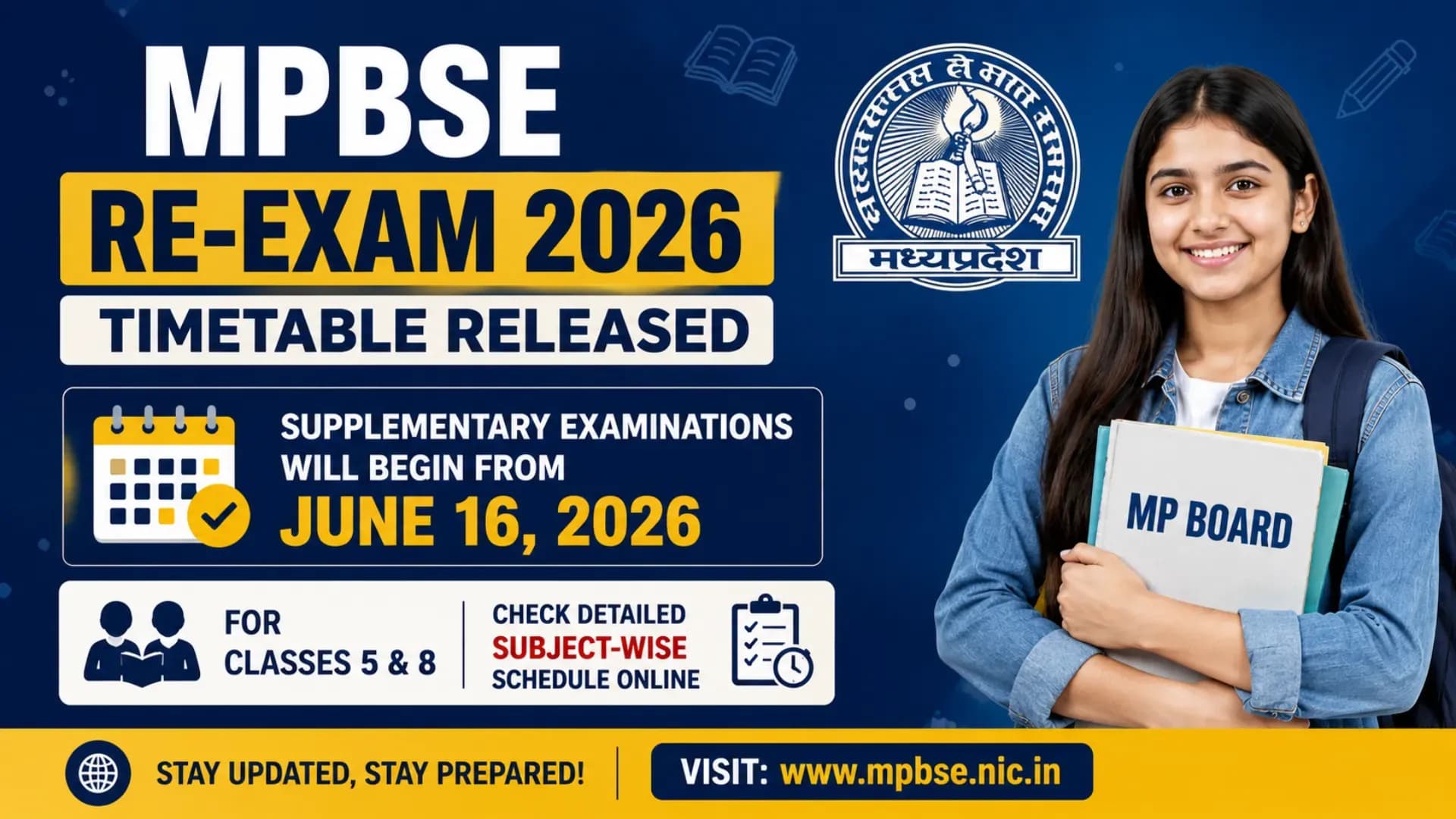
# MP Board Re-Exam 2026 From June 16 for Classes 5, 8; MPBSE Supplementary Timetable Released ```html MP Board Re-Exam 2026 From June 16 for Classes 5, 8; MPBSE Supplementary Timetable Released html { scroll-behavior: smooth; } summary::-webkit-details-marker { display: none; } MP Board Re-Exam 2026 From June 16 for Classes 5, 8; MPBSE Supplementary Timetable Released The MP Board Re-Exam 2026 schedule has been officially announced for students of Classes 5 and 8 across Madhya Pradesh. According to the latest MPBSE supplementary timetable 2026, the re-examinations will begin from June 16 under the supervision of the state education authorities. Students appearing for the MP Board Class 5 re-exam and MP Board Class 8 re-exam can now access the official MPBSE date sheet 2026 through the authorised portals including mpbse.nic.in timetable and RSKMP platforms. The MP Board supplementary exam dates have been finalised for all major subjects and schools have been instructed to complete admit card distribution before the examination window opens. Candidates are advised to regularly track MP Board latest news and updates regarding the RSKMP re-exam schedule, examination centre guidelines, and result declaration timeline. Key Highlights MP Board Re-Exam 2026 for Classes 5 and 8 will begin from June 16 across Madhya Pradesh MPBSE supplementary timetable 2026 released officially with complete subject-wise schedule MP Board Class 5 re-exam and MP Board Class 8 re-exam will be conducted in offline mode MPBSE date sheet 2026 available through official education portals and schools MP Board supplementary exam dates include language, mathematics, science, and social science papers RSKMP re-exam schedule activated for government school candidates across districts Students can check the official mpbse.nic.in timetable for revised updates and notifications All MP Board latest news and examination updates are being tracked on this page Explore This: JEE Mains Exam Guide Why It Matters The MP Board Re-Exam 2026 is an important opportunity for thousands of students who could not secure the minimum qualifying marks in the annual assessment cycle. Through the newly announced MPBSE supplementary timetable 2026, students appearing for the MP Board Class 5 re-exam and MP Board Class 8 re-exam now have a second chance to improve their academic performance without losing an academic year. The release of the official MPBSE date sheet 2026 also helps schools and parents prepare students according to the exact MP Board supplementary exam dates. Education authorities have clarified that the RSKMP re-exam schedule has been designed to ensure smooth conduct across all districts while maintaining evaluation transparency. 🔴 MP Board LIVE Updates — Re-Exam & Supplementary Tracker 📅 MP Board Re-Exam 2026 Begins June 16 The official MP Board Re-Exam 2026 schedule confirms that supplementary examinations for Classes 5 and 8 will commence from June 16. The complete MPBSE supplementary timetable 2026 has been issued to all district education offices and schools. 📄 MPBSE Date Sheet 2026 Released Students appearing in the MP Board Class 5 re-exam and MP Board Class 8 re-exam can now download the revised MPBSE date sheet 2026 from the official portal. Schools have also received printed copies of the MP Board supplementary exam dates. ⏱ RSKMP Re-Exam Schedule Activated The RSKMP re-exam schedule has been activated for government schools across Madhya Pradesh. Students are advised to monitor MP Board latest news and updates at mpbse.nic.in timetable for admit card instructions and examination guidelines. Related News: CUET UG Exam Guide Key Details — MP Board Re-Exam 2026 Particulars Details Exam NameMP Board Re-Exam 2026 Conducting AuthorityMPBSE and State Education Department Classes CoveredClass 5 and Class 8 Exam Start DateJune 16, 2026 Official ScheduleMPBSE supplementary timetable 2026 Official Portalmpbse.nic.in timetable Mode of ExaminationOffline Written Examination StatusTimetable Released How to Download MPBSE Supplementary Timetable 2026 Step 1: Visit the official portal providing the mpbse.nic.in timetable updates Step 2: Click on the link mentioning MP Board Re-Exam 2026 for Classes 5 and 8 Step 3: Open the latest MPBSE supplementary timetable 2026 PDF Step 4: Check your subject-wise MP Board supplementary exam dates Step 5: Download and print the official MPBSE date sheet 2026 for future reference Step 6: Follow all updates related to the RSKMP re-exam schedule and admit card release Also Read: KEAM 2026 Admit Card LIVE: Release Date, Physics Topics & Weightage 📌 Expert Analysis Education experts believe the MP Board Re-Exam 2026 provides students with a meaningful second opportunity to improve learning outcomes before promotion decisions are finalised. The release of the MPBSE supplementary timetable 2026 well in advance gives students adequate preparation time. Officials have also stated that the MP Board Class 5 re-exam and MP Board Class 8 re-exam will follow the same syllabus pattern used in the annual assessment cycle. Analysts tracking MP Board latest news suggest that students should regularly verify updates through the official mpbse.nic.in timetable page instead of relying on unofficial sources. Since the RSKMP re-exam schedule may receive district-level logistical adjustments, schools are expected to communicate any centre-specific changes directly to students. 🎓 One Form · Multiple Colleges Stop Stressing. Start Applying. Skip the chaos of filling endless forms. Apply to your dream colleges in one go through the College Nirnay Common Application Form — built for every student navigating India's competitive education landscape. Fill the Common Application Form → ✓ Free to apply · ✓ Takes under 5 minutes · ✓ Trusted by thousands of students FAQs Q1. When will MP Board Re-Exam 2026 begin? The MP Board Re-Exam 2026 for Classes 5 and 8 will begin from June 16 according to the official MPBSE supplementary timetable 2026. Q2. Where can students check the MPBSE date sheet 2026? Students can check the official MPBSE date sheet 2026 and mpbse.nic.in timetable updates through the official MPBSE portal and school notices. Q3. Which classes are covered under the MP Board supplementary exam dates? The announced MP Board supplementary exam dates apply to students appearing in the MP Board Class 5 re-exam and MP Board Class 8 re-exam. Q4. What is the RSKMP re-exam schedule? The RSKMP re-exam schedule refers to the supplementary examination schedule implemented for government schools under the Rajya Shiksha Kendra system in Madhya Pradesh. Q5. Where can students track MP Board latest news? Students should regularly monitor official notifications and MP Board latest news updates through school authorities and the official MPBSE portal. Related News / Articles Best Free AI Tools for Students in 2026 High-Income Tech Skills Without Programming Top AI Skills Students Must Learn in 2026 Top B.Tech Colleges in India 2026 Explore More Karnataka 2nd PUC Result Date TS INTER RESULT DATE KEAM ADMIT CARD 2026 JEE Advanced 2026 Registration GPAT Result 2026 LIVE CUET PG Response Sheet Rajasthan BSTC 2026 Notification UGC Releases New Guidelines Stay connected for all MP Board latest news, including updates on the MP Board Re-Exam 2026, revised MPBSE supplementary timetable 2026, result announcements, and official notices regarding the MP Board supplementary exam dates and RSKMP re-exam schedule. ```

Maharashtra FYJC Admission 2026 LIVE — Class 11 CAP Round 1 Allotment Today at 11 AM html { scroll-behavior:smooth; } summary::-webkit-details-marker { display:none; } Maharashtra FYJC Admission 2026 LIVE: Class 11 CAP Round 1 Allotment Today at 11 AM The Maharashtra FYJC Admission 2026 process has entered a crucial phase as the FYJC CAP Round 1 allotment result will be released today at 11 AM on the official portal. Students seeking Class 11 admission Maharashtra can check their allotment status online through the official portal and download the allotment confirmation once the FYJC admission result becomes active. The FYJC merit list 2026, category-wise cutoff trends, and college-wise admission status will also be available alongside the allotment announcement. Students participating in junior college admission Maharashtra counselling should regularly monitor the portal for the latest FYJC live updates, admission confirmation dates, and document verification instructions. Key Highlights Maharashtra FYJC Admission 2026 CAP Round 1 allotment releasing today at 11 AM FYJC CAP Round 1 allotment available online through the official admission portal FYJC merit list 2026 and college-wise allocation data released alongside allotment Students can check Class 11 admission Maharashtra allotment using login credentials mahafyjcadmissions.in allotment portal expected to witness heavy traffic after activation FYJC admission result includes allotted college name, stream, and quota details Maharashtra 11th admission confirmation process begins immediately after allotment FYJC cutoff 2026 for Science, Commerce, and Arts streams to be published junior college admission Maharashtra process will continue through multiple CAP rounds Track all FYJC live updates regarding admission confirmation and vacant seats Explore This: JEE Mains Exam Guide 🔴 FYJC LIVE Updates — CAP Round 1 Allotment Tracker 📅 FYJC CAP Round 1 Allotment Today The FYJC CAP Round 1 allotment for Maharashtra FYJC Admission 2026 will officially be activated today at 11 AM. Students participating in the Class 11 admission Maharashtra process can check their allotment through the official portal once the result link becomes live. The FYJC admission result will display allotted college details, stream selection, and category information. 📄 FYJC Merit List 2026 Released The official FYJC merit list 2026 has been published along with the admission allocation data. Students applying for junior college admission Maharashtra can compare their marks and category positions against the published merit trends. The FYJC cutoff 2026 for top Science and Commerce colleges is expected to remain highly competitive this year. ⏱ Admission Confirmation Begins Students allotted seats through the mahafyjcadmissions.in allotment portal must complete online confirmation and document verification within the prescribed schedule. The Maharashtra 11th admission process requires candidates to verify admission documents and confirm seats before the deadline. Follow all FYJC live updates for revised schedules and reporting instructions. Related News: CUET UG Exam Guide Key Details — Maharashtra FYJC Admission 2026 Particulars Details Admission Process Maharashtra FYJC Admission 2026 Current Phase FYJC CAP Round 1 allotment Result Time Today at 11 AM Official Website mahafyjcadmissions.in allotment portal Merit List FYJC merit list 2026 available online Admission Type Class 11 admission Maharashtra Streams Available Science, Commerce, Arts Cutoff Release FYJC cutoff 2026 released with allotment Admission Confirmation Starts immediately after allotment result Next Phase Vacancy display and Round 2 counselling Also Read: KEAM 2026 Admit Card LIVE: Release Date, Physics Topics & Weightage How to Check FYJC CAP Round 1 Allotment 2026 Step 1 — Visit the official portal: Open the official mahafyjcadmissions.in allotment website for the Maharashtra FYJC Admission 2026 process. Step 2 — Login with credentials: Enter your registered ID and password used during the Maharashtra 11th admission application process. Step 3 — Check allotment result: Click on the FYJC CAP Round 1 allotment result link to access your admission status. Step 4 — Download allotment letter: Students selected through the FYJC admission result can download their allotment confirmation for future admission formalities. Step 5 — Verify FYJC cutoff 2026: Compare your admission against the published FYJC cutoff 2026 and category-wise merit trends. Step 6 — Complete admission confirmation: Students participating in junior college admission Maharashtra must complete document verification and fee payment within the deadline. ⚠️ Important: Students who fail to confirm admission after the FYJC CAP Round 1 allotment may lose their allotted seat during the Maharashtra FYJC Admission 2026 process. Keep checking official FYJC live updates for reporting deadlines and vacancy announcements. 🎓 One Form · Multiple Colleges Stop Stressing. Start Applying. Skip the chaos of filling endless forms. Apply to your dream colleges in one go through the College Nirnay Common Application Form — built for every student navigating India's competitive education landscape. Fill the Common Application Form → ✓ Free to apply · ✓ Takes under 5 minutes · ✓ Trusted by thousands of students FAQs Q1. When will the FYJC CAP Round 1 allotment be released? The FYJC CAP Round 1 allotment for Maharashtra FYJC Admission 2026 will be released today at 11 AM through the official portal. Students can check the allotment using their login credentials. Q2. Where can I check the FYJC admission result? Students can check the FYJC admission result through the official mahafyjcadmissions.in allotment portal. The website will host the complete Maharashtra 11th admission allotment details. Q3. Is the FYJC merit list 2026 available? Yes, the official FYJC merit list 2026 has been released along with the allotment information. Students can compare their scores with the published cutoff and admission trends. Q4. What happens after the allotment result? After the FYJC CAP Round 1 allotment, students must complete document verification, fee payment, and admission confirmation for successful junior college admission Maharashtra. Q5. Will there be more counselling rounds? Yes, additional counselling rounds will be conducted after the completion of the current Maharashtra FYJC Admission 2026 allotment cycle depending on vacant seats and admission confirmations. Related News / Articles Best Free AI Tools for Students in 2026 High-Income Tech Skills Without Programming Top AI Skills Students Must Learn in 2026 Top B.Tech Colleges in India 2026 Explore More Karnataka 2nd PUC Result Date TS INTER RESULT DATE KEAM ADMIT CARD 2026 JEE Advanced 2026 Registration GPAT Result 2026 LIVE CUET PG Response Sheet Rajasthan BSTC 2026 Notification UGC Releases New Guidelines Stay connected for all FYJC live updates regarding Maharashtra FYJC Admission 2026, revised admission schedules, FYJC cutoff 2026, vacancy rounds, and complete Class 11 admission Maharashtra counselling coverage.
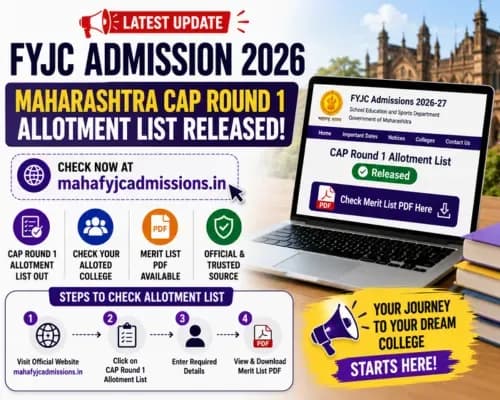
FYJC Admission 2026: Maharashtra CAP Round 1 Allotment List Released at mahafyjcadmissions.in html { scroll-behavior: smooth; } summary::-webkit-details-marker { display: none; } FYJC Admission 2026: Maharashtra CAP Round 1 Allotment List Released at mahafyjcadmissions.in — Check Merit List PDF Here The FYJC CAP Round 1 Allotment List for FYJC Admission 2026 has been officially released by the Maharashtra School Education Department on the centralised admission portal at mahafyjcadmissions.in. Students who registered for Maharashtra FYJC Admission and participated in the Common Admission Process can now check their FYJC College Allotment status at mahafyjcadmissions.in using their application credentials — and download the FYJC Merit List PDF available on the same portal. The FYJC Round 1 Result shows each student's allotted college, stream, and division based on their Class 10 SSC percentage and preference list submitted during the CAP registration process. Students who receive a FYJC College Allotment in Round 1 must confirm their admission within the specified deadline — failing to do so may result in cancellation of the allotted seat. All FYJC Admission Updates on the Round 1 confirmation process, document submission requirements, and Round 2 schedule are tracked on this page. Key Highlights FYJC CAP Round 1 Allotment List released at mahafyjcadmissions.in — check your allotted college, stream, and division now FYJC Merit List PDF available for download at mahafyjcadmissions.in — college-wise and stream-wise merit lists published FYJC Round 1 Result based on SSC Class 10 percentage and preference list order submitted during CAP registration Students allotted a seat must confirm FYJC College Allotment before the Round 1 confirmation deadline — unconfirmed seats are cancelled Students not allotted a seat in Round 1 or unsatisfied with allotment can participate in FYJC Admission 2026 Round 2 — schedule at mahafyjcadmissions.in Maharashtra Junior College Admission covers Science, Commerce, and Arts streams across government, aided, and unaided junior colleges Document verification at allotted college is mandatory within the confirmation window — carry originals and self-attested copies All FYJC Admission Updates — confirmation deadline, Round 2 schedule, document checklist — tracked on this page Explore This: JEE Mains Exam Guide Why It Matters The FYJC CAP Round 1 Allotment List is the first concrete outcome of a process that began with every Class 10 SSC student's board result — and for the nearly six lakh students participating in Maharashtra FYJC Admission 2026 across Mumbai, Pune, Nashik, Aurangabad, and other districts, the FYJC Round 1 Result determines the first and often the most important college allotment available to them. For students allotted a top-preference government or aided college, the Round 1 result is a career-shaping outcome that must be confirmed immediately. For students allotted a college lower on their preference list or not allotted at all, the FYJC Admission Updates on Round 2 and subsequent rounds provide a defined path forward. The Maharashtra Junior College Admission process is entirely deadline-driven — missing the Round 1 confirmation window or the Round 2 registration window has direct academic consequences that no amount of appeal can fully remedy after the fact. The time to act on the FYJC CAP Round 1 Allotment List is now. 🔴 FYJC Admission Updates — CAP Round 1 Allotment LIVE Tracker 📅 FYJC CAP Round 1 Allotment List Released FYJC CAP Round 1 Allotment List is officially live at mahafyjcadmissions.in. The Maharashtra School Education Department has activated the Round 1 allotment results for all participating districts — Mumbai, Pune, Nashik, Aurangabad, Nagpur, and others — under the centralised Maharashtra FYJC Admission process. Students can log in at mahafyjcadmissions.in using their application ID and password to view their individual FYJC College Allotment details — the allotted college name, stream (Science, Commerce, Arts), division, and seat category. All FYJC Admission Updates on the confirmation window closing time and next steps are tracked on this page. 📄 FYJC Merit List PDF — College-wise and Stream-wise The FYJC Merit List PDF for CAP Round 1 is available at mahafyjcadmissions.in in college-wise and stream-wise format — listing all students allotted to each college under the FYJC Admission 2026 process, ranked by SSC percentage within each stream and category. Students who want to compare their allotment position against the merit cut-offs for their preferred colleges — particularly for Science stream in government and high-demand aided colleges — should download the FYJC Merit List PDF and review closing percentages across colleges in their district. This data is essential for deciding whether to confirm the Round 1 allotment or participate in Round 2 with revised preferences. 🏫 FYJC College Allotment — What the Result Shows The FYJC Round 1 Result at mahafyjcadmissions.in shows each student's allotted college name, the stream (Science/Commerce/Arts), the division (English/Semi-English/Marathi medium), and the admission category under which the seat was allotted (Open, OBC, SC, ST, VJNT, SBC, EWS, or other). Students should verify all allotment details carefully — particularly stream and medium — against their intended course of study. Any discrepancy between the allotted details and the registered preference should be flagged to the CAP cell at mahafyjcadmissions.in immediately before the confirmation deadline, as post-deadline corrections are not guaranteed. ⏱ Round 1 Confirmation Deadline — Act Immediately Students allotted a seat in the FYJC CAP Round 1 Allotment List must confirm their FYJC College Allotment — by visiting the allotted college with original documents, completing verification, and paying the first instalment of fees — within the confirmation window published at mahafyjcadmissions.in. The exact deadline is specified in each student's individual allotment letter. Unconfirmed seats in FYJC Admission 2026 Round 1 are automatically released for Round 2 — and a student who misses the Round 1 confirmation deadline forfeits the allotted college without any guaranteed alternative. Check the deadline at mahafyjcadmissions.in and act today. Track all FYJC Admission Updates here. Related News: CUET UG Exam Guide Key Details — FYJC CAP Round 1 Allotment List 2026 Particulars Details Process NameFirst Year Junior College (FYJC) Common Admission Process (CAP) 2026 — Maharashtra Conducting AuthorityMaharashtra School Education Department — Centralised Admission Committee FYJC CAP Round 1 Allotment List StatusReleased — Available at mahafyjcadmissions.in FYJC Merit List PDFCollege-wise & Stream-wise Merit List — Download at mahafyjcadmissions.in Allotment BasisSSC Class 10 Percentage + Preference Order + Category — Per CAP Rules Streams CoveredScience · Commerce · Arts — English / Semi-English / Marathi Medium Round 1 ConfirmationVisit Allotted College with Original Documents + Pay Fees — Within Deadline Unconfirmed Seat ActionSeat Cancelled — Released for Round 2 — No Extension Guaranteed Round 2 ScheduleAfter Round 1 Confirmation Closes — Check mahafyjcadmissions.in for Dates Documents RequiredSSC Marksheet · School Leaving Certificate · Aadhar · Category Certificate (if applicable) · Passport Photos Official Portalmahafyjcadmissions.in — All allotment letters, merit lists, circulars How to Check FYJC CAP Round 1 Allotment List & Download Merit List PDF at mahafyjcadmissions.in Step 1 — Visit mahafyjcadmissions.in directly: Access the official Maharashtra FYJC Admission portal at mahafyjcadmissions.in — do not use third-party websites or links shared on social media, which may redirect to unofficial pages. The official portal is the only authoritative source for the FYJC CAP Round 1 Allotment List and FYJC Merit List PDF Step 2 — Log in with your CAP application credentials: Enter your application ID (login ID) and password registered during the FYJC Admission 2026 CAP process. If you have forgotten your password, use the password reset option at mahafyjcadmissions.in using your registered mobile number before the allotment deadline — do not wait until the last day Step 3 — Access and review your FYJC Round 1 Result: From your candidate dashboard at mahafyjcadmissions.in, access the Round 1 allotment result. Read every detail carefully — allotted college name, stream, division (English/Semi-English/Marathi medium), seat category, and any special condition mentioned. Cross-check the allotted details against your preference list Step 4 — Download and save your FYJC College Allotment letter: Download your individual allotment letter from mahafyjcadmissions.in immediately — save it to your phone, email, and cloud storage. This letter is the mandatory document required for reporting to your allotted junior college for confirmation. Do not close the page before downloading Step 5 — Download the FYJC Merit List PDF for your district: Access the FYJC Merit List PDF section at mahafyjcadmissions.in and download the merit list for your district and preferred colleges — review the closing percentages for Science, Commerce, and Arts streams to understand where your allotment places you relative to the cut-off and whether higher-preference colleges might be accessible in Round 2 Step 6 — Decide: Confirm Round 1 allotment or participate in Round 2: Based on your FYJC Round 1 Result and the FYJC Merit List PDF data, make an informed decision about whether to confirm your current allotment or opt for Round 2. Guidance on this decision is covered in the BONUS section below — read it carefully before deciding Step 7 — If confirming Round 1: Visit allotted college immediately with documents: To confirm your FYJC College Allotment, visit your allotted junior college in person within the confirmation window, submit your original documents for verification, pay the first instalment of fees as specified, and collect your confirmation receipt. Confirmation is only completed in-person at the college — online-only confirmation is not available under the current Maharashtra FYJC Admission process Step 8 — If not confirming Round 1: Register for Round 2 preferences before the deadline: Students who choose not to confirm a Round 1 allotment, or who were not allotted a seat in Round 1, must register their revised preference list for Round 2 at mahafyjcadmissions.in before the Round 2 registration deadline. The Round 2 schedule will be published at mahafyjcadmissions.in — monitor FYJC Admission Updates on this page for the confirmed dates ⚠️ Confirm Before the Deadline — No Extensions Are Guaranteed: The FYJC CAP Round 1 Allotment List confirmation window is strictly time-bound. Students who do not confirm their FYJC College Allotment by the specified deadline at mahafyjcadmissions.in — even by a single day — automatically lose the allotted seat. That seat is then released for Round 2 candidates. No extension requests are entertained after the deadline closes. If you are confirming your Round 1 allotment, visit your allotted college today — not on the last day — to avoid the inevitable rush and the risk of document-related delays on the final day. Also Read: KEAM 2026 Admit Card LIVE: Release Date, Physics Topics & Weightage Complete Guide — FYJC Admission 2026: What to Do After the CAP Round 1 Allotment List, Confirmation Strategy & Round 2 Planning The FYJC CAP Round 1 Allotment List release triggers a 48 to 72-hour decision window that is one of the most consequential in the entire Maharashtra FYJC Admission process — and most students make the Round 1 confirmation or Round 2 decision without a clear framework. Here is the complete guide to making this decision correctly. Should You Confirm Your Round 1 Allotment or Wait for Round 2? Confirm Round 1 immediately if: You have been allotted your first or second preference college and stream — particularly a government or high-demand aided college in your district. Top-preference allotments in Round 1 are the strongest outcomes the FYJC Admission 2026 process produces and should be confirmed without hesitation. The risk of forgoing a Round 1 top-preference allotment in the hope of a better Round 2 outcome is almost never worth taking — Round 2 allotments depend on what the Round 1 non-confirmers and new applicants generate as availability, which is inherently unpredictable Confirm Round 1 with a conditional upgrade plan if: You have been allotted a college that is acceptable but not your top preference — and your FYJC Merit List PDF analysis shows that your SSC percentage is close to the closing percentage of a higher-preference college from last year. In this case, confirm the Round 1 allotment (securing your current seat) while also participating in Round 2 with your higher-preference college at the top of your revised list. Under Maharashtra CAP rules, if you are allotted a better college in Round 2, your Round 1 seat is automatically cancelled and the Round 2 allotment takes precedence — you cannot hold both simultaneously Do not confirm Round 1 only if: The allotted college is significantly below your last preference — meaning you would genuinely prefer any Round 2 or subsequent round outcome over the Round 1 result. This is a high-risk decision because forgoing Round 1 without a confirmed alternative leaves you dependent on Round 2 availability, which may not produce a better outcome. Make this decision only after carefully reviewing the FYJC Merit List PDF closing percentages and having a realistic assessment of your chances in Round 2 based on your SSC percentage Regardless of your decision, register for Round 2: All students — whether or not they confirm a Round 1 allotment — should register their updated preference list for Round 2 at mahafyjcadmissions.in before the Round 2 deadline. Participation in Round 2 is the safety net. Missing Round 2 registration forfeits your opportunity for any improvement — and the Round 2 registration window at mahafyjcadmissions.in is typically very short Documents Required for FYJC College Allotment Confirmation — Complete Checklist FYJC CAP Round 1 Allotment Letter — printed copy from mahafyjcadmissions.in (mandatory — carry this to the college) SSC Class 10 Marksheet — original + 2 self-attested photocopies (the primary merit document for Maharashtra Junior College Admission) School Leaving Certificate (SLC / Transfer Certificate) — original issued by your Class 10 school — this is the most commonly forgotten document and its absence prevents confirmation on that day Aadhaar Card — original + photocopy (identity and address proof) Category Certificate — if you were allotted under a reserved category (OBC/SC/ST/VJNT/SBC/EWS), carry the original caste/income certificate issued by the competent authority. Expired or incorrectly issued certificates will be rejected — verify validity before visiting Passport-size photographs — 4 to 6 recent photographs as required by the allotted college Fee payment — confirm the first instalment fee amount with your allotted college before visiting — carry cash and/or digital payment options as accepted by that specific college Migration Certificate — if you appeared for SSC from a board other than Maharashtra SSC Board (CBSE, ICSE, State board from another state), a migration certificate from your previous board is required for Maharashtra Junior College Admission confirmation Stream-wise Priority Framework for Round 2 Preference Building For students participating in the FYJC Admission 2026 Round 2 process — whether upgrading from Round 1 or starting fresh — the FYJC Merit List PDF from Round 1 is the most important data source for building an effective preference list. Use the Round 1 closing percentages for each college and stream as your reference — colleges where the Round 1 closing cut-off was very close to your SSC percentage (within 1 to 2%) are realistic Round 2 targets where seat availability from non-confirmers may create an opening. For Science stream, focus your top preferences on government colleges and NEET-preparatory affiliated colleges where infrastructure and faculty quality are verified. For Commerce stream, aided colleges with strong BMS and BAF faculty connections are the priority. For Arts stream, colleges with strong research culture and university-affiliated programme access deserve priority over brand recognition alone. Build your Round 2 list at mahafyjcadmissions.in with at least 8 to 10 preferences across a realistic range — all aspirational, competitive, and secure options — rather than listing only 3 to 4 and leaving yourself exposed to an unacceptable Round 2 outcome. What's Next — FYJC Admission 2026 Full CAP Timeline The FYJC Admission 2026 CAP process follows a defined multi-round sequence that every student must track carefully at mahafyjcadmissions.in. The Round 1 confirmation window closes at the published deadline — all unconfirmed seats are then pooled with residual vacancies to create Round 2 availability. Round 2 preference registration and allotment follow, with another confirmation window. Maharashtra CAP typically runs three to four allotment rounds before the process concludes with an in-house admission round at individual junior colleges for remaining vacant seats. Students who are not allotted a seat in any CAP round or who choose not to participate can seek admission through the In-House process at colleges with remaining vacancies — this process also runs through mahafyjcadmissions.in and individual college portals. The complete Maharashtra Junior College Admission CAP schedule — including Round 2 preference registration dates, Round 2 allotment date, confirmation window, and subsequent rounds — will be published at mahafyjcadmissions.in as each phase opens. All FYJC Admission Updates on the Round 2 schedule, preference registration opening, and allotment dates will be tracked on this page. 📌 Expert Analysis Education counsellors and student guidance specialists who work with Maharashtra Class 10 students annually identify three consistently recurring errors in the FYJC CAP Round 1 Allotment List response period — each of which costs students avoidable academic disadvantage. The first is delaying the confirmation decision until the final day of the window, which creates a predictable document rush and queue at the allotted college that turns a straightforward confirmation into a stressful multi-hour experience. The second is deciding to forgo a good Round 1 allotment based on the hope of an unresearched Round 2 improvement — without using the FYJC Merit List PDF data to assess whether the hoped-for upgrade is statistically realistic. The third is failing to register for Round 2 preferences even after confirming Round 1 — losing the upgrade opportunity that Round 2 provides at no cost to the confirmed seat. The most effective approach to the FYJC Admission 2026 Round 1 result period, as consistently confirmed by students who navigate the Maharashtra Junior College Admission process successfully, is: download the FYJC Merit List PDF today, spend two hours analyzing the data against your preferences, make the confirmation or Round 2 decision by tomorrow, visit the allotted college the day after if confirming, and register for Round 2 preferences regardless of whether you confirmed Round 1. This four-step, three-day sequence uses the available time efficiently and protects against all three of the common errors. Monitor all FYJC Admission Updates at mahafyjcadmissions.in and on this page to stay ahead of every deadline in the remaining CAP rounds. 🎓 One Form · Multiple Colleges Stop Stressing. Start Applying. Skip the chaos of filling endless forms. Apply to your dream colleges in one go through the College Nirnay Common Application Form — built for every student navigating India's competitive education landscape. Fill the Common Application Form → ✓ Free to apply · ✓ Takes under 5 minutes · ✓ Trusted by thousands of students FAQs Q1. Where can I check the FYJC CAP Round 1 Allotment List? The FYJC CAP Round 1 Allotment List is available at the official Maharashtra FYJC Admission portal mahafyjcadmissions.in. Log in using your CAP application ID and password to access your individual FYJC College Allotment details — including the allotted college name, stream, division, and category. The FYJC Merit List PDF for your district is also downloadable from the same portal under the merit list section. Use only the official portal — do not rely on third-party websites for allotment information. Q2. What documents do I need to carry for FYJC Round 1 allotment confirmation? For FYJC Admission 2026 Round 1 confirmation at your allotted college, carry: the printed FYJC CAP Round 1 Allotment List letter from mahafyjcadmissions.in, original SSC Class 10 marksheet with photocopies, original School Leaving Certificate (SLC/Transfer Certificate), Aadhaar card (original + photocopy), category certificate if allotted under a reserved category, passport-size photographs (4 to 6), and the first instalment fee payment. Carry all originals and self-attested photocopies — colleges do not accept photocopies alone for initial document verification under the Maharashtra Junior College Admission process. Q3. Can I participate in FYJC Round 2 even after confirming Round 1 allotment? Yes — students who confirm their Round 1 FYJC College Allotment can still register for Round 2 preferences at mahafyjcadmissions.in if they wish to be considered for a higher-preference college. Under Maharashtra FYJC Admission CAP rules, if you receive a better allotment in Round 2, your Round 1 confirmed seat is automatically cancelled and replaced by the Round 2 allotment. You cannot hold both simultaneously. This means confirming Round 1 while registering for Round 2 is the safest strategy — you secure your current allotment while remaining in contention for improvement. Monitor FYJC Admission Updates for the Round 2 preference registration window at mahafyjcadmissions.in. Q4. What happens if I do not confirm my FYJC Round 1 allotment by the deadline? If you do not confirm your FYJC CAP Round 1 Allotment List seat by the specified deadline at mahafyjcadmissions.in, the allotted seat is automatically cancelled — it is released into the Round 2 pool for allotment to other students. Your FYJC College Allotment is forfeited without any guaranteed alternative. No extension requests are entertained after the deadline. You can still participate in Round 2, but you will have no secured seat from Round 1. If you are considering confirming your current allotment, act today — do not wait for the last day of the confirmation window. Q5. How is the FYJC Merit List 2026 and allotment determined under Maharashtra CAP? The FYJC Merit List 2026 and FYJC CAP Round 1 Allotment List are computed based on three primary factors: your SSC Class 10 aggregate percentage (the primary merit criterion), your ranked preference list submitted during CAP registration (determining which college you are considered for at your merit position), and your admission category (Open, OBC, SC, ST, VJNT, SBC, EWS — each category has reserved seat quotas within every college). The system allots the highest-preference college for which a seat is available at your percentage and category. The FYJC Merit List PDF at mahafyjcadmissions.in shows the closing percentage (last student allotted) for each college and stream — use this to assess your position in Round 2 for any college on your updated preference list. Related News / Articles Best Free AI Tools for Students in 2026 High-Income Tech Skills Without Programming Top AI Skills Students Must Learn in 2026 Top B.Tech Colleges in India 2026 Explore More Karnataka 2nd PUC Result Date TS INTER RESULT DATE KEAM ADMIT CARD 2026 JEE Advanced 2026 Registration GPAT Result 2026 LIVE CUET PG Response Sheet Rajasthan BSTC 2026 Notification UGC Releases New Guidelines Stay with College Nirnay for all FYJC Admission Updates — including FYJC CAP Round 1 Allotment List confirmation deadline reminders, FYJC Merit List PDF analysis, Round 2 preference registration dates, FYJC Round 1 Result cut-off data, and the complete Maharashtra FYJC Admission CAP schedule — as your definitive source for FYJC Admission 2026 and Maharashtra Junior College Admission coverage at mahafyjcadmissions.in.
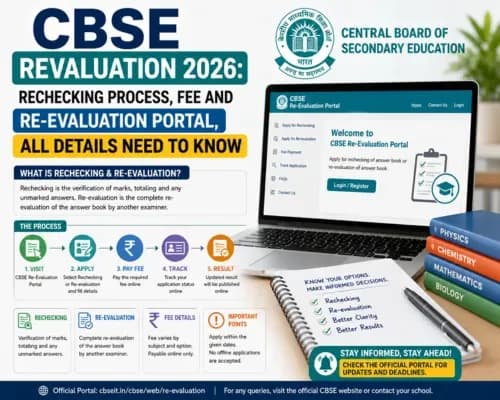
CBSE Revaluation 2026: Rechecking Process, Fee and Re-Evaluation Portal, All Details Need to Know The CBSE Revaluation 2026 process is expected to begin shortly after the declaration of CBSE Class 10 and Class 12 board results. Students dissatisfied with their marks can apply through the official CBSE Re-evaluation Portal for answer sheet verification, photocopy access, and rechecking requests. The complete CBSE Rechecking Process includes multiple stages — verification of marks, obtaining a photocopy of the evaluated answer sheet, and applying for subject-wise re-evaluation. According to previous CBSE Latest Updates, students must complete the application process within the prescribed deadline through the official CBSE Student Portal. The board generally releases separate schedules for CBSE 10th Revaluation 2026 and CBSE 12th Revaluation 2026. Students are advised to check the official notification regarding the CBSE Revaluation Fee, important dates, and document submission requirements before applying. Key Highlights CBSE Revaluation 2026 process starts after board result declaration The complete CBSE Rechecking Process includes verification, photocopy access, and re-evaluation Applications will be accepted through the official CBSE Re-evaluation Portal Separate schedules expected for CBSE 10th Revaluation 2026 and CBSE 12th Revaluation 2026 Students can request a CBSE Photocopy of Answer Sheet before re-evaluation The board will release updated CBSE Revaluation Fee details officially Students must complete CBSE Revaluation Apply Online before the last date Latest CBSE Education News and official notices will clarify important deadlines Explore This: JEE Mains Exam Guide CBSE Rechecking Process Explained The official CBSE Rechecking Process generally occurs in three stages. First, students apply for CBSE Result Verification 2026, where the board checks whether marks were totaled correctly and whether any answer remained unevaluated. After verification, students may request a CBSE Photocopy of Answer Sheet to review the evaluation details personally. Once students receive the photocopy, they can proceed with CBSE Revaluation Apply Online for specific questions if they identify discrepancies in evaluation. The board then reviews those answers under the official CBSE Result Correction Process. Any increase or decrease in marks after re-evaluation becomes final and is updated in official records. Important: Students should carefully review the official CBSE Revaluation Last Date because late applications are generally not accepted after portal closure. Related News: CUET UG Exam Guide CBSE Revaluation 2026 — Important Details Particulars Details Process Name CBSE Revaluation 2026 Portal Official CBSE Re-evaluation Portal Classes Covered CBSE 10th Revaluation 2026 & CBSE 12th Revaluation 2026 Stages Verification → Photocopy → Re-evaluation Verification Purpose CBSE Mark Verification and totaling check Photocopy Access CBSE Photocopy of Answer Sheet available online Fee Structure Subject-wise CBSE Revaluation Fee applicable Application Mode CBSE Revaluation Apply Online Official Updates Available via CBSE Latest Updates and CBSE Education News Expert Analysis Education experts advising students on CBSE Board Exam 2026 results recommend applying for revaluation only after reviewing the photocopy of the answer sheet carefully. The official CBSE Rechecking Process is primarily designed to correct evaluation errors rather than improve marks through moderation. Many students confuse CBSE Mark Verification with complete answer re-evaluation. Verification checks totaling and unevaluated answers, while re-evaluation involves reassessing selected answers in the answer sheet. Students should therefore understand each stage of the CBSE Result Correction Process before submitting requests. Experts also suggest monitoring official CBSE Latest Updates regularly because timelines for the CBSE Re-evaluation Portal, fee payment, and result revision may change each year. 🎓 One Form · Multiple Colleges Stop Stressing. Start Applying. Skip the chaos of filling endless forms. Apply to your dream colleges in one go through the College Nirnay Common Application Form — built for every student navigating India's competitive education landscape. Fill the Common Application Form → ✓ Free to apply · ✓ Takes under 5 minutes · ✓ Trusted by thousands of students FAQs What is CBSE Revaluation 2026? CBSE Revaluation 2026 allows students to apply for answer sheet verification, photocopy access, and question-wise re-evaluation after the declaration of board exam results. How can students apply for CBSE rechecking? Students can complete CBSE Revaluation Apply Online through the official CBSE Re-evaluation Portal within the prescribed deadline. What is the CBSE Revaluation Fee? The official CBSE Revaluation Fee varies depending on verification, photocopy requests, and re-evaluation services. Students should check the latest notification before applying. Can marks increase after CBSE re-evaluation? Yes, marks may increase, decrease, or remain unchanged after the official CBSE Result Correction Process. The revised marks become final after re-evaluation. Related News / Articles Best Free AI Tools for Students in 2026 High-Income Tech Skills Without Programming Top AI Skills Students Must Learn in 2026 Top B.Tech Colleges in India 2026 Explore More Karnataka 2nd PUC Result Date TS INTER RESULT DATE KEAM ADMIT CARD 2026 JEE Advanced 2026 Registration GPAT Result 2026 LIVE CUET PG Response Sheet Rajasthan BSTC 2026 Notification UGC Releases New Guidelines Stay connected for more CBSE Latest Updates, complete guides on the CBSE Rechecking Process, official notifications regarding the CBSE Re-evaluation Portal, and all important announcements related to CBSE Revaluation 2026 and CBSE Board Exam 2026. ```

COMEDK Result 2026 LIVE: Download Rankcard Today at 4 PM at comedk.org The COMEDK Result 2026 will be officially released today at 4 PM on the official portal comedk.org result. Candidates who appeared for the Undergraduate Entrance Test can access the COMEDK UGET result live updates and complete their COMEDK scorecard download directly from the official website. The COMEDK rank card 2026 will include candidate scores, ranks, and qualifying details required for the upcoming COMEDK counselling 2026 process. Students awaiting the COMEDK result time should keep their application credentials ready to access the COMEDK rank list and begin preparation for Karnataka engineering admission. Key Highlights COMEDK Result 2026 releasing today at official comedk.org result portal COMEDK result time officially confirmed for 4 PM COMEDK rank card 2026 available for download online Access COMEDK UGET result live updates throughout the day COMEDK scorecard download required for counselling registration COMEDK counselling 2026 schedule expected soon after result declaration COMEDK cutoff 2026 will vary by branch and participating colleges COMEDK rank list determines seat allotment in participating institutes Important update for Karnataka engineering admission candidates Explore This: JEE Mains Exam Guide 🔴 COMEDK UGET Result LIVE Updates 📅 Result Release Today The COMEDK Result 2026 will be activated at the official comedk.org result portal at the announced COMEDK result time of 4 PM. Candidates can access the COMEDK UGET result live updates and begin their COMEDK scorecard download immediately after activation. 📄 Rank Card Download The COMEDK rank card 2026 will contain candidate marks, overall rank, and qualifying status. Students must complete the COMEDK scorecard download from comedk.org result before the start of COMEDK counselling 2026. 🎓 Counselling & Admission Updates The COMEDK rank list will play a critical role in Karnataka engineering admission across participating private engineering colleges. Experts expect the COMEDK cutoff 2026 to remain competitive for Computer Science, AI, and Electronics branches during COMEDK counselling 2026. Related News: CUET UG Exam Guide Why COMEDK Result 2026 Matters The COMEDK Result 2026 is one of the most important gateways for students seeking Karnataka engineering admission in private engineering colleges. The COMEDK rank card 2026 determines eligibility for seat allotment during COMEDK counselling 2026. Candidates tracking the COMEDK UGET result live updates should also monitor expected COMEDK cutoff 2026 trends and analyse the previous year COMEDK rank list data to improve counselling strategy. COMEDK Result 2026 — Key Details Particulars Details Exam Name COMEDK UGET 2026 Result Name COMEDK Result 2026 Official Website comedk.org result COMEDK Result Time 4 PM Today Document Available COMEDK rank card 2026 Required For COMEDK counselling 2026 Admission Process Karnataka engineering admission Also Read: KEAM 2026 Admit Card LIVE: Release Date, Physics Topics & Weightage How to Download COMEDK Rank Card 2026 Visit official comedk.org result portal Click on COMEDK Result 2026 link Login using application number and password Access COMEDK UGET result live dashboard Complete COMEDK scorecard download Save and print your COMEDK rank card 2026 Prepare documents for COMEDK counselling 2026 ⚠ Important: Candidates should complete the COMEDK scorecard download immediately after the declared COMEDK result time to avoid website traffic issues at comedk.org result. 📌 Expert Analysis Experts tracking the COMEDK Result 2026 believe competition for top engineering branches remains intense this year. The COMEDK cutoff 2026 for Computer Science and AI-related branches is expected to rise across leading institutions participating in Karnataka engineering admission. Students accessing the COMEDK UGET result live updates should analyse previous COMEDK rank list trends before entering COMEDK counselling 2026. Candidates are advised to complete their COMEDK scorecard download and preserve the COMEDK rank card 2026 carefully, as it will be mandatory throughout the counselling and seat allotment process. With the official COMEDK result time approaching, traffic on comedk.org result is expected to increase significantly. 🎓 One Form · Multiple Colleges Stop Stressing. Start Applying. Skip the chaos of filling endless forms. Apply to your dream colleges in one go through the College Nirnay Common Application Form — built for every student navigating India's competitive education landscape. Fill the Common Application Form → ✓ Free to apply · ✓ Takes under 5 minutes · ✓ Trusted by thousands of students FAQs When will COMEDK Result 2026 be released? The COMEDK Result 2026 will be released today at the official COMEDK result time of 4 PM on comedk.org result. How to complete COMEDK scorecard download? Candidates can access the COMEDK scorecard download section through the COMEDK UGET result live portal at comedk.org result. What is included in COMEDK rank card 2026? The COMEDK rank card 2026 contains marks, overall rank, and details needed for COMEDK counselling 2026 and Karnataka engineering admission. What is the expected COMEDK cutoff 2026? The COMEDK cutoff 2026 is expected to remain high for popular branches like CSE and AI based on the projected COMEDK rank list. Related News / Articles Best Free AI Tools for Students in 2026 High-Income Tech Skills Without Programming Top AI Skills Students Must Learn in 2026 Top B.Tech Colleges in India 2026 Explore More Karnataka 2nd PUC Result Date TS INTER RESULT DATE KEAM ADMIT CARD 2026 JEE Advanced 2026 Registration GPAT Result 2026 LIVE CUET PG Response Sheet Rajasthan BSTC 2026 Notification UGC Releases New Guidelines Stay tuned for all COMEDK UGET result live updates, including COMEDK Result 2026, COMEDK rank card 2026, COMEDK scorecard download, expected COMEDK cutoff 2026, and complete COMEDK counselling 2026 coverage for students seeking Karnataka engineering admission through the official comedk.org result portal.

CBSE’s New Language Policy: The Critical Conditions for Keeping Foreign Languages After Class 8 The revised CBSE language policy has introduced significant changes regarding foreign languages after class 8, creating nationwide discussion among students, parents, and educators. Under the updated CBSE new education policy, schools must now fulfill specific academic and operational requirements to continue offering foreign language subjects beyond middle school. According to recent CBSE 2026 updates, these reforms are part of broader CBSE curriculum changes aligned with the evolving language policy India framework under NEP 2020. The latest CBSE foreign language rules may directly affect schools offering French, German, Japanese, Spanish, and other international subjects. The revised foreign language eligibility guidelines are expected to influence how institutions manage teacher recruitment, student enrollment, and subject allocation. As this issue dominates CBSE education news, many schools are closely examining the updated class 8 language policy framework before the 2026 academic session. Key Highlights The revised CBSE language policy introduces stricter conditions for continuing foreign languages after class 8 The updated CBSE new education policy focuses on multilingual learning and curriculum restructuring Recent CBSE 2026 updates indicate schools may require qualified foreign language teachers The latest CBSE foreign language rules require schools to maintain minimum enrollment criteria The revised language policy India framework supports Indian languages alongside international exposure Several upcoming CBSE curriculum changes may impact subject availability in secondary classes The new foreign language eligibility requirements could affect private and urban schools significantly Education experts tracking CBSE education news believe implementation details will become clearer soon The updated class 8 language policy may reshape language education across CBSE-affiliated schools Explore This: JEE Mains Exam Guide Why the New CBSE Language Policy Matters The revised CBSE language policy is considered one of the most important academic reforms introduced in recent years. The updated framework governing foreign languages after class 8 attempts to balance multilingual education with institutional preparedness. Analysts reviewing recent CBSE 2026 updates suggest that the policy reflects the long-term direction of the CBSE new education policy and its emphasis on educational flexibility. According to the latest CBSE foreign language rules, schools may need adequate infrastructure, trained teachers, and sustainable student enrollment to continue offering foreign language subjects. This issue has become a major focus in CBSE education news because many institutions currently market international language education as a premium academic feature. Experts monitoring the broader language policy India framework believe the latest CBSE curriculum changes are designed to strengthen Indian language learning while still allowing foreign language exposure. However, the revised foreign language eligibility conditions could create challenges for schools lacking specialized faculty. The updated class 8 language policy therefore represents both an opportunity and an operational challenge. Related News: CUET UG Exam Guide CBSE Language Policy 2026 — Key Details Particulars Details Policy Name CBSE Language Policy 2026 Primary Focus Continuation of foreign languages after class 8 Policy Framework CBSE new education policy aligned with NEP 2020 Major Reform Area CBSE foreign language rules and subject continuation criteria Implementation Timeline Expected during CBSE 2026 updates cycle Policy Impact May affect CBSE curriculum changes and language offerings Eligibility Requirement Foreign language eligibility based on teacher and student availability Related Coverage Featured widely in CBSE education news Policy Category Class 8 language policy reform Expert Analysis Education policy analysts believe the revised CBSE language policy is part of a broader attempt to redesign how schools approach multilingual education. The discussion surrounding foreign languages after class 8 reflects the growing emphasis on balancing global competencies with Indian linguistic priorities. Several experts reviewing the CBSE new education policy say that language reforms were expected as part of the national education restructuring process. The latest CBSE 2026 updates suggest implementation may vary depending on institutional capacity. Under the revised CBSE foreign language rules, schools with limited teacher availability may face operational challenges. Experts also argue that the revised language policy India framework could encourage schools to prioritize regional languages alongside international language exposure. Important: Schools planning to continue international language subjects must closely monitor future CBSE curriculum changes and official notifications regarding foreign language eligibility. Many upcoming clarifications related to the revised class 8 language policy are expected through future CBSE education news announcements. Also Read: KEAM 2026 Admit Card LIVE: Release Date, Physics Topics & Weightage Stay Updated With Every CBSE 2026 Update Get the latest CBSE education news, official circulars, curriculum reforms, board examination announcements, and complete updates on the revised CBSE language policy and foreign languages after class 8. Explore More Education News → 🎓 One Form · Multiple Colleges Stop Stressing. Start Applying. Skip the chaos of filling endless forms. Apply to your dream colleges in one go through the College Nirnay Common Application Form — built for every student navigating India's competitive education landscape. Fill the Common Application Form → ✓ Free to apply · ✓ Takes under 5 minutes · ✓ Trusted by thousands of students FAQs What is the new CBSE language policy? The revised CBSE language policy introduces updated conditions for continuing foreign languages after class 8. The policy forms part of the broader CBSE new education policy framework. What do the CBSE foreign language rules say? According to recent CBSE 2026 updates, the revised CBSE foreign language rules require schools to satisfy staffing, curriculum, and enrollment requirements before continuing foreign language programs. How do CBSE curriculum changes affect foreign languages? The latest CBSE curriculum changes may affect how schools implement language education. Updated foreign language eligibility conditions and the revised class 8 language policy may influence subject availability. How does this align with the language policy India framework? Experts say the revised language policy India approach attempts to balance Indian language promotion with continued access to international language education. Related News / Articles Best Free AI Tools for Students in 2026 High-Income Tech Skills Without Programming Top AI Skills Students Must Learn in 2026 Top B.Tech Colleges in India 2026 Explore More Karnataka 2nd PUC Result Date TS INTER RESULT DATE KEAM ADMIT CARD 2026 JEE Advanced 2026 Registration GPAT Result 2026 LIVE CUET PG Response Sheet Rajasthan BSTC 2026 Notification UGC Releases New Guidelines Stay connected for more CBSE education news, detailed analysis on the revised CBSE language policy, official announcements regarding foreign languages after class 8, and all upcoming CBSE 2026 updates related to the evolving language policy India framework and future CBSE curriculum changes.

NEET UG 2026 Re-fund Window: Last Date to Submit Bank Details Extended to June 22 The NEET UG 2026 refund process has been extended by the National Testing Agency (NTA), bringing major relief to candidates. As per the latest NEET 2026 latest news, the NEET refund window 2026 will now remain open until June 22. This important NTA NEET update allows candidates to complete their NEET UG bank account update through the official portal neet.nta.nic.in refund. The extension of the NEET refund deadline June 22 ensures more candidates can successfully complete the NEET refund process. Key Highlights NEET refund window 2026 extended till NEET refund deadline June 22 Submit NTA refund bank details at neet.nta.nic.in refund NEET UG bank account update required for NEET UG fee refund Latest NEET 2026 latest news confirms extension Follow official NEET refund process to avoid delays Important NTA NEET update for all eligible candidates Explore This: JEE Mains Exam Guide Why It Matters The extension of the NEET UG 2026 refund deadline is crucial for candidates who missed earlier submission windows. According to NEET 2026 latest news, many candidates were unable to complete their NEET UG bank account update due to technical issues. With the NEET refund window 2026 now extended, candidates have another opportunity to complete the NEET refund process using the official neet.nta.nic.in refund portal. Missing the NEET refund deadline June 22 could result in losing the NEET UG fee refund. How to Complete NEET Refund Process 2026 Visit the official portal neet.nta.nic.in refund Login for NEET UG 2026 refund using credentials Access the NEET refund window 2026 Enter NTA refund bank details carefully Complete NEET UG bank account update Submit before NEET refund deadline June 22 Follow the official NEET refund process As per the latest NTA NEET update, candidates should not delay the NEET UG fee refund process. The NEET refund window 2026 is time-bound, and the NEET 2026 latest news suggests heavy traffic near the NEET refund deadline June 22. Ensure correct NTA refund bank details while using neet.nta.nic.in refund. ⚠ Important: Incorrect NTA refund bank details during the NEET UG bank account update may delay your NEET UG fee refund. Always verify before submitting in the NEET refund process through neet.nta.nic.in refund. Related News: CUET UG Exam Guide Key Details — NEET Refund 2026 Particulars Details Exam NEET UG 2026 Refund Type NEET UG fee refund Portal neet.nta.nic.in refund Deadline NEET refund deadline June 22 Also Read: KEAM 2026 Admit Card LIVE: Release Date, Physics Topics & Weightage 🎓 One Form · Multiple Colleges Stop Stressing. Start Applying. Skip the chaos of filling endless forms. Apply to your dream colleges in one go through the College Nirnay Common Application Form — built for every student navigating India's competitive education landscape. Fill the Common Application Form → ✓ Free to apply · ✓ Takes under 5 minutes · ✓ Trusted by thousands of students FAQs What is the last date for NEET UG 2026 refund? The NEET refund deadline June 22 is the final date to complete the NEET UG 2026 refund process through neet.nta.nic.in refund. How to submit NTA refund bank details? Login and complete NEET UG bank account update by entering correct NTA refund bank details under the NEET refund process. Where to complete NEET refund process? The NEET refund process is available on neet.nta.nic.in refund as per the latest NTA NEET update and NEET 2026 latest news. Related News / Articles Best Free AI Tools for Students in 2026 High-Income Tech Skills Without Programming Top AI Skills Students Must Learn in 2026 Top B.Tech Colleges in India 2026 Explore More Karnataka 2nd PUC Result Date TS INTER RESULT DATE KEAM ADMIT CARD 2026 JEE Advanced 2026 Registration GPAT Result 2026 LIVE CUET PG Response Sheet Rajasthan BSTC 2026 Notification UGC Releases New Guidelines Stay updated with NEET 2026 latest news and every NTA NEET update regarding the NEET UG 2026 refund, NEET refund window 2026, and NEET refund deadline June 22. Complete your NEET UG bank account update and submit NTA refund bank details through neet.nta.nic.in refund to ensure successful NEET UG fee refund.