
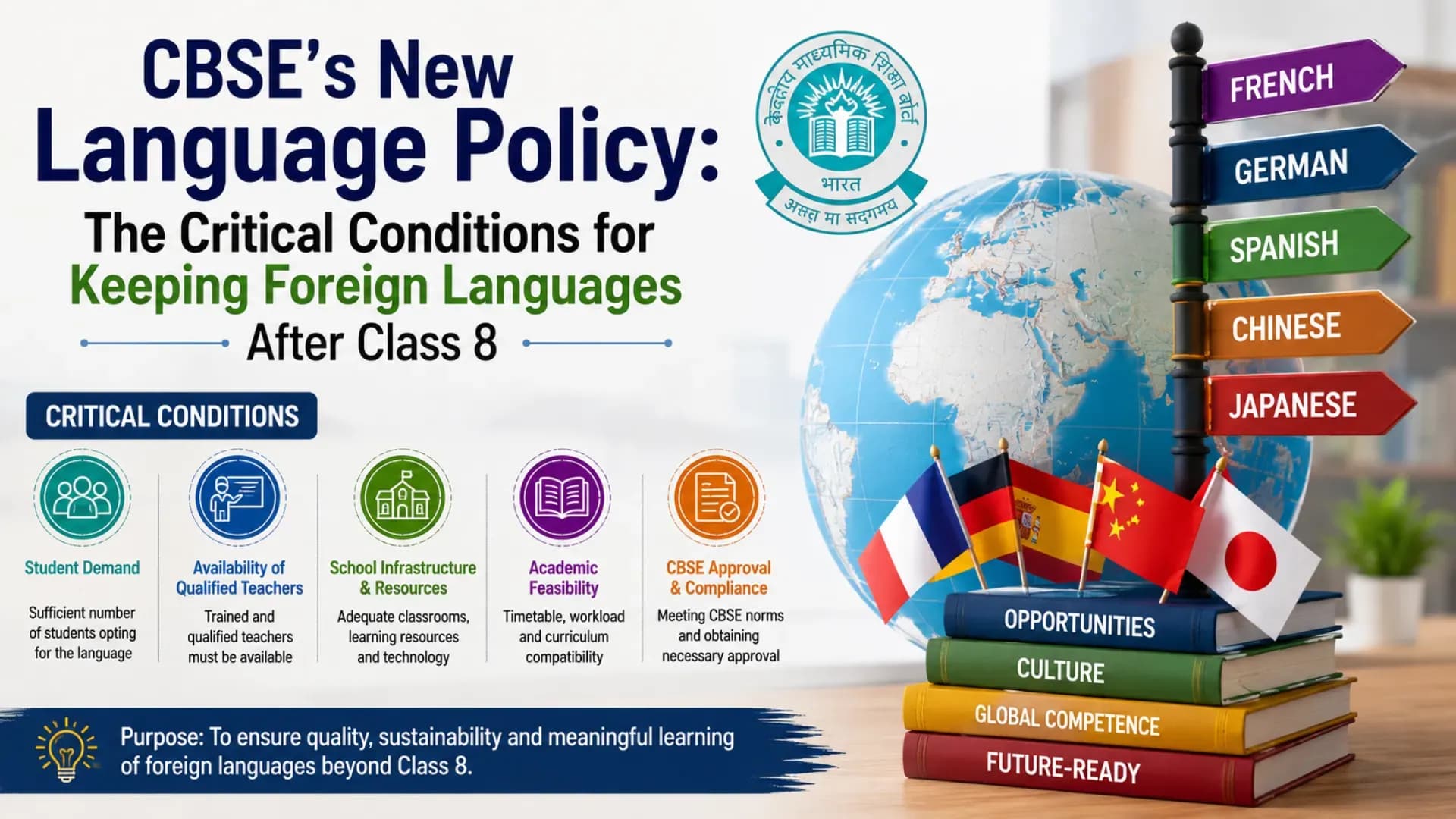
CBSE’s New Language Policy: The Critical Conditions for Keeping Foreign Languages After Class 8
The revised CBSE language policy has introduced significant changes regarding foreign languages after class 8, creating nationwide discussion among students, parents, and educators. Under the updated CBSE new education policy, schools must now fulfill specific academic and operational requirements to continue offering foreign language subjects beyond middle school. According to recent CBSE 2026 updates, these reforms are part of broader CBSE curriculum changes aligned with the evolving language policy India framework under NEP 2020.
The latest CBSE foreign language rules may directly affect schools offering French, German, Japanese, Spanish, and other international subjects. The revised foreign language eligibility guidelines are expected to influence how institutions manage teacher recruitment, student enrollment, and subject allocation. As this issue dominates CBSE education news, many schools are closely examining the updated class 8 language policy framework before the 2026 academic session.
Key Highlights
- The revised CBSE language policy introduces stricter conditions for continuing foreign languages after class 8
- The updated CBSE new education policy focuses on multilingual learning and curriculum restructuring
- Recent CBSE 2026 updates indicate schools may require qualified foreign language teachers
- The latest CBSE foreign language rules require schools to maintain minimum enrollment criteria
- The revised language policy India framework supports Indian languages alongside international exposure
- Several upcoming CBSE curriculum changes may impact subject availability in secondary classes
- The new foreign language eligibility requirements could affect private and urban schools significantly
- Education experts tracking CBSE education news believe implementation details will become clearer soon
- The updated class 8 language policy may reshape language education across CBSE-affiliated schools
Explore This: JEE Mains Exam Guide
Why the New CBSE Language Policy Matters
The revised CBSE language policy is considered one of the most important academic reforms introduced in recent years. The updated framework governing foreign languages after class 8 attempts to balance multilingual education with institutional preparedness. Analysts reviewing recent CBSE 2026 updates suggest that the policy reflects the long-term direction of the CBSE new education policy and its emphasis on educational flexibility.
According to the latest CBSE foreign language rules, schools may need adequate infrastructure, trained teachers, and sustainable student enrollment to continue offering foreign language subjects. This issue has become a major focus in CBSE education news because many institutions currently market international language education as a premium academic feature.
Experts monitoring the broader language policy India framework believe the latest CBSE curriculum changes are designed to strengthen Indian language learning while still allowing foreign language exposure. However, the revised foreign language eligibility conditions could create challenges for schools lacking specialized faculty. The updated class 8 language policy therefore represents both an opportunity and an operational challenge.
Related News: CUET UG Exam Guide
CBSE Language Policy 2026 — Key Details
| Particulars | Details |
|---|---|
| Policy Name | CBSE Language Policy 2026 |
| Primary Focus | Continuation of foreign languages after class 8 |
| Policy Framework | CBSE new education policy aligned with NEP 2020 |
| Major Reform Area | CBSE foreign language rules and subject continuation criteria |
| Implementation Timeline | Expected during CBSE 2026 updates cycle |
| Policy Impact | May affect CBSE curriculum changes and language offerings |
| Eligibility Requirement | Foreign language eligibility based on teacher and student availability |
| Related Coverage | Featured widely in CBSE education news |
| Policy Category | Class 8 language policy reform |
Expert Analysis
Education policy analysts believe the revised CBSE language policy is part of a broader attempt to redesign how schools approach multilingual education. The discussion surrounding foreign languages after class 8 reflects the growing emphasis on balancing global competencies with Indian linguistic priorities. Several experts reviewing the CBSE new education policy say that language reforms were expected as part of the national education restructuring process.
The latest CBSE 2026 updates suggest implementation may vary depending on institutional capacity. Under the revised CBSE foreign language rules, schools with limited teacher availability may face operational challenges. Experts also argue that the revised language policy India framework could encourage schools to prioritize regional languages alongside international language exposure.
Important: Schools planning to continue international language subjects must closely monitor future CBSE curriculum changes and official notifications regarding foreign language eligibility. Many upcoming clarifications related to the revised class 8 language policy are expected through future CBSE education news announcements.
Stay Updated With Every CBSE 2026 Update
Get the latest CBSE education news, official circulars, curriculum reforms, board examination announcements, and complete updates on the revised CBSE language policy and foreign languages after class 8.
Explore More Education News →Stop Stressing. Start Applying.
Skip the chaos of filling endless forms. Apply to your dream colleges in one go through the College Nirnay Common Application Form — built for every student navigating India's competitive education landscape.
Fill the Common Application Form →✓ Free to apply · ✓ Takes under 5 minutes · ✓ Trusted by thousands of students
FAQs
What is the new CBSE language policy?
The revised CBSE language policy introduces updated conditions for continuing foreign languages after class 8. The policy forms part of the broader CBSE new education policy framework.
What do the CBSE foreign language rules say?
According to recent CBSE 2026 updates, the revised CBSE foreign language rules require schools to satisfy staffing, curriculum, and enrollment requirements before continuing foreign language programs.
How do CBSE curriculum changes affect foreign languages?
The latest CBSE curriculum changes may affect how schools implement language education. Updated foreign language eligibility conditions and the revised class 8 language policy may influence subject availability.
How does this align with the language policy India framework?
Experts say the revised language policy India approach attempts to balance Indian language promotion with continued access to international language education.
Explore More
Stay connected for more CBSE education news, detailed analysis on the revised CBSE language policy, official announcements regarding foreign languages after class 8, and all upcoming CBSE 2026 updates related to the evolving language policy India framework and future CBSE curriculum changes.