
Search colleges, courses...
Ctrl K
Latest insights, news and guides from education experts
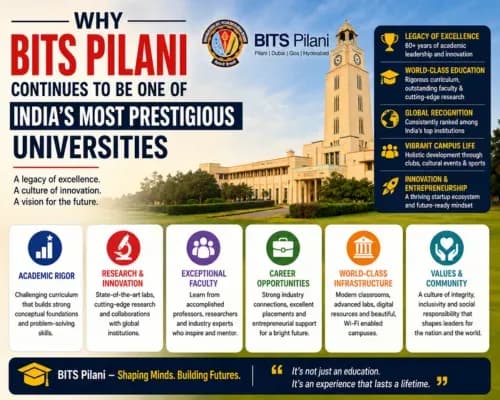
Why BITS Pilani Remains One of India's Top Universities Why BITS Pilani Remains One of India's Top Universities Introduction In a country where the conversation about engineering colleges India almost always begins and ends with the IITs, one private institution has consistently held its ground at the very top of the national conversation — not through government funding, centrally mandated reservations, or legacy infrastructure, but through the sheer quality of what it produces. BITS Pilani — the Birla Institute of Technology and Science — has for over six decades been one of the most respected and genuinely distinctive prestigious universities India has built in the private sector. This review of BITS Pilani is written for students, parents, and serious aspirants who want to understand what the institution truly offers in 2026 — beyond the brand, beyond the rankings, and beyond the remarkable BITS Pilani alumni network that has become one of the most powerful in Indian academia and industry. How does the academic experience compare? What does BITS Pilani campus life actually look like? What do BITS Pilani placements deliver and for whom? And is the BITS Pilani ranking story backed by ground-level reality? This comprehensive guide covers academic programmes, the BITS practice school system, research culture, campus infrastructure, the BITSAT admission process, placement outcomes, and the honest trade-offs every serious aspirant must weigh. If you want clarity and not a brochure — read on. Also Read: No Coding? No Problem! High-Income Tech Skills Without Programming Quick Highlights Institution Birla Institute of Technology and Science (BITS Pilani) Location Pilani, Rajasthan — with additional campuses in Goa, Hyderabad, and Dubai Established 1964 (deemed university status) — over six decades of academic excellence Blog Focus Honest 2026 Review — Academics, Placements, Campus Life, Admission, and Rankings Who This Is For BITSAT aspirants and students evaluating BITS Pilani for B.E., M.Sc., M.E., MBA, and PhD programmes Honest Rating India's finest private engineering institution — rigorous, autonomous, and uniquely student-empowering in its academic design Table of Contents The BITS Legacy — What Makes It Different from Other Top Universities in India Academic Programmes — What BITS Pilani Offers The Practice School System — Industry Immersion Like No Other BITS Pilani Placements — The Honest Picture BITS Pilani Campus Life — Infrastructure and Student Culture BITS Pilani Alumni — The Network Effect BITS Pilani Ranking — What the Numbers Actually Mean BITS Pilani Admission — BITSAT 2026 Guide Reality Check — Who Should and Shouldn't Target BITS Pilani FAQs Conclusion The BITS Legacy — What Makes It Different from Other Top Universities in India Among top universities in India, BITS Pilani occupies a uniquely earned position — it is the only private institution that has, over six decades, consistently been mentioned in the same breath as the IITs by recruiters, academics, and former students worldwide. This is not a marketing claim. It is a pattern visible in the career trajectories of tens of thousands of graduates, in the founding stories of Indian technology companies, and in the faculty rosters of global research universities where BITS alumni hold senior positions. What makes BITS Pilani genuinely different is institutional philosophy. The academic design — a credit-based flexible system that allows students to choose their curriculum path, pursue dual degrees, and substitute courses based on demonstrated competence — was decades ahead of its time when introduced and remains one of the most student-empowering academic structures in Indian higher education. This is not a university that processes students through a fixed conveyor belt; it is one that demands intellectual ownership from day one. The Practice School system — which places students in real industry environments for full semesters — is perhaps the most structurally distinctive feature of a BITS education. No other engineering colleges India has produced at national scale has built this level of mandatory, credit-bearing industry immersion into the undergraduate curriculum as consistently and as long as BITS Pilani has. That combination of academic flexibility and industry integration is the foundation of the institution's enduring reputation. Academic Programmes — What BITS Pilani Offers BITS Pilani offers undergraduate, postgraduate, and doctoral programmes across engineering, science, pharmacy, and management — structured around a flexible credit system that is genuinely rare among engineering colleges India. Here is the programme landscape as of 2026: B.E. Programmes: Chemical Engineering, Civil Engineering, Computer Science, Electrical and Electronics Engineering, Electronics and Instrumentation, Manufacturing Engineering, and Mechanical Engineering. All B.E. programmes at BITS Pilani share a common first year, which allows students to transfer between programmes based on performance — an unusual and genuinely meritocratic feature M.Sc. (Hons.) and M.Sc. (Tech.) Programmes: Integrated five-year dual degree programmes in Physics, Chemistry, Mathematics, Biology, Economics, and Finance — available as standalone programmes or in combination with a B.E. degree. The dual degree option is one of the most valued features of a BITS education, producing graduates with both technical depth and scientific breadth M.E. / M.Pharm. Postgraduate Programmes: Postgraduate engineering and pharmacy programmes primarily for working professionals under the BITS Work Integrated Learning Programme (WILP) — and full-time M.E. programmes for high-ranked BITSAT and GATE candidates MBA: The BITS MBA, offered at the Pilani and other campuses, benefits from the institution's industry network and practice school philosophy — producing graduates positioned competitively in technology management and consulting roles PhD Programmes: Doctoral research programmes across all departments — increasingly funded by national and international grants, with growing collaboration with industry research labs and global academic institutions The flexibility embedded in the BITS Pilani credit system — course substitution, minor programmes, dual degrees, and branch change on academic merit — means that the academic programme a student finishes may look quite different from the one they started, shaped by their own intellectual interests rather than administrative constraints. Related Article: Best Free AI Tools for Students in 2026 The Practice School System — Industry Immersion Like No Other The Practice School (PS) system is the most structurally distinctive feature of a BITS Pilani education — and arguably the single most important reason why BITS Pilani placements and career outcomes compare favourably with institutions that spend far more on placement infrastructure. It is, at its core, a mandatory semester-long placement in a real industry or research environment, with full academic credit, structured learning objectives, and faculty supervision. Practice School I (PS-I): A two-month summer station typically after the second year — students work at partner organisations across India in roles aligned with their academic programmes. The exposure is real work, not observation, and students receive academic credit alongside professional experience that most peers at other engineering colleges India do not access until final year internships Practice School II (PS-II): A full five-to-six-month semester at a PS station — the most significant industry immersion component of the BITS undergraduate experience. PS-II stations include some of the most respected technology, manufacturing, consulting, research, and financial services organisations in India and internationally. Many students receive Pre-Placement Offers (PPOs) from their PS-II stations — meaning they complete their degree with a job already confirmed Station diversity: The PS network spans hundreds of organisations — from ISRO and DRDO to Goldman Sachs, Google, McKinsey, Qualcomm, and leading Indian and multinational corporations. The breadth of the station network is a genuine institutional asset that has been built over decades Research stations: Students interested in academic research can opt for research-focused PS stations at national laboratories, IITs, and international research institutions — making PS-II a genuine exploratory opportunity for those considering graduate study Practice School Reality: The PS system means that a BITS Pilani graduate entering the job market has already spent a full semester working professionally in a real organisation — this is a structural advantage that no amount of campus recruitment infrastructure at other institutions fully replicates. PPO conversion rates from PS-II are among the most consistent and high-quality placement outcomes the institution produces. BITS Pilani Placements — The Honest Picture BITS Pilani placements are among the strongest of any private institution in India — and the honest picture requires understanding what drives them, what the realistic range of outcomes is, and what students must do themselves to achieve the upper end of that range. Top recruiters: BITS Pilani placements regularly feature technology product companies (Google, Microsoft, Adobe, Qualcomm, Samsung Research), consulting firms (McKinsey, BCG, Bain, Deloitte), financial services (Goldman Sachs, JP Morgan, Deutsche Bank), and core engineering and manufacturing organisations. The recruiter quality at BITS is consistently comparable to the top NITs and competitive with several IITs for specific profiles Salary range: Median domestic CTCs for CSE and EEE graduates at BITS Pilani Pilani campus have consistently been in the ₹20–35 LPA range for top-tier offers, with international offers from companies like Google and Qualcomm regularly crossing ₹1 crore CTC. The median across all programmes and all campuses is lower — students should request branch-specific and campus-specific data rather than relying on headline figures PPO contribution: A significant portion of final placements at BITS Pilani come through PPOs from the Practice School system — students who perform well at their PS-II station frequently receive offers before the formal placement season begins. This is a structural advantage that inflates quality outcomes relative to what the formal placement drive alone would produce Campus variation: The Pilani campus — the original and most established — consistently delivers the strongest placement outcomes. Goa and Hyderabad campuses have strong placements but the Pilani brand carries additional weight with some legacy recruiters. Students should evaluate campus-specific data when comparing offers Self-directed outcomes: As at any strong institution, BITS Pilani placements outcomes for individual students depend enormously on preparation — competitive programming, open-source contributions, research publications, and internship quality outside the PS system all influence individual results significantly BITS Pilani Campus Life — Infrastructure and Student Culture BITS Pilani campus life is one of the most frequently and positively discussed aspects of the institution — and unlike many private universities where campus life is a brochure category rather than a lived reality, the BITS Pilani experience has a distinct, earned character that alumni across decades consistently describe with genuine affection. Physical campus: The Pilani campus spans over 300 acres in the arid landscape of Rajasthan — an unlikely location that has become one of the most recognisable academic environments in India. The campus is largely self-contained: hostels, academic buildings, faculty residences, markets, medical facilities, and recreational infrastructure are all within the campus boundary. The remoteness that initially seems like a limitation becomes, for most students, one of the campus's most defining features — it creates a genuinely immersive academic community Student autonomy: BITS Pilani campus life is characterised by a level of student autonomy that is rare among Indian universities. The Student Union, departmental associations, and technical and cultural clubs are largely student-run with minimal faculty interference. This produces a self-governing culture that builds leadership and organisational skills alongside academic ones APOGEE and OASIS: BITS Pilani's technical festival (APOGEE) and cultural festival (OASIS) are among the largest and most respected student-organised events in India — attracting participants from hundreds of institutions nationally. Organising and participating in these events is a significant part of the BITS Pilani campus life experience and a genuine opportunity for students to develop competencies far beyond the classroom Student clubs and technical groups: The density and quality of technical clubs at BITS Pilani — robotics, coding, electronics, astronomy, entrepreneurship, and more — means that students with specific technical interests have structured communities to develop them in. Many student projects have resulted in published research, startup launches, and national competition victories Hostel culture: The BITS hostel system is a central part of student life — with a culture of collaborative learning, late-night discussions, and peer teaching that many alumni cite as formative. The isolation of Pilani means that friendships built on campus tend to be deep and long-lasting — a contributor to the strength of the BITS Pilani alumni network BITS Pilani Alumni — The Network Effect The BITS Pilani alumni network is, by almost any measure, one of the most powerful and active alumni communities in Indian higher education — and its influence on career outcomes for current students is both direct and substantial. Understanding what the BITS Pilani alumni network actually delivers is important for any serious aspirant. Entrepreneurship legacy: The BITS Pilani alumni community includes the founders and co-founders of some of India's most prominent technology companies — including Dhruv Shringi (Yatra), Sanjay Mehrotra (Micron CEO), Vinod Khosla (Sun Microsystems, Khosla Ventures), and dozens of others across fintech, SaaS, and deep tech. This entrepreneurial tradition creates a culture at BITS Pilani where founding a company is treated as a credible career path rather than a deviation from the conventional one Global academic presence: A disproportionately large number of BITS Pilani alumni hold faculty and research positions at leading global universities — MIT, Stanford, Carnegie Mellon, and others. This academic network facilitates graduate admissions, research collaborations, and mentorship access for current students who are considering international graduate programmes Industry mentorship: The BITS alumni network is well-organised and actively engaged — alumni regularly return to campus for guest lectures, participate in placement processes as hiring managers, and provide mentorship through formal and informal channels. For students navigating career decisions, having access to BITS Pilani alumni at senior levels across industries is a practical advantage that compounds over the course of four or five years on campus Startup ecosystem support: Several BITS Pilani alumni-backed funds and angel networks specifically prioritise BITS-origin startups — creating a funding pipeline that is visible and accessible to students who want to build companies during or after their degree BITS Pilani Ranking — What the Numbers Actually Mean The BITS Pilani ranking story is strong across every major Indian ranking framework — and understanding what those rankings measure (and what they do not) is important context for any evaluation of the institution. NIRF Rankings: The BITS Pilani ranking in the National Institutional Ranking Framework (NIRF) consistently places it in the top 20 overall institutions in India and among the top 5–7 engineering institutions — a remarkable position for a private, tuition-funded institution competing against IITs and NITs that receive substantially larger government funding QS World Rankings: BITS Pilani features in the QS World University Rankings and consistently ranks among India's top private universities in the QS system — with particular strength in employer reputation scores, reflecting the genuine industry recognition of the institution's graduates What rankings capture: The BITS Pilani ranking strength reflects genuine institutional quality in research output, faculty-student ratio, industry connectivity, and graduate outcomes. These are not inflated by the kind of factors that can distort rankings at institutions with large endowments and extensive marketing operations What rankings miss: Rankings do not capture the Practice School system, the flexible academic architecture, the student autonomy culture, or the quality of the BITS Pilani alumni network — all of which are arguably more important determinants of long-term career outcomes than any ranking metric. Treating the BITS Pilani ranking as the primary reason to choose BITS misses most of what actually makes it valuable Ranking Reality: Among top universities in India, BITS Pilani is the only private institution that has sustained top-tier ranking positions across multiple frameworks over multiple decades without a single year of government grant support for undergraduate programmes. That institutional durability is itself a signal of fundamental quality that ranking numbers reflect but do not fully explain. BITS Pilani Admission — BITSAT 2026 Guide BITS Pilani admission to all undergraduate programmes is conducted exclusively through BITSAT — the Birla Institute of Technology and Science Admission Test — a computer-based online examination held annually. Unlike most engineering admissions in India, BITS Pilani admission does not accept JEE Main or JEE Advanced scores, making BITSAT preparation a distinct and dedicated requirement. BITSAT structure: BITSAT is a 3-hour, 130-question computer-based test covering Physics, Chemistry, English Proficiency, Logical Reasoning, and Mathematics. The unique feature is a bonus 12-question section for students who complete the main paper before time — making speed and accuracy simultaneously important in a way that JEE does not demand Cutoffs for Pilani campus (2025 reference): CSE at Pilani requires approximately 390–400+ out of 450 for general category — among the most competitive cutoffs in Indian engineering admissions. EEE and Chemical Engineering cutoffs are marginally lower. The Goa and Hyderabad campuses have lower cutoffs for equivalent branches, offering a strategic option for students who strongly prefer BITS over IITs or NITs but cannot reach Pilani campus cutoffs Board performance requirement: BITS Pilani admission also requires a minimum of 75% aggregate in Physics, Chemistry, and Mathematics at Class 12 — students who score very high on BITSAT but fall below this threshold are not eligible. This board performance requirement is a distinct consideration compared to JEE-based admissions Dual degree iteration: Candidates can be offered a dual degree (B.E. + M.Sc.) combination if their score is sufficient for the engineering branch but not the standalone M.Sc. programme — the iteration system allows students to explore multiple combination options during BITS Pilani admission counselling Apply at: bitsadmission.com — monitor the official site for BITSAT 2026 dates, registration windows, and admission notifications. Missing the registration window is a common avoidable error; set calendar reminders from January onwards Reality Check — Who Should and Shouldn't Target BITS Pilani BITS Pilani Is the Right Choice If: You are a high-performing student who values academic autonomy and wants to shape your own curriculum — the flexible credit system rewards intellectual initiative in ways that fixed-curriculum institutions do not You want mandatory, credit-bearing industry immersion as part of your undergraduate experience — the Practice School system delivers this in a way that no comparable engineering colleges India has replicated at scale You are targeting roles at technology product companies, global consulting firms, or research-oriented organisations — BITS Pilani placements in these categories are genuinely strong and consistently produced You are considering entrepreneurship or graduate study abroad — the BITS Pilani alumni network and the research culture are genuine accelerators for both pathways You are comparing BITS Pilani against a lower-ranked NIT or a private institution with weaker placement outcomes — in this comparison, BITS is almost always the stronger choice for most career goals Reconsider or Recalibrate If: You have secured admission at IIT Bombay, IIT Delhi, IIT Madras, or IIT Kharagpur for a branch you want — at that level, the IIT brand carries incremental advantages in certain research and academic pathways that are worth evaluating honestly rather than assuming BITS is equivalent Your BITSAT preparation is not on track for the Pilani campus cutoff for your target branch — in that case, evaluate the Goa and Hyderabad campuses on their own merits rather than targeting Pilani unrealistically You require significant financial aid — BITS Pilani fees are among the highest in Indian engineering education (approximately ₹5–6 lakh per semester for Pilani campus), and scholarship availability is limited compared to government-funded institutions. The fee investment is justified by outcomes, but it must be sustainable for the family You find the remote Pilani location a significant personal concern — the campus is self-contained and the community is strong, but students who struggle with geographic isolation may find the environment challenging in the first year before the campus culture absorbs them You are comparing BITS Pilani to institutions primarily based on BITS Pilani ranking numbers alone — the ranking is real, but the decision should be made on the basis of the specific academic environment, Practice School access, and placement outcomes, not the rank number in isolation 🎓 One Form · Multiple Colleges Stop Stressing. Start Applying. Skip the chaos of filling endless forms. Apply to your dream colleges in one go through the College Nirnay Common Application Form — built for every student navigating India's competitive education landscape. Fill the Common Application Form → ✓ Free to apply · ✓ Takes under 5 minutes · ✓ Trusted by thousands of students FAQs Q1. Is BITS Pilani better than NITs for engineering? BITS Pilani is generally considered superior to all but the top 3–4 NITs (NIT Trichy, NIT Warangal, NIT Surathkal, and MNIT Jaipur in some comparisons) in terms of placement outcomes, alumni network strength, and academic flexibility. For most NIT comparisons — particularly for CSE and EEE branches — BITS Pilani at Pilani campus is the stronger choice if the student can manage the higher fee structure. The Practice School system, the BITS Pilani alumni network depth, and the brand recognition among top universities in India give BITS a consistent edge. However, for students who receive IIT admission at any campus for their preferred branch, that comparison requires a more nuanced evaluation. Q2. How should I prepare for BITSAT 2026? BITSAT preparation should begin alongside or slightly after JEE Main preparation, as the Physics, Chemistry, and Mathematics syllabus substantially overlaps. The key differences are the English Proficiency and Logical Reasoning sections — which require dedicated preparation not covered by standard JEE coaching — and the speed requirement of the BITSAT format, which penalises students who solve correctly but slowly. Mock tests in the BITSAT format are essential; the bonus section (available only to students who finish early) can add 12 marks and meaningfully improve your score. Target a minimum of 370+ for Goa/Hyderabad campus CSE and 390+ for Pilani campus CSE as your preparation benchmarks. Q3. How are BITS Pilani placements compared to IIT placements? BITS Pilani placements for CSE and EEE at the Pilani campus are comparable to IIT placements at the top NITs and competitive with several IITs outside the top 5. The key distinction is that a larger proportion of BITS Pilani placements happen through PPOs from the Practice School system — meaning many of the best offers are secured months before the formal placement season through real work performance rather than interview performance alone. For high-salary technology product roles, BITS competes effectively — the recruiter list at Pilani campus consistently includes Google, Microsoft, Qualcomm, Adobe, and Goldman Sachs. Q4. What is the fee structure at BITS Pilani and is it worth it? BITS Pilani fees for the Pilani campus are approximately ₹5–6 lakh per semester — making the total programme cost for a 4-year B.E. approximately ₹40–48 lakh, excluding hostel and living expenses. This is among the highest fee structures in engineering colleges India. The value calculation is positive for most students who complete the programme and leverage BITS Pilani placements effectively — a median first-year salary of ₹20–35 LPA produces a fee recovery period of 2–3 years even at the higher end of total cost. Educational loans from major banks are available and commonly used. Merit scholarships are limited but exist for students with exceptional academic performance. Q5. How does BITS Pilani campus life compare to IIT campuses? BITS Pilani campus life is frequently described by students who have visited or compared notes with IIT peers as distinctly more autonomous and self-governing. The absence of a formal faculty-controlled student union, the culture of student-run festivals and clubs, and the relative freedom of the hostel environment give BITS Pilani campus life a character that many alumni describe as formative in ways beyond academics. The trade-off is the geographic remoteness of Pilani — city access is limited, and the campus community is genuinely insular. Students who thrive in self-contained, intellectually dense environments consistently rate the BITS Pilani campus life experience as one of the defining features of their education. Explore More CGPA vs Experience: What Matters? How to Choose Your Dream University Top Emerging Courses in 2026 Careers Without a Traditional Degree JEE Main 2026 Result Updates Top AI Skills Students Must Learn Best Free AI Tools for Students Freelancing vs Job for Students Conclusion This review delivers an honest verdict: BITS Pilani has earned its place among India's finest institutions not through government funding or historical inertia, but through six decades of consistently producing graduates who perform at the highest levels in industry, research, and entrepreneurship. Among top universities in India, it occupies a category of its own — the only private institution whose brand, alumni network, and academic culture genuinely compete with the IIT system across most career dimensions. The students who will extract maximum value from a BITS Pilani education are those who treat the flexible curriculum as an invitation to build something genuinely personal, who engage seriously with the Practice School system as a professional development opportunity rather than a semester to endure, and who understand that the BITS Pilani alumni network is a lifelong resource that rewards contribution as much as extraction. For students seriously evaluating BITS Pilani admission — prepare hard for BITSAT, visit the campus if possible, speak with current students and recent graduates across different branches, and make your decision with full information. The BITS Pilani ranking number is the starting point of the conversation, not the end of it. What the institution actually offers — in academic freedom, industry immersion, and community — is the real case for choosing it, and this review has given you the honest framework to evaluate exactly that.

How AIIMS Jodhpur Is Shaping the Next Generation of Healthcare Professionals Introduction When India's central government launched a new wave of All India Institutes of Medical Sciences under the Pradhan Mantri Swasthya Suraksha Yojana, the goal was clear: decentralise excellence in medical education and bring world-class healthcare education to regions historically underserved by top-tier institutions. AIIMS Jodhpur — established in 2012 in Rajasthan — has emerged as one of the most significant success stories of that vision, steadily building a reputation that now rivals several of the older AIIMS campuses in academic rigour, research output, and the quality of healthcare professionals it produces. This review of AIIMS Jodhpur medical education is written for students, parents, and healthcare aspirants who want an honest, ground-level understanding of what the institution truly offers — how its MBBS and postgraduate programmes compare nationally, what the research culture looks like, how the campus experience shapes future doctors, and what realistic expectations should be for those aiming at admission. The AIIMS brand is India's gold standard in medical college India — but every campus within the network has its own evolving character, strengths, and gaps. This comprehensive guide covers academic programmes, AIIMS Jodhpur research culture, campus infrastructure, clinical training, faculty profile, and the honest trade-offs every serious aspirant must weigh. If you want clarity rather than promotional copy — read on. Also Read: No Coding? No Problem! High-Income Tech Skills Without Programming Quick Highlights Institution All India Institute of Medical Sciences, Jodhpur (AIIMS Jodhpur) Location Basni Phase-2, Jodhpur, Rajasthan — approximately 8 km from Jodhpur city centre Established 2012, under the Pradhan Mantri Swasthya Suraksha Yojana Blog Focus Honest 2026 Review — Medical Education, Research, Campus Life, and Career Outcomes Who This Is For NEET aspirants and postgraduate medical students evaluating AIIMS Jodhpur for MBBS, MD, MS, and allied health programmes Honest Rating A maturing AIIMS campus with strong research culture, growing clinical infrastructure — one of India's most important emerging medical institutions Table of Contents The AIIMS Legacy — What the Brand Means for Healthcare Professionals AIIMS Jodhpur Courses — Academic Programmes Overview AIIMS Jodhpur Research — Building a Culture of Scientific Inquiry Medical Training at AIIMS Jodhpur — Clinical Exposure and Patient Care AIIMS Jodhpur Campus — Infrastructure and Student Life Faculty and Academic Environment Career Outcomes — What Happens After AIIMS Jodhpur Admission to AIIMS Jodhpur — How to Apply in 2026 Reality Check — Who Should and Shouldn't Target AIIMS Jodhpur FAQs Conclusion The AIIMS Legacy — What the Brand Means for Healthcare Professionals The AIIMS brand — built over decades through the New Delhi flagship and bolstered by the new-generation campuses — represents the apex of medical training India has to offer. For healthcare professionals and aspiring doctors, an AIIMS degree carries a weight that no other medical institution in the country can match: it signals not just academic rigour but a culture of excellence in clinical practice, research, and public health service. This matters enormously in postgraduate selection, fellowship applications, international placements, and long-term career credibility. AIIMS Jodhpur — as one of the six new-generation AIIMS campuses — inherits this institutional DNA. The curriculum frameworks, governance structures, national faculty networks, and research collaboration channels are all part of the AIIMS system. However, the specific campus experience — the depth of clinical infrastructure, the breadth of superspecialty exposure, the faculty-student ratio, and the local healthcare ecosystem — is specific to Jodhpur, not a carbon copy of AIIMS New Delhi. For future doctors India must produce at scale — particularly for Rajasthan and the broader western and central India catchment — AIIMS Jodhpur plays a role that goes beyond individual career outcomes. It is actively shaping regional healthcare capacity, training specialists who serve populations that historically had no access to tertiary-level care. That mission is as much a part of the institutional identity as its national ranking. AIIMS Jodhpur Courses — Academic Programmes Overview AIIMS Jodhpur courses span undergraduate, postgraduate, doctoral, and paramedical streams — a full academic ecosystem designed to train healthcare professionals across every dimension of modern medicine. Here is the programme landscape as of 2026: MBBS (100 seats): The flagship undergraduate programme. The MBBS at AIIMS Jodhpur follows the AIIMS curriculum — which is widely acknowledged as one of the most rigorous undergraduate medical curricula in India. The programme integrates early clinical exposure from the first year, problem-based learning components, and structured research opportunities that set it apart from most medical college India MBBS programmes MD / MS Postgraduate Programmes: Postgraduate speciality training across major clinical departments including General Medicine, Surgery, Paediatrics, Obstetrics & Gynaecology, Orthopaedics, Radiology, Psychiatry, Anaesthesiology, and more. The PG programme at AIIMS Jodhpur has expanded steadily since 2015 and now offers seats across 25+ specialities DM / MCh Superspeciality Programmes: Superspeciality training in Cardiology, Neurology, Nephrology, Gastroenterology, Neurosurgery, and Urology — marking AIIMS Jodhpur's evolution toward comprehensive tertiary and quaternary care training PhD Programmes: Doctoral research programmes across basic sciences (Anatomy, Physiology, Biochemistry, Pharmacology, Microbiology, Pathology) and clinical departments — central to the AIIMS Jodhpur research ecosystem B.Sc. Nursing and Paramedical Programmes: Including B.Sc. Nursing, B.Sc. in Medical Technology (Radiology, Lab Technology, Operation Theatre Technology), and related allied healthcare education programmes that support the full spectrum of patient care training MHA (Master of Hospital Administration): A management programme for healthcare systems leadership — producing professionals equipped to manage India's growing hospital infrastructure The breadth of AIIMS Jodhpur courses is a genuine institutional strength — students at every level of the healthcare career ladder can find a programme that positions them for national and international competitive outcomes. Related Article: Best Free AI Tools for Students in 2026 AIIMS Jodhpur Research — Building a Culture of Scientific Inquiry AIIMS Jodhpur research is one of the most rapidly growing dimensions of the institution — and arguably the clearest evidence that it is fulfilling its mandate as a true academic medical centre, not merely a teaching hospital. The research trajectory since 2015 has been consistent: increasing publications in indexed journals, growing extramural funding from ICMR, DBT, DST, and international bodies, and a deepening culture of inquiry that now shapes undergraduate education from the first year. Research infrastructure: The AIIMS Jodhpur campus has developed dedicated research laboratories, a central instrumentation facility, and biosafety-compliant wet lab infrastructure. The Translational Health Science and Technology Institute (THSTI) collaboration and partnerships with national science institutions provide additional research bandwidth beyond the campus itself Focus areas: AIIMS Jodhpur research has developed particular depth in tropical medicine and infectious disease (highly relevant to Rajasthan's disease burden), non-communicable disease epidemiology, maternal and child health, cancer biology, and clinical pharmacology. These are not arbitrary academic choices — they reflect the actual health challenges of the western India catchment population that AIIMS Jodhpur serves Student research participation: MBBS students at AIIMS Jodhpur are encouraged to participate in research projects from the second year onwards — the Short Term Studentship (STS) programme of ICMR provides a formal national pathway for undergraduate research participation. A meaningful percentage of AIIMS Jodhpur graduates have publications before completing their MBBS — a significant advantage in postgraduate competitive examinations and fellowship applications International collaborations: Active research collaborations with institutions in the UK, USA, and Australia — including joint grant applications and faculty exchange programmes — have accelerated the internationalisation of AIIMS Jodhpur research culture in ways that were not present in the early years of the campus Research Reality: Students who actively engage with the research culture at AIIMS Jodhpur — pursuing STS projects, attending journal clubs, participating in departmental research seminars — develop a competitive profile that significantly outpaces peers who treat the MBBS as a purely clinical degree. In an era where postgraduate selection is increasingly competitive, research exposure is a genuine differentiator. Medical Training at AIIMS Jodhpur — Clinical Exposure and Patient Care The quality of medical training India's future doctors receive is defined not just by classroom instruction but by the richness and volume of clinical exposure. AIIMS Jodhpur has built a 500-bed hospital (expanding to over 750 beds by 2026) that serves as the primary clinical training ground — and the patient load, drawn from across Rajasthan, Gujarat, and parts of Madhya Pradesh, is both high-volume and clinically diverse. OPD and IPD volume: The AIIMS Jodhpur hospital manages thousands of outpatient visits daily and a substantial inpatient census — providing students and residents with a breadth of clinical case exposure that is central to the quality of medical training India's most capable institutions offer. Rare and complex cases from the region's underserved populations present clinical challenges that sharpen diagnostic and management skills Skills laboratory: A dedicated clinical skills and simulation laboratory gives students structured opportunities to practise procedural competencies — IV cannulation, suturing, airway management, obstetric simulations — before performing them on patients. This infrastructure has been systematically upgraded since the initial campus development phase Superspecialty exposure: The presence of DM and MCh programmes in cardiology, neurology, neurosurgery, and nephrology means that MBBS and MD students at AIIMS Jodhpur have access to superspecialty clinical environments that most medical college India campuses simply do not offer at the undergraduate and junior resident level Community health training: Mandatory postings in the urban health centre, rural health and training centre, and district hospital network give students grounded exposure to primary and secondary care realities — ensuring that healthcare professionals from AIIMS Jodhpur understand the full continuum of care, not just tertiary hospital medicine AIIMS Jodhpur Campus — Infrastructure and Student Life The AIIMS Jodhpur campus is a purpose-built academic medical complex developed on approximately 205 acres in the Basni Phase-2 area of Jodhpur. The campus continues to develop — as of 2026, most of the core infrastructure is operational and the expansion projects are in advanced stages. Academic buildings: Modern lecture theatres, tutorial rooms, anatomy dissection halls, physiology and biochemistry laboratories, a central library with digital journal access and substantial physical collection — the academic infrastructure at AIIMS Jodhpur is well-suited to the demands of a rigorous medical curriculum Hostel facilities: Separate hostel blocks for MBBS students, postgraduate residents, nursing students, and faculty. The hostel accommodation is functional — shared rooms for junior MBBS students, single-room accommodation for postgraduate residents. Mess facilities, common rooms, and 24-hour security are standard Sports and recreation: Cricket ground, football field, basketball and volleyball courts, an indoor sports complex, and a gymnasium reflect the institutional commitment to student wellbeing beyond the academic grind. The intensity of a medical degree makes recreational infrastructure genuinely important, and AIIMS Jodhpur has invested meaningfully in this dimension Student culture: The student community at AIIMS Jodhpur is academically high-achieving — NEET toppers from across India — and the peer learning environment is one of the less-discussed but most powerful aspects of an AIIMS education. Cultural fests, sports weeks, academic quiz competitions, and departmental societies create a campus life that is active and intellectually stimulating City connectivity: Jodhpur is a well-connected tier-2 city with an international airport, good rail connectivity, and a developing urban infrastructure. The campus is approximately 8 km from the city centre — manageable by auto-rickshaw or shared cab. Students generally find Jodhpur more accessible and liveable than more remote AIIMS locations Faculty and Academic Environment The faculty at AIIMS Jodhpur has grown steadily from the initial cohort recruited at founding to a substantially broader and more experienced body of clinician-scientists. As of 2026, the faculty profile reflects both the strength of the AIIMS recruitment system and the ongoing challenge all new-generation AIIMS campuses face in attracting senior faculty away from established metro institutions. Senior faculty depth: Most major departments now have professors with strong publication records, national committee experience, and clinical expertise that is competitive with mid-tier older AIIMS campuses. The early years of faculty thinness have been substantially addressed — though AIIMS New Delhi's faculty bench remains considerably deeper in superspecialty departments Faculty research engagement: A higher proportion of AIIMS Jodhpur faculty are active researchers compared to the national average for medical colleges — this flows directly into the student experience, as students have meaningful access to research mentors who are producing current work Teaching quality: Student feedback on teaching quality is generally positive — the structured AIIMS curriculum framework provides a baseline, and the relative youth of many faculty members translates to energy and accessibility that students appreciate. As at all institutions, quality varies by department and individual Faculty-student ratio: The faculty-student ratio at AIIMS Jodhpur remains better than at most medical college India equivalents in the private sector — a structural advantage of the AIIMS system's funding model and staffing norms Career Outcomes — What Happens After AIIMS Jodhpur The career outcomes for graduates of AIIMS Jodhpur are, by any honest measure, among the strongest available to medical professionals in India. The honest picture requires understanding both what the institution provides and what individual students build on that foundation. NEET PG performance: AIIMS Jodhpur MBBS graduates consistently perform at the top percentiles of NEET PG — the highly competitive examination for postgraduate medical admissions. The combination of rigorous clinical training, research exposure, and the intellectual culture of a high-achieving peer cohort produces graduates who compete effectively for MD and MS seats at AIIMS New Delhi, PGI Chandigarh, and other premier institutions International opportunities: A meaningful number of AIIMS Jodhpur graduates pursue postgraduate and fellowship training in the UK, USA, Canada, and Australia — particularly those who have engaged with the research culture and accumulated publications. USMLE and PLAB preparation is common among students from the second year onwards Academic medicine: The institution's research culture produces graduates who are well-positioned for academic medicine careers — faculty positions at medical colleges, research fellowships, and public health leadership roles. Future doctors India needs in academic and research roles will increasingly come from institutions like AIIMS Jodhpur that build this orientation from the undergraduate years Clinical practice: Graduates who choose direct clinical practice — whether in private hospitals, corporate healthcare groups, or public health systems — carry a credential that commands respect and, in many markets, preferential selection in hiring and partnership decisions Career Reality: The AIIMS Jodhpur degree is a powerful platform — but the outcomes among graduates vary significantly based on individual engagement with research, clinical opportunities, and competitive examination preparation. Students who treat the degree as the finish line achieve less than those who treat it as the starting point for a career of continuous excellence. Admission to AIIMS Jodhpur — How to Apply in 2026 Admission to AIIMS Jodhpur for all programmes is through national competitive examinations — there is no management quota, donation-based admission, or institutional entrance test. This is one of the defining features of the AIIMS system and a guarantee of merit-based selection that is genuinely rare in Indian healthcare education. MBBS: NEET UG is the sole admission pathway for MBBS at all AIIMS campuses. For AIIMS Jodhpur's 100 MBBS seats, the competitive cutoff in 2025 required NEET scores in the high 600s and above for general category — placing it among the most competitive undergraduate admissions in Indian medicine. Reservations for SC/ST/OBC and EWS categories apply as per central government norms MD / MS: NEET PG is the admission examination. Competitive cutoffs for AIIMS Jodhpur postgraduate seats are high — particularly for sought-after specialities like Radiology, Dermatology, and Orthopaedics DM / MCh: AIIMS conducted a combined entrance examination (INI-CET) for superspecialty admissions across all AIIMS campuses — AIIMS Jodhpur DM/MCh seats are allocated through this system PhD: Departmental written test and interview — candidates should contact individual departments for current admission criteria and available supervisors in their area of interest B.Sc. Nursing and Paramedical: AIIMS Jodhpur conducts its own entrance examination for B.Sc. Nursing and paramedical programme admissions — details and application timelines are published on the official website aiimsjodhpur.edu.in Apply at: aiimsjodhpur.edu.in — monitor the website regularly for admission notifications, as timelines are published each year and missing application windows is common among students who rely on informal sources Reality Check — Who Should and Shouldn't Target AIIMS Jodhpur AIIMS Jodhpur Is the Right Destination If: You have the NEET preparation depth to compete for a genuine AIIMS seat — not as a fallback from a lower-tier goal, but as a primary target you are building your preparation around You want a medical education that integrates research, clinical excellence, and community health — not just a degree that qualifies you for private clinical practice You are from Rajasthan, Gujarat, or central India and want to serve regional healthcare needs while receiving a nationally prestigious education — AIIMS Jodhpur is deeply embedded in the healthcare needs of this catchment You are targeting a career in academic medicine, public health policy, or research-oriented clinical practice — the AIIMS Jodhpur research culture and institutional network are genuine accelerators for these pathways You want an undergraduate medical experience that prepares you competitively for postgraduate admissions at India's premier institutions or for international fellowship training Reconsider or Recalibrate If: Your NEET preparation is aimed at scores below approximately 650 — at that level, targeting AIIMS Jodhpur is not realistic, and calibrating toward other strong government medical colleges and private medical college India options is the appropriate strategy You expect the AIIMS degree alone — without active engagement in research, competitive exam preparation, and clinical skill development — to produce exceptional outcomes. The institution provides the platform; the student must build on it You are comparing AIIMS Jodhpur to AIIMS New Delhi or PGI Chandigarh and trying to determine which is categorically better — each has specific strengths, and both represent an extraordinary standard of healthcare education; the right question is which you are competitive for You require significant flexibility in campus rules or lifestyle — AIIMS campuses maintain a structured, demanding academic environment that rewards discipline and personal resilience over comfort-seeking You are planning for purely private clinical practice in a high-fee market and are unconcerned with research or public service dimensions — even in this case, AIIMS Jodhpur is an excellent choice, but the full value of the experience only materialises for students who engage with its full academic culture 🎓 One Form · Multiple Colleges Stop Stressing. Start Applying. Skip the chaos of filling endless forms. Apply to your dream colleges in one go through the College Nirnay Common Application Form — built for every student navigating India's competitive education landscape. Fill the Common Application Form → ✓ Free to apply · ✓ Takes under 5 minutes · ✓ Trusted by thousands of students FAQs Q1. How good is AIIMS Jodhpur for MBBS compared to other new AIIMS campuses? AIIMS Jodhpur is consistently ranked among the top 3–4 new-generation AIIMS campuses in terms of research output, clinical infrastructure, and placement of graduates in premier postgraduate programmes. Its hospital volume, superspecialty departments, and active research culture give it a competitive edge over several of the more recently established campuses. Among the new AIIMS campuses — Bhopal, Bhubaneswar, Jodhpur, Patna, Raipur, Rishikesh — Jodhpur is frequently considered one of the stronger options, though rankings vary depending on the specific parameter evaluated. Q2. What is the NEET cutoff for AIIMS Jodhpur MBBS admission? The NEET cutoff for AIIMS Jodhpur MBBS admission varies by year and category. For general category candidates, competitive scores have historically been in the range of 650–680+ out of 720. OBC, SC, and ST categories have lower effective cutoffs as per reservation norms. Because seat counts at AIIMS campuses are fixed and national competition is intense, aspirants should target the highest possible NEET score rather than optimising for a specific cutoff number. Confirm the most recent cutoff data at aiimsjodhpur.edu.in or through AYUSH/MCC counselling portals. Q3. What research opportunities are available at AIIMS Jodhpur for MBBS students? AIIMS Jodhpur research opportunities for MBBS students include the ICMR Short Term Studentship (STS) programme, departmental project assistantships, participation in ongoing faculty-led studies, and access to the Undergraduate Research Cell that coordinates student engagement with ongoing trials and observational studies. Students interested in research should proactively approach faculty in departments of interest — the culture at AIIMS Jodhpur actively encourages early research engagement and most faculty members are open to motivated undergraduate research participants. Q4. What courses does AIIMS Jodhpur offer beyond MBBS? AIIMS Jodhpur courses beyond MBBS include MD/MS postgraduate programmes in 25+ specialities, DM/MCh superspecialty programmes in Cardiology, Neurology, Nephrology, Neurosurgery, Gastroenterology, and Urology, PhD programmes across basic science and clinical departments, B.Sc. Nursing, paramedical programmes in radiology and lab technology, and the MHA (Master of Hospital Administration). The full AIIMS Jodhpur courses catalogue is available at aiimsjodhpur.edu.in — prospective students should verify current seat availability and admission criteria directly from the official source. Q5. How is the hostel and campus life at AIIMS Jodhpur? AIIMS Jodhpur campus life is structured, demanding, and — for the right student — deeply rewarding. Hostel facilities are functional with separate blocks for MBBS students, PG residents, and nursing students. Mess food quality is the most frequently cited improvement area in student feedback. Sports facilities, a gymnasium, and regular cultural and academic events make campus life active beyond the clinical and academic schedule. Jodhpur as a city is well-connected and more liveable than many AIIMS locations — the combination of a well-resourced campus and a functional city environment makes the overall healthcare education experience at AIIMS Jodhpur one of the more comfortable among the new AIIMS campuses. Explore More CGPA vs Experience: What Matters? How to Choose Your Dream University Top Emerging Courses in 2026 Careers Without a Traditional Degree JEE Main 2026 Result Updates Top AI Skills Students Must Learn Best Free AI Tools for Students Freelancing vs Job for Students Conclusion This review delivers an honest verdict: AIIMS Jodhpur is one of India's most important emerging medical institutions — not merely because of the AIIMS brand it carries, but because of the specific academic culture, research orientation, and clinical training infrastructure it has built in just over a decade of existence. For aspiring healthcare professionals who can compete for its seats, it represents one of the finest healthcare education opportunities available anywhere in the country. The students who will extract the maximum from AIIMS Jodhpur medical education are those who arrive with intellectual curiosity intact, who engage with the research culture from day one, who treat every clinical posting as a learning opportunity rather than a requirement to fulfil, and who understand that the AIIMS degree is a starting point for a lifetime of medical excellence — not a guaranteed outcome in itself. For future doctors India needs — not just in volume but in quality, in research capability, and in the ability to serve complex and underserved populations — AIIMS Jodhpur is actively delivering on its founding mandate. If you are seriously evaluating this institution, visit the campus, speak with current students and residents, and make your decision with full information. No review can substitute for that first-hand conversation — but this one has given you the honest framework to ask the right questions.
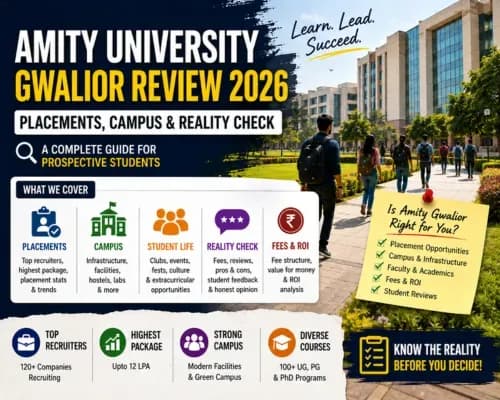
Amity University Gwalior Review 2026: Placements, Campus & Reality Check Introduction The Amity brand carries significant recognition across India's private university landscape — and that recognition is both its greatest asset and the source of the most important misconception prospective students bring to the evaluation process. This Amity University Gwalior review is written for students who are seriously evaluating Amity Gwalior as a university choice in 2026 and want an honest, ground-level assessment — not a brochure reading. Amity University Gwalior is a relatively newer campus within the Amity network — established in Madhya Pradesh with the benefit of the Amity brand, curriculum frameworks, and corporate relationships developed by the flagship Amity Noida campus. But brand benefit has limits: the campus infrastructure, faculty depth, local employer relationships, and Amity Gwalior placements record are specific to the Gwalior campus — not inherited from Noida. This distinction is the most important one to understand before making an admission decision. This Amity Madhya Pradesh review covers the full picture: academic programmes, Amity University campus life, hostel quality, placement infrastructure, fees, and the honest trade-offs that every student should weigh before committing. If you are looking for a reality check — this is it. Also Read: No Coding? No Problem! High-Income Tech Skills Without Programming Quick Highlights University Amity University Madhya Pradesh (Gwalior Campus) Location Gwalior, Madhya Pradesh — approximately 15 km from Gwalior city centre Blog Focus Honest 2026 Review — Placements, Campus, Fees, and Realistic Expectations Who This Is For Students evaluating Amity Gwalior for BTech, BCA, MBA, BBA, or LLB programmes Honest Rating Emerging campus with brand advantage, growing infrastructure — outcomes depend heavily on individual effort Table of Contents The Amity Brand — What It Gives You and What It Doesn't Programmes Offered — Which Are Worth Considering Amity Gwalior Placements — The Honest Picture Amity University Campus Life — Infrastructure Assessment Amity Gwalior Hostel — What to Expect Amity University Fees — Is It Worth the Cost? Amity University Admission 2026 — How to Apply Amity Gwalior Reality Check — Who Should and Shouldn't Apply FAQs Conclusion The Amity Brand — What It Gives You and What It Doesn't The Amity University brand — built primarily through the Noida flagship campus over two decades — offers genuine transferable benefits to the Gwalior campus: curriculum design frameworks, corporate MOU relationships, access to the Amity alumni network, and a degree certificate that carries name recognition with recruiters familiar with the Amity brand. These are real advantages in a competitive private university landscape where many institutions have neither the curriculum infrastructure nor the employer recognition that Amity has developed. What the brand does not give you automatically: the specific campus culture, faculty depth, and local employer network of Amity Noida. The Amity University Gwalior review must be based on what the Gwalior campus itself delivers — not on the reputation of the Noida campus. Recruiters from Gurgaon and Bengaluru technology companies who recruit from Amity Noida do not automatically recruit from Amity Gwalior; the Gwalior campus must develop its own employer relationships alongside the brand recognition, and this process is still underway in 2026. That is the fundamental reality that separates an informed admission decision from one based on brand assumption. Programmes Offered — Which Are Worth Considering Amity University Gwalior offers programmes across engineering, management, law, science, and allied fields. From the perspective of this private university review, the programmes worth most serious consideration from a career-outcome standpoint are: BTech (Computer Science and Engineering / AI & ML / Data Science): The technology programmes are the strongest career-outcome candidates at Amity Gwalior — the Amity curriculum in CSE is updated, the labs are reasonably equipped, and the national Amity brand provides a baseline of IT recruiter familiarity. Outcomes for CSE students who supplement the degree with DSA practice and internship quality are meaningfully better than students who rely only on campus placement facilitation BCA / MCA: Solid technology programmes for students who want a non-engineering pathway into IT. The 2-year MCA post-2022 restructuring makes it a competitive option for BCA and B.Sc. graduates who want to position for software development roles MBA: The Amity MBA benefits from the brand and corporate tie-ups — but students should compare this specifically against RJIT (Rewa), ITM Group Gwalior, and other Madhya Pradesh MBA options before deciding. The Amity MBA at Gwalior is competitive within the MP private university space BBA / BCom: Good undergraduate commerce programmes — particularly for students who will pursue CA or MBA post-graduation using the Amity credential as a foundation LLB / LLM: The law school at Amity Gwalior is modest but functional — not a primary destination for serious law career aspirants (CLAT-NLU pathway is the correct route for that), but viable for students seeking a law credential in central India with Amity's institutional backing Related Article: Best Free AI Tools for Students in 2026 Amity Gwalior Placements — The Honest Picture Amity Gwalior placements are the most important and most honestly variable aspect of this Amity University Gwalior review. The honest picture requires three simultaneous truths: The national Amity brand does attract a corporate recruitment presence: Companies including TCS, Infosys, Wipro, Cognizant, and HCL participate in campus placements — the Amity name is a credible door-opener for IT services bulk recruitment. This is a genuine advantage over many comparably-placed Madhya Pradesh private institutions that have narrower recruiter access Product company and high-salary placements are limited: The high-salary technology product company placements that define the top-tier private university experience (Flipkart, Google, Microsoft, Deloitte, Goldman Sachs technology) are not a regular feature of Amity Gwalior placements. These are genuinely competitive roles filled nationally by the strongest candidates from the top 50 institutions — students targeting them should evaluate IITs, NITs, and top private universities ahead of Amity Gwalior Individual outcomes vary enormously: The most consistent finding across multiple cohort reviews is that students who invest in DSA skill development, GitHub portfolio building, and internship quality independently of the campus placement process achieve outcomes significantly above the campus average. Students who rely entirely on the institutional placement machinery typically land in the 3.5 to 5 LPA range Gwalior's location matters: Gwalior has a smaller local IT and corporate employer ecosystem than Noida, Bengaluru, Pune, or Hyderabad — which means internship access and off-campus placement opportunities require more intentional effort than in a tier-1 city university Placement Reality: Amity Gwalior placements data published by the institution should be verified against student testimonials and LinkedIn profiles of recent graduates. Ask specifically: how many students from the graduating batch received offers, what was the median (not average) salary, and what were the company names — not just the headline figure. Amity University Campus Life — Infrastructure Assessment Amity University campus life at the Gwalior campus is developing — which means it has genuine strengths and genuine gaps compared to the Amity Noida campus experience that many prospective students may have seen in promotional materials. Physical infrastructure: The Gwalior campus has modern lecture halls, air-conditioned classrooms, reasonable computer labs, a library with digital database access, sports facilities (cricket ground, basketball court, indoor sports), and a cafeteria — the physical infrastructure is functional and improving Technology infrastructure: High-speed internet, computer labs with updated systems, and access to Amity's digital learning platform are consistent with the national Amity standard — these are genuine campus advantages Student clubs and activities: Amity University student life features a range of student clubs — technical, cultural, entrepreneurship, and sports — and the Amity annual fest (Amifest) is a notable campus event. Student-reported satisfaction with extra-curricular activities is generally positive Faculty quality: Mixed — as in most private universities in tier-2 cities, faculty depth varies significantly by department. CSE and management departments tend to have stronger faculty profiles than some allied departments. The Amity pedagogical framework provides some standardisation, but individual faculty quality is the most variable element of the Amity University campus life experience Location limitations: The campus is approximately 15 km from Gwalior city centre — connectivity for students without personal transport requires reliance on shared transport. Students who value city access for internships, cultural activity, or weekend mobility should factor this in Amity Gwalior Hostel — What to Expect The Amity Gwalior hostel experience is one of the most frequently discussed aspects in student reviews — and the assessment is honest: the facilities are functional and improving but are not at the level of the Amity Noida hostel, which benefits from 20+ years of infrastructure development. Room quality: Shared rooms (2 to 3 occupants) are the standard format at the Amity Gwalior hostel — rooms are clean and reasonably sized with basic furniture. Air conditioning availability varies by hostel block — confirm specific block facilities at the time of admission Mess/food: Hostel mess food quality is the most consistently cited concern in student feedback — the standard institutional canteen food, with a limited menu that improves when student feedback is actively engaged. A separate cafeteria with better variety is available on campus at an additional cost Security and rules: The Amity Gwalior hostel maintains a structured environment — curfew timings, restricted visitor access, and a warden system that some students find restrictive compared to off-campus living. This is consistent with Amity's institutional approach across campuses Internet connectivity: Wi-Fi is available in hostel blocks — quality varies by block and time of day. Many students supplement with personal mobile data Overall assessment: The Amity Gwalior hostel is acceptable — not exceptional. Students from smaller towns transitioning to campus life typically find it adequate; students from larger cities or those used to higher accommodation standards may find it a significant adjustment. Budget approximately ₹60,000 to ₹90,000 per year for hostel and mess in addition to tuition fees Amity University Fees — Is It Worth the Cost? Amity University fees at the Gwalior campus are one of the most important financial considerations for families evaluating this choice. The Amity University fees structure is: Programme Approx. Annual Fee Total Programme Cost BTech (CSE/AI/Data Science)₹2.5 – 3.5L₹10 – 14L (4 years) BCA / B.Sc.₹1.5 – 2.5L₹4.5 – 7.5L (3 years) MBA₹2.5 – 3.5L₹5 – 7L (2 years) BBA / BCom₹1.5 – 2.5L₹4.5 – 7.5L (3 years) ⚠️ Approximate figures — confirm exact 2026-27 fee structure at amity.edu before applying. Add ₹60,000–90,000 per year for hostel + mess. The value-for-money question has a nuanced answer in this Amity University Gwalior review. For a BTech CSE student who actively develops DSA skills, completes quality internships, and builds a portfolio — the Amity brand credential combined with self-directed skill development produces outcomes that justify the fee structure. For a student who expects the degree and the campus placement process alone to produce a high-salary outcome — the Amity University fees are a significant investment for moderate returns. Compare with: RGPV-affiliated government engineering colleges in MP offer comparable education at significantly lower fees for students who clear MP state entrance. Amity's advantage over these options is primarily the brand name and curriculum modernisation — not definitively superior placement outcomes for all candidates. Amity University Admission 2026 — How to Apply Amity University admission 2026 for the Gwalior campus is conducted through the Amity Joint Entrance Examination (AMIJEE) — Amity's own national entrance test — or through national entrance scores: BTech: JEE Main 2026 score accepted; AMIJEE also accepted; merit-based scholarships for JEE performers at specific score thresholds MBA: CAT, MAT, XAT, GMAT scores considered; AMIJEE for management also available BBA / BCA / BCom: Class 12 merit; AMIJEE for undergraduate programmes LLB: CLAT score considered; AMIJEE for law Scholarship availability: Amity offers merit scholarships for JEE Main performers, AMIJEE rank holders, and students from specific academic achievement backgrounds — confirm current 2026 scholarship criteria at amity.edu before applying. Scholarships can meaningfully reduce the effective Amity University fees Apply at: amity.edu — online application for all programmes; campus visit strongly recommended before confirming admission Amity Gwalior Reality Check — Who Should and Shouldn't Apply Amity Gwalior Is the Right Choice If: You want a nationally recognised private university brand in central India — and Amity's name recognition matters to you for career positioning You are considering BTech CSE or technology-adjacent programmes and will actively invest in skill development beyond the classroom You value structured campus life with clear rules — the Amity environment suits students who prefer organised, disciplined campus systems over more autonomous environments You are from Madhya Pradesh or central India and want a Gwalior-based private university that has genuine national brand backing without the cost of Amity Noida You received a merit scholarship that makes the effective Amity University fees comparable to or below other private MP university options Look Elsewhere If: You are primarily motivated by the Amity Noida brand and assume the Gwalior campus delivers equivalent outcomes — it does not, and making this assumption leads to disappointed expectations You have secured admission at a clearly stronger engineering institution — NITs, IIITs, BITS, Manipal, VIT — and are comparing Amity Gwalior as an alternative. In this case, the stronger institution is clearly the better choice You are targeting high-salary product company placements as a primary outcome — Amity Gwalior's current placement track record does not regularly produce these outcomes; building that outcome requires significant self-directed effort that could be done from any institution The Amity University fees require a significant family financial stretch without scholarship support — the investment should be calibrated against realistic outcome expectations You require significant flexibility and autonomy in campus living — the Amity campus culture is structured and rule-bound, which suits some students but frustrates others significantly 🎓 One Form · Multiple Colleges Stop Stressing. Start Applying. Skip the chaos of filling endless forms. Apply to your dream colleges in one go through the College Nirnay Common Application Form — built for every student navigating India's competitive education landscape. Fill the Common Application Form → ✓ Free to apply · ✓ Takes under 5 minutes · ✓ Trusted by thousands of students FAQs Q1. Is Amity University Gwalior good for placements? Amity Gwalior placements are good for IT services recruitment (TCS, Infosys, Wipro, Cognizant) where the Amity brand gives a credible advantage over lesser-known local institutions. The campus attracts a reasonable range of recruiters relative to other MP private universities. However, Amity Gwalior placements for high-salary product company roles are limited — the outcomes in this category depend almost entirely on what individual students do beyond the classroom rather than on institutional facilitation. Students who invest in competitive programming, portfolio projects, and quality internships consistently achieve better outcomes than those who rely solely on campus placement processes. Q2. How is Amity University campus life at the Gwalior campus? Amity University campus life at Gwalior is structured and disciplined — consistent with Amity's institutional approach across all campuses. The campus has modern infrastructure, a range of student clubs and activities, and reasonable recreational facilities. Amity University student life is active with technical events, fests, and co-curricular programmes. Students from smaller cities or those who prefer organised campus environments typically adapt well. Students from metros who value autonomy and city access may find the structured environment and campus-city distance challenging. The campus is approximately 15 km from Gwalior city centre, which limits casual city access without personal transport. Q3. What are the Amity University fees at Gwalior? Amity University fees at the Gwalior campus range from approximately ₹1.5 to ₹3.5 lakh per year depending on the programme — with BTech CSE at the higher end and BBA/BCA at the lower end. Total programme costs range from approximately ₹5 lakh (3-year undergrad) to ₹14 lakh (4-year BTech) exclusive of hostel and mess fees of approximately ₹60,000 to ₹90,000 per year. Merit scholarships are available for JEE Main and AMIJEE performers that can meaningfully reduce these figures. Always confirm current 2026-27 Amity University fees at amity.edu before making a financial commitment. Q4. How do I apply for Amity University admission 2026 at Gwalior? Amity University admission 2026 at Gwalior is available through the online application at amity.edu — for BTech through JEE Main score or AMIJEE, for MBA through CAT/MAT/AMIJEE, and for undergraduate programmes through Class 12 merit or AMIJEE. The admission process includes an application form, document submission, and a counselling session. Merit-based scholarships for AMIJEE and JEE Main performers are offered — check the current scholarship criteria at amity.edu. A campus visit before confirming Amity University admission 2026 is strongly recommended — speaking with current students in your target programme provides information that no online review can replicate. Q5. How is Amity Gwalior compared to other private universities in Madhya Pradesh? Within Madhya Pradesh's private university landscape, Amity Gwalior holds a competitive position primarily on the strength of its national brand recognition — which gives it an advantage over most other Madhya Pradesh private institutions for IT services recruitment and for the national employer name-recognition dimension. However, this Amity Madhya Pradesh review notes that RGPV-affiliated government engineering colleges offer comparable technical education at significantly lower fees. Privately, institutions like Sage University, ITM University, and Oriental University have comparable academic offerings but weaker brand recognition. For management programmes, Prestige Institute Indore and Indore Management Association-affiliated institutions have stronger local employer relationships than Amity Gwalior in some specialisations. Explore More CGPA vs Experience: What Matters? How to Choose Your Dream University Top Emerging Courses in 2026 Careers Without a Traditional Degree JEE Main 2026 Result Updates Top AI Skills Students Must Learn Best Free AI Tools for Students Freelancing vs Job for Students Conclusion This Amity University Gwalior review delivers the honest verdict: Amity Gwalior is a credible private university choice in central India — with genuine national brand advantages, developing infrastructure, and a structured campus environment that suits students who value organised academic environments. It is not a top-tier institution by national standards, and it should not be chosen on the assumption that the Amity Noida experience or placement record transfers automatically to the Gwalior campus. The students who will do well at Amity Gwalior are those who treat the four years as a platform for self-directed skill development — using the brand credential and corporate access as a starting point, not the finish line. The students who will feel underwhelmed are those who expected the institutional process alone to produce high-salary careers without significant personal investment in skills, internships, and portfolio development. If you are seriously evaluating Amity Gwalior, visit the campus, speak with current students in your target programme, and verify the Amity Gwalior placements data independently before committing. No university review — including this one — can substitute for first-hand information from students who are living the experience.
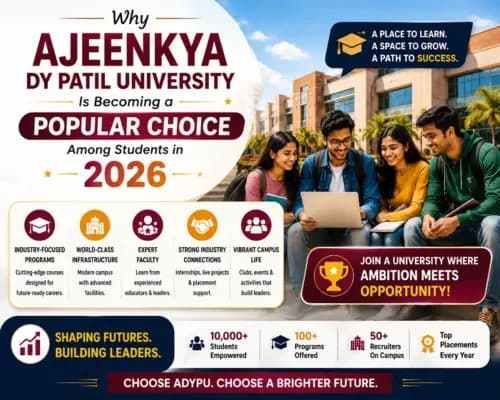
Why Ajeenkya DY Patil University Is Becoming a Popular Choice Among Students in 2026 Introduction The private university landscape in Pune has evolved considerably over the past decade — and in 2026, Ajeenkya DY Patil University is attracting a level of student and parent interest that places it among the more credibly rising private institutions in Maharashtra. This blog is written for students who are genuinely evaluating ADYPU Pune as a university choice and want an honest, informed assessment of why the institution is growing in appeal — not a brochure reproduction. The answer to why Ajeenkya DY Patil University is gaining traction among students in 2026 is multi-dimensional — it involves the specific positioning of ADYPU courses in high-demand domains, an emphasis on industry focused education that addresses a genuine gap in how Indian private universities typically deliver curriculum, and a campus experience that has developed meaningfully since the university's early years. For students evaluating best private university Pune options — comparing ADYPU against Symbiosis, MIT-WPU, Flame, and similar institutions — this blog provides the context and specificity to make a genuinely informed comparison. The Ajeenkya DY Patil University review that follows covers the institution's academic strengths, placement infrastructure, campus life, and the honest trade-offs that every prospective student should understand before applying. Also Read: No Coding? No Problem! High-Income Tech Skills Without Programming Quick Highlights University Ajeenkya DY Patil University (ADYPU), Pune, Maharashtra Location Charoli, Pune — close to Pune International Airport and IT corridors Established 2014 — Maharashtra Private University Programmes Offered Engineering · Management · Design · Media · Law · Architecture · Health Sciences Known For Industry Integrations · International Collaborations · Design and Creative Programmes Blog Audience Students Evaluating ADYPU vs Symbiosis · MIT-WPU · Flame · VIT Pune Table of Contents How ADYPU Pune Is Positioned in 2026 ADYPU Courses — What Stands Out Industry Focused Education — The ADYPU Approach Ajeenkya DY Patil University Placements — Honest Assessment ADYPU Campus Life and Student Experience ADYPU Admissions 2026 — How to Apply ADYPU vs Other Top Private Universities in Pune Honest Review — Who Should (and Shouldn't) Choose ADYPU FAQs Conclusion How ADYPU Pune Is Positioned in 2026 Ajeenkya DY Patil University occupies a specific and increasingly credible position in Pune's private university landscape. It is not competing with Symbiosis International for the top-of-tier-1 position — nor is it positioned as a lower-tier fallback institution. In 2026, ADYPU Pune is best understood as a Tier 2 private university with genuine Tier 1 aspirations in specific domains: design, creative arts, media, and the interdisciplinary programmes that blend technology with industry application. The university's differentiation strategy — industry focused education through curriculum co-development with companies, mandatory internship integration, and international academic partnerships — addresses the single most frequent criticism of Indian private university education: the gap between what is taught and what employers actually need. Whether this strategy delivers in practice at Ajeenkya DY Patil University is examined in the placements section below. What has shifted in 2026 is the perception among prospective students. Social media visibility of ADYPU student life, peer-to-peer word of mouth from the 2022–24 cohorts who are now in employment, and the university's aggressive investment in campus infrastructure have all contributed to a growing consideration rate — particularly among students who are open to Pune as a city and who are evaluating creative, design, and management programmes rather than purely engineering. ADYPU Courses — What Stands Out The ADYPU courses portfolio covers engineering, management, design, media and communication, law, architecture, and health sciences — making it one of the more genuinely multi-disciplinary private university offerings in Maharashtra. But not all ADYPU courses are equally strong. Here is an honest assessment by programme category: Design and Creative Programmes — ADYPU's Strongest Domain B.Des (Communication Design, Product Design, Fashion Design, Game Design): The design school at Ajeenkya DY Patil University is among the more genuinely equipped private design programmes in Pune — with dedicated design studios, industry-grade software access, and a curriculum that incorporates real project briefs from industry partners. Game Design is a particularly differentiated offering, with very few private universities in India offering it with the infrastructure depth that ADYPU provides Animation and VFX: The media arts programmes benefit from the broader DY Patil group's media industry connections — producing graduates who have demonstrably found work in animation, post-production, and digital media studios Engineering Programmes — Mid-tier With Growing CSE Track BTech programmes in CSE, AI/ML, Mechanical, Civil, and Electronics — competitive with other Pune-area private engineering institutions at a similar fee range; CSE and AI/ML tracks have benefited from the industry focused education initiatives including IBM, Microsoft, and AWS academic partnerships Engineering at ADYPU is a viable option for students who didn't secure admission at MIT-WPU, Symbiosis Institute of Technology, or VIT Pune — it should be evaluated as a mid-tier private engineering option, not a primary choice for students with strong JEE scores Management — MBA and BBA MBA with specialisations in Marketing, Finance, HR, and Business Analytics — positioned below Symbiosis MBA but above the general baseline of Pune's private management colleges BBA is a strong undergraduate management offering — particularly for students who want a career-oriented foundation before pursuing a top MBA Media and Communication — Growing Credibility Journalism, Advertising, Public Relations, and Digital Media programmes benefit from Pune's active media industry; ADYPU student life in the media school includes production work, internships, and industry visits Related Article: Best Free AI Tools for Students in 2026 Industry Focused Education — The ADYPU Approach The most frequently cited reason why students choose Ajeenkya DY Patil University over other mid-tier Pune private universities is the institution's explicit emphasis on industry focused education. This manifests in several specific forms — not just marketing language: Curriculum co-development with industry: Several ADYPU courses — particularly in design, technology, and management — have been developed in collaboration with industry partners who also participate in live project delivery during the programme. IBM, Microsoft, AWS, Autodesk, Adobe, and sector-specific design and media companies have documented partnerships with the university Mandatory internship integration: ADYPU builds internship components into the formal academic programme rather than treating them as extracurricular activities — internship completion and performance are graded academic requirements in most programmes Industry mentorship: The mentorship programme connects students with working professionals across their target industry — covering career planning, portfolio review, and networking in a structured format International academic collaborations: ADYPU has established partnerships with universities in the UK, USA, Australia, and Southeast Asia — providing student exchange, dual-degree, and collaborative research opportunities that are more developed than those at many comparable-tier Pune institutions Entrepreneurship and startup ecosystem: The ADYPU incubation centre and entrepreneurship development cell supports student ventures — a growing priority for students who are exploring startup pathways alongside traditional employment The honest caveat: The quality of industry integration varies significantly across schools within the university. Design, animation, and select technology programmes demonstrate the highest industry curriculum integration. Engineering programmes — particularly non-CSE tracks — show a more conventional curriculum with industry integration that is meaningful but less deeply embedded than in the creative schools. The industry focused education claim is strongest for students who choose ADYPU specifically for its design or media programmes. Ajeenkya DY Patil University Placements — Honest Assessment Ajeenkya DY Patil University placements are among the most frequently researched questions by prospective students — and the honest picture requires differentiating by programme, because outcomes vary considerably across schools. Design and Creative Programmes: The strongest Ajeenkya DY Patil University placements outcomes are in design, animation, and media — with graduates placed at studios, agencies, gaming companies, production houses, and digital marketing firms across India and in a smaller number of international opportunities. Portfolio quality is the primary determinant of outcomes in this space, and ADYPU's curriculum investment in portfolio development produces competitive graduates Engineering (CSE / AI/ML): IT services companies (TCS, Wipro, Infosys, Cognizant) recruit in bulk; selective product company placements exist for top-quartile CSE students who invest in DSA and competitive programming beyond the formal curriculum. The placement profile is consistent with other mid-tier Pune private engineering institutions Management: MBA placements focus on mid-size companies, Pune-based corporate headquarters, and FMCG, financial services, and technology companies with Maharashtra operations. The Business Analytics MBA track has a stronger placement profile than general MBA Media and Communication: Internship-to-placement conversion is high — Pune's active media and advertising sector absorbs BMM/Communication graduates from ADYPU Overall placement infrastructure: The Training and Placement Cell at ADYPU Pune is active and maintains company relationships across sectors. The highest-placed students are consistently those who supplement institutional facilitation with self-directed DSA practice (for engineering), portfolio development (for design), and domain expertise (for management) Key Insight: Ajeenkya DY Patil University placements are best for students who treat the degree as a platform and actively invest in skill development beyond the classroom. Students who rely entirely on institutional placement facilitation will achieve moderate outcomes. Students who build portfolios, complete quality internships, and develop domain-specific competencies achieve the highest outcomes. ADYPU Campus Life and Student Experience ADYPU campus life is one of the factors that has changed the most in the perception of the university since its early years. The campus infrastructure — spread across the Charoli campus in Pune — has developed into a genuinely capable environment with sports facilities, design studios, media production labs, coding centres, cafeterias, and residential options that support a full campus experience. Campus infrastructure: Modern lecture halls and seminar rooms, well-equipped design studios with industry-grade tools (Autodesk, Adobe Creative Suite, game engines), a media production facility that includes recording studios and green-screen facilities, engineering labs with reasonable equipment quality, and a sports complex covering cricket, football, basketball, and indoor sports Hostel and accommodation: Both on-campus and off-campus accommodation options are available; the hostel facilities are adequate — not luxury — and Charoli's proximity to Pune city centre provides reasonable access to the broader city ecosystem Student clubs and activities: ADYPU student life features an active student club ecosystem — technical clubs, design collectives, entrepreneurship cells, sports teams, cultural festivals, and inter-university competitions. The annual cultural fest and the design showcase have grown into events that attract industry participation International exposure: Student exchange programmes, international workshops, and visiting faculty from partner universities contribute to a campus culture that is meaningfully more internationally connected than comparable-tier institutions Location advantage: Charoli, Pune — the university's location provides proximity to the Pune IT corridor, Hinjewadi tech park, and Pune's broader professional ecosystem, facilitating internship access and industry engagement in a way that more remote campuses cannot Honest assessment of ADYPU campus life: Students from major metros who have experienced high-resource urban environments may find the campus infrastructure functional but not exceptional compared to top-tier institutions. Students transitioning from smaller cities to Pune will find ADYPU's campus a genuinely capable and well-resourced environment. The experience is strongest for students who actively engage with clubs, the entrepreneurship cell, and the design/media production facilities. ADYPU Admissions 2026 — How to Apply ADYPU admissions 2026 are conducted through a combination of centralised national entrance scores and the university's own aptitude process — with the specific pathway varying by programme: Engineering (BTech): JEE Main 2026 score or MHT CET 2026 score — along with HSC marks for eligibility. Merit-based scholarship is available for strong JEE/CET performers Design (B.Des): NID DAT, UCEED, or CEED scores considered; ADYPU also conducts its own design aptitude test and portfolio review. Design admissions are the most competitive in the ADYPU admissions 2026 cycle Management (BBA / MBA): BBA through HSC merit; MBA through CAT/MAT/CMAT scores or ADYPU's own management entrance Media and Law: HSC merit with CLAT scores considered for Law; aptitude tests for media programmes Scholarship availability: Merit-based fee scholarships for top performers in national entrance examinations; sports and arts scholarships for students with documented achievements Apply at: adypu.edu.in — the official portal with programme-specific application processes and the ADYPU admissions 2026 schedule Honest Review — Who Should (and Shouldn't) Choose ADYPU Choose Ajeenkya DY Patil University If: You are specifically interested in Design, Animation, Game Design, or Creative Media — ADYPU is genuinely among the better options in Pune for these disciplines at a fee point that is competitive with less well-equipped alternatives You value industry focused education over pure academic theory — and you will actively engage with the internship programmes, mentorship, and industry partner sessions that ADYPU provides You are interested in interdisciplinary programmes that blend technology with design or media — ADYPU's cross-disciplinary curriculum design is a genuine differentiator You want access to international exchange and collaboration opportunities at a fee level below top-tier institutions like Symbiosis You are evaluating Pune as your city of choice and want a private university with a developing but genuine campus community Look Elsewhere If: Your primary goal is an MBA — Symbiosis SCMHRD, SIBM, or Pune University-affiliated MBA programmes have stronger brand recognition with employers that matters at the recruitment stage You are targeting a top-quartile engineering placement — ADYPU's engineering placement profile is consistent with mid-tier private institutions; students targeting Tier 1 product companies should prioritise institutions with stronger technical placement records Campus infrastructure quality is a top decision criterion — ADYPU's campus is functional and developing, but does not yet match the established campuses of Symbiosis or MIT-WPU in overall infrastructure quality You have secured admission at a clearly stronger institution in your target programme — no loyalty to a second-choice institution is warranted if a definitively better option is available 🎓 One Form · Multiple Colleges Stop Stressing. Start Applying. Skip the chaos of filling endless forms. Apply to your dream colleges in one go through the College Nirnay Common Application Form — built for every student navigating India's competitive education landscape. Fill the Common Application Form → ✓ Free to apply · ✓ Takes under 5 minutes · ✓ Trusted by thousands of students FAQs Q1. Is Ajeenkya DY Patil University a good university? Ajeenkya DY Patil University is a good university for the right student choosing the right programme. Its strongest areas are Design, Animation, Creative Media, and interdisciplinary technology programmes — where the combination of industry focused education, portfolio development infrastructure, and international exposure creates genuinely competitive graduates. For general engineering and standard MBA programmes, the Ajeenkya DY Patil University review is more moderate — the institution is credible and improving, but faces strong competition from MIT-WPU and Symbiosis for student quality and placement records in these areas. Q2. How are ADYPU placements compared to other Pune universities? Ajeenkya DY Patil University placements are strongest in Design, Creative Media, and Animation — where portfolio-driven industry hiring gives ADYPU graduates a competitive positioning. For Engineering, ADYPU Pune placements are comparable to other mid-tier private Pune engineering institutions — bulk IT services recruitment through Infosys, TCS, and Wipro, with selective product company placements for top CSE/AI performers. The best private university Pune for placements overall is Symbiosis for management; MIT-WPU for engineering; and ADYPU for design and creative programmes. Q3. How do I apply for ADYPU Admissions 2026? ADYPU admissions 2026 are conducted through the official portal at adypu.edu.in — with programme-specific processes for Engineering (JEE Main / MHT CET scores), Design (NID DAT / UCEED / ADYPU design aptitude), Management (CAT/MAT/CMAT for MBA; HSC merit for BBA), and other programmes. Merit-based scholarships are available for strong entrance performance. Visit adypu.edu.in for the current ADYPU admissions 2026 schedule, eligibility criteria, and application process — and if possible, schedule a campus visit to assess the infrastructure and speak with current students in your target programme before confirming admission. Q4. What is ADYPU campus life like? ADYPU campus life is active and increasingly well-resourced — with design studios, media production facilities, sports infrastructure, and a student club ecosystem that spans technical, creative, cultural, and entrepreneurial domains. ADYPU student life benefits from Pune's city ecosystem and proximity to the Hinjewadi IT corridor for internship access. The campus experience is strongest for students who actively engage with available resources rather than treating the university purely as a classroom institution. Hostel accommodation and cafeteria facilities are functional — students from large metros may find the scale modest compared to top-tier institutions. Q5. Is ADYPU better than other private universities in Pune? For design and creative programmes, Ajeenkya DY Patil University is among the top private options in Pune in 2026 — a genuinely competitive choice against institutions that have stronger overall brand recognition but less specialised infrastructure in design and creative disciplines. For engineering and management, ADYPU Pune competes in the mid-tier with MIT-WPU and Symbiosis offering stronger alternatives for most students in those disciplines. The best private university Pune answer depends entirely on which programme you are evaluating — the comparison in this blog covers the key criteria by programme domain. Explore More CGPA vs Experience: What Matters More? How to Choose Your Dream University Top Emerging Courses in 2026 Careers Without a Traditional Degree JEE Main 2026 Result Updates Top AI Skills Students Must Learn Best Free AI Tools for Students Freelancing vs Job for Students Conclusion Ajeenkya DY Patil University is becoming a more popular choice among students in 2026 for reasons that are real and documentable — not simply marketing: the growing strength of its design and creative programmes, the genuine integration of industry focused education into curriculum delivery, the development of ADYPU campus life and infrastructure, and the university's increasingly strong international connections. These are meaningful improvements that have translated into better student outcomes and greater word-of-mouth visibility. The honest synthesis: ADYPU Pune is the right choice for students whose target programme aligns with its strengths — design, creative arts, animation, media, and technology programmes that benefit from industry focused education — and who will actively engage with the industry integration, internship infrastructure, and international exposure the university provides. It is not the right choice if the decision is primarily based on brand name recognition or if the target programme is one where clearly stronger institutions are accessible. Visit College Nirnay for detailed ADYPU admissions 2026 guidance, ADYPU courses comparison across all programmes, and the most current Ajeenkya DY Patil University review — to ensure your university decision is made with the complete information picture rather than brochure impressions or social media first looks.

A Complete Student Guide to Life at JK Lakshmipat University | College Nirnay html { scroll-behavior: smooth; } summary::-webkit-details-marker { display: none; } A Complete Student Guide to Life at JK Lakshmipat University Introduction JK Lakshmipat University occupies a distinctive position in Jaipur's private university landscape — not because it is the largest or the oldest, but because it has built a deliberate, differentiated model of higher education that combines engineering and management with liberal arts integration, entrepreneurship culture, and a smaller-batch, high-attention academic environment that produces outcomes disproportionate to its size. For students considering JKLU, understanding what this model actually means in daily practice — in the classroom, in the hostel corridor, in the placement season, and in the city of Jaipur itself — is what this guide is for. This is a complete, honest student guide JKLU — covering every dimension of university life at JKLU that a prospective student or incoming fresher needs to understand before Day 1. From JKLU courses and academic culture to JKLU hostel life, JK Lakshmipat University campus infrastructure, JKLU placements outcomes, and the JKLU fresher guide essentials that nobody tells you in the brochure — this blog gives you the full picture with the specificity and honesty that genuine decision-making requires. Whether you are a student deciding between JKLU and other Jaipur institutions, a fresher preparing for your first semester at JKLU Jaipur, or a parent evaluating this university for your child — this guide is built for you. Read it as a reference, not a ranking — because what makes JK Lakshmipat University the right choice for some students is precisely what makes it the wrong choice for others, and understanding that distinction clearly is the most valuable thing this guide can help you do. Also Read: Top Factors to Consider When Selecting Your Dream University Quick Highlights Aspect Details University JK Lakshmipat University (JKLU), Jaipur Established 2011 — Private University, Rajasthan Act Location Mahindra SEZ, Jaipur, Rajasthan Key Programmes B.Tech · MBA · BBA · B.Des · M.Tech · MCA Distinctive Model Liberal education integration · Small batch sizes · Entrepreneurship focus Blog Focus Complete honest student guide — campus, hostel, academics, placements Who This Is For Prospective students, incoming freshers, and families evaluating JKLU Jaipur Table of Contents Why JK Lakshmipat University Stands Out in Jaipur JKLU Courses — Academic Programmes and Curriculum Design JK Lakshmipat University Campus — Infrastructure and Facilities JKLU Hostel — Residential Life on Campus JKLU Student Life — Academics, Activities, and Culture JKLU Placements — Career Outcomes and Industry Connect JKLU Fresher Guide — What to Know Before You Arrive FAQs Conclusion Why JK Lakshmipat University Stands Out in Jaipur To understand what makes JK Lakshmipat University different, you need to understand the educational philosophy it was built on — because that philosophy shapes everything from the curriculum design to the way faculty engage with students to the kind of professional the university is trying to produce. JKLU Jaipur was founded on the conviction that India's engineering and management graduates are over-specialised and under-rounded — technically capable in narrow domains but lacking the cross-disciplinary thinking, communication skills, and creative problem-solving that complex professional environments actually demand. The Liberal Education + Engineering Model JK Lakshmipat University built a curriculum that deliberately integrates liberal arts components — writing, philosophy, social science, design thinking, and communication — into engineering and management programmes alongside the technical core. This is not a cosmetic addition; it is a structural commitment that means a B.Tech student at JKLU Jaipur graduates with genuinely stronger written communication, critical thinking, and interdisciplinary awareness than most of their peers from conventional engineering programmes. Employers who hire from JKLU consistently note this difference — and for students who understand its value, it is one of the most compelling reasons to choose this university. Small Batch Sizes and Faculty Attention JK Lakshmipat University operates with significantly smaller batch sizes than most private universities in Rajasthan — a deliberate structural choice that produces a qualitatively different academic experience. In a class of 30 to 40 students rather than 120, every student is visible to every faculty member. Office hour conversations happen. Projects are assessed individually, not just as anonymous submissions. Faculty mentorship of specific students for research, internships, and career development is practically feasible in a way it is not in larger institutions. For students who thrive with individual attention and genuine faculty engagement, the small-batch environment of university life at JKLU is one of its most valuable characteristics. Entrepreneurship and Innovation Culture The entrepreneurship emphasis at JKLU Jaipur is structural, not decorative. The university has a dedicated entrepreneurship and innovation centre, funds student startup ideas through internal seed grant mechanisms, and maintains active connections with Jaipur's startup and investor ecosystem. Students who want to build something during their degree — rather than simply preparing to work for someone else — find the university life at JKLU environment actively supportive in ways that most conventional universities, focused primarily on placement statistics, simply are not. Related Article: Top B.Tech Colleges in India: Fees, Admission & Ranking 2026 JKLU Courses — Academic Programmes and Curriculum Design The JKLU courses portfolio spans engineering, management, design, and applied sciences — with a curriculum philosophy that consistently prioritises depth of understanding over breadth of coverage, practical application alongside theoretical grounding, and interdisciplinary exposure at every stage. Understanding what is actually taught — and how — is essential for any student seriously evaluating whether JK Lakshmipat University is the right fit for their goals. B.Tech Programmes — Engineering with a Difference The flagship B.Tech JKLU courses include Computer Science and Engineering (with specialisations in AI, Data Science, and Cybersecurity), Mechanical Engineering, Electrical Engineering, and Civil Engineering. What differentiates the B.Tech curriculum at JK Lakshmipat University from conventional engineering programmes is the mandatory liberal arts core — courses in writing, ethics, design thinking, and communication that run alongside technical subjects throughout all four years — and the project-based learning components embedded from Semester 1 rather than deferred to the final year. Students who engage genuinely with both the technical and liberal components consistently report that the combination produces a more holistic professional capability than either dimension alone would have. MBA and BBA — Management Education at JKLU The MBA and BBA JKLU courses are built around the same liberal-integrated curriculum philosophy as the engineering programmes — with a strong emphasis on case-based learning, live industry projects, and entrepreneurship. The MBA at JKLU Jaipur draws on the university's industry connections for guest faculty, live consulting projects, and internship placements. For students targeting management careers in Jaipur-based or Rajasthan-focused organisations, the regional industry network that the university has built is a genuine and practical advantage over institutions without those specific connections. B.Des — Design as a Core Discipline The Bachelor of Design programme is one of the most distinctive JKLU courses in the Jaipur private university landscape — covering product design, interaction design, and communication design within a curriculum that connects design theory with engineering practice and human-centred thinking. For students with a design sensibility who want a programme that takes the discipline seriously rather than treating it as a subdepartment of engineering, JKLU's B.Des is one of the more credible options available in Rajasthan. The programme's integration into the larger JK Lakshmipat University engineering and technology environment also provides cross-disciplinary collaboration opportunities that standalone design institutes cannot offer. Curriculum Depth: What Students Actually Experience Across all JKLU courses, the academic experience is characterised by higher assignment frequency, more active classroom participation expectations, and more direct faculty engagement than students accustomed to passive lecture formats typically expect. This is a feature for students who want genuine intellectual development — and an adjustment challenge for those who expected university to involve less active engagement than school. The honest student guide JKLU advice is to arrive expecting to be challenged and to engage — not to sit, receive, and perform at exam time. JK Lakshmipat University Campus — Infrastructure and Facilities The JK Lakshmipat University campus is located within the Mahindra World City SEZ in Jaipur — a planned industrial and business development zone on the outskirts of the city that gives the campus a clean, professionally landscaped environment distinct from the urban density of central Jaipur. The campus design reflects the university's values — open, modern, and designed for both individual focus and collaborative interaction. Academic Infrastructure The JK Lakshmipat University campus academic blocks include well-maintained lecture halls, seminar rooms designed for discussion-format teaching, and state-of-the-art laboratories for engineering, computing, and design programmes. The computing infrastructure is regularly upgraded — an important practical consideration for CS and engineering students whose laboratory environments need to reflect current industry tools. The design studios for B.Des students are purpose-built with the equipment, software, and collaborative workspace that serious design education requires. Library and Learning Resources The central library at the JK Lakshmipat University campus provides access to physical collections and digital subscriptions across engineering, management, design, and social sciences. The digital resource access — including e-journal databases, online research repositories, and digital textbooks — is one area where JKLU's library investment exceeds what most comparable private universities in Rajasthan provide, and it is a resource that students who engage with research from early in their degree will find genuinely valuable. Register your library access in the first week and learn the digital portal before you need it urgently. Innovation and Entrepreneurship Centre One of the most distinctive physical spaces on the JK Lakshmipat University campus is the dedicated Innovation and Entrepreneurship Centre — a maker space, incubation hub, and startup support environment that is available to all students regardless of their programme. The Centre hosts prototyping equipment, collaborative workspaces, mentoring sessions with entrepreneurs and investors, and the internal seed funding process for student startup ideas. For students whose goals extend beyond employment into building something of their own, this facility represents a genuine infrastructure investment by the university that most peer institutions have not made. Sports, Recreation, and Campus Wellbeing The JKLU Jaipur campus infrastructure for sports and physical wellbeing includes outdoor grounds for cricket, football, and basketball, indoor sports facilities, and a gymnasium. The campus environment — surrounded by the planned green spaces of the Mahindra World City development — is particularly conducive to the kind of daily outdoor activity that supports both physical health and the mental clarity that rigorous academic programmes demand. The relative tranquillity of the campus location, away from the noise and traffic density of central Jaipur, is a consistent positive in student feedback about the overall JKLU student life environment. CHECK OUT: Best Free AI Tools for Students in 2026 — Study Smarter at JKLU JKLU Hostel — Residential Life on Campus Residential life at the JKLU hostel is one of the most consistently distinctive aspects of the overall university life at JKLU — and one of the areas where the small-community character of the university produces an experience that differs meaningfully from what students encounter at larger institutions. The JKLU hostel environment is more intimate, more closely connected to the academic life of the campus, and more conducive to the kind of deep peer relationships that the small batch model of the university encourages across every dimension of student experience. Hostel Facilities and Room Types The JKLU hostel provides separate accommodation blocks for male and female students, with double and single occupancy room options depending on availability. Rooms are furnished with basic necessities — bed, study desk, wardrobe, and fan — with AC options available in some configurations. The hostel Wi-Fi coverage is campus-wide and is generally considered reliable by residential students for academic and personal use, though evening peak hours produce occasional slowdowns that a personal data backup plan manages effectively. The campus location within Mahindra World City means the immediate surrounding area is well-maintained and safe — a practical quality-of-life advantage for both students and parents. Mess and Dining at JKLU Hostel The JKLU hostel mess provides regular meals across breakfast, lunch, and dinner at scheduled times. The food quality — as at virtually every Indian university hostel — is the most variable and most commented-upon aspect of residential life. The honest JKLU student life assessment of the mess is that it is adequate, reasonably hygienic, and significantly improved from the university's early years. Students who require dietary variety supplement with the campus canteen, the food options available within Mahindra World City, and Jaipur's food delivery ecosystem — all of which are accessible during permitted hostel hours. The Social Dimension of Hostel Life at JKLU Because JKLU Jaipur operates with small batch sizes across all programmes, the hostel community is smaller and more tightly knit than at large private universities — and this has a measurable effect on the quality of social connections formed during the degree. The students who live in the JKLU hostel tend to know each other across programmes rather than exclusively within their own batch, which produces a richer cross-disciplinary social and intellectual environment than larger, more siloed residential systems. The friendships built in the JKLU hostel — between B.Tech, MBA, BBA, and B.Des students living in the same community — are frequently cited by alumni as one of the most enduring and professionally valuable outcomes of their time at the university. Hostel Rules and What Freshers Should Know The JKLU hostel operates under the standard set of rules governing curfew timing, visitor policies, noise regulations, and disciplinary procedures. These rules are actively enforced and should be read and understood completely before arrival. The warden and hostel administration at JK Lakshmipat University are generally reported by students as approachable and reasonable in enforcement — but the rules exist for good reasons and violations have real consequences. As a JKLU fresher guide essential: read the hostel handbook during orientation week, not when you have already made an inadvertent violation. JKLU Student Life — Academics, Activities, and Culture JKLU student life is shaped by the same core characteristic that defines every other dimension of the university — intentional smallness. The student community at JK Lakshmipat University is not large, and the culture that this produces is one of genuine familiarity, accessible faculty, active peer collaboration, and a social environment where meaningful connections are formed relatively quickly compared to the anonymous first-semester experience at large universities. Academic Culture — What to Genuinely Expect The academic culture at JKLU Jaipur is meaningfully more demanding in terms of active participation and continuous assessment than most students who come from conventional school systems expect. The curriculum is not designed around a single semester-end examination — it is continuous: presentations, assignments, projects, group work, and class participation all contribute to the final grade, which means that absence, disengagement, or half-hearted effort is visible immediately rather than concealed until the exam. Students who thrive in this environment are those who genuinely enjoy learning and are willing to be intellectually uncomfortable — which is a self-selection filter that the university's small-community environment makes quite transparent. Clubs, Societies, and Co-curricular Life JKLU student life beyond the classroom includes an active ecosystem of student-run clubs across technical, cultural, social, and entrepreneurship domains. The annual cultural and technical festivals are well-organised events that bring students from across the campus together and provide inter-college competition experience. Technical clubs aligned with the engineering programmes host workshops, hackathons, and guest industry sessions throughout the academic year — and participation from the first semester is consistently among the highest-return co-curricular investments in the student guide JKLU advice from seniors to freshers. Jaipur as Part of the University Life at JKLU University life at JKLU extends well beyond the Mahindra World City campus into Jaipur itself — and this extension is one of the genuine advantages of studying in a city as rich and connected as Jaipur. The technology and startup ecosystem of the city, the cultural life of the Walled City and its surrounding heritage, the Jaipur Literature Festival, and the broader social and professional opportunities available to university students in Jaipur all enrich the JKLU experience in ways that campus-only environments cannot. Students who engage actively with the city — attending industry events, exploring its cultural offerings, and building connections in the Jaipur professional community — leave with a broader and deeper experience than those who remain exclusively within the campus boundary. Student Diversity and Campus Community The JKLU student life community draws students from across Rajasthan and increasingly from other states — attracted by the university's distinctive educational model and the quality of its academic environment. The resulting campus community has more diversity of background, aspiration, and perspective than a purely local student body would produce — and this diversity is one of the social enrichments of university life at JKLU that students in the small-batch environment experience directly, in every classroom discussion and every collaborative project team. Related Article: Top AI Skills Students Must Learn in 2026 JKLU Placements — Career Outcomes and Industry Connect JKLU placements are one of the most frequently researched aspects of the university for prospective students — and one of the areas where the honest picture is more nuanced than a simple headline figure conveys. The placement record at JK Lakshmipat University reflects the university's distinctive profile: smaller cohort sizes mean absolute placement numbers are smaller than at large universities, but the quality and diversity of companies that recruit from JKLU are often proportionately stronger than the university's ranking would suggest. Companies That Recruit from JKLU JKLU placements across recent years have included IT services companies (TCS, Infosys, Cognizant, and their ecosystem partners), technology product companies and startups, consulting firms, FMCG and retail organisations, financial services companies, and design and media agencies. The specific mix varies by programme — B.Tech CSE produces the strongest technology sector placement outcomes, while MBA and BBA graduates enter marketing, operations, consulting, and finance roles. B.Des graduates find placements across design agencies, in-house design teams at product companies, and UX/UI roles at technology firms. The breadth of companies that engage with JKLU Jaipur is partly a function of the university's liberal education model — graduates who can communicate well, think across disciplines, and engage with complex problems are valuable to a wider range of employers than purely technically specialised graduates. What Determines Individual Placement Outcomes at JKLU The most consistent pattern across JKLU placements data is the same one that applies at every university outside the IIT/IIM tier: individual preparation and demonstrated capability, not institutional brand, determines which end of the placement outcome distribution a student occupies. Students who build strong technical skills alongside the liberal arts capabilities the curriculum develops, who maintain a strong CGPA, who pursue internships actively from Year 2 onwards, and who engage with the placement cell's preparation programmes consistently from their third year are those who achieve the strongest individual outcomes. The honest student guide JKLU message on placements is: the institution provides a genuinely good platform and an active placement cell — the outcome is co-produced by the student across all four years. Entrepreneurship as a Placement Outcome One dimension of JKLU placements that is absent from most placement statistics but genuinely significant at this university is the proportion of graduates who do not enter employment at all — not because they could not, but because they chose to launch ventures instead. The entrepreneurship culture at JK Lakshmipat University produces a higher-than-average proportion of founder-track graduates who use the campus incubation infrastructure to build businesses during and immediately after their degree. For students whose career aspiration is building rather than joining, this outcome pathway is as legitimate and supported as the conventional placement route — and it is one of the genuine differentiators of university life at JKLU compared to most peer institutions. Starting Salaries and Long-Term Career Trajectory Entry-level starting salaries for JKLU placements vary significantly by programme and company tier — B.Tech CSE graduates joining technology companies typically start between ₹4 lakh and ₹10 lakh per annum, MBA graduates in management roles between ₹5 lakh and ₹12 lakh, and B.Des graduates in design and UX roles between ₹4 lakh and ₹9 lakh. The more meaningful metric than starting salary at any private university — including JKLU Jaipur — is the long-term trajectory of graduates who invested fully in the four-year experience: the liberal education model consistently produces graduates who grow into leadership roles faster than their technically specialised peers, and this trajectory advantage compounds significantly over a 10-year career horizon. JKLU Fresher Guide — What to Know Before You Arrive This JKLU fresher guide section is for students who have confirmed their admission and are preparing for their first semester. The things covered here are the ones that seniors at JK Lakshmipat University consistently wish someone had told them before Day 1 — not generic advice, but specific insights calibrated to the JKLU environment. Arrive Early and Learn the Campus Before Classes Begin The JK Lakshmipat University campus at Mahindra World City is compact enough that a single thorough campus walk covers everything — but knowing where the library, your department building, the Innovation Centre, the health facility, the placement cell office, and the hostel warden's office are before your first class makes the first week significantly less disorienting. Arrive on campus at least one day before orientation and spend that time mapping everything physically. Students who know where they are going from Day 1 project confidence and are more accessible to faculty engagement than those who are still navigating on Day 5. Engage With Faculty From the First Week The small-batch environment of JKLU student life makes genuine faculty engagement not just possible but practically easy — and this is one of the university's greatest structural advantages. Visit two or three faculty members during their consultation hours in the first two weeks — not with a problem, but simply to introduce yourself and express interest in their subject or research. In a community as small as JK Lakshmipat University, faculty who know you as a person engage with your work, your career, and your development in ways that faculty managing hundreds of anonymous students simply cannot. Use this advantage from Day 1. Embrace the Liberal Arts Components — They Are Not Filler One of the most common adjustment challenges for freshers in the JKLU courses is the mandatory liberal arts component — the writing courses, philosophy seminars, communication workshops, and design thinking modules that run alongside the technical core. Students who come expecting a conventional engineering or management curriculum sometimes resist these components as unnecessary, soft, or irrelevant to their career goals. This is the single most consequential intellectual error a JKLU fresher can make. The graduates who benefit most from the JK Lakshmipat University model are those who engage genuinely with every component — including the liberal ones — because the combination, not either component alone, produces the cross-disciplinary capability that defines the JKLU graduate's professional edge. Build Your Professional Presence from Semester 1 Create a LinkedIn profile in your first week. Add your programme, institution, and interests. Connect with JKLU seniors, faculty, and Jaipur-area professionals in your field of interest. Begin the habit of posting about your projects, ideas, and learning — even when they feel small and incomplete. The professional presence you build across four years of JKLU student life is visible to every recruiter who considers you at placement time — and the students who begin building it in Semester 1 rather than Semester 7 have a measurable advantage that no last-minute LinkedIn update can replicate. Use the Innovation Centre and Entrepreneurship Infrastructure Even if you have no immediate startup idea, make it a point to visit the Innovation and Entrepreneurship Centre in your first month at JKLU Jaipur. Attend the workshops, meet the mentors, and understand what resources are available. The best ideas rarely arrive in isolation — they emerge from exposure to the work, thinking, and conversations happening around you. The students who discover the entrepreneurship infrastructure in their final year and wish they had used it from Year 1 are the single most consistent regret pattern in JK Lakshmipat University alumni feedback. Do not be that student. Manage Your Expectations Honestly The final and most important item in this JKLU fresher guide is the same one that closes every honest student guide to any university: the quality of your university life at JKLU is co-produced by you and the institution. JK Lakshmipat University provides exceptional infrastructure, a thoughtful curriculum, a genuinely supportive faculty, and an entrepreneurship culture that is rare at the private university level in Rajasthan. What it cannot provide is your engagement, your discipline, your curiosity, or your willingness to be intellectually challenged and grow through the discomfort that real learning requires. The students who leave JKLU with the strongest outcomes — academically, professionally, and personally — are those who understood this from the beginning and acted accordingly. 🎓 One Form · Multiple Colleges Stop Stressing. Start Applying. Skip the chaos of filling endless forms. Apply to your dream colleges in one go through the College Nirnay Common Application Form — built for every student navigating India's competitive education landscape. Fill the Common Application Form → ✓ Free to apply · ✓ Takes under 5 minutes · ✓ Trusted by thousands of students FAQs Q1. What programmes does JK Lakshmipat University offer? JK Lakshmipat University offers B.Tech (in Computer Science and Engineering, Mechanical, Electrical, and Civil Engineering), Bachelor of Design, BBA, MBA, M.Tech, and MCA across its campus at Mahindra World City in Jaipur. All JKLU courses are delivered through a liberal education-integrated curriculum that combines technical or professional depth with communication, critical thinking, and design thinking components across all four years of the programme. Q2. How are JKLU placements for engineering and management graduates? JKLU placements include IT services companies, technology product firms, startups, consulting organisations, FMCG companies, and design agencies. B.Tech CSE starting salaries typically range from ₹4 lakh to ₹10 lakh per annum, MBA graduates from ₹5 lakh to ₹12 lakh, and B.Des graduates from ₹4 lakh to ₹9 lakh. Placement outcomes are significantly influenced by individual preparation — students who build skills, internship experience, and a strong portfolio across all four years consistently achieve the strongest results from the JKLU Jaipur placement process. Q3. What is the JKLU hostel experience like? The JKLU hostel provides separate accommodation for male and female students with double and single occupancy options, basic furnished rooms, campus Wi-Fi, and mess dining. The residential experience is more intimate than at large universities due to the smaller student community — cross-programme friendships form naturally, faculty are genuinely accessible, and the hostel culture reflects the collaborative, intellectually active character of JKLU student life overall. The campus location within Mahindra World City provides a clean, secure environment that students and parents consistently rate positively. Q4. What makes JK Lakshmipat University different from other private universities in Jaipur? JK Lakshmipat University is distinguished by three structural characteristics that are rare in the Jaipur private university landscape: a mandatory liberal arts integration into all technical and management programmes, deliberately small batch sizes that enable genuine faculty attention and intellectual community, and a committed entrepreneurship culture with dedicated infrastructure and funding support for student ventures. These three features combine to produce a university life at JKLU experience that develops graduates with stronger cross-disciplinary capability, communication skills, and creative problem-solving than most comparable programmes — at the cost of a more demanding and actively engaging academic environment. Q5. What should a fresher know before joining JKLU? The most important things for any fresher to know as a JKLU fresher guide essential are: the academic culture is more participatory and continuously assessed than most students expect; the liberal arts components are genuinely valuable and should be engaged with rather than tolerated; faculty are accessible and approachable in the small-batch environment — use this from Week 1; the Innovation Centre is available from Day 1 — visit it early; and LinkedIn and professional presence building should begin in Semester 1 for maximum impact at placement time. The students who thrive in JKLU student life are those who arrive prepared to be actively, intellectually engaged rather than passively taught. Q6. Is JKLU Jaipur a good choice for students interested in entrepreneurship? JKLU Jaipur is one of the strongest choices among Rajasthan private universities for students whose career direction includes entrepreneurship. The dedicated Innovation and Entrepreneurship Centre, internal seed grant mechanism, active connections with Jaipur's startup and investor ecosystem, and a campus culture that actively celebrates founders make JK Lakshmipat University genuinely supportive of venture creation in a way most peer institutions are not. A meaningful proportion of JKLU graduates choose the entrepreneurship path over conventional employment — and the infrastructure, mentoring, and cultural environment that enables this is a structural feature of university life at JKLU rather than an occasional event programme. Explore More CGPA vs Experience: What Matters? How to Choose Your Dream University Top B.Tech Colleges India Top M.Tech Colleges India Top AI Skills Students Must Learn Best Free AI Tools for Students Top Emerging Courses 2026 Freelancing vs Job for Students Conclusion JK Lakshmipat University is not the right choice for every student — and the honesty of that statement is itself part of the honest student guide JKLU that prospective students deserve. It is the right choice for students who value genuine intellectual development over credential collection, who want a campus environment where they are known and challenged rather than anonymous and comfortable, who are drawn to the intersection of technical capability and liberal thinking, and who want the support infrastructure to build something of their own alongside or after their degree. For those students, university life at JKLU — from the JK Lakshmipat University campus at Mahindra World City to the intimate JKLU hostel community, the demanding and rewarding JKLU courses, the active JKLU student life ecosystem, and the strong JKLU placements outcomes that follow genuine four-year investment — delivers on its promise in ways that are measurable, alumni-confirmed, and structurally grounded in an educational model that is more thoughtfully designed than most of its competitors in the Jaipur private university landscape. Explore College Nirnay for detailed programme comparisons, admissions guidance, placement data, and everything a student needs to make the best possible decision about their next four years — wherever that decision leads.

Best Courses at Poornima University for High Salary Careers Introduction Choosing a university and a programme is one of the most consequential decisions you will make in your early adult life — and it deserves more than a brochure reading and a campus tour. Poornima University, located in Jaipur, Rajasthan, has built a reputation as one of the more credibly career-focused private universities in the state — with an emphasis on Poornima University placements, industry connectivity, and curriculum design that takes employability seriously rather than treating it as a marketing claim. This blog is written for students who are genuinely evaluating Poornima University courses and want to know which programmes are most strongly aligned with high-salary careers — not which programmes sound impressive in a brochure. The answer is not the same for every student. High salary potential depends on the intersection of programme quality, industry demand for that discipline, and what a student does with the four years of the programme. This blog examines the best courses at Poornima University — specifically the high salary courses — across engineering, management, design, and allied disciplines — with an honest assessment of what each programme offers, what career trajectories it opens, and what the Poornima University placements picture looks like for each. Whether you are a Class 12 student deciding between B.Tech at Poornima University and other Jaipur options, a lateral entry candidate considering MCA or MBA, or a parent researching top university courses Rajasthan for your child — this is the assessment you need. Also Read: No Coding? No Problem! High-Income Tech Skills Without Programming Quick Highlights University Poornima University, Jaipur, Rajasthan Blog Focus Best Courses for High Salary Careers — Honest Assessment Top Programmes Covered B.Tech (CSE, AI/ML, ECE) · MBA · MCA · B.Des · B.Sc Data Science Placement Strength CSE and AI/ML tracks — highest salary outcomes; management and design growing City Advantage Jaipur — IT hub, startup ecosystem, tourism-tech, Rajasthan Govt. digitisation Who This Is For Class 12 students, lateral entry candidates, parents evaluating Rajasthan options Table of Contents Why Course Choice Matters More Than University Name B.Tech CSE — The Highest Salary Ceiling at Poornima University B.Tech AI/ML and Data Science — The Future-Facing Choice B.Tech ECE — For Hardware, Embedded, and Telecom Careers MBA at Poornima University — Management Courses Assessment MCA — The Tech Pathway for Non-Engineering Graduates B.Des — Design as a High Salary Career Path Poornima University Placements — Honest Picture Honest Advice for Students Considering Poornima University FAQs Conclusion Why Course Choice Matters More Than University Name Before evaluating specific Poornima University courses, it is worth establishing a framework that applies to any private university choice in Rajasthan. At the level of top university courses Rajasthan — where you are choosing among Poornima, SGVU, UEM Jaipur, Jaipur National University, and similar institutions — the career outcome variation between universities at similar tier levels is far smaller than the career outcome variation between different programmes at the same university. A CSE student at Poornima who actively develops skills, participates in internships, and builds a portfolio will consistently achieve better outcomes than an MBA student at the same university who does not engage with the available professional development infrastructure. The programme choice is the higher-leverage decision. The programmes that consistently produce the highest salary outcomes share three characteristics: strong and documented industry demand for graduates from that discipline, a curriculum that the industry considers relevant (rather than purely theoretical), and a placement infrastructure that actively facilitates employer access to the student cohort. The best courses at Poornima University for high salary careers are those where all three of these factors converge — and this blog examines each major programme against these three criteria honestly. One additional factor specific to Jaipur: the city's employer landscape — technology companies, financial services, tourism-tech, and the Rajasthan government's active digitisation agenda — creates specific demand patterns that benefit certain programmes more than others. Engineering courses Jaipur in CSE and adjacent domains have the strongest local employer pull, followed by management and design programmes that target Jaipur's growing retail, hospitality, and creative industries. B.Tech CSE — The Highest Salary Ceiling at Poornima University B.Tech in Computer Science and Engineering is the highest salary-potential programme in the Poornima University courses portfolio — not because of institutional prestige, but because of industry demand dynamics. Software engineering, web development, cloud computing, DevOps, and data engineering roles represent the most numerically significant high-salary employment category available to graduates of private universities in Jaipur. The B.Tech at Poornima University in CSE is structured around a four-year curriculum that includes programming fundamentals, data structures and algorithms, database management, operating systems, software engineering, and an expanding set of electives in modern technology stacks. Curriculum highlights: Object-oriented programming (Java, Python), DSA, DBMS, Computer Networks, Operating Systems, Web Development (React, Node.js in newer electives), Cloud fundamentals, and a mandatory final-year project with industry mentorship Placement outcomes: CSE is the strongest programme in Poornima University placements — with IT services companies (TCS, Wipro, Infosys, HCL) recruiting in bulk and technology product companies and Jaipur-based startups recruiting selectively for high-salary roles. Students who complement the formal curriculum with DSA practice, competitive programming, and web development portfolio work achieve the highest placement outcomes Career trajectories: Software Developer, Backend Engineer, Full Stack Developer, Data Engineer, DevOps Engineer, Cloud Solutions Architect (with experience), Product Manager (with additional business acumen development) Salary range: Entry-level at IT services companies typically ranges from ₹3.5 to ₹6 LPA; at product companies and startups recruiting from Jaipur, the range extends from ₹6 to ₹15 LPA for strong candidates with technical portfolios The honest caveat: CSE at Poornima is a high-ceiling programme only for students who invest in self-directed skill development beyond the classroom. The curriculum provides the foundation; the competitive programming practice, the GitHub portfolio, and the internship quality determine the actual ceiling. Students who treat the degree as the output rather than the platform will find themselves in the IT services bulk recruitment pool, which offers good but not exceptional salaries. Related Article: Best Free AI Tools for Students in 2026 B.Tech AI/ML and Data Science — The Future-Facing Choice Among all career oriented courses at Poornima University, the B.Tech in Artificial Intelligence and Machine Learning — and the adjacent B.Tech/B.Sc in Data Science — are the most aligned with the highest-growth segment of the technology employment market. The demand for AI/ML engineers, data scientists, and analytics professionals has been growing consistently across all industry sectors — not just technology — and is expected to intensify as Indian enterprises accelerate their AI adoption. Poornima University launched its AI/ML programme as part of a curriculum modernisation initiative and has invested in the computational infrastructure (GPU labs, cloud computing access, specialised faculty) required to teach these subjects meaningfully. Curriculum highlights: Machine Learning fundamentals, Deep Learning (CNNs, RNNs, Transformers), Natural Language Processing, Computer Vision, Data Engineering pipelines, Statistical analysis, Python for ML (NumPy, Pandas, TensorFlow, PyTorch), Cloud ML deployment Who should choose this over CSE: Students who have a genuine interest in mathematics (linear algebra, probability, statistics) and who are drawn to the data-driven problem-solving approach rather than pure software development. The AI/ML track requires more mathematical rigour than standard CSE — students who dislike mathematics will struggle Career trajectories: Machine Learning Engineer, Data Scientist, AI Research Analyst, NLP Engineer, Computer Vision Engineer, Data Analyst (for those preferring applied analytics over modelling) Salary range: Entry-level data analyst roles: ₹4 to ₹7 LPA. ML engineer and data scientist roles at product companies: ₹8 to ₹20 LPA for strong candidates with demonstrable project portfolios The honest caveat: The AI/ML programme's quality is heavily dependent on faculty expertise — which at private universities varies more than the curriculum document suggests. Supplement institutional learning with Coursera, fast.ai, and Kaggle competition participation regardless of classroom instruction quality. The programme provides the credential and the framework; the self-directed learning provides the actual expertise. B.Tech ECE — For Hardware, Embedded, and Telecom Careers B.Tech in Electronics and Communication Engineering at Poornima University is a strong programme for students whose career interests lie in hardware systems, embedded engineering, VLSI design, telecommunications, and the Internet of Things — domains where the India Semiconductor Mission and the 5G rollout are creating significant talent demand. Among engineering courses Jaipur, Among all engineering courses Jaipur offers, Poornima's ECE programme benefits from reasonably well-equipped electronics labs and a curriculum that includes both the theoretical foundations (signals and systems, communication theory, analog circuits) and practical tracks (VLSI design, embedded C, microcontroller programming, PCB design). Curriculum highlights: Analog and Digital Electronics, Signals and Systems, Communication Engineering, VLSI Design, Embedded Systems, Microprocessors, RF and Antenna Engineering, IoT systems integration Career trajectories: Embedded Systems Engineer, VLSI Design Engineer, RF Engineer, Telecom Network Engineer, IoT Developer, Electronics R&D Engineer Salary range: Entry-level embedded and VLSI roles: ₹4 to ₹8 LPA. The highest ECE salaries come from semiconductor companies (Intel, Qualcomm, Texas Instruments India design centres) which are increasingly recruiting from strong private university ECE programmes — though GATE scores remain the most reliable pathway to these roles The honest caveat: ECE placement outcomes at private Jaipur universities are more locally concentrated than CSE — the highest-paying ECE roles are at semiconductor and telecommunications companies that do not routinely recruit from all Jaipur-based private universities. GATE examination preparation alongside the B.Tech programme is the most reliable path to the top ECE salary bracket for ECE students at Poornima. 🎓 One Form · Multiple Colleges Stop Stressing. Start Applying. Skip the chaos of filling endless forms. Apply to your dream colleges in one go through the College Nirnay Common Application Form — built for every student navigating India's competitive education landscape. Fill the Common Application Form → ✓ Free to apply · ✓ Takes under 5 minutes · ✓ Trusted by thousands of students MBA at Poornima University — Management Courses Assessment Among the range of management courses Poornima University offers, the MBA stands as the most prominent. The MBA is among the management courses Poornima programme's most visible offerings — and it occupies a specific and clearly defined position in the Jaipur management education landscape. It is not a replacement for IIM or other top-tier MBA programmes accessed through high CAT scores — but for candidates targeting marketing, operations, HR, and general management roles at mid-size and large companies, particularly those with Jaipur and Rajasthan operations, the Poornima University MBA provides a viable pathway with genuine placement support. Specialisations available: Marketing, Finance, Human Resources, Operations, Business Analytics — the Business Analytics track is the most career-aligned given current employer demand patterns Programme structure: 2-year full-time MBA with mandatory summer internship in Year 1, industry mentor sessions, case-based learning, and a final-year live project component Career trajectories: Marketing Manager, Brand Executive, HR Business Partner, Operations Executive, Business Development Manager, Sales Manager (at mid-size companies), Management Trainee (at large corporates through campus placement) Salary range: Entry-level management roles from Poornima MBA placements: ₹4 to ₹8 LPA depending on specialisation and company type. Business Analytics track candidates with strong Excel, SQL, and Tableau skills achieve the higher end of this range Who should choose the Poornima MBA: Working professionals with 1 to 3 years of experience who want a management credential with placement infrastructure in Jaipur, and fresh graduates targeting regional corporate careers rather than pan-India top-tier management consulting or investment banking roles. The latter require programmes accessed through competitive entrance scores that are not substitutable with a private university MBA. MCA — The Tech Pathway for Non-Engineering Graduates The Master of Computer Applications at Poornima University is the programme most frequently undervalued by prospective students who see it as a lesser alternative to B.Tech — and most frequently overperforming in actual career outcomes for students who use it correctly. The MCA is specifically designed for graduates from non-engineering backgrounds (B.Sc, BCA, B.Com with mathematics) who want to build a technology career. The restructured 2-year MCA programme (following the NEP revision from 3 to 2 years) covers the core software development competencies that employers actually hire for — programming, web development, database management, software engineering, and increasingly, AI/ML applications. Curriculum highlights: Python and Java programming, Data Structures and Algorithms, Database Management (SQL and NoSQL), Web Development (Full Stack), Software Engineering, Cloud Computing, Machine Learning basics, Capstone project Career trajectories: Software Developer, Web Developer, Full Stack Engineer, Database Administrator, Software Tester, Business Analyst (for students with strong analytical foundations from their undergraduate programme) Salary range: ₹3.5 to ₹6 LPA at IT services companies; ₹5 to ₹10 LPA at product companies and startups for MCA graduates who build strong technical portfolios and DSA skills during the programme The MCA advantage: MCA graduates from strong private programmes compete effectively with B.Tech graduates from comparable tier institutions — particularly when the MCA student has invested in competitive programming and portfolio development. The 2-year format means lower time investment for equivalent technology career positioning compared to a 4-year B.Tech B.Des — Design as a High Salary Career Path B.Des (Bachelor of Design) is among the most underappreciated career oriented courses in Rajasthan's higher education landscape — and Poornima University's design programme is one of the more credibly structured offerings among Jaipur's private universities. The convergence of UI/UX design demand (driven by India's digital product economy), graphic design needs across the media and advertising sector, and product design opportunities in manufacturing and consumer goods creates a genuine high-salary career pathway for students who develop strong design competencies. Specialisations: Communication Design, Product Design, Fashion Design, Interior Design — with Communication Design and Product Design having the strongest high-salary career alignment Career trajectories: UI/UX Designer (Communication Design track — highest salary potential), Graphic Designer, Brand Identity Designer, Product Designer, Industrial Designer, Interior Space Designer Salary range: UI/UX design is the strongest salary-growth track — entry-level at ₹4 to ₹7 LPA; mid-career at ₹10 to ₹20 LPA for skilled designers at product companies. Graphic and communication design entry-level: ₹3 to ₹5 LPA Portfolio is everything: Unlike engineering, design careers are entirely portfolio-dependent. The quality of work produced during the B.Des programme — digital products, brand identities, UI/UX case studies — determines career outcomes more than any other single factor Poornima University Placements — Honest Picture Poornima University placements are conducted through a dedicated Training and Placement Cell that maintains active company relationships across IT services, technology product, manufacturing, FMCG, financial services, and management consulting sectors. The honest characterisation of Poornima University placements — consistent with any private engineering university outside the IIT/NIT tier — is one where outcomes are genuinely variable: the highest-placed students achieve competitive salaries and strong company profiles, while a significant portion of the cohort receives placements at IT services companies or Jaipur-area businesses at moderate salary levels. Consistent recruiters: TCS, Infosys, Wipro, HCL, Capgemini, Tech Mahindra (bulk IT services recruitment), alongside Jaipur-based technology companies, FMCG companies, and financial services organisations High-value recruiters (selective): Technology product companies, analytics firms, digital marketing agencies, and startups from Jaipur's growing startup ecosystem — these recruit in smaller numbers but at significantly higher salaries Best placement outcomes by programme: CSE > AI/ML > MCA > MBA (Business Analytics specialisation) > ECE > B.Des (Communication Design) > other streams The individual preparation factor: The students who achieve the best Poornima University placements outcomes are consistently those who built DSA skills, completed quality internships, and developed demonstrable project portfolios — not those who relied entirely on institutional placement facilitation Placement Preparation Timing: The students who achieve the best placement outcomes at Poornima University begin preparation from Year 2 — not Year 4. DSA, communication skills, resume building, and internship hunting should begin in Semester 3, not Semester 7. Honest Advice for Students Considering Poornima University Choose your programme before choosing your university: Among the best courses at Poornima University, CSE and AI/ML have the strongest salary ceiling. If you are undecided between streams, choose technology over management at the undergraduate level — management can be pursued at the postgraduate stage after gaining domain expertise Compare Poornima against its actual peer set: The right comparison is with SGVU, UEM Jaipur, Jaipur National University, Vivekananda Global University, and similar institutions — not with MNIT, Rajasthan University, or IITs. Within this peer set, Poornima's infrastructure, industry connectivity, and placement cell quality are competitive Use the Jaipur advantage actively: Poornima University in Jaipur gives you access to a city with a growing technology and business ecosystem — technology companies, startups, retail, hospitality, and the government's active digitisation initiatives. Students who identify and pursue internships in this ecosystem during Years 2 and 3 of their programme dramatically improve their placement outcomes Admission process: Poornima University admission for B.Tech is through JEE Main scores (for engineering programmes) and PUAT (Poornima University Aptitude Test) — with merit-based scholarships available for strong JEE performers. MBA and MCA admissions use RUET or similar state-level entrance scores or the university's own admission process Visit the campus before deciding: A campus visit, conversations with current students in your target programme, and a meeting with the placement cell head will tell you more about whether Poornima is the right fit for your specific goals than any blog post — including this one FAQs Q1. Which is the best course at Poornima University for a high salary? The best courses at Poornima University for high salary potential are B.Tech CSE and B.Tech AI/ML — both in the technology domain, which has the strongest and most consistent employer demand among all Poornima University courses. CSE offers the broadest employment base; AI/ML offers the highest salary ceiling for students with strong mathematical aptitude and data science interest. Both require significant self-directed skill development alongside the formal curriculum to achieve the highest salary outcomes in Poornima University placements. Q2. How are Poornima University placements compared to other Jaipur universities? Poornima University placements are competitive within the private university peer set in Jaipur — comparing favourably with institutions like SGVU, UEM Jaipur, and Jaipur National University in terms of recruiter quality and placement infrastructure. The consistent recruiters for engineering courses Jaipur at Poornima include TCS, Infosys, Wipro, HCL, and Capgemini for bulk IT services recruitment, alongside selective recruitment by technology product companies, Jaipur-area startups, and domain-specific employers. Placement outcomes vary significantly by programme and by individual preparation depth. Q3. Is B.Tech at Poornima University worth pursuing for a software engineering career? B.Tech at Poornima University in CSE is a viable and worthwhile choice for a software engineering career — provided the student treats the degree as a platform rather than a credential to be collected. The curriculum provides solid programming and computer science foundations; the placement infrastructure facilitates employer access; and the Jaipur city context provides internship and networking opportunities. Students who complement the programme with DSA practice, competitive programming, GitHub portfolio development, and quality internships consistently achieve competitive software engineering placements. Students who rely entirely on the institutional programme without self-directed skill development typically land in the IT services recruitment pool. Q4. What are the management courses at Poornima University and which is best? Management courses Poornima University offers include MBA (with specialisations in Marketing, Finance, HR, Operations, and Business Analytics), BBA, and PGDM tracks. Among these management courses Poornima University offers, the career oriented courses with the strongest salary potential are MBA in Business Analytics (for candidates with quantitative aptitude and interest in data-driven decision-making) and MBA in Marketing (for candidates targeting the growing retail, FMCG, and e-commerce sector). As one of the top university courses Rajasthan for management, Poornima's MBA is positioned above the baseline of Jaipur's management college landscape but below top-tier programmes accessed through competitive CAT scores. Q5. How does Poornima University admission work for B.Tech? Poornima University admission for B.Tech programmes primarily uses JEE Main 2026 scores for engineering admissions, with merit-based scholarships available for candidates with strong JEE performance. The university also conducts PUAT (Poornima University Aptitude Test) for candidates who did not appear in JEE Main or wish to apply through a separate pathway. Admission notifications, eligibility criteria, fee structure, and scholarship details are published on the official Poornima University website. Candidates are advised to visit the campus before confirming admission — a direct conversation with faculty and current students in the target programme provides information that no admission brochure can replicate. Explore More CGPA vs Experience: What Matters More? How to Choose Your Dream University Top Emerging Courses in 2026 Careers Without a Traditional Degree JEE Main 2026 Result Updates Top AI Skills Students Must Learn Best Free AI Tools for Students Freelancing vs Job for Students Conclusion The best courses at Poornima University — the genuinely high salary courses — are those in the technology and data science space — particularly B.Tech CSE, B.Tech AI/ML, and MCA — because these align with the highest-demand and highest-salary employment categories accessible to graduates of private Jaipur universities. Management courses Poornima University offers — particularly the MBA in Business Analytics — represent strong options for the right candidate profile. Management courses Poornima University offers are positioned above the state average for private university management education. Design is an underappreciated pathway with a genuine high-salary ceiling for talented students who build compelling portfolios. The honest synthesis: Poornima University provides credible infrastructure and genuine placement support. It is a good institutional choice in its competitive tier. But the primary determinant of salary outcomes for Poornima University graduates — as at any private university outside the IIT/NIT tier — is what the student does with the four years rather than what the institution does for them. The right programme, chosen with honest career goals rather than general prestige assumptions, combined with consistent self-directed skill development and active use of the Jaipur employer ecosystem, produces consistently strong career outcomes. Explore College Nirnay for detailed Poornima University admission process guidance, comparison of high salary courses across all programmes, process guidance, Poornima University courses comparison across all programmes, and honest student reviews — to ensure that whichever choice you make about top university courses Rajasthan is made with the complete information picture.

Things Every Fresher Should Know Before Joining JNU Jaipur | College Nirnay html { scroll-behavior: smooth; } summary::-webkit-details-marker { display: none; } Things Every Fresher Should Know Before Joining JNU Jaipur Introduction Getting your admission confirmed at Jaipur National University is a milestone — but walking through those gates on Day 1 without knowing what to expect is a very different experience from arriving prepared. This JNU Jaipur fresher guide is written for exactly that gap: the space between receiving your admission letter and understanding what college life at JNU Jaipur actually looks and feels like in practice. Whether you are moving into the JNU Jaipur hostel for the first time, figuring out how to navigate the campus, trying to understand what the JNU Jaipur admission process means for your first semester timetable, or wondering what you should be doing from Week 1 to set yourself up for strong JNU Jaipur placements — this guide covers it all. These are the things that seniors know by the end of their first year. You are going to know them before yours even begins. This is not a brochure. It is an honest, practical, student-first JNU Jaipur review of everything a fresher needs to know — from the facilities and JNU Jaipur campus life to the academic expectations, the hostel reality, and the Jaipur National University fresher tips that nobody puts in the welcome packet. Also Read: Top Factors to Consider When Selecting Your Dream University Quick Highlights Aspect Details University Jaipur National University (JNU Jaipur) Who This Is For Freshers joining JNU Jaipur for B.Tech, BBA, MBA, B.Sc, and other programmes Topics Covered Campus life, hostel, facilities, academics, placements, fresher tips Location Jagatpura, Jaipur, Rajasthan Key Programmes B.Tech · BBA · MBA · B.Sc · LLB · BCA · MCA · M.Tech Blog Type Honest JNU Jaipur review — practical fresher preparation guide Table of Contents JNU Jaipur at a Glance — What Kind of University Are You Joining? JNU Jaipur Admission — What Happens After You Confirm Your Seat JNU Jaipur Campus Life — The Reality Behind the Brochure JNU Jaipur Hostel — What to Expect as a Residential Student JNU Jaipur Facilities — What's On Campus and How to Use It Academic Life at JNU Jaipur — Adjusting to University-Level Study JNU Jaipur Placements — What Freshers Should Start Building Now Jaipur National University Fresher Tips — Practical Day 1 Advice FAQs Conclusion JNU Jaipur at a Glance — What Kind of University Are You Joining? Before the practicalities of hostel rooms and timetables, every fresher benefits from understanding the broader context of the institution they are joining. Jaipur National University is a private university established in 2007, located in the Jagatpura area of Jaipur, approved by the UGC and accredited by NAAC. It is one of the more established private universities in Rajasthan — not in the IIT or NIT tier, but a credible, recognised institution within the private university landscape of the state with a diverse academic portfolio and an active placement infrastructure. What Makes JNU Jaipur Distinctive in Jaipur's University Landscape Among the private universities in Jaipur, JNU Jaipur is distinguished by the breadth of its academic portfolio — spanning engineering, management, law, science, pharmacy, and allied health sciences under one campus — and by the infrastructure investment it has made in laboratory facilities, library resources, and the campus environment. JNU Jaipur campus life benefits from this scale: the student community is large and diverse, the co-curricular ecosystem includes multiple clubs and societies, and the campus has the feel of a university rather than a standalone college. Understanding Your Position as a Fresher The most important framing for any fresher at JNU Jaipur — and at any private university — is this: the institution provides the infrastructure, the curriculum, the faculty, and the placement facilitation. The quality of your outcome across four years is co-produced by how actively and intentionally you engage with what the institution makes available. The students who look back positively on their time at JNU Jaipur are almost always those who arrived with purpose and engaged proactively — not those who waited for the institution to deliver the experience to them. This is the foundational insight of every honest JNU Jaipur review that covers the full range of student outcomes. Related Article: Top B.Tech Colleges in India: Fees, Admission & Ranking 2026 JNU Jaipur Admission — What Happens After You Confirm Your Seat Most freshers understand the JNU Jaipur admission process up to the point of seat confirmation — the application, the merit or entrance score, the offer letter, and the initial fee payment. What very few know is what the post-confirmation period involves and how to navigate it effectively before classes begin. Step 1: Complete Document Submission Without Delay After seat confirmation in the JNU Jaipur admission process, the university requires submission of original documents — Class 10 and 12 mark sheets, transfer certificate, character certificate, migration certificate (if applicable), and category certificate. These are submitted to the admissions office and typically held by the institution for the duration of your programme. Ensure all documents are in order and submitted within the deadline specified in your admission letter — delays can affect your ability to complete registration for the first semester. Step 2: Understand the Fee Structure Before Joining The complete fee structure at JNU Jaipur — including tuition, examination, development, and miscellaneous fees — should be understood in full before Day 1, not discovered semester by semester. Request a complete multi-year fee schedule from the admissions office and plan family finances accordingly. The JNU Jaipur admission process includes a fee at confirmation — subsequent semester fees are payable at the beginning of each semester and should not come as a surprise. Step 3: Hostel Allotment and Pre-Joining Logistics If you are opting for the JNU Jaipur hostel, apply for hostel accommodation early — allotment is typically done on a first-come basis and popular room configurations fill quickly. Confirm your hostel allotment, understand the hostel rules and reporting date, and prepare accordingly. If you are a day scholar, map your commute route to the Jagatpura campus from your accommodation well before classes begin — Jaipur's traffic patterns during peak hours can significantly affect travel time from different parts of the city. JNU Jaipur Campus Life — The Reality Behind the Brochure JNU Jaipur campus life is genuinely active and offers more than most freshers expect — provided they engage with it rather than waiting for it to engage with them. The campus hosts a mix of programmes and student communities, which creates a social environment more diverse than a single-discipline college and richer for the cross-stream interactions that come with it. The Social Landscape in the First Semester The first semester of JNU Jaipur student life is the most socially fluid — this is when friend groups form, when students find their communities through clubs and shared interests, and when the shape of your next four years begins to take form. Do not wait for social connections to arrive passively. Introduce yourself to the students sitting next to you in every class. Attend the club introduction sessions in the first two weeks. Say yes to things that feel slightly uncomfortable — the discomfort is exactly the feeling of your social comfort zone expanding. Co-curricular Ecosystem at JNU Jaipur College life at JNU Jaipur extends well beyond the classroom through technical clubs, cultural societies, a student council, sports teams, and the annual Utsav cultural festival and technical events that bring the full student community together. Joining at least one technical or interest-based club from the first semester is one of the most consistent differentiators between students who develop strong profiles by graduation and those who rely entirely on academic credentials at placement time. The co-curricular involvement record is something employers notice — and it is something you build starting in Year 1, not Year 4. Managing Expectations About "College Life" Every honest JNU Jaipur review acknowledges the gap between the social life depicted in admission brochures and the actual first-semester experience of most freshers. The first month at any university — including JNU Jaipur — involves adjustment, homesickness for residential students, surface-level socialising that has not yet converted into genuine connection, and the academic shock of a self-directed learning environment. This is normal, it is universal, and it passes. Knowing it in advance is one of the most practical Jaipur National University fresher tips this guide can offer. CHECK OUT: Best Free AI Tools for Students in 2026 — Study Smarter From Day 1 JNU Jaipur Hostel — What to Expect as a Residential Student The JNU Jaipur hostel experience is one of the most transformative and most misrepresented aspects of life at Jaipur National University. The transformation is real — living away from home, managing your own schedule, coexisting with a roommate from a different background, and building independence under the mild pressure of institutional rules produces genuine personal growth. The misrepresentation comes from expecting hostel life to look like a movie — it does not, and freshers who arrive with calibrated expectations adjust faster and more happily than those who don't. Hostel Facilities: The Honest Picture The JNU Jaipur hostel blocks provide separate accommodation for male and female students, with shared room options (typically double or triple occupancy) as the standard arrangement. Rooms are furnished with basic necessities — bed, study table, cupboard, and fan — with room cooler or AC availability varying by block and room type. The campus has Wi-Fi connectivity in hostel areas, though speed and reliability during peak usage hours (evenings) is a consistent student feedback point that every honest JNU Jaipur review mentions. Carry a personal data plan as backup for essential study and communication needs. Mess Food and Dietary Management The mess dining experience at the JNU Jaipur hostel — like at virtually every university hostel in India — is the most commonly cited source of student dissatisfaction in the first semester. Meals are served at fixed times, the menu rotates weekly, and the food quality is functional rather than exciting. The students who adapt fastest are those who supplement mess meals with the city's food ecosystem: Jaipur has an excellent and affordable street food culture, delivery app availability on campus is practical, and weekend outings to the city provide genuine food variety. Managing nutritional needs through a combination of mess food and proactive supplementation is a skill that most hostel freshers develop by Month 2. Hostel Rules and the Social Reality of Shared Living The JNU Jaipur hostel operates under rules covering curfew timing, visitor policies, common area conduct, and disciplinary procedures. Understand these rules completely before you arrive — not to find ways around them, but to avoid inadvertent violations that create unnecessary friction with hostel administration. The social reality of shared living — a roommate whose habits differ from yours, a corridor with varying noise levels, bathrooms shared across a floor — is genuinely challenging in the first few weeks and genuinely manageable (often enjoyable) once you find your equilibrium. The friendships built in hostel corridors across four years are frequently among the most lasting of an entire university experience. What to Pack — A Practical Hostel List Bedding set (mattress sheets, pillow, light blanket — confirm what the hostel provides) Study essentials: stationery, notebook organiser, desk lamp, extension cord Personal care items for 1 month — pharmacy access near campus is available but carry basics Lock for personal cupboard — essential and easy to forget Light indoor footwear, rainwear (Jaipur monsoon is occasional but real) Personal water bottle and a small set of eating utensils for between-meal needs A power bank — useful during campus and hostel power-outage moments JNU Jaipur Facilities — What's On Campus and How to Use It Understanding the JNU Jaipur facilities available to you is one of the most practically useful things a fresher can do in the first week — because students who know where things are and how to access them from Day 1 are disproportionately effective compared to those who discover resources only when they urgently need them. Here is an honest map of the key JNU Jaipur facilities and how to get the most from each. Academic Facilities The central library at JNU Jaipur provides access to physical books, reference texts, and digital database subscriptions — including e-journal and e-book repositories relevant to engineering, management, law, and science programmes. Register for your library card within the first week and learn the digital access portal before you need it urgently at 11 PM before a submission deadline. The computer labs across the campus are equipped for programme-specific software use — laboratory access schedules are posted by department and should be factored into your self-study planning from Semester 1. Sports and Physical Infrastructure JNU Jaipur facilities for sports and physical activity include an indoor sports complex, outdoor grounds for cricket and football, a basketball court, and a gymnasium. These are among the most underutilised campus resources by freshers in the first semester — which is also when the stress of adjustment makes physical activity most valuable. Building a consistent physical activity habit from the first month of JNU Jaipur student life is one of the most evidence-supported strategies for managing academic stress and maintaining the energy that a full university schedule demands. Health and Counselling Services The campus has a medical facility for primary health care — important for hostel residents who do not have immediate family support for health issues. Know the location and operating hours of the medical facility in your first week. If you experience significant emotional distress, homesickness beyond the normal adjustment period, or academic anxiety that is affecting your functioning, the university's student support services are available — using them is a sign of intelligence, not weakness, and is one of the most important Jaipur National University fresher tips this guide can offer. Canteen and Food Outlets Beyond the hostel mess, the campus has canteen facilities serving snacks, beverages, and light meals throughout the day. For day scholars and hostel students alike, knowing the canteen schedule and the food quality of different stalls is practical knowledge that improves JNU Jaipur campus life quality significantly — and it is knowledge that is discovered through the first two weeks of attendance, not through any formal guide. Academic Life at JNU Jaipur — Adjusting to University-Level Study The academic adjustment from Class 12 board-style learning to university-level study is consistently the most underestimated challenge of JNU Jaipur student life — and addressing it early is one of the most consequential Jaipur National University fresher tips any guide can offer. University study is self-directed, faster-paced, and evaluates a broader range of competencies than the exam-revision cycle that most students have trained for throughout their school years. The Attendance Reality JNU Jaipur enforces a minimum attendance requirement — typically 75% per subject — that directly affects eligibility to appear in end-semester examinations. Missing this threshold in any subject means losing the right to sit that subject's examination, which creates a cascading consequence for your CGPA and potentially your semester standing. This is not a flexible guideline — it is a hard cutoff that the administration tracks and enforces. Freshers who treat university attendance with the same casualness as school attendance occasionally discover this rule's consequences far too late in the semester. Track your attendance in every subject from Week 1. The CGPA System and Why It Matters From Semester 1 College life at JNU Jaipur operates on a credit-based CGPA system — and your Semester 1 CGPA forms the baseline from which all subsequent semesters build. A poor first semester creates a mathematical hole that becomes progressively harder to recover from as the programme progresses. Most companies recruiting through JNU Jaipur placements apply a minimum CGPA cutoff — typically 6.5 to 7.5 on a 10-point scale — as an initial filter. Students who fall below this in early semesters find themselves filtered out of the placement pool before their skills are ever evaluated. Starting well in Semester 1 is not about being a topper — it is about keeping all future doors open. Building a Study System That Actually Works The most effective JNU Jaipur fresher guide advice on academics is to build a weekly study rhythm rather than a daily timetable — because daily timetables fail within two weeks at university, while weekly rhythms adapt to the variability of university schedules. Identify 3 to 4 fixed weekly study blocks for each subject, treat them as non-negotiable, and use the remaining time flexibly for assignments, projects, and co-curricular engagement. Forming a study group of 3 to 5 peers from your first month is consistently among the highest-return academic decisions a fresher can make — the peer accountability and concept-explanation practice it produces improves both understanding and retention. 🎓 One Form · Multiple Colleges Stop Stressing. Start Applying. Skip the chaos of filling endless forms. Apply to your dream colleges in one go through the College Nirnay Common Application Form — built for every student navigating India's competitive education landscape. Fill the Common Application Form → ✓ Free to apply · ✓ Takes under 5 minutes · ✓ Trusted by thousands of students JNU Jaipur Placements — What Freshers Should Start Building Now The most surprising thing most freshers learn about JNU Jaipur placements — usually in their third year, which is too late — is that placement outcomes are almost entirely determined by preparation decisions made in Years 1 and 2. The students who achieve the strongest placement results are not simply the ones who studied harder in the final semester; they are the ones who built skills, projects, and professional profiles consistently across all four years, starting from the very first month of JNU Jaipur student life. How JNU Jaipur Placements Actually Work JNU Jaipur placements are facilitated through the Training and Placement Cell, which invites companies to campus for on-campus recruitment drives in the final year of each programme. The companies that recruit include IT services organisations, technology startups, manufacturing firms, financial services companies, retail and FMCG organisations, and consulting and logistics companies — with the specific mix depending on the programme, year, and economic conditions. The placement cell also facilitates pre-placement training, mock interview sessions, and aptitude workshops — all of which are most valuable when used consistently across the final two years rather than intensively in the final semester. What Freshers Should Do Right Now for Placement Readiness Every honest JNU Jaipur review of placement outcomes identifies the same pattern: the students who receive the best offers have built something demonstrable by the time recruiters arrive. Here is what that building looks like, starting from Year 1: Create a LinkedIn profile in the first month — add your programme, institution, and basic information. Connect with seniors, faculty, and Jaipur-area professionals in your domain. LinkedIn is not a Year 4 activity; it is a four-year compounding investment Learn one practical skill per semester beyond your syllabus — Python for B.Tech students, Excel and data skills for BBA/MBA students, legal research tools for law students. Skills built early become portfolio items by graduation Build a project by the end of Year 2 — something you designed, built, or analysed that solves a real problem. A GitHub repository, a business plan document, a research paper draft, a design portfolio — any form of tangible work is more compelling to a recruiter than a resume entry about courses attended Apply for internships from Year 2 onwards — even a 4-week unpaid internship in Year 2 produces a reference, a real-world experience entry on your resume, and the kind of clarity about your career direction that no classroom can provide Engage with the Training and Placement Cell from Day 1 — attend every pre-placement workshop, every mock interview session, and every industry talk they organise. The students who are known to the placement cell by Year 3 have a measurable advantage over those who introduce themselves in the final semester Jaipur National University Fresher Tips — Practical Day 1 Advice These are the Jaipur National University fresher tips that seniors consistently wish someone had told them before they arrived. They are not generic motivational advice — they are specific, actionable, and grounded in the actual experience of JNU Jaipur campus life. Tip 1 — Know the Campus Before Your First Day of Classes Arrive on campus at least one day before orientation or classes begin. Walk the campus. Locate your department building, the library, the computer lab, the medical facility, the canteen, the placement cell office, and the hostel warden's office if you are a residential student. Students who arrive knowing their way around are visibly more confident in the first week — and that early confidence has a measurable social and academic downstream effect in JNU Jaipur student life. Tip 2 — Introduce Yourself to Your Faculty in the First Week Visit at least two faculty members in your department during their consultation hours in the first week of classes — not with a problem to solve, but simply to introduce yourself and express genuine interest in the subject. Faculty who know your name and face before examination season are more accessible mentors, better references, and more engaged guides throughout your programme. This simple habit of early faculty engagement is one of the most consistently undervalued Jaipur National University fresher tips in every honest JNU Jaipur review. Tip 3 — Be Present at Orientation — Completely Present The orientation programme at JNU Jaipur covers information about the academic calendar, examination patterns, attendance policies, disciplinary rules, available facilities, and student support services. Most freshers treat orientation as a formality to be survived. The students who pay full attention to orientation are the ones who do not discover a critical academic rule through the painful experience of having violated it. Phone away. Full attention. It takes one day and saves potentially significant academic consequence. Tip 4 — Explore Jaipur — It Is Part of Your Education JNU Jaipur campus life extends to the city — and Jaipur is one of India's most rewarding cities to explore. The Walled City, Amber Fort, Jawahar Circle, the cultural festivals, the food lanes of MI Road and Bapu Bazaar, and the growing technology and startup ecosystem of the city are all accessible from the Jagatpura campus. Students who explore Jaipur actively emerge from their four years with a far richer personal and professional network, a cultural broadening that formal education cannot replicate, and an attachment to the city that frequently influences where they choose to live and work after graduation. Tip 5 — Manage Your Money Consciously From Month 1 The financial reality of independent university life catches most freshers off guard. Track every expenditure for the first two months — not to restrict yourself, but to understand where your money actually goes before deciding how to allocate it intentionally. The students who build basic financial literacy and budgeting habits in their first semester at JNU Jaipur are less stressed, less dependent on mid-semester family transfers, and better prepared for the financial independence that follows graduation than those who discover money management under pressure. FAQs Q1. What is JNU Jaipur campus life like for freshers? JNU Jaipur campus life for freshers is an active mix of academics, co-curricular engagement, and the social adjustment of a large, multi-programme university. The first semester involves orientation to a self-directed learning environment, the formation of early friend groups, and the discovery of the clubs, societies, and student community that define JNU Jaipur student life over four years. The students who engage proactively — attending club introductions, speaking to seniors, and exploring the campus fully — consistently have a richer first-year experience than those who wait for it to come to them. Q2. What are the JNU Jaipur hostel facilities like? The JNU Jaipur hostel provides separate residential blocks for male and female students with double or triple occupancy rooms, basic furniture, campus Wi-Fi, and mess dining. The honest JNU Jaipur review of hostel life is that the facilities are functional and adequate — not luxurious, but sufficient for a focused and comfortable student life. The mess food is the most consistent feedback point; supplementing with the city's food ecosystem and occasional weekend outings manages this well. The hostel experience builds independence, adaptability, and lasting friendships that most residential students rate as one of the most valuable dimensions of their university years. Q3. How is the JNU Jaipur admission process completed after seat confirmation? After initial seat confirmation, the JNU Jaipur admission process requires submission of original academic documents (Class 10 and 12 mark sheets, transfer certificate, character certificate, and migration certificate), payment of the confirmed semester fee, hostel allotment application (if applicable), and registration for the first semester timetable. Students should request a complete multi-year fee structure at confirmation to avoid mid-programme financial surprises. All post-confirmation steps should be completed promptly — delays in document submission can affect first-semester registration. Q4. What should freshers know about JNU Jaipur placements? JNU Jaipur placements are facilitated through a Training and Placement Cell that invites companies across IT services, technology, management, and core engineering sectors for final-year campus recruitment. The most important JNU Jaipur fresher guide insight about placements is that outcomes are shaped by decisions made in Years 1 and 2 — not Year 4. Freshers who build skills, internship experience, a LinkedIn presence, and a project portfolio from the first year consistently outperform peers who begin placement preparation only in the final semester, regardless of programme or branch. Q5. What are the most important Jaipur National University fresher tips for surviving the first semester? The most impactful Jaipur National University fresher tips for the first semester are: attend every class from Week 1 to protect your attendance percentage, engage with at least one club or society in the first month, build a weekly study rhythm rather than a daily timetable, introduce yourself to two faculty members in your department, know the campus layout before classes begin, and allow yourself the adjustment time that the first month genuinely requires without catastrophising the normal discomfort of transition. These six actions, implemented consistently, produce a first semester outcome significantly better than the average JNU Jaipur student life experience. Q6. What JNU Jaipur facilities are most useful for students? The JNU Jaipur facilities most consistently valuable to students are the central library (physical and digital resources, register your access card in Week 1), the department-specific computer labs (learn the schedule and booking system early), the sports infrastructure (gymnasium, outdoor grounds — build physical activity into your routine from Month 1), the campus medical facility (know its location and hours as a hostel resident), and the Training and Placement Cell (attend every workshop and training session they organise from Year 1 onwards). Knowing and using these facilities from the start of college life at JNU Jaipur is one of the most practical advantages a fresher can build. Explore More CGPA vs Experience: What Matters More? How to Choose Your Dream University Top B.Tech Colleges India Top Emerging Courses 2026 Top AI Skills Students Must Learn Best Free AI Tools for Students Freelancing vs Job for Students High-Income Tech Skills Without Coding Conclusion The things that make the difference between an average four years at JNU Jaipur and an exceptional one are not the things that happen to you — they are the things you choose to do from the very beginning. This JNU Jaipur fresher guide has covered the practical reality of the JNU Jaipur admission process, the honest texture of JNU Jaipur campus life, the real experience of the JNU Jaipur hostel, how the JNU Jaipur facilities work and how to use them, what the academic adjustment to JNU Jaipur student life actually involves, and why JNU Jaipur placements are built across four years not four months. These Jaipur National University fresher tips are not shortcuts — they are the honest, condensed wisdom of the adjustment process that every student goes through, delivered before you have to learn it the hard way. College life at JNU Jaipur rewards students who arrive prepared, stay curious, engage genuinely, and build consistently — not those who wait for the institution to deliver the experience to them. Explore College Nirnay for complete programme comparisons, placement data, student reviews, and everything else you need to make the most of your time at Jaipur National University — your journey starts here.
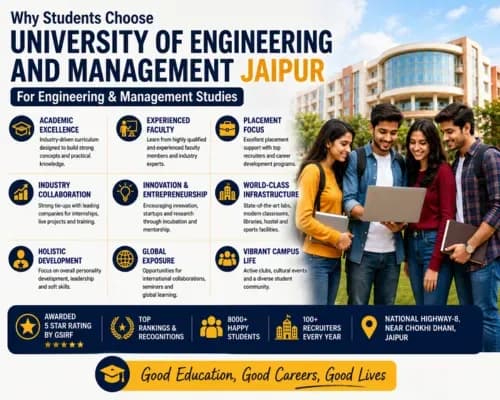
Why Students Choose University of Engineering and Management Jaipur for Engineering & Management Studies Introduction In a city with one of India's highest concentrations of private engineering and management institutions, choosing the right university is genuinely difficult — not because good options are scarce, but because the landscape of Jaipur's higher education market contains institutions of sharply varying quality, and distinguishing between them requires more than reading rankings and brochures. The University of Engineering and Management Jaipur — UEM Jaipur — has established itself over the past several years as one of the more substantively differentiated choices in this competitive landscape, attracting students from across Rajasthan and increasingly from other states who are looking for an institution that combines strong academic foundations with genuine industry connectivity and a career-focused education model. This blog is written for students who are seriously evaluating UEM Jaipur as a choice — whether for B.Tech, BBA, MBA, or other programmes — and want an honest, specific account of why students choose this institution, what the academic and campus experience actually looks like, and what the UEM Jaipur placements and career outcomes picture genuinely offers. The goal is neither promotional nor cynical — it is the kind of honest assessment that helps a prospective student make an informed decision about whether University of Engineering and Management Jaipur is the right fit for their specific goals and aspirations. The factors that consistently distinguish UEM Jaipur in the landscape of engineering colleges in Jaipur and management studies Jaipur fall into five categories — academics and curriculum, industry integration and internships, campus infrastructure and life, placement support and outcomes, and the broader context of what Jaipur as a city contributes to the engineering and management university Rajasthan student experience. Each of these is examined with the specificity and honesty that genuine decision-making requires. Also Read: No Coding? No Problem! High-Income Tech Skills Without Programming Quick Highlights Aspect Details University University of Engineering and Management Jaipur (UEM Jaipur) Blog Focus Why Students Choose UEM Jaipur — Honest Assessment Key Programmes B.Tech (UEM Jaipur Engineering) · BBA · MBA (UEM Jaipur MBA) · MCA Dimensions Covered Academics, Industry Integration, Campus Life, Placements, Career Support Location Context Engineering and Management University Rajasthan — Jaipur City Who This Is For Students evaluating UEM Jaipur for Engineering & Management programmes Table of Contents The Jaipur Engineering & Management Landscape — Where UEM Fits UEM Jaipur Engineering & Management Academics — What's Actually Taught Industry Integration & Internships — Bridging Campus and Career Campus Life & Infrastructure at UEM Jaipur UEM Jaipur MBA — Management Studies Jaipur at a Glance UEM Jaipur Placements — Honest Career Outcomes Picture Why Jaipur Matters — The City Advantage Honest Advice for Students Considering UEM Jaipur FAQs Conclusion The Jaipur Engineering & Management Landscape — Where UEM Fits Jaipur is home to a substantial number of private engineering and management institutions — ranging from well-established universities with strong placement records and NAAC accreditation to newer colleges that are still building their academic and industry infrastructure. Among the engineering colleges in Jaipur and institutions offering management studies Jaipur, the competitive landscape that prospective students navigate is genuinely complex — and UEM Jaipur occupies a specific and increasingly recognised position within it. The University of Engineering and Management Jaipur is the Jaipur campus of the UEM Group — an institution that operates campuses across India with a consistent emphasis on technology-forward curriculum, industry partnership-based learning, and career placement infrastructure. The Jaipur campus benefits from this group-level institutional knowledge while being specifically positioned within the Rajasthan higher education ecosystem — with approvals, affiliations, and industry connections calibrated to both the national and state-level employment markets that most of its students will enter. Among the reasons students consistently cite for choosing UEM Jaipur over other engineering colleges in Jaipur are: the curriculum's alignment with industry skill requirements (particularly in technology domains), the active placement cell infrastructure, the campus culture that supports both academic rigour and co-curricular development, and the location advantage that being in Jaipur provides for internships, networking, and the broader cultural experience of studying in one of India's most historically significant cities. This blog examines each of these reasons with the specificity that makes them genuinely useful rather than generic. Related Article: Best Free AI Tools for Students in 2026 UEM Jaipur Engineering & Management Academics — What's Actually Taught The academic programmes at University of Engineering and Management Jaipur span a range of undergraduate and postgraduate offerings in engineering and management — with the B.Tech programmes in Computer Science and Engineering (and its specialisations in AI/ML, Data Science, and Cybersecurity), Electronics and Communication Engineering, Mechanical Engineering, and Civil Engineering as the flagship undergraduate offerings under UEM Jaipur engineering. The management side offers BBA, MBA, and MCA programmes that together form the institution's management studies Jaipur portfolio. What distinguishes the UEM Jaipur engineering curriculum — at least in its stated design and increasingly in its delivered reality — is the integration of practical and project-based learning components from the first year of the programme. Rather than a purely theoretical first-two-years-then-internship structure, the curriculum is designed to introduce programming, circuit design, and engineering problem-solving from Semester 1 — with lab components, mini-projects, and domain-exposure exercises building the kind of applied knowledge that employers consistently report is missing in graduates of more conventionally structured programmes. Students who engage actively with this structure consistently report that they arrive at their third-year and final-year industry placements and internships with a meaningfully stronger practical foundation than peers from comparable institutions. CSE and AI/ML tracks: The most heavily enrolled programmes at UEM Jaipur engineering — covering data structures, algorithms, machine learning, deep learning, cloud computing, and software engineering. The curriculum has been revised in recent years to reflect the actual skill requirements of technology employers in Jaipur, Hyderabad, Pune, and Bengaluru ECE: Electronics and Communication Engineering with a focus on VLSI, embedded systems, and signal processing — relevant to Jaipur's growing electronics manufacturing sector and to defence electronics opportunities in the state Mechanical and Civil: Traditional engineering branches with strong fundamentals and practical lab components — placement outcomes in these branches are more locally concentrated than CSE, with significant opportunities in Rajasthan's manufacturing, construction, and infrastructure sectors Management programmes: The BBA and UEM Jaipur MBA programmes are structured around case-based learning, industry mentor sessions, and live project components — the MBA particularly attracts candidates who want a Jaipur-based management credential with genuine placement infrastructure rather than the classroom-only offerings that characterise weaker management studies Jaipur institutions Industry Integration & Internships — Bridging Campus and Career One of the most frequently cited reasons students choose UEM Jaipur over comparable engineering colleges in Jaipur is the institution's approach to industry integration — embedding real-world exposure into the academic calendar rather than treating it as an add-on at the end of the programme. The University of Engineering and Management Jaipur maintains a structured internship programme as a mandatory curriculum component, with dedicated internship windows built into the second and third year academic calendars for B.Tech students and into the first year for MBA students. The UEM Jaipur Training and Placement Cell facilitates company connections for internship placement — with a mix of Jaipur-based technology companies, Rajasthan manufacturing firms, FMCG and retail organisations, and national technology companies that have Jaipur-area presence or recruit from Jaipur campuses Students who supplement the institutional internship facilitation with their own proactive outreach — through LinkedIn, alumni connections, and direct company applications — consistently report the best internship quality outcomes; the institution's location in Jaipur provides accessible access to a city with a growing technology, design, and startup ecosystem for this proactive search Guest lecture programmes, industry visits, and company-specific workshops are conducted through the academic year — providing career exposure that goes beyond the formal internship window and gives students early understanding of what their target industries actually look for when hiring The UEM Jaipur engineering and management programmes both include a final-year industry project component — which can be completed in collaboration with a company or under faculty supervision with industry relevance. Students who use this component to build genuine, portfolio-ready project work arrive at the placement season with a demonstrably stronger profile than those who treat it as an academic requirement to be completed minimally Campus Life & Infrastructure at UEM Jaipur The campus infrastructure at University of Engineering and Management Jaipur is one of the practical considerations that prospective students and families evaluate when comparing options among engineering colleges in Jaipur — and it is one of the areas where the institution has invested consistently. The campus includes well-maintained academic blocks, dedicated computer and electronics laboratories, a central library with digital access and online journal subscriptions, seminar and conference facilities, sports infrastructure, and hostel accommodation for students who require residential facilities. Technology infrastructure: The computer labs at UEM Jaipur engineering are equipped with the software environments relevant to the programmes taught — including programming IDEs, circuit simulation tools, and data science platforms. The campus Wi-Fi network covers academic and hostel areas, with the quality of connectivity being a consistent student satisfaction factor in campus feedback Library and learning resources: The central library provides access to physical and digital resources — including online databases and e-journals that support both academic coursework and research projects. The resource quality for technology and management subjects has been actively maintained as part of the institution's academic investment Hostel facilities: Separate hostel blocks for male and female students with room options, mess dining, and common facilities. The hostel experience quality — particularly mess food — is the most variable element of campus life feedback and the one that improves most significantly as students discover the city's food options and Jaipur's accessible delivery ecosystem Co-curricular infrastructure: Technical clubs, cultural societies, sports teams, and an entrepreneurship cell provide the co-curricular ecosystem that is important for building a well-rounded profile alongside academic credentials. The annual technical and cultural festivals are well-attended and provide both social engagement and inter-college competitive experience Student diversity: The UEM Jaipur student community draws from Rajasthan and increasingly from other states — with a mix of students from urban and semi-urban backgrounds that creates a campus social environment more diverse than many state-level institutions, enriching the peer learning and cross-cultural exposure dimension of the experience Related Article: PGDM in Business Analytics: Top Colleges, Fees, Scope & Career Opportunities UEM Jaipur MBA — Management Studies Jaipur at a Glance The UEM Jaipur MBA is one of the more actively positioned management programmes in the management studies Jaipur landscape — designed for candidates who want a practice-oriented, placement-focused MBA from a Jaipur-based institution with genuine corporate connections. The UEM Jaipur MBA offers specialisations in Marketing, Finance, Human Resources, Operations, and Business Analytics — with the Business Analytics track being particularly aligned with the current employer demand landscape and the technology integration focus of the institution as a whole. The UEM Jaipur MBA curriculum emphasises case study methodology, live project work, and industry mentor engagement — consistent with the institution's broader philosophy of bridging academic learning and professional reality The mandatory summer internship in the first year of the MBA is structured and placement-cell facilitated — providing students with real work experience in marketing, operations, HR, or finance functions at companies in Jaipur and beyond before the final placement season For students considering MBA options within the management studies Jaipur ecosystem, the UEM Jaipur MBA sits in the tier of private university MBA programmes that offer genuine placement support and curriculum quality above the baseline of the city's management college landscape — though it is positioned below the top-tier B-schools that MBA aspirants targeting Fortune 500 companies or top consulting firms would typically pursue through CAT The most appropriate candidates for the UEM Jaipur MBA are those targeting roles in marketing, operations, HR, and general management at mid-size and large companies — particularly those with Jaipur or Rajasthan operations — and those who want a credential with placement infrastructure rather than a purely academic management qualification UEM Jaipur Placements — Honest Career Outcomes Picture UEM Jaipur placements are conducted through a dedicated Training and Placement Cell that facilitates on-campus recruitment across the final-year cohort. The companies that recruit through UEM Jaipur placements include a mix of IT services companies (TCS, Infosys, Wipro, Capgemini and their ecosystem partners), technology product companies and startups, manufacturing and engineering firms with Rajasthan operations, FMCG and retail companies, and financial services organisations. The honest characterisation of UEM Jaipur placements — as at most private engineering and management universities outside the IIT/NIT/top-B-school tier — is one of meaningful variability: the outcomes across different programme, different cohorts, and different individual students within the same cohort vary significantly. CSE and technology branches produce the strongest UEM Jaipur placements outcomes — with IT services companies recruiting in bulk and product companies and startups recruiting students who have built demonstrable technical portfolios through projects and competitions Management graduates from the UEM Jaipur MBA access placements in sales, operations, HR, and marketing roles — with the strongest outcomes going to students who built internship experience, communication skills, and domain knowledge through the full MBA curriculum rather than treating it as a credential to collect minimally The most consistent differentiator in UEM Jaipur placements outcomes is preparation depth and timing — students who begin aptitude, technical, and communication skill preparation from Year 2 of their B.Tech or from Semester 1 of their MBA consistently outperform those who treat placement preparation as a Year 4 or Semester 4 concern The Training and Placement Cell runs pre-placement preparation workshops, mock interviews, aptitude training sessions, and resume review programmes — these are among the highest-return activities for placement season readiness and should be engaged with consistently from Year 2 onwards rather than selectively in the final semester The alumni network of UEM Jaipur — now spanning multiple years of graduates in technology, management, and core engineering roles — is an increasingly accessible resource for current students seeking mentoring, internship referrals, and placement insider guidance. Active engagement with the alumni community is one of the most underutilised UEM Jaipur placements preparation advantages available Why Jaipur Matters — The City Advantage for UEM Students One dimension of the UEM Jaipur student experience that is often underweighted in institutional comparisons — because it is not listed in rankings or placement statistics — is the city of Jaipur itself. Among the engineering and management university Rajasthan options, Jaipur provides a city context that genuinely enriches the student experience in ways that campus-bound institutions in smaller cities or less developed urban ecosystems simply cannot. Jaipur's technology sector — with a growing presence of IT services, software product companies, digital marketing agencies, and increasingly a startup ecosystem — provides internship and part-time work opportunities that students at UEM Jaipur engineering and management programmes can access through their own initiative alongside the institutionally facilitated placements The city's manufacturing, retail, tourism, and financial services industries provide diverse placement and internship opportunities for management studies Jaipur students across functions and company sizes Jaipur's cultural richness — the Jaipur Literature Festival, music and arts events, heritage experiences, and the increasingly cosmopolitan food and social scene — provides a quality of student life that goes beyond the campus and enriches the four-year experience in ways that matter for personal development alongside professional preparation The city's travel connectivity — to Delhi (5 hours by road, 3.5 hours by train), Agra, Udaipur, and Jodhpur — makes weekend exploration genuinely accessible and produces the kind of social and cultural broadening that students who spend their undergraduate years in more isolated locations miss For students from Rajasthan specifically, studying in Jaipur at an engineering and management university Rajasthan option like UEM Jaipur provides the balance of proximity to home and genuine urban university experience — without the displacement cost of relocating to Delhi or Bengaluru for a comparable quality of institution Honest Advice for Students Considering UEM Jaipur Having examined the academic, industry, campus, placement, and city dimensions of the UEM Jaipur experience, here is the most direct and honest guidance for students making this decision: UEM Jaipur is a genuinely good choice if your primary goal is a well-structured engineering or management programme in Jaipur with active placement infrastructure, industry exposure, and the opportunity to build a strong career foundation through consistent effort across four years. The institution provides the infrastructure; the quality of the outcome is co-produced by the student's engagement with it Start preparation from Day 1 — the students who achieve the best outcomes at UEM Jaipur placements are those who began skill building, project work, and placement preparation from Year 1, not Year 4. The institution's co-curricular and industry-engagement infrastructure is most valuable when used consistently rather than selectively at the end Engage with the city — Jaipur's professional ecosystem is an extension of the campus for students who use it actively. Identifying internship opportunities in the city's technology and business community, attending professional events and networking sessions, and building a LinkedIn presence that connects with Jaipur-area professionals are activities that multiply the value of a UEM Jaipur degree significantly Compare honestly across your specific rank and budget range — UEM Jaipur should be evaluated against other engineering colleges in Jaipur and management studies Jaipur institutions at a comparable fee point and admission criteria level. It competes most directly with institutions like SGVU, Jaipur National University, Poornima University, and similar private institutions in Jaipur — not with MNIT or central university options that have different admission thresholds Visit before deciding — a campus visit, attendance at an open day, and honest conversations with current students and faculty members will tell you more about whether University of Engineering and Management Jaipur is the right fit for you than any brochure, ranking, or blog post — including this one 🎓 One Form · Multiple Colleges Stop Stressing. Start Applying. Skip the chaos of filling endless forms. Apply to your dream colleges in one go through the College Nirnay Common Application Form — built for every student navigating India's competitive education landscape. Fill the Common Application Form → ✓ Free to apply · ✓ Takes under 5 minutes · ✓ Trusted by thousands of students FAQs Q1. What engineering programmes does UEM Jaipur offer? UEM Jaipur engineering programmes at the University of Engineering and Management Jaipur include B.Tech in Computer Science and Engineering (with specialisations in AI/ML, Data Science, and Cybersecurity), Electronics and Communication Engineering, Mechanical Engineering, and Civil Engineering. The CSE and AI/ML tracks are the most heavily enrolled and produce the strongest UEM Jaipur placements outcomes in the technology sector. The B.Tech programmes are 4-year full-time degrees with a curriculum designed around both theoretical foundations and practical, industry-aligned skill development. Q2. How are UEM Jaipur placements for engineering students? UEM Jaipur placements for engineering students are strongest in the CSE and technology branches — with IT services companies (TCS, Infosys, Wipro, Capgemini) and technology product companies and startups recruiting on campus. The most consistent differentiator in UEM Jaipur placements outcomes is individual preparation depth — students who begin aptitude, coding, and communication skill preparation from Year 2 and build demonstrable project portfolios consistently achieve better placements than those who treat placement preparation as a final-year concern. The Training and Placement Cell runs pre-placement training workshops that supplement individual preparation. Q3. Is UEM Jaipur MBA worth pursuing for management studies in Jaipur? The UEM Jaipur MBA is a worthwhile choice for candidates targeting management roles in marketing, operations, HR, and finance at mid-size and large companies — particularly those with Jaipur or Rajasthan operations. The programme offers genuine placement infrastructure and a case-based, industry-connected curriculum that places it above the baseline of management studies Jaipur institutions at a comparable fee point. It is most appropriately positioned for students who want a Jaipur-based MBA with real placement support — not as a substitute for top-tier B-school MBA programmes accessed through high CAT scores. Q4. How does UEM Jaipur compare to other engineering colleges in Jaipur? Among engineering colleges in Jaipur at a comparable private university level and fee range, University of Engineering and Management Jaipur competes primarily with institutions like SGVU, Jaipur National University, Poornima University, and similar private universities rather than with MNIT or central institutions that have different admission thresholds. The UEM Jaipur differentiators in this competitive set include its technology-forward curriculum, active placement cell infrastructure, group-level institutional backing, and the industry integration philosophy embedded in its academic structure. A campus visit and conversation with current students is the most reliable way to assess the fit for your specific programme and career goals. Q5. What courses does UEM Jaipur offer besides engineering? UEM Jaipur courses beyond engineering include BBA (Bachelor of Business Administration), MBA (with specialisations in Marketing, Finance, HR, Operations, and Business Analytics — the UEM Jaipur MBA), and MCA (Master of Computer Applications). The BBA and MBA programmes form the management studies Jaipur portfolio of the institution, and the MCA provides a postgraduate technology pathway for students from non-engineering undergraduate backgrounds who want to build a software career. All programmes are delivered with the institution's consistent emphasis on industry integration and placement infrastructure. Explore More CGPA vs Experience: What Matters More? How to Choose Your Dream University Top Emerging Courses in 2026 Careers Without a Traditional Degree JEE Main 2026 Result Updates Top AI Skills Students Must Learn Best Free AI Tools for Students Freelancing vs Job for Students Conclusion Students choose the University of Engineering and Management Jaipur for reasons that are specific, consistent, and honest — not because it is the highest-ranked institution in its tier, but because the combination of factors it offers matches the needs of students who want a structured, industry-connected, placement-supported engineering or management education in a city that adds genuine value to the four-year experience. UEM Jaipur engineering and UEM Jaipur MBA programmes serve students who come with genuine academic ambition, willingness to engage with the institution's co-curricular and industry infrastructure, and the self-directedness to supplement institutional facilitation with personal initiative. The students who leave UEM Jaipur with the best outcomes are the ones who understood from Day 1 that a best private university Jaipur experience — like any university experience — is co-created between the institution and the student, and that the institution provides the stage while the student writes the performance. Explore College Nirnay for detailed UEM Jaipur courses comparison — from UEM Jaipur courses in engineering to MBA comparison, UEM Jaipur placements data, and honest student reviews that go beyond the brochure — to help you make the most informed decision about whether University of Engineering and Management Jaipur — a genuine contender among best private university Jaipur options for technology and management careers — and a best private university Jaipur pick for students who want placement-backed education in Rajasthan's capital city — is the right fit for your goals.

From Admission to Placement: Student Journey at Suresh Gyan Vihar University Introduction Choosing a university is rarely a single decision — it is a sequence of bets placed on people, places, programmes, and promises, made at a moment when most students have limited information and maximum uncertainty. For the growing number of students who have chosen Suresh Gyan Vihar University in Jaipur as the institution they will call home for the next three to four years, the question that matters most is not "what does the brochure say?" but "what does the journey actually look like — from the day you apply to the day you walk into your first job?" This blog traces that full arc — the SGVU student journey from first inquiry and SGVU admissions 2026 through the lived texture of SGVU campus life, the realities of academic engagement and internships at SGVU, and the outcomes that SGVU placements and SGVU career opportunities actually deliver. It is written for prospective students considering SGVU Jaipur, for admitted students preparing to arrive, and for families trying to understand what their investment of trust and money will look like across four years of student experience SGVU. The goal throughout is honest, specific, and useful — because the students who thrive at Suresh Gyan Vihar University are almost always the ones who arrived with accurate expectations, clear intentions, and the willingness to engage actively with everything the institution makes available. That combination of accurate expectation and active engagement is precisely what this blog is designed to support. Also Read: No Coding? No Problem! High-Income Tech Skills Without Programming Quick Highlights Aspect Details University Suresh Gyan Vihar University (SGVU), Jaipur, Rajasthan Blog Focus Full SGVU Student Journey — Admission to Placement Dimensions Covered Admissions, Campus Life, Academics, Internships, Placements, Career Support SGVU Admissions 2026 Multiple Programmes — Engineering, Management, Law, Commerce, Sciences Location SGVU Jaipur — Mahal Road, Jagatpura, Jaipur, Rajasthan Who This Is For Prospective students, admitted students & families evaluating SGVU Table of Contents SGVU Admissions 2026 — Getting In Arriving at SGVU Jaipur — First Impressions & Orientation Academic Life — What Student Experience SGVU Actually Looks Like SGVU Campus Life — Infrastructure, Culture & Community Internships at SGVU — Building Real-World Experience SGVU Placements — How the Career Pipeline Works SGVU Career Opportunities & University Placement Support Honest Advice for Incoming SGVU Students FAQs Conclusion SGVU Admissions 2026 — Getting In The SGVU admissions 2026 process is one of the more accessible and clearly structured of Jaipur's private university landscape — covering a wide range of undergraduate and postgraduate programmes across Engineering, Management, Law, Commerce, Computer Applications, Sciences, and Journalism. Suresh Gyan Vihar University accepts admissions through multiple routes: direct application based on qualifying examination scores, the SGVU Entrance Test conducted by the university itself, and scores from national examinations including JEE Main, CUET, CAT, MAT, and CLAT — depending on the programme applied for. The SGVU admissions 2026 portal allows students to apply online, upload documents, pay the application fee, and track their application status — a reasonably well-functioning digital process that most students navigate without significant difficulty. Merit scholarships are available for students with strong qualifying examination scores — and the scholarship criteria and amounts are communicated during the admission counselling process. Students who visit the campus before finalising admission consistently report that the in-person counselling session adds meaningful clarity about programme structure, fee payment schedules, and hostel availability. Engineering (BTech) — JEE Main score or SGVU Entrance Test; branches include CSE, CSE with AI/ML, ECE, Mechanical, Civil Management (BBA / MBA) — Direct merit or SGVU test; MBA also accepts CAT / MAT scores Law (BA LLB / BBA LLB / LLM) — CLAT score or direct university counselling Commerce (BCom / BCom Honours) — CUET or direct merit-based admission Computer Applications (BCA / MCA) — Merit-based or SGVU Entrance Test Sciences, Journalism, and other programmes — CUET or direct merit; check programme-specific eligibility through official SGVU admissions page A practical note for students in the SGVU admissions 2026 cycle: the scholarship window and early admission rounds typically offer better financial terms than late-stage admission — and the hostel room availability for first-year students is significantly better when confirmed early. Delaying application after qualifying examination results are declared is the most common and most avoidable cost in the SGVU admissions 2026 process. Related Article: Best Free AI Tools for Students in 2026 Arriving at SGVU Jaipur — First Impressions & Orientation SGVU Jaipur is located on Mahal Road in Jagatpura — a well-connected area on the southern edge of Jaipur with reasonable access to the city's transportation network, commercial areas, and the broader student-oriented ecosystem that has developed around Jaipur's growing university concentration. The campus makes a positive first impression — green, organised, and substantially built — with the physical infrastructure communicating the kind of institutional seriousness that prospective students look for when visiting to make their final decision. Orientation at Suresh Gyan Vihar University is a multi-day process that combines administrative completion (document verification, ID card collection, library registration, hostel allotment) with academic introduction sessions and a structured programme-level orientation conducted by faculty and senior students. The first week of the SGVU student journey is denser with logistics than most incoming students expect — a common feature of large private universities processing hundreds of new students simultaneously — but is generally well-organised and completed without significant friction for students who arrive with their documentation in order. The emotional texture of arrival week is worth acknowledging honestly. For outstation students arriving in Jaipur for the first time, the combination of logistical intensity, physical unfamiliarity, and social newness can produce a specific kind of disorientation that is temporary but genuinely felt. The first two to three weeks of the SGVU student journey are consistently reported as the adjustment period — after which the campus begins to feel like a community rather than an institution, and the SGVU campus life rhythm begins to establish itself naturally. Academic Life — What Student Experience SGVU Actually Looks Like The student experience SGVU in the academic dimension is shaped by a curriculum structure that combines core programme subjects with elective options, mandatory skill development components, and a continuous internal assessment system that runs throughout each semester rather than concentrating evaluation pressure at the end. This structure rewards consistent engagement over the "study in the final two weeks" approach that many students arrive with from their school years — and is one of the more significant academic culture adjustments that incoming students must make. The teaching quality at Suresh Gyan Vihar University — as at most private universities of comparable scale — is variable across departments and faculty members. Several departments, particularly in Technology and Management, have faculty with meaningful industry experience who bring practical relevance to their teaching alongside theoretical rigour. Students who have navigated the SGVU student journey most successfully are consistently those who supplemented classroom instruction with online learning platforms, built relationships with faculty members whose expertise aligned with their interests, and engaged with the research and project-based learning opportunities that SGVU Jaipur offers through its Centre for Innovation, Entrepreneurship, and Research. Attendance requirements are enforced consistently — the minimum threshold is real and consequential; track it from Day 1 The internal assessment component (projects, assignments, mid-semester tests) typically accounts for 30 to 40% of the final grade — treating it as secondary to semester-end examination preparation is one of the most common academic mistakes in the student experience SGVU The university's Learning Management System carries assignment deadlines, study materials, and assessment feedback — engaging with it actively from the first week is a consistent differentiator between students who manage their academic workload well and those who do not The Centre for Innovation and Entrepreneurship at Suresh Gyan Vihar University provides structured opportunities for research projects, startup mentoring, and competitive participation — these are among the highest-value academic engagement options available to students who use them SGVU Campus Life — Infrastructure, Culture & Community SGVU campus life is one of the dimensions of the university that most consistently exceeds incoming student expectations — driven by the combination of physical infrastructure investment, a genuinely active co-curricular programme, and the energy of a diverse student community drawn from across Rajasthan and increasingly from other Indian states and international programmes. Physical infrastructure — The SGVU Jaipur campus includes well-maintained academic blocks, dedicated engineering and computer laboratories, a central library with digital access, seminar halls, sports facilities including a cricket ground and indoor sports complex, and cafeteria and food court options that provide a reasonable range of dining choices beyond the hostel mess Hostels — Separate hostel facilities for male and female students with room options at different capacity levels; hostel mess quality is the most consistently variable element of SGVU campus life feedback, and students quickly develop supplementary food strategies through campus canteens and delivery apps once they settle in Clubs and societies — Suresh Gyan Vihar University maintains an active student club ecosystem covering technical societies (coding club, robotics, electronics), cultural organisations (dance, drama, music), literary and debate associations, entrepreneurship cells, and social service groups. The annual cultural festival and technical fest are significant events on the SGVU campus life calendar — providing entry points into the broader campus social community for students who engage with them Sports — The sports programme at SGVU Jaipur is more active than many comparable private universities, with inter-departmental and inter-university competitions providing genuine participation opportunities for students with athletic interests Student diversity — The SGVU campus life community is increasingly diverse — with international students from Nepal, Afghanistan, African nations, and Southeast Asian countries adding a genuinely cosmopolitan dimension to the campus social environment that enriches the student experience SGVU in ways that purely domestic university communities do not provide Related Article: PGDM in Business Analytics: Top Colleges, Fees, Scope & Career Opportunities Internships at SGVU — Building Real-World Experience Internships at SGVU are structured into the curriculum as a mandatory component for most programmes — with dedicated summer internship periods built into the academic calendar, typically between the second and third years for BTech and BBA students. This mandatory structure ensures that every student in the relevant programmes engages with at least one formal work experience before entering the final-year placement cycle — a baseline that is more than many comparable private universities provide. The quality and relevance of internships at SGVU varies considerably — and this variation is one of the most honest and important things to understand about the programme. The Training and Placement Cell facilitates connections with companies that offer internship positions to SGVU students, and a portion of these are with meaningful organisations in technology, manufacturing, financial services, and hospitality. However — as at most private universities outside the IIT/NIT/top-10 tier — the most valuable internships at SGVU consistently go to students who combine the institutional facilitation with their own proactive outreach: building LinkedIn profiles early, applying directly to companies through online platforms, and using the faculty network and alumni connections that Suresh Gyan Vihar University has developed over its years of operation. Start internship preparation from the end of Year 1 — not Year 2. Building a project portfolio, GitHub presence, and LinkedIn profile 12 months before the internship season consistently produces better outcomes than starting the preparation process when the internship window is already open Use the university's Centre for Entrepreneurship and Innovation for project work that can serve as internship portfolio content — faculty-guided projects with real brief and deliverables are more credible to internship employers than solo personal projects Jaipur's growing technology and startup ecosystem — including companies in IT services, e-commerce enablement, digital marketing, and fintech — provides a realistic and accessible internships at SGVU hunting ground for students who are willing to approach local employers directly rather than waiting exclusively for campus facilitation The internship experience itself — regardless of company size or prestige — is valuable primarily for what you make of it: the skills you practice, the professional habits you build, and the reference relationships you develop with supervisors who can vouch for your capabilities when placements arrive SGVU Placements — How the Career Pipeline Works SGVU placements are conducted through a dedicated Training and Placement Cell that facilitates company visits, pre-placement talks, aptitude and technical screening rounds, and final offer processes across the final-year student cohort. The companies that recruit through SGVU placements include a mix of IT services companies (TCS, Wipro, Infosys, Capgemini, and their vendor and partner ecosystem), mid-size technology product and services companies, manufacturing and engineering firms, hospitality groups, financial services companies, and a growing presence of Jaipur-based startups and digital businesses. The most honest characterisation of SGVU placements is one that most university marketing materials avoid but that genuinely useful guidance requires: outcomes vary significantly — not just across programmes but within the same programme and the same cohort. The students who consistently achieve the best SGVU placements outcomes are those who began their preparation at least 18 months before the placement season, built demonstrable skills through projects and internships, maintained reasonable academic performance (CGPA above 6.5 to 7.0 is the effective floor for most campus recruitment processes), and developed the aptitude and communication skills that the screening process at most mass recruiters consistently evaluates. BTech (CSE and related branches) — The most active SGVU placements stream; IT services companies recruit in bulk, with some product and startup opportunities for students with strong coding portfolios BBA / MBA — Placements in sales, operations, HR, and marketing roles across FMCG, retail, financial services, and hospitality; MBA students with relevant internship experience and strong communication skills access the strongest offers BCom / BCA — Placements in accounting, finance, data entry, and business analyst roles; BCA students with strong programming skills often cross over into the tech placement pool Law (BA LLB / BBA LLB) — Placements through law firm empanelment, corporate legal department offers, and government legal service examinations; the SGVU placements infrastructure for law is supplemented by the university's moot court and legal clinic programme SGVU Career Opportunities & University Placement Support The SGVU career opportunities ecosystem goes beyond the formal campus placement season — and understanding its full scope is important for students building their career strategy across four years of the SGVU student journey. The university placement support infrastructure at Suresh Gyan Vihar University includes pre-placement training programmes, aptitude and reasoning preparation workshops, mock interview and group discussion practice sessions, resume and LinkedIn profile building workshops, and a alumni network that students can access for mentoring and referral connections. Pre-placement training — The Training and Placement Cell runs structured preparation programmes from the third year covering quantitative aptitude, verbal ability, logical reasoning, and technical subject preparation — the core competencies tested in the screening rounds of most companies that participate in SGVU placements Industry connect events — Guest lectures, industry visits, and company-specific workshops conducted through the Placement Cell provide exposure to industry professionals and company cultures that is difficult to access through classroom instruction alone — and are among the highest-return activities in the university placement support calendar Entrepreneurship pathway — For students whose SGVU career opportunities interest lies in building something rather than joining something, the Centre for Innovation and Entrepreneurship at SGVU Jaipur provides mentoring, seed support exploration, and connections to the Jaipur startup ecosystem — an increasingly viable pathway given Rajasthan's growing startup policy infrastructure Higher education pathway — A meaningful proportion of SGVU graduates proceed to postgraduate education — GATE for MTech, CAT/XAT/MAT for MBA, CLAT PG for LLM, and civil services examinations for the government sector. The university placement support infrastructure includes preparation guidance for these pathways alongside the corporate recruitment track Alumni network — The SGVU career opportunities available through the alumni community — now spanning multiple years of graduates in technology, management, law, and public service — are accessible through the official alumni association and increasingly through LinkedIn, where SGVU alumni are an active and generally accessible professional community Honest Advice for Incoming SGVU Students Having mapped the full arc of the SGVU student journey — from SGVU admissions 2026 through SGVU campus life, academics, internships at SGVU, SGVU placements, and SGVU career opportunities — here is the most direct and actionable guidance for students beginning this journey: Your outcome is mostly in your hands. The most consistent finding across every dimension of the student experience SGVU is that the university provides the infrastructure and the opportunities — but the quality of your four-year outcome depends more on how actively you engage with that infrastructure than on any fixed institutional quality. This is true at most universities, but it is especially true at institutions outside the top-10 national tier where the brand itself does less of the work in the job market Start career preparation in Year 1. The students who achieve the best SGVU placements outcomes consistently started their skill development, portfolio building, and professional presence creation long before the final-year placement season. Year 1 is not too early to create a LinkedIn profile, join a coding platform, start a reading practice in your domain, or speak to a senior about what preparation actually made the difference in their placement Engage with everything in the first month. The SGVU campus life community, the clubs, the orientation events, the technical society introductions — all of these are significantly easier to enter in the first four weeks of campus life than at any later point. The social and co-curricular fabric of your SGVU student journey is woven most easily in this window Use the Placement Cell as a starting point, not a finishing point. The university placement support provided by the Training and Placement Cell is a genuine resource — use it fully. But also build your own career-development activities around it rather than treating it as the only source of SGVU career opportunities. The students who access the best outcomes combine institutional support with personal initiative in a ratio that consistently tilts toward the personal Jaipur is a resource, not just a backdrop. The city's technology sector, startup ecosystem, heritage and tourism industry, and growing financial services presence all represent SGVU career opportunities and internships at SGVU hunting grounds that proactive students access in ways that purely campus-dependent students do not. Engage with the city — professionally, culturally, and socially — as an active dimension of your four-year SGVU student journey 🎓 One Form · Multiple Colleges Stop Stressing. Start Applying. Skip the chaos of filling endless forms. Apply to your dream colleges in one go through the College Nirnay Common Application Form — built for every student navigating India's competitive education landscape. Fill the Common Application Form → ✓ Free to apply · ✓ Takes under 5 minutes · ✓ Trusted by thousands of students FAQs Q1. How are SGVU placements for engineering students? SGVU placements for BTech students — particularly in Computer Science and related branches — are the most active in the university's placement ecosystem. IT services companies including TCS, Wipro, Infosys, Capgemini, and their partner organisations recruit regularly from the campus. Product companies and startups also participate, with offers going primarily to students who have built strong coding portfolios and relevant project experience through internships at SGVU and independent work. The most consistent differentiator in SGVU placements outcomes for engineering students is preparation depth — students who begin aptitude, coding, and communication skill preparation from Year 2 consistently achieve better outcomes than those who treat placements as a Year 4 concern. Q2. What is SGVU campus life like for outstation students? SGVU campus life for outstation students is anchored by the hostel community — with facilities including shared rooms, mess dining, Wi-Fi access, and common room spaces. The adjustment period for most outstation students is 2 to 4 weeks — after which the SGVU Jaipur campus begins to feel like a genuine community. The student experience SGVU is enriched by the diversity of the student body — including a meaningful international student presence — and by the range of clubs, societies, and events that provide social and co-curricular engagement beyond the hostel and classroom. The city of Jaipur — accessible from campus — adds significantly to the richness of SGVU campus life for students who engage with it. Q3. How does SGVU admissions 2026 work? SGVU admissions 2026 are conducted through a combination of direct merit-based admission (using qualifying examination scores from boards and national tests), the university's own entrance examination, and national entrance scores including JEE Main, CUET, CAT, MAT, and CLAT depending on the programme. The application process is online through the official Suresh Gyan Vihar University admissions portal. Merit scholarships are available and communicated during counselling. Students are advised to complete SGVU admissions 2026 early — scholarship terms and hostel availability are generally better in early admission rounds than in late-stage applications. Q4. What internship opportunities are available at SGVU? Internships at SGVU are structured as a mandatory curriculum component for most programmes — with dedicated summer internship periods built into the academic calendar. The Training and Placement Cell facilitates connections with companies across technology, manufacturing, financial services, and hospitality. In parallel, SGVU Jaipur's location in a city with a growing technology and startup ecosystem provides accessible internship opportunities for students who proactively approach employers through LinkedIn, online platforms, and faculty network referrals. The most valuable internships at SGVU go to students who combine institutional facilitation with personal outreach — starting their preparation and platform building at least one year before the internship season. Q5. What university placement support does SGVU provide? The university placement support at Suresh Gyan Vihar University includes a dedicated Training and Placement Cell, structured pre-placement preparation programmes (aptitude, technical, communication), mock interviews and group discussions, resume and LinkedIn profile building workshops, industry connect events with guest lecturers and company representatives, and alumni network access. This infrastructure supports the full range of SGVU career opportunities — from campus placements through higher education preparation and entrepreneurship pathways. Students who engage with the university placement support ecosystem actively and consistently from Year 2 onwards achieve significantly better outcomes than those who engage only in the final placement season. Explore More CGPA vs Experience: What Matters More? How to Choose Your Dream University Top Emerging Courses in 2026 Careers Without a Traditional Degree JEE Main 2026 Result Updates Top AI Skills Students Must Learn Best Free AI Tools for Students Freelancing vs Job for Students Conclusion The SGVU student journey — from the first inquiry through SGVU admissions 2026, across four years of SGVU campus life and student experience SGVU, through internships at SGVU and the university placement support ecosystem, to the first offer in SGVU placements — is a journey that Suresh Gyan Vihar University makes possible and that students must make meaningful. The institution provides the campus, the curriculum, the placement infrastructure, and the city of Jaipur as context. What it cannot provide — and what no university can — is the student's own sustained engagement, proactive skill development, genuine intellectual curiosity, and willingness to do more than the minimum required to get through. The SGVU career opportunities that matter most in the long run are the ones that students create through their own preparation, relationships, and initiative — supported but not substituted for by university placement support. Come to SGVU Jaipur with that understanding — and the four-year journey from admission to placement will be one that compounds in ways that a passive university experience never can. Explore College Nirnay for college comparison tools, placement data, and honest programme-level reviews to inform every step of your decision.
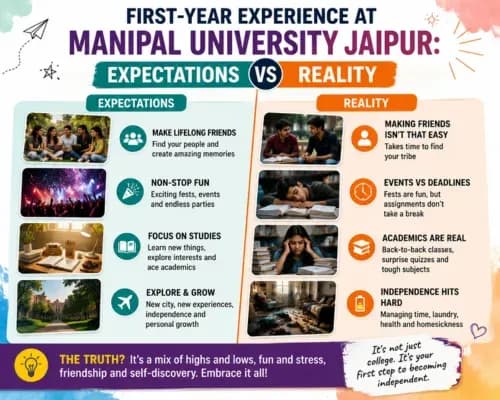
First-Year Experience at Manipal University Jaipur: Expectations vs Reality Introduction Starting college is exciting, overwhelming, and full of expectations. For thousands of students every year, Manipal University Jaipur becomes the place where school life officially transforms into university life. From imagining hostel freedom and campus events to worrying about academics and placements, students enter their first year carrying a mix of curiosity and anxiety. The real MUJ first year experience often turns out to be very different from what students expect before arriving on campus. The reality of Manipal Jaipur student life is a combination of independence, responsibility, friendships, academic pressure, and unforgettable memories. Whether it is adjusting to MUJ hostel life, understanding the academic structure, exploring the vibrant Manipal University campus culture, or preparing for future opportunities connected to Manipal Jaipur placements, the first year becomes a foundation for the rest of university life. This blog explores the complete first year college experience at Manipal University Jaipur — comparing student expectations with reality while discussing MUJ academics, hostel life, social culture, student reviews, and what truly makes the university journey memorable for freshers entering one of Rajasthan’s most recognised private universities. Also Read: No Coding? No Problem! High-Income Tech Skills Without Programming Quick Highlights Key Aspect Details University Manipal University Jaipur (MUJ) Location Jaipur, Rajasthan Focus First-Year Student Experience & Campus Life Campus Culture Clubs, Events, Networking & Student Activities Hostel Life Modern Hostels with Diverse Student Community Placements Strong Internship & Placement Opportunities Table of Contents Expectations Before Joining Manipal University Jaipur Reality of the MUJ First Year Experience MUJ Hostel Life — Freedom vs Responsibility MUJ Academics — Pressure, Projects & Learning Manipal University Campus Culture How First Year Connects to Manipal Jaipur Placements MUJ Student Review — What Freshers Usually Feel FAQs Conclusion Expectations Before Joining Manipal University Jaipur Before entering Manipal University Jaipur, most students imagine university life as complete freedom with exciting events, luxurious hostels, and nonstop social life. Social media often creates the image that the MUJ first year experience is entirely about festivals, parties, and meeting new people. While those experiences are definitely part of Manipal Jaipur student life, reality is usually much more balanced. Common expectations students usually have: Huge expectations from MUJ hostel life and campus freedom Belief that academics at college are easier than school studies Excitement about the vibrant Manipal University campus culture Dreams about building strong friend circles immediately Curiosity regarding internships and Manipal Jaipur placements The expectations are not entirely wrong, but the actual first year college experience at Manipal University Jaipur includes academic adaptation, emotional adjustment, time management, and learning how to handle independence for the first time. Reality of the MUJ First Year Experience The actual MUJ first year experience is a mix of excitement and adjustment. During the first few months at Manipal University Jaipur, students learn how to manage schedules, assignments, attendance, hostel responsibilities, and social interactions all at the same time. Many students initially struggle with homesickness and academic pressure before gradually becoming comfortable with university life Jaipur. One major reality of Manipal Jaipur student life is diversity. Students from different states, cultures, and educational backgrounds study together, making the environment dynamic and competitive. The friendships formed during the first year college experience often become one of the most valuable parts of life at Manipal University Jaipur. Another reality students discover is that the Manipal University campus culture is not only about events and enjoyment. It is also about networking, skill development, club participation, leadership opportunities, and professional growth that eventually contribute to better internships and Manipal Jaipur placements. MUJ Hostel Life — Freedom vs Responsibility For many students, MUJ hostel life becomes the most memorable part of their journey at Manipal University Jaipur. Hostel life gives students independence for the first time, but it also teaches discipline and responsibility. Students learn how to manage routines, maintain personal schedules, and balance academics with social life. What students usually experience in MUJ hostel life: Late-night conversations and strong friendships Learning time management during exams and assignments Participating in hostel competitions and activities Experiencing diverse food and student communities Adjusting to independence away from home The reality of MUJ hostel life is that it shapes maturity. While expectations are usually focused on fun, the actual MUJ first year experience teaches students emotional growth, communication skills, and adaptability — all important aspects of Manipal Jaipur student life. MUJ Academics — Pressure, Projects & Learning One of the biggest surprises during the MUJ first year experience is the academic structure. Many students expect college studies to be easier than school, but MUJ academics involve regular assignments, presentations, projects, lab work, and semester examinations. Students at Manipal University Jaipur quickly realise that consistency matters more than last-minute preparation. Key realities about MUJ academics: Attendance and internal assessments are important Practical learning and projects are strongly encouraged Faculty interaction plays a major role in learning Students need to balance clubs with academics carefully Technical and communication skills both matter The advantage of MUJ academics is that they prepare students for internships and future opportunities connected to Manipal Jaipur placements. The academic environment at Manipal University Jaipur pushes students to become more disciplined, independent, and professionally aware from the very first year. Manipal University Campus Culture The Manipal University campus culture is one of the strongest reasons why students enjoy their first year college experience. From technical clubs and coding communities to dance teams, music societies, photography clubs, sports events, and entrepreneurship cells, the campus environment offers opportunities for every type of student. A major part of Manipal Jaipur student life is participation. Students who actively join clubs and campus activities usually adapt faster and build stronger social networks. The Manipal University campus culture encourages students to step outside their comfort zone and explore leadership, creativity, and collaboration. Events and fests also become memorable highlights of the MUJ first year experience. While students initially expect only entertainment, the reality is that these activities also improve networking, communication, and confidence — skills that indirectly contribute to better internships and Manipal Jaipur placements later in university life Jaipur. How First Year Connects to Manipal Jaipur Placements Most freshers think placements are only important in the final year, but the reality at Manipal University Jaipur is different. The habits students develop during their MUJ first year experience directly influence future internship opportunities and Manipal Jaipur placements. How first year impacts future placements: Building communication and presentation skills early Learning teamwork through projects and clubs Improving technical skills consistently Maintaining academic performance from the beginning Creating professional networks through campus activities Students who actively participate in Manipal Jaipur student life and focus on MUJ academics usually build stronger resumes over time. The university environment helps students gradually prepare for internships, skill development programmes, and ultimately better Manipal Jaipur placements. MUJ Student Review — What Freshers Usually Feel According to many students, the best part of the MUJ first year experience is personal growth. The transition from school to university life Jaipur initially feels challenging, but students gradually become more confident, independent, and socially active. Common points in a typical MUJ student review: The campus infrastructure is modern and visually impressive MUJ hostel life creates unforgettable memories The student crowd is diverse and energetic MUJ academics require consistency and discipline The Manipal University campus culture feels vibrant and active throughout the year Every student’s journey at Manipal University Jaipur is different, but most agree that the first year becomes the phase where expectations slowly transform into reality. The complete first year college experience ultimately teaches students lessons that go far beyond classrooms and examinations. 🎓 One Form · Multiple Colleges Stop Stressing. Start Applying. Skip the chaos of filling endless forms. Apply to your dream colleges in one go through the College Nirnay Common Application Form — built for every student navigating India's competitive education landscape. Fill the Common Application Form → ✓ Free to apply · ✓ Takes under 5 minutes · ✓ Trusted by thousands of students FAQs (Schema-Ready) What is the MUJ first year experience really like? The MUJ first year experience is a combination of academics, hostel life, friendships, campus activities, and personal growth. Students at Manipal University Jaipur usually experience both excitement and adjustment during their first year. How is MUJ hostel life for freshers? MUJ hostel life is considered one of the most memorable parts of Manipal Jaipur student life. Students experience independence, build friendships, participate in hostel activities, and learn responsibility while living on campus. Are MUJ academics difficult? MUJ academics require consistency, attendance, project work, and regular preparation. Students at Manipal University Jaipur often find the academic structure manageable if they balance studies with extracurricular activities properly. How is the Manipal University campus culture? The Manipal University campus culture is vibrant and student-focused, with clubs, fests, competitions, sports activities, and networking opportunities forming an important part of Manipal Jaipur student life. Do first-year activities help in Manipal Jaipur placements? Yes, participation in academics, projects, clubs, and skill-building activities during the first year helps students gradually prepare for internships and future Manipal Jaipur placements opportunities. Conclusion The MUJ first year experience at Manipal University Jaipur is much more than what students imagine before joining. While expectations often focus on fun and freedom, the real experience includes academic growth, emotional adjustment, skill development, friendships, and personal transformation. From understanding MUJ academics and adapting to MUJ hostel life to participating in the vibrant Manipal University campus culture, students gradually become more independent and confident. The complete first year college experience ultimately prepares students not only for better Manipal Jaipur placements but also for life beyond university.
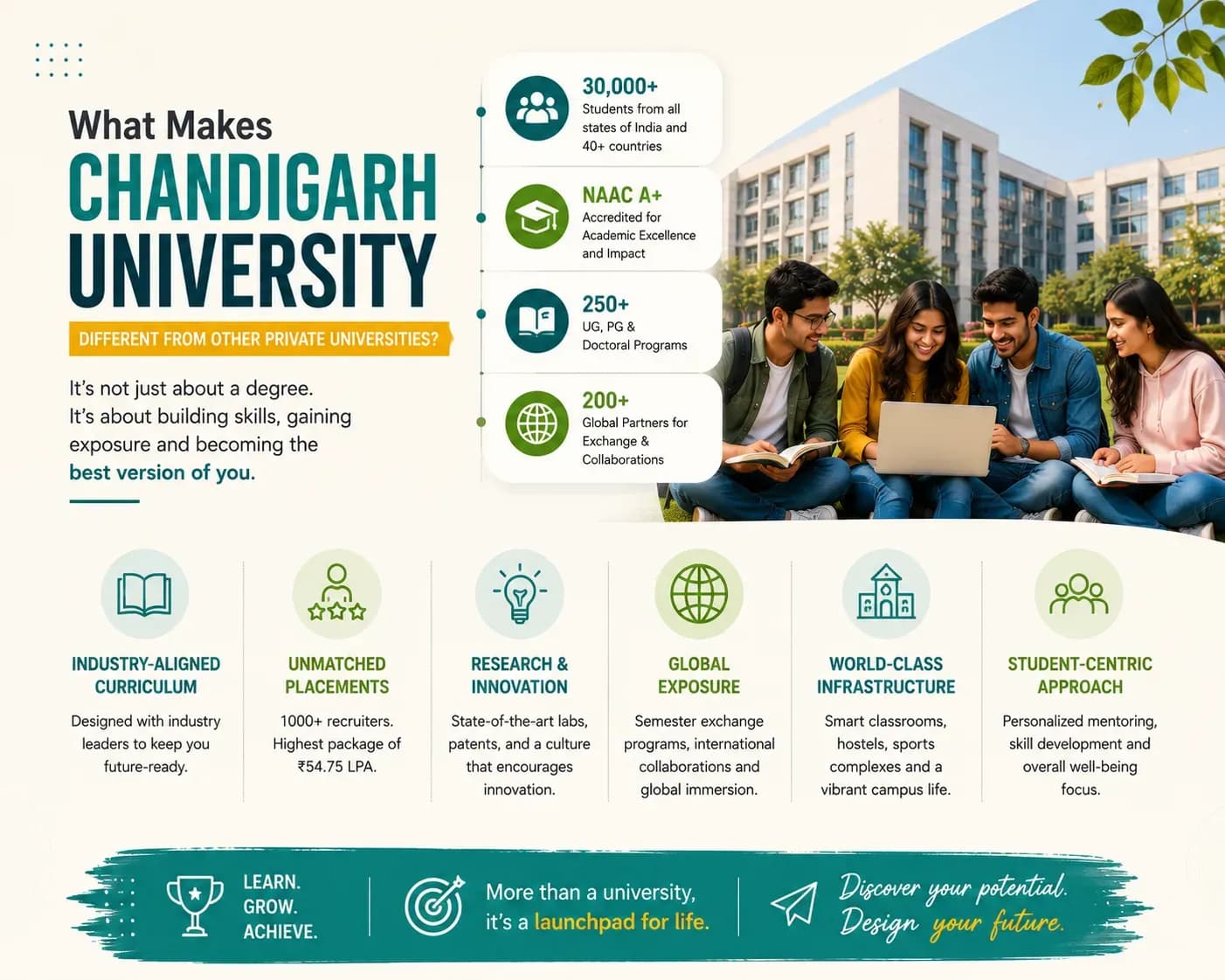
What Makes Chandigarh University Different From Other Private Universities? Over the past few years, Chandigarh University has emerged as one of the most discussed names in India’s higher education ecosystem. As competition among institutions continues growing rapidly, students today are not only searching for degrees — they are looking for career exposure, placements, global opportunities, campus culture, industry readiness, and long-term professional growth. This shift is one of the biggest reasons why conversations around why choose Chandigarh University have increased significantly among students across India. The university has gained attention for combining academics with strong industry integration, modern infrastructure, skill-oriented education, and large-scale student engagement. Discussions surrounding Chandigarh University placements, international partnerships, innovation initiatives, and student activities have also contributed to its growing visibility within the category of top private universities India. For students exploring the broader private university comparison landscape, Chandigarh University often stands out because of its focus on employability, global collaborations, technology integration, and experiential learning models. The growing popularity of Chandigarh University admissions 2026 further reflects increasing student interest in universities that offer both academic learning and practical career development opportunities. Also Read: Why UX/UI Design Is the Career Opportunity Indian Students Cannot Afford to Overlook in 2026 Table of Contents The Rapid Growth of Chandigarh University Chandigarh University Placements and Industry Focus CU Campus Life and Student Environment Chandigarh University Courses and Academic Diversity CU Global Collaborations and International Exposure Private University Comparison — What Makes CU Different? Chandigarh University Student Experience Chandigarh University Admissions 2026 FAQs Conclusion The Rapid Growth of Chandigarh University One of the biggest reasons Chandigarh University receives growing national attention is the speed at which the institution has expanded its academic ecosystem, infrastructure, industry partnerships, and student outreach. In a relatively short period, the university has positioned itself among the more visible names within the category of top private universities India. Unlike many institutions that focus only on conventional classroom teaching, Chandigarh University has consistently invested in research infrastructure, skill-based learning, entrepreneurship initiatives, innovation centres, technology-enabled education, and global academic partnerships. These developments have significantly strengthened conversations surrounding why choose Chandigarh University among modern students. Educational experts involved in broader private university comparison discussions often point out that universities growing rapidly in employability, international exposure, and industry engagement tend to attract stronger student interest nationwide. Chandigarh University Placements and Industry Focus For many students, the strongest factor influencing university decisions today is employability. This is one of the key reasons discussions around Chandigarh University placements have become increasingly popular among engineering, management, commerce, media, design, healthcare, and computer science aspirants. Key placement-oriented strengths often associated with CU include: Strong industry recruitment partnerships Internship-focused academic training Skill-oriented certification ecosystems Industry-linked curriculum updates Corporate interaction programs and workshops Career guidance and placement preparation support Technology and innovation-focused training environments Students comparing institutions within the broader private university comparison landscape often evaluate placement exposure very carefully because employability outcomes increasingly shape the long-term value of higher education. The visibility of Chandigarh University placements across digital platforms and student communities has therefore become one of the institution’s strongest differentiating factors. Related Article: Best Careers for Students in the AI & Automation Era CU Campus Life and Student Environment Another major factor contributing to the popularity of Chandigarh University is its large-scale student engagement ecosystem. Modern students increasingly expect universities to provide not only academics, but also social exposure, networking opportunities, extracurricular participation, innovation culture, and personal growth experiences. The overall CU campus life environment is frequently discussed because of its active student clubs, cultural festivals, entrepreneurship activities, technical competitions, sports participation, and collaborative learning atmosphere. These experiences often shape the broader Chandigarh University student experience beyond academics alone. Students evaluating universities under the broader top private universities India category increasingly value institutions capable of offering balanced academic and social development environments. Chandigarh University Courses and Academic Diversity One of the strongest institutional advantages associated with Chandigarh University courses is academic diversity. The university offers programs across engineering, management, commerce, law, media, healthcare, computer applications, design, hospitality, sciences, liberal arts, and multiple emerging interdisciplinary domains. This wide academic ecosystem allows students to explore career pathways aligned with modern industry trends rather than remaining limited to traditional degree structures alone. As industries evolve rapidly because of technology, automation, AI integration, and digital transformation, universities offering broader interdisciplinary opportunities are gaining stronger relevance. The increasing interest surrounding Chandigarh University admissions 2026 also reflects rising student preference for institutions capable of combining academic flexibility with skill-based professional preparation. CU Global Collaborations and International Exposure One of the biggest reasons Chandigarh University receives attention from students nationwide is its growing focus on international exposure and global academic integration. Modern higher education increasingly values cross-border collaboration, international mobility, industry exposure, and multicultural learning environments, especially for students preparing for globally connected careers. The university’s expanding network of CU global collaborations has contributed significantly to its visibility among students comparing institutions under the broader private university comparison category. International partnerships, exchange opportunities, collaborative research initiatives, and foreign academic engagement programs are now becoming important decision-making factors for students exploring higher education options. Educational experts believe universities actively investing in global exposure tend to provide stronger professional adaptability because students gain access to broader academic perspectives, international networking environments, and globally aligned skill ecosystems. For many students evaluating why choose Chandigarh University, the university’s global outreach strategy becomes an important differentiating factor compared to institutions offering only conventional local academic models. Also Read: Global Career Opportunities Indian Students Should Explore Private University Comparison — What Makes CU Different? When students conduct a detailed private university comparison, they usually evaluate several important factors including placements, campus infrastructure, faculty quality, academic diversity, global exposure, research opportunities, industry integration, affordability, student life, and career support systems. Areas where Chandigarh University often stands out include: Large-scale placement ecosystem and industry partnerships Strong emphasis on employability and practical learning Wide academic program diversity Technology-driven campus infrastructure Growing international academic collaborations Active extracurricular and student engagement environment Skill-oriented education models aligned with modern industries Rapid institutional growth and visibility nationwide For many students comparing institutions within the category of top private universities India, Chandigarh University’s combination of academics, placements, industry integration, and campus environment creates a broader “career ecosystem” rather than only a traditional degree-oriented experience. This broader institutional positioning is one of the major reasons discussions surrounding why choose Chandigarh University continue increasing among students preparing for future-focused careers. Chandigarh University Student Experience The overall Chandigarh University student experience is often described as dynamic, fast-paced, and opportunity-oriented. Students today increasingly value institutions capable of offering exposure beyond textbooks, including leadership development, innovation culture, networking opportunities, entrepreneurial support, and real-world skill building. The active CU campus life ecosystem plays an important role in shaping this experience. Cultural events, technical competitions, sports activities, innovation programs, startup ecosystems, industry workshops, hackathons, and collaborative student communities contribute to a more engaging university environment. Experts analysing student engagement trends believe universities with stronger campus participation ecosystems often create better peer learning environments and higher professional confidence among graduates. As a result, the overall Chandigarh University student experience continues attracting students who want a balance between academics, industry exposure, creativity, and social development. Chandigarh University Admissions 2026 Interest surrounding Chandigarh University admissions 2026 is expected to remain strong as more students explore universities offering modern infrastructure, industry-focused learning, international exposure, and employability-oriented education models. Students considering Chandigarh University generally evaluate factors such as: Placement opportunities and industry connections Availability of emerging and interdisciplinary programs Campus environment and student activities Scholarship opportunities and financial support systems International collaborations and exchange programs Research, innovation, and startup ecosystems Skill development and certification opportunities For many aspirants participating in the broader private university comparison process, Chandigarh University remains one of the institutions frequently considered because of its rapid visibility growth and strong focus on career-oriented education. Expert Analysis Education experts believe the growing popularity of Chandigarh University reflects broader shifts happening across India’s higher education ecosystem. Modern students are increasingly prioritising employability, global exposure, practical skills, innovation ecosystems, and campus engagement rather than evaluating universities only through conventional academic reputation. Analysts studying the broader top private universities India category believe institutions capable of combining strong placements, academic diversity, international partnerships, and active student ecosystems are likely to continue attracting higher student interest in the coming years. The visibility surrounding Chandigarh University placements, CU global collaborations, and the overall Chandigarh University student experience therefore reflects larger changes in how students now evaluate higher education opportunities in India. 🎓 One Form · Multiple Colleges Stop Stressing. Start Applying. Skip the chaos of filling endless forms. Apply to your dream colleges in one go through the College Nirnay Common Application Form — built for every student navigating India's competitive education landscape. Fill the Common Application Form → ✓ Free to apply · ✓ Takes under 5 minutes · ✓ Trusted by thousands of students FAQs Why is Chandigarh University becoming popular among students? Chandigarh University is gaining popularity because of its placement ecosystem, modern infrastructure, industry integration, global collaborations, and active student engagement environment. How are Chandigarh University placements viewed by students? Many students consider Chandigarh University placements one of the university’s strongest advantages because of industry partnerships, internship exposure, and career-oriented training systems. What makes CU campus life different from other universities? The overall CU campus life environment is known for active student clubs, cultural events, innovation activities, sports participation, and collaborative learning experiences. Are Chandigarh University courses available across multiple fields? Yes. Chandigarh University courses are available across engineering, management, commerce, law, healthcare, design, media, sciences, and multiple emerging interdisciplinary areas. Why are CU global collaborations important for students? CU global collaborations provide students with opportunities for international exposure, academic partnerships, exchange programs, and globally aligned learning experiences. Explore More CGPA vs Experience: What Matters More? How to Choose Your Dream University Top Emerging Courses in 2026 Careers Without a Traditional Degree JEE Main 2026 Result Updates Top AI Skills Students Must Learn Best Free AI Tools for Students Freelancing vs Job for Students Conclusion The growing visibility of Chandigarh University reflects broader changes happening across India’s higher education landscape. Today’s students increasingly prioritise employability, international exposure, campus culture, innovation ecosystems, and practical learning experiences alongside traditional academics. The university’s focus on Chandigarh University placements, active CU campus life, diverse academic ecosystem, and expanding CU global collaborations has helped it stand out in the broader private university comparison category. For students exploring Chandigarh University admissions 2026, the institution continues attracting attention because it combines academics with career readiness, student engagement, and industry-focused opportunities within one rapidly growing educational ecosystem.

Why Lovely Professional University Attracts Students From Across India Introduction Every year, students from almost every state in the country make the decision to leave their hometowns and move to Punjab to study at Lovely Professional University. Some arrive looking for stronger career opportunities, some are searching for an academically modern environment, and many are drawn by the scale, diversity, and professional ecosystem that LPU Punjab has built over the years. What makes this migration especially significant is that students choosing Lovely Professional University are not coming from just one academic stream or region — they represent engineering aspirants, management students, design learners, healthcare professionals, entrepreneurs, and creatives from across India who believe the university offers a genuinely future-oriented education experience. The growing national popularity of LPU admissions 2026 is not the result of a single factor. It is the combined outcome of strong academic infrastructure, a large multidisciplinary campus ecosystem, industry-oriented learning, global exposure initiatives, and consistently visible LPU placements. For many students and families evaluating higher education options, the answer to why choose LPU increasingly lies in the university's ability to combine scale with opportunity — creating an educational environment that feels nationally connected rather than regionally limited. This article explores the complete picture behind the rise of Lovely Professional University as one of the most recognised private universities in the country — examining the academic ecosystem, LPU courses, placement culture, scholarships, campus environment, and the broader LPU student experience that continues attracting learners from every corner of India. Also Read: Best Careers for Students in the AI & Automation Era Quick Highlights Key Aspect Details University Lovely Professional University (LPU Punjab) Recognition One of the Top Private Universities in India LPU Courses Engineering, Management, Design, Law, Healthcare, Arts & More LPU Placements Strong National & International Recruiter Presence LPU Scholarships Merit-Based & Entrance-Based Financial Support Student Diversity Students from Across India & Multiple Countries Table of Contents Why Choose LPU — Understanding the University's National Appeal LPU Campus Life — A University Experience Beyond Classrooms LPU Courses — A Multidisciplinary Academic Ecosystem LPU Placements — Career Outcomes That Attract Students Nationwide LPU Scholarships — Making Quality Education Accessible LPU Student Experience — Diversity, Exposure & Growth LPU Admissions 2026 — How Students Can Apply FAQs Conclusion Why Choose LPU — Understanding the University's National Appeal For many students evaluating private universities today, the question is no longer simply about obtaining a degree — it is about finding an institution that can genuinely improve career readiness, provide industry exposure, and create opportunities that extend beyond academics alone. This shift in student priorities is one of the biggest reasons Lovely Professional University has emerged as one of the most recognised names in Indian higher education. The answer to why choose LPU differs slightly for every student, but certain themes consistently appear across student decisions. Some are attracted by the scale and modern infrastructure of LPU Punjab, while others focus primarily on LPU placements, industry-oriented learning, or the wide variety of LPU courses available across disciplines. The university's ability to bring together engineering, management, design, healthcare, law, humanities, media, and emerging technology programmes under one ecosystem creates a level of academic flexibility many students actively seek today. Another major factor behind the popularity of LPU admissions 2026 is the university's national diversity. Students entering Lovely Professional University are exposed to peers from different cultures, languages, educational backgrounds, and professional ambitions — creating a learning environment that feels much larger than a conventional regional university ecosystem. This diversity has become a defining part of the overall LPU student experience. Related Article: Future Tech Careers Indian Students Should Watch Closely LPU Campus Life — A University Experience Beyond Classrooms One of the strongest reasons students from across India are drawn toward Lovely Professional University is the scale and energy of LPU campus life. Unlike institutions where the university experience revolves almost entirely around academics, the campus ecosystem at LPU Punjab is designed to create a much broader environment of personal growth, interaction, creativity, leadership, and professional development. What defines LPU campus life for students: Large multicultural environment — Students at Lovely Professional University interact daily with peers from different Indian states and international backgrounds, creating one of the most diverse private university ecosystems in the country Student clubs and activities — Technical clubs, cultural societies, entrepreneurship cells, sports communities, innovation hubs, and creative groups play a major role in shaping the overall LPU student experience Modern infrastructure — Smart classrooms, laboratories, libraries, sports facilities, auditoriums, startup support systems, and digital learning resources contribute significantly to the appeal of LPU campus life Events and exposure — Festivals, hackathons, celebrity interactions, corporate events, and student competitions create a dynamic environment that extends learning beyond traditional classrooms For many students relocating from smaller towns and cities, the transition into LPU Punjab becomes more than a university shift — it becomes the beginning of a much larger personal and professional transformation. LPU Courses — A Multidisciplinary Academic Ecosystem Another major reason behind the growing popularity of Lovely Professional University is the enormous academic diversity the university offers. Students applying through LPU admissions 2026 are no longer limited to conventional engineering or management pathways alone. Instead, the university has built a multidisciplinary ecosystem where learners can explore technology, business, design, healthcare, law, agriculture, media, architecture, sciences, humanities, and emerging digital fields within one integrated academic environment. Popular LPU courses students frequently explore include: Engineering & Technology — Computer Science, AI & ML, Cybersecurity, Data Science, Robotics, Mechanical Engineering and more Management & Commerce — MBA, BBA, Finance, Marketing, International Business, Analytics Design & Creative Programs — Fashion Design, UI/UX Design, Animation, Multimedia, Interior Design Healthcare & Sciences — Pharmacy, Biotechnology, Nutrition, Microbiology, Physiotherapy Law & Humanities — BA LLB, Journalism, Psychology, Sociology, English and Political Science Emerging Industry Programs — AI, Cloud Computing, Digital Marketing, FinTech and Product Design The diversity of LPU courses gives students the flexibility to combine technical learning with creativity, entrepreneurship, innovation, and professional exposure. This multidisciplinary approach is increasingly becoming one of the biggest answers to the question of why choose LPU among students looking for modern career-oriented education. LPU Placements — Career Outcomes That Attract Students Nationwide For many students and parents evaluating higher education options, career outcomes remain one of the most important deciding factors. This is precisely where LPU placements have played a major role in strengthening the national reputation of Lovely Professional University. Over the years, the university has consistently highlighted strong recruiter participation across engineering, management, design, technology, healthcare, and other professional disciplines. Key factors contributing to strong LPU placements: Industry-Oriented Curriculum — Many LPU courses are structured around skill development, practical exposure, and employability-focused learning Corporate Interaction — Guest lectures, internships, workshops, and industry projects connect students with professionals from major companies Placement Preparation — Aptitude training, mock interviews, coding practice, communication training, and career guidance support the overall placement ecosystem Recruiter Diversity — Companies from IT, consulting, analytics, banking, product development, healthcare, media, and emerging technology sectors participate in recruitment drives Internship Opportunities — Exposure to internships often improves both industry understanding and employability among students at LPU Punjab The visibility of LPU placements across social media, placement reports, student testimonials, and career discussions has significantly contributed to the growth of LPU admissions 2026. Many applicants today view the university not only as an academic institution, but as a long-term career-building ecosystem. Explore More: High Demand Careers Students Should Prepare for in 2026 LPU Scholarships — Making Quality Education Accessible Financial accessibility is another major reason why students from across India continue exploring Lovely Professional University. Through multiple scholarship categories, the university attempts to support students with strong academic performance, entrance exam scores, sports achievements, and extracurricular excellence. For many families considering private higher education, LPU scholarships play a critical role in making professional education more financially manageable. Common types of LPU scholarships available: Merit-Based Scholarships — Based on academic performance in qualifying examinations Entrance-Based Scholarships — Linked to LPUNEST and other recognised examinations Sports Scholarships — For students with national and international sports achievements Cultural & Performance Scholarships — Supporting talent in arts, creativity, and extracurricular excellence Special Category Financial Support — Available in selected categories and conditions The availability of LPU scholarships significantly increases accessibility for students from different socioeconomic backgrounds, especially those relocating to LPU Punjab from other parts of the country for higher education. LPU Student Experience — Diversity, Exposure & Growth What truly differentiates Lovely Professional University for many students is the overall LPU student experience. Beyond academics, the university environment often exposes students to cultural diversity, entrepreneurship, innovation, public speaking, collaborative learning, networking opportunities, and industry interaction at a much larger scale than they previously experienced. Students entering LPU Punjab frequently describe the university as a place where they encounter people with completely different ambitions, languages, ideas, and career goals. This diversity naturally pushes students to become more adaptable, socially confident, and professionally aware — qualities increasingly important in modern workplaces. The overall LPU student experience is also shaped by internships, practical projects, startup culture, competitions, industry events, technical festivals, innovation challenges, and interaction with recruiters. This broader exposure is one of the strongest reasons students exploring why choose LPU often view the university as more than just a traditional degree-granting institution. LPU Admissions 2026 — How Students Can Apply With increasing national visibility and strong student interest, LPU admissions 2026 are expected to witness substantial participation across undergraduate, postgraduate, diploma, and doctoral programmes. Students interested in applying to Lovely Professional University can complete the admission process primarily through the official university portal. General admission process for LPU admissions 2026: Visit the official admission portal of Lovely Professional University Create a student application account Select preferred LPU courses based on eligibility and career goals Upload academic documents and identification details Appear for LPUNEST or other required assessments where applicable Check scholarship eligibility under available LPU scholarships categories Complete counselling, fee submission, and final admission confirmation Because of the growing popularity of LPU admissions 2026, students are generally advised to begin the application process early, especially for highly competitive programmes and scholarship opportunities. 🎓 One Form · Multiple Colleges Stop Stressing. Start Applying. Skip the chaos of filling endless forms. Apply to your dream colleges in one go through the College Nirnay Common Application Form — built for every student navigating India's competitive education landscape. Fill the Common Application Form → ✓ Free to apply · ✓ Takes under 5 minutes · ✓ Trusted by thousands of students FAQs Why do students from across India choose Lovely Professional University? Students choose Lovely Professional University because of its multidisciplinary academic ecosystem, strong LPU placements, modern campus infrastructure, national diversity, industry exposure, and wide variety of LPU courses. What makes LPU campus life different from other universities? LPU campus life is often recognised for its multicultural environment, student activities, technical festivals, innovation culture, sports ecosystem, and large-scale interaction opportunities that contribute strongly to the overall LPU student experience. Are LPU scholarships available for meritorious students? Yes. Multiple LPU scholarships are available based on academic performance, LPUNEST scores, sports achievements, and other eligibility categories depending on the programme. How are LPU placements for students? LPU placements are considered one of the major strengths of the university, with recruiter participation across technology, management, analytics, healthcare, design, and multiple professional sectors. How can students apply for LPU admissions 2026? Students can complete the LPU admissions 2026 process through the official admission portal of Lovely Professional University by registering online, selecting courses, uploading documents, and completing counselling requirements. Explore More CGPA vs Experience: What Matters More? How to Choose Your Dream University Top Emerging Courses in 2026 Careers Without a Traditional Degree JEE Main 2026 Result Updates Top AI Skills Students Must Learn Best Free AI Tools for Students Freelancing vs Job for Students Conclusion The rise of Lovely Professional University as one of the most recognised names in Indian higher education reflects a broader shift in what modern students expect from universities today. Learners are no longer searching only for classrooms and degrees — they are searching for environments that combine academics, career preparation, exposure, diversity, innovation, and long-term professional growth. From strong LPU placements and multidisciplinary LPU courses to scholarships, industry exposure, and a nationally diverse student ecosystem, LPU Punjab continues attracting students who want more than a traditional university experience. The combination of infrastructure, opportunity, and professional orientation has become central to the answer behind why choose LPU for higher education. As LPU admissions 2026 continue gaining attention across India, the university is likely to remain one of the most discussed private institutions among students exploring future-focused academic and career pathways.