
MBA Admission 2026 remains one of the most competitive and consequential postgraduate decisions for commerce, engineering, and science graduates across India. With over 200 B-schools, multiple MBA Entrance Exams 2026 to choose from, and an enormous range of fee structures and specialisations on offer, the path from "I want to do an MBA" to actually sitting in a classroom involves far more strategic decision-making than most students anticipate. This MBA Course Guide is designed to give that strategic decision-making a complete framework, rather than treating any single factor — entrance exam score, institution name, or specialisation trend — as the whole story. This guide covers the complete MBA Admission Guide — MBA Eligibility Criteria, the MBA Admission Process from entrance exam to final seat confirmation, realistic MBA Fees Structure ranges, the CAT Exam 2026 and its alternatives, popular MBA Specializations, and the honest MBA Career Scope and MBA Placement Opportunities that follow.
Explore This: CAT Exam 2026 Overview
What We Cover
MBA Eligibility Criteria — Who Can Apply
The baseline MBA Eligibility Criteria across nearly every recognised B-school in India follows a similar structure, though specific thresholds vary by institution and programme tier:
- Bachelor's degree requirement: A 3-year or 4-year bachelor's degree from a UGC-recognised university in any discipline — Commerce, Engineering, Science, Arts, and other backgrounds are all eligible, since MBA programmes are explicitly designed to admit students from diverse academic backgrounds
- Minimum aggregate marks: Most top-tier institutions require 50% aggregate in the bachelor's degree (45% for reserved categories at many institutions), though highly competitive IIMs and top private B-schools often see successful candidates well above this minimum
- Final-year students can apply: Candidates in the final year of their bachelor's degree are generally eligible to apply, provided they complete and submit proof of graduation before the admission confirmation deadline
- Work experience — required by some, valued by all: Executive MBA and certain part-time or weekend MBA programmes specifically require 2 to 5 years of work experience as a mandatory MBA Eligibility Criteria component. For standard full-time MBA programmes, work experience is not mandatory but is genuinely valued in the selection process, particularly at institutions that weight the personal interview heavily
Always verify the specific MBA Eligibility Criteria for each institution and entrance exam you are targeting — IIMs, top private institutions, and state-level colleges each set their own precise thresholds, and a candidate marginally below one institution's cutoff may comfortably qualify at another.
MBA Entrance Exams 2026 — CAT and the Alternatives
The CAT Exam 2026 remains the most widely recognised and most competitive of all MBA Entrance Exams 2026, used as the primary admission criterion by all 21 IIMs and accepted by more than 1,000 other B-schools nationally. But CAT is far from the only path into a quality MBA programme.
| Exam | Primarily Used By | Key Note |
|---|---|---|
| CAT | All 21 IIMs + 1,000+ other B-schools | Most competitive; conducted once annually by IIMs on rotation |
| XAT | XLRI Jamshedpur + 150+ institutes | Includes a distinctive decision-making section |
| CMAT | Many private and state universities | NTA-conducted; broader acceptance at accessible fee tiers |
| MAT | 600+ B-schools nationally | Conducted multiple times a year, giving more attempts |
| SNAP | Symbiosis institutes | Specific to Symbiosis-affiliated programmes |
| NMAT | NMIMS + select other institutes | Flexible test window across multiple days |
A practical strategy many successful candidates use: prepare seriously for CAT Exam 2026 as the primary target, since its preparation overlaps heavily with XAT, CMAT, and MAT, then register for 2 to 3 of these additional MBA Entrance Exams 2026 as a hedge — giving multiple genuine admission pathways rather than depending entirely on a single exam-day performance.
CAT Exam Eligibility Page: Check CAT Eligibility Criteria
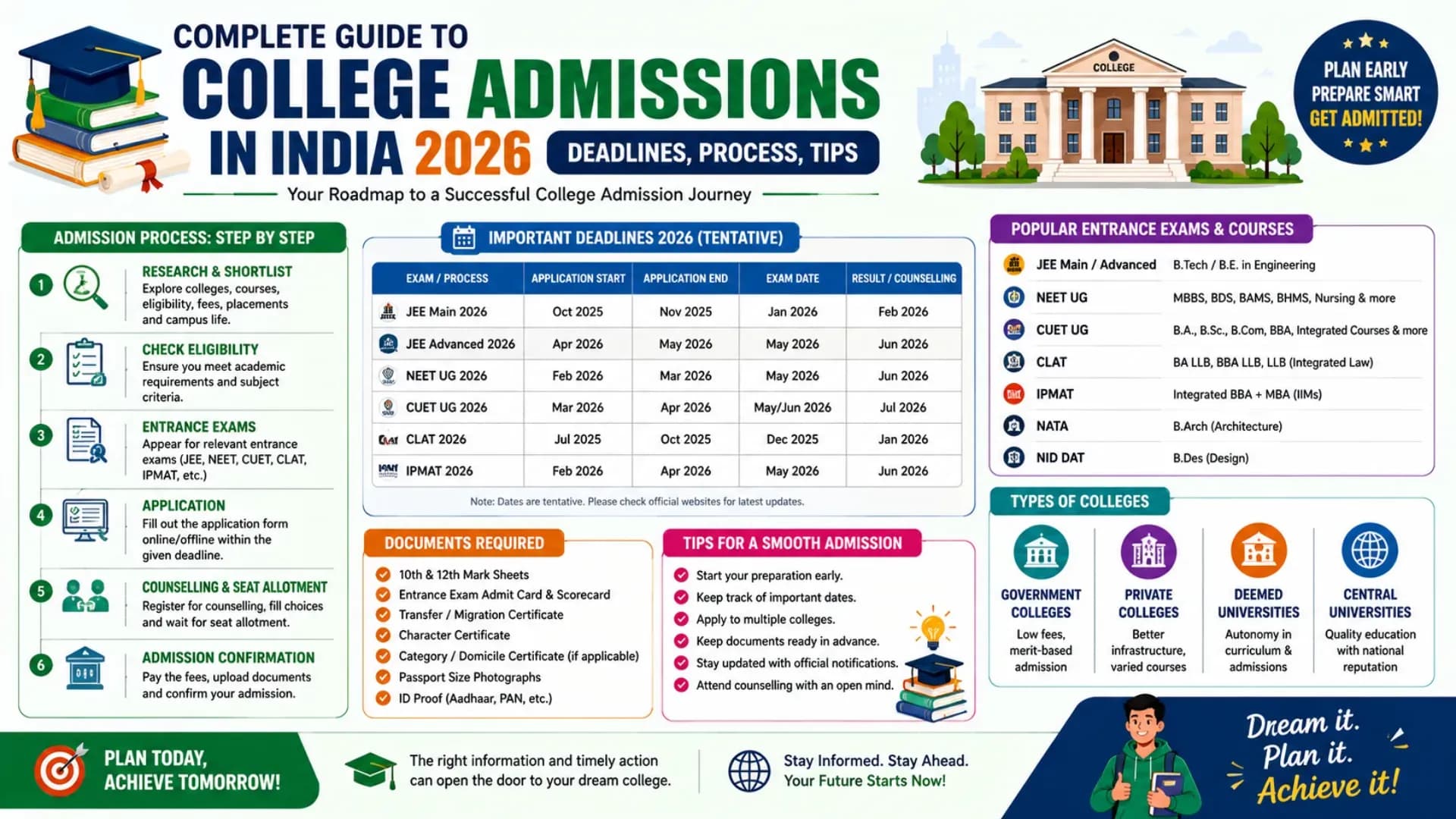
MBA Admission Process — From Exam to Seat Confirmation
The MBA Admission Process at most institutions follows a multi-stage funnel rather than a single exam-determines-everything model — understanding each stage helps candidates prepare holistically rather than over-indexing on the entrance exam alone:
- Stage 1 — Entrance exam: CAT, XAT, CMAT, MAT, SNAP, or NMAT score, depending on your target institutions. This typically determines the initial shortlist for further rounds
- Stage 2 — Written Ability Test (WAT): Many top institutions, particularly IIMs, include a timed essay-writing component testing structured thinking and written communication on a given topic, separate from the entrance exam itself
- Stage 3 — Group Discussion (GD): Some institutions include a group discussion round evaluating how candidates communicate, listen, and contribute in a group setting — though many top institutions have phased this out in favour of WAT and personal interview alone
- Stage 4 — Personal Interview (PI): The personal interview is where academic background, work experience (if any), career goals, and general awareness are evaluated directly — this stage often carries significant weight in final selection, sometimes more than the entrance exam score itself at the margin
- Stage 5 — Final merit list and seat allotment: Institutions combine entrance exam score, academic record, WAT/GD/PI performance, and sometimes work experience or diversity factors into a final composite score to generate merit lists and allot seats
A genuinely important MBA Admission Process insight that catches many candidates off guard: a strong entrance exam score does not guarantee admission on its own. Candidates who treat WAT and PI preparation as an afterthought after a good exam score frequently lose ground to candidates with marginally lower scores but stronger overall presentation in these later stages.
CAT Exam Application Form Page: View Application Form Details
MBA Fees Structure — What You Should Actually Budget For
The MBA Fees Structure across Indian B-schools spans an extraordinarily wide range, and understanding where your target institutions fall on this spectrum is essential for realistic financial planning:
| Institution Tier | Total Programme Fee (Approx.) |
|---|---|
| Top IIMs (A/B/C and similar) | ₹20 lakh – ₹25 lakh |
| Newer IIMs and equivalent-tier institutes | ₹12 lakh – ₹18 lakh |
| Top private B-schools (XLRI, SPJIMR, ISB-equivalent) | ₹18 lakh – ₹28 lakh |
| Mid-tier private universities | ₹5 lakh – ₹12 lakh |
| Government/State university MBA | ₹1 lakh – ₹4 lakh |
A critical part of evaluating MBA Fees Structure honestly: the fee figure alone is meaningless without comparing it against realistic placement outcomes for that specific institution. A ₹20 lakh programme with median placements at ₹25 LPA can be a better financial decision over a career than a ₹5 lakh programme with median placements at ₹6 LPA — but the reverse is equally often true at mid-tier private institutions whose marketing materials emphasise top packages rather than median outcomes. Always research median (not highest) placement figures before committing to any specific MBA Fees Structure tier.
CAT Exam Admit Card Page: Check Admit Card Details
MBA Specializations — Choosing the Right Stream
Choosing among the available MBA Specializations is often more consequential to long-term career outcomes than the choice of institution itself, particularly for mid-tier and government college MBA programmes where the specialisation's industry demand significantly shapes placement quality.
- MBA Marketing: Brand management, market research, consumer behaviour, and traditional FMCG/retail recruitment — one of the most consistently in-demand MBA Specializations across both product and service industries
- MBA Finance: Investment banking, corporate finance, equity research, and financial analysis — typically commands strong starting packages at top institutions, though it is also among the most competitive specialisations to break into at premier firms
- MBA Human Resource Management: Talent acquisition, organisational development, compensation and benefits, and employee relations — a stable, consistently demanded specialisation across virtually every industry sector
- MBA Operations Management: Supply chain, logistics, manufacturing operations, and process optimisation — increasingly valuable as companies invest heavily in operational efficiency and supply chain resilience
- MBA Information Technology: IT project management, technology consulting, and the intersection of business strategy with technology implementation — a strong fit for engineering graduates pursuing MBA
- MBA Business Analytics: Data-driven decision making, predictive modelling for business contexts, and analytics consulting — one of the fastest-growing MBA Specializations given the broader industry shift toward data-informed strategy
- MBA Digital Marketing: Performance marketing, social media strategy, SEO/SEM, and digital brand building — a specialisation that has grown rapidly as companies shift marketing budgets from traditional to digital channels
The honest framework for choosing among MBA Specializations: pick based on genuine interest and your undergraduate background's natural extension, not purely on which specialisation currently advertises the highest starting salary — any thorough MBA Course Guide should emphasise this point well before discussing specific specialisation salary figures — specialisation demand shifts over a 20-to-30-year career, and genuine competence built on real interest outperforms a chased trend over the long run.
MBA Career Scope and Placement Opportunities
The MBA Career Scope in India spans nearly every industry sector, since the degree's core value proposition — structured business decision-making, leadership preparation, and a cross-functional professional network — transfers across consulting, finance, technology, FMCG, manufacturing, healthcare, and the public sector alike.
- Consulting and strategy roles: Top consulting firms recruit heavily from premier B-schools for strategy, management, and operations consulting roles — among the most competitive but highest-paying MBA Placement Opportunities for top-tier graduates
- Corporate roles across functions: Marketing managers, finance managers, HR business partners, and operations leads at large corporates remain the largest single category of MBA Career Scope outcomes across the full range of institution tiers, not just the premier ones
- Banking and financial services: Investment banking, corporate banking, and financial services firms recruit substantially from MBA Finance specialisations specifically, with structured graduate programmes at most major banks
- Technology sector business roles: Product management, business operations, and strategy roles at technology companies have become a major MBA Placement Opportunities category over the past decade, particularly for candidates with an engineering background combined with an MBA
- Entrepreneurship: A meaningful and growing share of MBA graduates, particularly from top institutions, use their degree as preparation for founding or joining early-stage startups rather than pursuing traditional corporate placement
The honest reality of MBA Placement Opportunities that most marketing materials understate: outcomes vary dramatically by institution tier, and the headline placement packages reported by any institution typically represent a small fraction of the graduating batch, not the median outcome. Research median placement data — not highest package — for an accurate picture of MBA Career Scope at any specific institution before committing significant fees toward that programme.
CAT Exam Syllabus Page: View Complete Syllabus
MBA Colleges India — Researching Your Shortlist
Among MBA Colleges India has on offer — from the 21 IIMs to hundreds of state, private, and deemed universities — building an honest shortlist requires looking past brand name alone toward three specific data points for each institution: median placement package (not highest), specific placement rate by specialisation, and the actual fee-to-outcome ratio over a typical career timeline.
Among MBA Colleges India outside the IIM system, several private and state institutions have built genuinely strong placement records in specific specialisations — researching specifically for your target specialisation, rather than relying on an institution's overall brand reputation, frequently surfaces stronger options than the most commonly recommended names.
CAT Exam Highlights Page: View Key Highlights
Conclusion
Navigating MBA Admission 2026 well requires treating it as a genuine multi-stage strategic decision rather than a single high-stakes exam day. Understanding the real MBA Eligibility Criteria for your target institutions, preparing seriously across multiple MBA Entrance Exams 2026 rather than betting everything on one, budgeting honestly against the actual MBA Fees Structure at each tier, and choosing among MBA Specializations based on genuine fit rather than chasing the current trend — these are the decisions that compound into a meaningfully better outcome over a career.
Use this MBA Course Guide and MBA Admission Guide as your working framework — the most complete MBA Admission Guide works only when applied consistently across every stage, not selectively at the parts that feel most urgent: research MBA Colleges India by median outcomes rather than brand alone, understand the full MBA Admission Process beyond just the entrance exam, and evaluate MBA Career Scope and MBA Placement Opportunities honestly before committing significant time and fees to any specific programme. The CAT Exam 2026 and its alternatives are the gateway — but the research and preparation you do beyond the exam itself is what ultimately determines whether your MBA delivers on its promise.