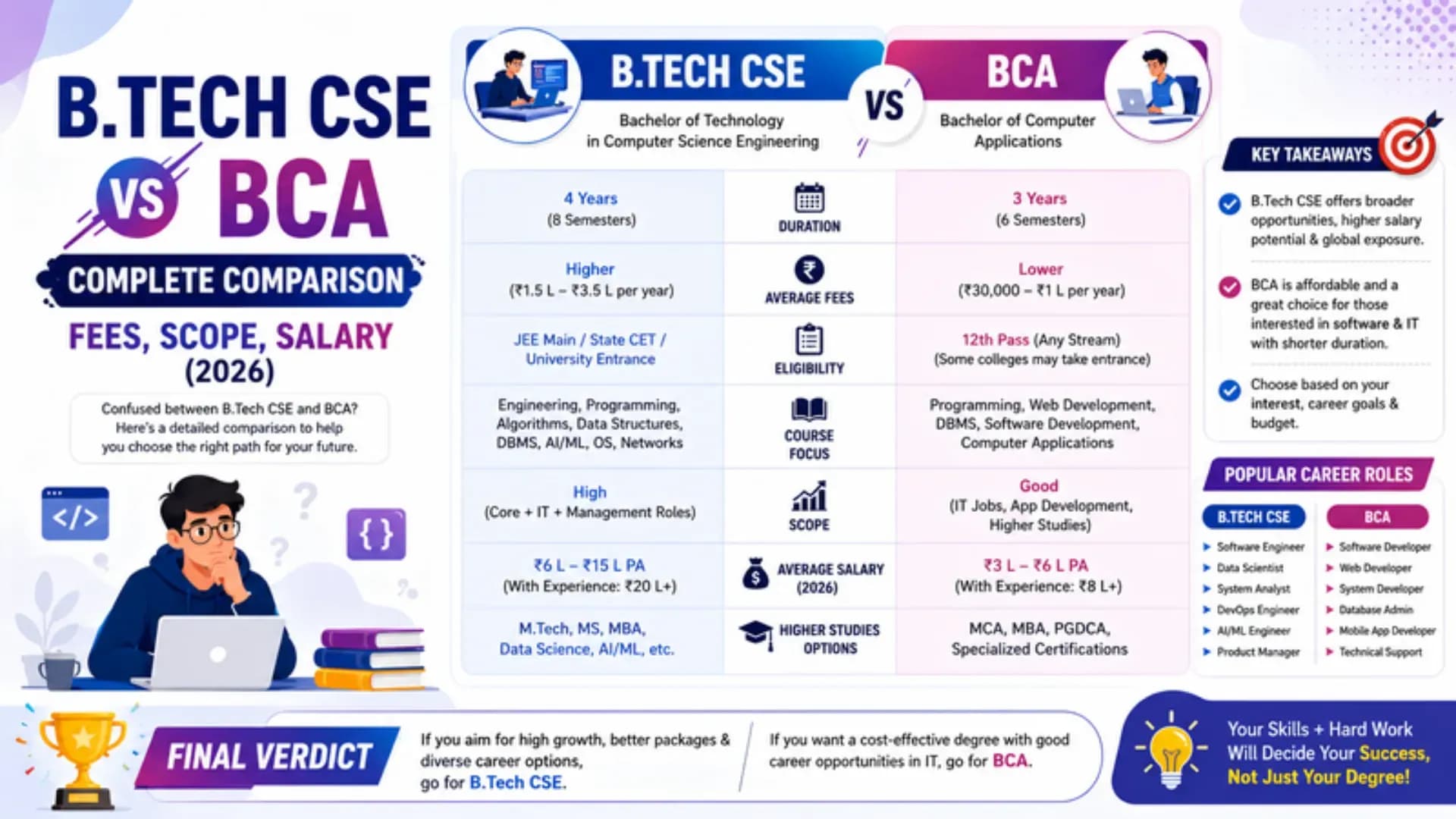
After Class 12, students with PCM or Mathematics who want to build a career in technology face one of the most common — and most consequently misunderstood — course selection questions: B.Tech CSE vs BCA. Both lead to careers in software, both are computer science-oriented, and both take three to four years. But they are not equivalent paths, and the choice between them should not be made based on which coaching centre is promoting which option or which is more commonly seen in the student's social circle. This blog is the most honest and complete BCA vs BTech Comparison available for 2026 — covering all aspects of these two most popular Computer Science Courses 2026. Choosing between these Computer Science Courses 2026 matters enormously for your career trajectory, financial health, and the options available to you at every subsequent stage. This guide gives you what most Computer Science Courses 2026 comparisons do not: the honest financial and outcome analysis, not just the programme description — covering programme structure, fees, salary outcomes, placement patterns, higher education pathways, and the specific circumstances in which each is the genuinely better choice.
Also Read: High-Income Tech Skills Without Programming
B.Tech CSE vs BCA — Quick Reference Comparison
| Parameter | B.Tech CSE | BCA |
|---|---|---|
| Duration | 4 years (8 semesters) | 3 years (6 semesters) |
| Degree Type | B.Tech / B.E. (Engineering) | BCA (Computer Applications) |
| Eligibility | Class 12 PCM; JEE Main / State entrance | Class 12 (Math); many colleges accept any stream |
| BCA vs BTech Fees (Govt.) | ₹50,000–2 LPA (NIT/State Govt.) | ₹20,000–80,000 PA (Govt. colleges) |
| BCA vs BTech Fees (Private) | ₹1–5 LPA | ₹50,000–2.5 LPA |
| BTech CSE Salary (Entry) | ₹4–12 LPA (median; NIT/IIT higher) | — |
| BCA Salary in India (Entry) | — | ₹2.5–6 LPA (median); MCA adds ₹2–4 LPA |
| PG Options | M.Tech, MBA, MS abroad, MCA | MCA (2 years; PG-level; mandatory for many PSU roles) |
| Core Engineering Subjects | Yes — algorithms, OS, compilers, networks, hardware | Partial — applications-focused; less hardware/OS depth |
| Best For | Engineering roles, product companies, research, GATE | Faster entry, budget-conscious, followed by MCA or MBA |
What We Cover
Programme Structure — What You Actually Study
The most fundamental distinction in the B.Tech CSE vs BCA comparison is not duration or fees — it is curriculum depth and orientation.
B.Tech CSE is an engineering degree. It covers computer science from the ground up — mathematics (calculus, linear algebra, probability, discrete maths), physics, engineering fundamentals in Years 1 and 2, then data structures, algorithms, operating systems, computer networks, database systems, compilers, computer architecture, and software engineering in Years 3 and 4. The curriculum is designed to produce engineers who can build systems, not just use them. BTech CSE graduates understand why a system works the way it does — not just how to use its interface. This depth is what makes BTech CSE a prerequisite for research roles, product engineering at top technology companies, and competitive examinations like GATE.
BCA (Bachelor of Computer Applications) is a 3-year degree oriented toward computer applications rather than engineering. It covers programming (C, Java, Python), web development, database management, software project management, and business communication. BCA graduates are application users and builders at the interface level — they develop websites, build database-driven applications, and work in IT support and software testing roles. What BCA does not cover in the same depth: hardware, operating system internals, compilers, computer architecture, and the mathematical foundations that underpin advanced algorithm development.
In the BCA vs BTech Comparison, neither is inherently superior — they serve different career paths. BCA is genuinely sufficient for many IT roles, particularly in service companies, web development, and IT support. BTech CSE is genuinely necessary for product engineering, algorithmic roles, research, and companies that require deep computer science understanding. Choosing the right one depends on which career path you are targeting.
BCA vs BTech Fees — The Complete Cost Picture
The BCA vs BTech fees difference is one of the most practically significant factors in the decision — and the complete picture is more nuanced than "BCA is cheaper."
- Government BTech CSE: At government engineering colleges and NITs, BTech CSE fees range from ₹50,000 to ₹2 LPA annually. Over 4 years, total fees of ₹2 to ₹8 lakh. This is the best fee-to-outcome ratio in Indian engineering education
- Private BTech CSE: Private engineering college fees range from ₹1 to ₹5 LPA depending on institution quality and location. Over 4 years: ₹4 to ₹20 lakh total. At the higher end, the BCA vs BTech fees difference becomes very significant when comparing private BTech to government BCA
- Government BCA: Government BCA programmes at state universities and degree colleges are among the most affordable computer science pathways in India — ₹20,000 to ₹80,000 per year. Over 3 years: ₹60,000 to ₹2.4 lakh total. A BCA from a reputable state university at this cost, followed by MCA, can be the most financially efficient path to a strong IT career
- Private BCA: Private BCA fees range from ₹50,000 to ₹2.5 LPA. Over 3 years: ₹1.5 to ₹7.5 lakh total
The honest BCA vs BTech fees comparison for most students: government BTech (where accessible through JEE Main) is the best option regardless of BCA fees. Private BTech at high fees (₹3 LPA+) should be compared seriously against government BCA followed by MCA — the outcomes may be comparable at significantly lower total investment.
Related Article: Best Free AI Tools for Students 2026
BTech CSE Placements vs BCA Placement Guide
BTech CSE Placements and BCA Placement Guide outcomes differ significantly at the entry level — but converge more than most guides admit at the 3 to 5 year career mark for candidates who invest in skill-building regardless of degree type.
BTech CSE Placements — the honest picture:
- NIT and IIT BTech CSE placements are genuinely strong — median packages of ₹8 to ₹25 LPA at top NITs; product company hiring from top IITs at ₹30 to ₹50 LPA. These figures are real but represent a small fraction of total BTech CSE graduates
- Private college BTech CSE placements are more variable. At strong private colleges (Manipal, Thapar, BITS), median packages of ₹5 to ₹12 LPA are realistic. At mid-tier private colleges, the median is ₹3.5 to ₹6 LPA, primarily service sector hiring
- The key differentiator in BTech CSE Placements is the institution, not the degree type itself. A BTech CSE from a poor-quality private college has worse placement outcomes than a BCA from a reputed state university
BCA Placement Guide — honest assessment:
- Most BCA programmes do not have formal campus placement cells with the same industry relationships as engineering colleges. BCA placement is primarily through skill-based hiring, job portals, and network-driven job search rather than campus recruitment drives
- BCA graduates who proactively build portfolios (GitHub projects, Coursera certifications, freelance work) during the degree often achieve comparable entry-level outcomes to average private BTech graduates — but the burden of proof is higher for BCA candidates in most hiring processes
- The BCA Placement Guide most relevant to 2026: BCA followed by MCA from a reputed institution (IIT MCA via NIMCET, NIT MCA, or top state university MCA) significantly improves placement outcomes and brings BCA+MCA candidates into parity with many BTech CSE graduates for service sector roles
BTech CSE Salary vs BCA Salary in India — 2026 Data
BTech CSE salary and BCA salary in India figures are the most frequently cited and most frequently misrepresented data points in the B.Tech CSE vs BCA comparison. The headline numbers mask a wide distribution. Here is the honest picture for 2026:
| Career Stage | BTech CSE Salary | BCA Salary in India | BCA + MCA Salary |
|---|---|---|---|
| Entry Level (0–1 yr) | ₹3.5–12 LPA (wide range by college) | ₹2.5–5 LPA | ₹4–8 LPA |
| Mid Level (3–5 yr) | ₹8–25 LPA | ₹5–12 LPA | ₹7–18 LPA |
| Senior Level (8+ yr) | ₹18–60 LPA+ | ₹10–25 LPA | ₹14–35 LPA |
| NIT/IIT BTech Median | ₹12–28 LPA (entry) | N/A | IIT MCA: ₹10–20 LPA |
The BTech CSE salary advantage is real and significant at the entry level — particularly for NIT and top private college graduates. At mid-career, skills and experience matter more than the degree, and the BCA salary in India gap narrows substantially for high-performing BCA graduates who invested in their technical skills continuously. The senior level gap reflects the compounding effect of the higher starting salary over a career, not a persistent degree premium.
The most accurate summary of the BTech CSE salary vs BCA salary in India comparison: BTech CSE has a higher floor and a higher ceiling, primarily because it opens the door to product engineering roles and research roles that BCA alone does not. BCA+MCA narrows the gap significantly and is the path that most serious BCA graduates should be planning for.
BTech CSE Scope 2026 vs BCA Career Opportunities
BTech CSE scope 2026 and BCA career opportunities overlap substantially in the middle of the tech job market — but diverge at the extremes.
BTech CSE Scope 2026 — Where the Degree Opens Doors Others Cannot
- Product engineering at top companies: Google, Microsoft, Amazon, Flipkart, Razorpay, PhonePe, and Zepto primarily hire from BTech CSE graduates (or equivalent). The technical interviews at these companies test data structures, algorithms, system design, and computer science fundamentals at a depth that requires BTech CSE preparation — the curriculum genuinely produces the foundation for this
- GATE and government PSU roles: GATE (Graduate Aptitude Test in Engineering) is open only to BTech CSE and related engineering graduates. GATE scores enable M.Tech admission at IITs and NITs, and are used for direct PSU hiring by BHEL, ONGC, DRDO, and ISRO. This pathway is entirely closed to BCA graduates without MCA
- Research and PhD pathways: Most PhD programmes in computer science and engineering require a BTech or M.Tech background. BTech CSE scope 2026 includes the full academic research trajectory
- Specialisation pathways: AI/ML engineering, embedded systems, computer vision, cybersecurity at the engineering level all build on BTech CSE foundations
BCA Career Opportunities — Where BCA Genuinely Competes
- Service sector IT hiring: TCS, Infosys, Wipro, Cognizant, HCL, and Tech Mahindra hire BCA graduates into their mass hiring programmes. The BCA career opportunities in the service sector are genuine and accessible — BCA graduates who pass the company aptitude tests are hired alongside BTech graduates for the same roles
- Web development and digital roles: Full-stack web development, UI/UX, digital marketing technology, content management, and SEO tool management — these roles value demonstrated skills over degree type. BCA graduates with strong portfolios compete well here
- Entrepreneurship and freelancing: For students who intend to build their own product or freelance in web/app development, BCA's shorter duration and lower cost provides a faster path to capability with less financial burden
- BCA career opportunities through MCA: MCA (Master of Computer Applications) from a reputed institution is the most powerful career accelerator for BCA graduates — it brings them into parity with BTech CSE for most service sector roles and significantly improves salary outcomes
Who Should Choose Which — The Honest Decision Framework
The Best Course After 12th PCM for a student interested in technology is not universally BTech CSE or universally BCA. It depends on specific circumstances:
Choose BTech CSE if:
- You can access a government engineering college (NIT, state government college) through JEE Main / state counselling — the government BTech CSE path is the best combination of depth, reputation, and fees available to most students
- You want to target product engineering roles at top technology companies — the BTech CSE scope 2026 includes Google, Amazon, Microsoft, Razorpay, and similar companies; BCA alone does not reliably open these doors
- You are considering GATE for M.Tech, PSU recruitment, or IIT admission — this path requires BTech CSE or equivalent
- You want to pursue research or a PhD in computer science
- You genuinely want the engineering depth — understanding operating systems, compilers, hardware, and networking from a foundational level
Choose BCA if:
- You cannot access a government BTech CSE seat and the only option is private BTech at ₹3 LPA+ — in this case, a government BCA followed by government MCA is almost certainly a better financial and career decision. The combined BCA+MCA investment is lower than 4 years of private BTech, and the outcome is often comparable for service sector roles
- You come from a non-PCM Class 12 background (BCA eligibility is broader than BTech CSE in many states)
- You want to enter the job market one year earlier and are confident in your ability to build skills independently during the degree
- Your career goal is web development, IT support, digital operations, or a role where skills demonstration matters more than the engineering credential
- You are planning to do MCA from a top institution after BCA — the BCA+MCA pathway to a reputed MCA programme (IIT MCA via NIMCET, NIT MCA) is a legitimate and financially efficient path to strong outcomes
The one answer that is almost always wrong in the B.Tech CSE vs BCA decision: choosing private BTech CSE at ₹3–5 LPA annual fees at a mid-tier college because "BTech CSE sounds better than BCA." The credential perception gap between BTech CSE and BCA is real in the job market — but the BTech CSE advantage disappears when the institution is weak, and the financial burden of a private BTech can follow a student for a decade. Government BCA + strong MCA often beats mid-tier private BTech CSE on every metric that matters for real-world outcomes.
Explore More
Conclusion
The B.Tech CSE vs BCA decision is not a prestige contest — it is a strategic choice that should be made based on your specific score, financial situation, career goals, and the quality of institutions accessible to you. BTech CSE scope 2026 is broader and the BTech CSE salary ceiling is higher — but only when the BTech is from a credible institution with genuine placement infrastructure. BCA career opportunities are real in the service sector and in skills-first roles — and the BCA salary in India gap with BTech CSE narrows significantly at mid-career for candidates who invest in their skills.
The Best Course After 12th PCM for a student who can access a government engineering seat is BTech CSE — without qualification. The Best Course After 12th PCM for a student facing private BTech at ₹3+ LPA annual fees at a mid-tier institution is a more complex analysis — and often, government BCA followed by a strong MCA emerges as the better answer. The BCA vs BTech Comparison and computer science courses 2026 landscape in India gives students more genuine options than are usually acknowledged. Use this guide as the basis for your own analysis — the BTech CSE Placements data, the BCA Placement Guide strategy, the BCA vs BTech fees comparison, and the scope framework all point toward the same conclusion: choose based on what you can access and what serves your actual goals, not on degree name recognition alone.