Complete Guide to College Admissions in India 2026 — Deadlines, Process & Tips
Last Updated: June 2026 | Topic: College Admissions India 2026, Admission Process, Deadlines, Counselling
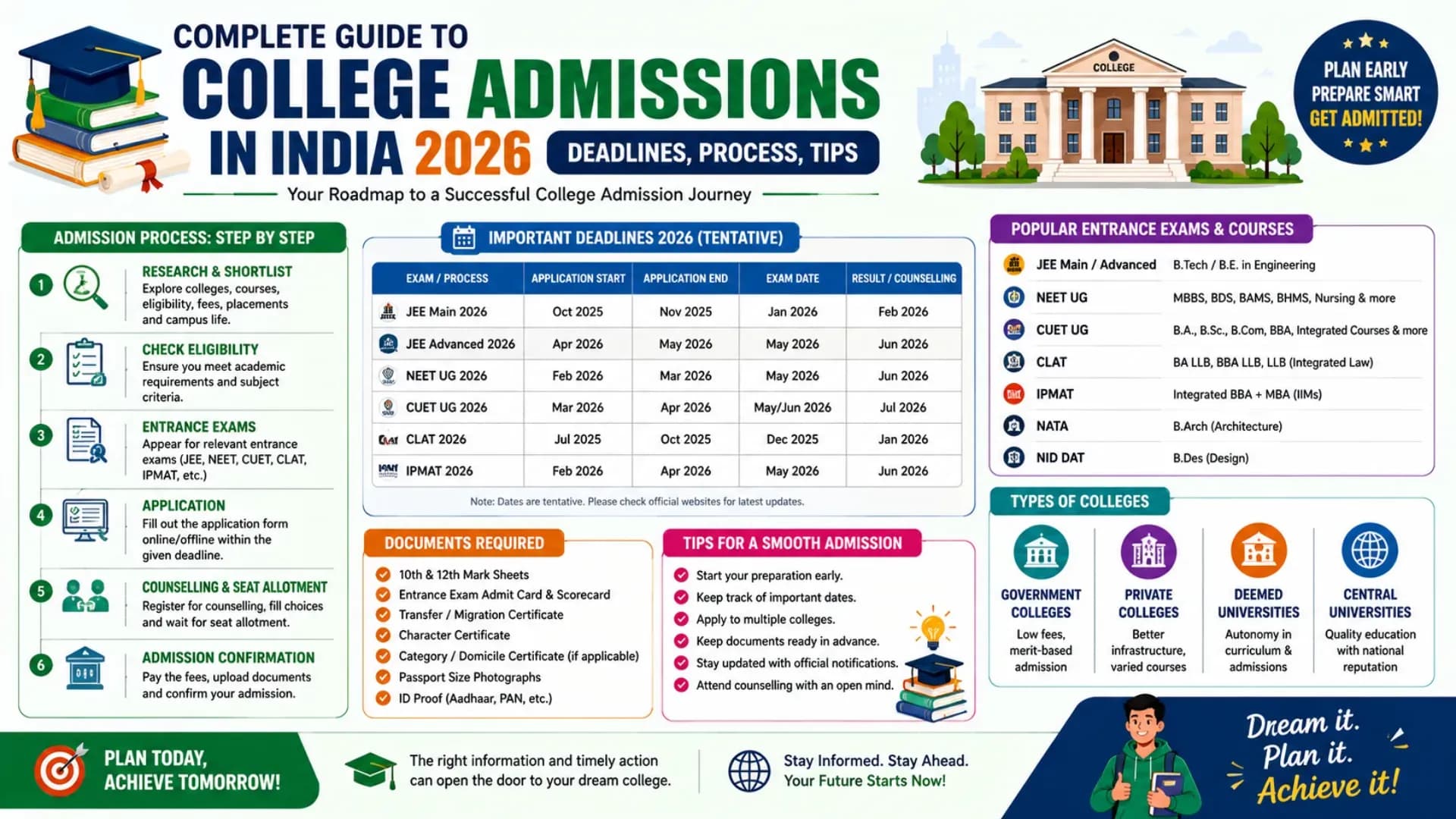
Navigating College Admissions India 2026 is more complex than it has ever been. With multiple entrance examinations, dozens of counselling portals, category-specific reservation rules, and institution-specific deadlines all running simultaneously, the Admission Process 2026 demands a level of planning and organisation that most students and parents underestimate until they are already inside it. This College Admission Guide India is designed to fix that — giving you a complete, honest, and actionable overview of every major admission pathway operating in 2026: from Engineering Admission 2026 through JEE and state CETs, to Medical Admission 2026 through NEET-UG, to CUET Admission 2026 for central universities, to management, law, design, and arts programmes. This Indian University Admission Guide covers the complete Counselling Process India, critical College Admission Deadlines across streams, Higher Education Admissions pathways at every tier, and practical Admission Tips for Students that make a real difference in outcomes. Whether you are a Class 12 student appearing for board exams or a parent helping plan the next step in your child's education, this University Admission 2026 guide gives you the full picture in one place.
College Admissions India 2026 — Quick Reference by Stream
| Stream | Entrance Exam | Counselling Body | Key Deadline Window |
|---|---|---|---|
| Engineering | JEE Main, JEE Advanced, State CETs | JoSAA, CSAB, State counselling | June–August 2026 |
| Medical / Dental | NEET-UG | MCC (AIQ), State counselling | July–September 2026 |
| Central Universities (UG) | CUET UG | University-wise (DU, JNU, BHU etc.) | August–September 2026 |
| Management (MBA) | CAT, XAT, SNAP, MAT | Individual IIMs / B-schools | Jan–April 2026 (for 2026 batch) |
| Law | CLAT, AILET, LSAT India | Consortium of NLUs | June–August 2026 |
| Design | UCEED, CEED, NID DAT | Individual institutes | March–June 2026 |
| Arts / Humanities / Commerce | CUET UG, State CETs | University-wise portals | August–October 2026 |
What This Guide Covers
- Engineering Admission 2026 — JEE, State CETs & JoSAA Counselling
- Medical Admission 2026 — NEET-UG, MCC & State Quota Process
- CUET Admission 2026 — Central Universities & DU Admissions
- Counselling Process India — How Each System Works
- College Admission Deadlines 2026 — Master Calendar
- Higher Education Admissions — PG, Management & Law
- Admission Tips for Students — What Actually Works
Engineering Admission 2026 — JEE, State CETs & JoSAA Counselling
Engineering Admission 2026 in India operates through a layered system of national and state-level examinations. Understanding exactly which exam leads to which institution is the first step in planning your Engineering Admission 2026 strategy effectively. Here is the complete breakdown:
JEE Main 2026
JEE Main is the gateway for admission to NITs, IIITs, GFTIs, and state engineering colleges that accept JEE Main scores. Conducted by NTA in two sessions (January and April), JEE Main scores are the primary filter for the majority of Engineering Admission 2026 seats in government institutions. The best of the two session scores is considered for ranking and counselling. For University Admission 2026 at NITs and IIITs, JoSAA counselling uses the JEE Main rank alongside category certificates.
JEE Advanced 2026
JEE Advanced is the second stage for IIT admission and is open only to the top 2.5 lakh JEE Main qualifiers. JEE Advanced 2026 is the most competitive single-day examination in India for Engineering Admission 2026. IIT admission is through JoSAA counselling exclusively based on JEE Advanced ranks.
State CETs for Engineering Admission 2026
Each state runs its own Combined Entrance Test (CET) for state-quota engineering seats. Major state CETs relevant to Engineering Admission 2026:
- MHT-CET — Maharashtra state engineering colleges
- KCET — Karnataka state engineering colleges
- WBJEE — West Bengal state and private engineering colleges
- AP EAPCET / TS EAPCET — Andhra Pradesh and Telangana engineering colleges
- COMEDK UGET — Private engineering colleges in Karnataka
- KEAM — Kerala state engineering and pharmacy colleges
- GUJCET — Gujarat state engineering colleges
JoSAA Counselling — Engineering Admission 2026
Joint Seat Allocation Authority (JoSAA) conducts centralised online counselling for IITs, NITs, IIITs, and GFTIs. JoSAA counselling for Engineering Admission 2026 runs from June to August 2026 and involves multiple rounds of seat allotment. Key steps: registration, choice filling (listing preferred institute-programme combinations), seat allotment, document verification, and fee payment. The Counselling Process India for engineering through JoSAA is entirely online — candidates do not need to physically visit institutions for the allotment phase.
Medical Admission 2026 — NEET-UG, MCC & State Quota Process
Medical Admission 2026 in India is governed entirely by NEET-UG — the single national entrance test for MBBS, BDS, BAMS, BHMS, BSMS, and BUMS programmes. There is no alternative pathway for Medical Admission 2026 at any recognised medical college in India. Here is how the complete Medical Admission 2026 system works:
NEET-UG 2026
Conducted by NTA, NEET-UG 2026 is a pen-and-paper (OMR-based) test of 720 marks covering Physics, Chemistry, and Biology. The exam is held once a year, typically in May. Qualifying NEET-UG is mandatory for every medical seat — government, private, deemed, and minority institutions included. Your NEET rank determines whether you qualify for AIQ (All India Quota) counselling through MCC, or only for state quota seats.
MCC AIQ Counselling — Medical Admission 2026
The Medical Counselling Committee (MCC) conducts centralised counselling for 15% All India Quota seats in all government medical colleges, 100% seats in ESIC and Central government colleges, and all deemed medical universities. MCC AIQ counselling for Medical Admission 2026 runs in multiple rounds — Round 1, Round 2, and a Mop-Up Round — between July and September 2026. The College Admission Deadlines for MCC rounds are strict and non-extendable.
State Quota Medical Admission 2026
85% of government medical college seats are filled through state quota counselling conducted by individual state authorities. State quota Medical Admission 2026 counselling runs parallel to MCC counselling. Students must apply separately to their state's counselling authority — eligibility is typically based on domicile. Key state medical counselling bodies include DGHS (Delhi), DMER (Maharashtra), Rajasthan state counselling, and similar bodies in all major states.
CUET Admission 2026 — Central Universities & DU Admissions
CUET Admission 2026 is the pathway for undergraduate admission to all 45 Central Universities in India, including Delhi University, JNU, BHU, Hyderabad Central University, Jamia Millia Islamia, and over 225 other participating institutions. CUET Admission 2026 is conducted by NTA and replaces Class 12 percentage-based admissions for all participating universities. Understanding CUET Admission 2026 is essential for any student targeting Arts, Commerce, Science, or interdisciplinary programmes at premier central and state universities.
How CUET Admission 2026 Works
- Single application, multiple universities: One CUET UG application gives you access to all 270+ participating institutions. CUET Admission 2026 scores are shared with all universities you applied to — there is no separate score reporting process
- Subject-wise scores: Each university uses specific CUET subject scores relevant to the programme. Your score in Accountancy is used for B.Com, your score in History for B.A. History, and so on
- No Class 12 percentage: For University Admission 2026 through CUET, your Class 12 marks do not determine your admission — only your CUET score does. Class 12 is used only for eligibility verification
- Decentralised counselling: Unlike JoSAA or MCC, CUET Admission 2026 counselling is managed separately by each university. There is no single portal for all CUET universities
Delhi University CUET Admission 2026
DU uses a centralised portal (du.ac.in/admissions) for all CUET Admission 2026 applicants. After CUET results are declared, DU releases a programme-wise merit list for each college. The DU CUET Admission 2026 process includes three rounds of merit list release, a spot round, and ECA/Sports quota admission. This is the largest single-university admission exercise in India — DU admits over 70,000 students annually through CUET Admission 2026.
Counselling Process India — How Each System Works
The Counselling Process India is not a single system — it is a collection of parallel processes, each with its own portal, timeline, and rules. Most students interact with two or three counselling systems simultaneously, which is where most admission mistakes happen. Here is a clear breakdown of each major Counselling Process India track:
JoSAA — Engineering Counselling Process India
JoSAA counselling is the most structured and transparent Counselling Process India for engineering. It runs for 6 rounds. In each round, candidates fill choices (institute + programme combinations), a seat is allotted based on rank and category, and the candidate must respond — accept the seat and pay the fee, or float to the next round for a potentially better option. Withdrawing without penalty is allowed only before a certain stage. The Counselling Process India for JoSAA is entirely online and requires no physical reporting until document verification at the allotted institute.
MCC — Medical Counselling Process India
MCC counselling for Medical Admission 2026 follows a similar structure — registration, choice filling, allotment, reporting. However, MCC counselling has a critical difference: once you accept an MCC AIQ seat and report to the college, withdrawing and joining a state quota college requires paying a penalty fee and following a strict withdrawal process. Understanding this distinction in the Counselling Process India for medical admissions prevents costly errors.
CSAB — Special Round Engineering Counselling
Central Seat Allocation Board (CSAB) conducts special rounds after JoSAA closes, specifically for seats remaining vacant in NITs, IIITs, and GFTIs. CSAB is a second opportunity in the Counselling Process India for engineering candidates who did not receive an allotment in JoSAA or who want to explore remaining seats.
University-wise Counselling — CUET & Others
For CUET Admission 2026, Law (CLAT), and Management programmes, the Counselling Process India is institution-driven. Each university or consortium releases its own merit list, sets its own document submission window, and manages fee payment independently. The key challenge here is tracking multiple portals simultaneously — a student applying to DU, JNU, BHU, and Jamia through CUET Admission 2026 must monitor four separate counselling processes with different timelines.
Related Article:
How to Choose Your Dream University — Complete GuideCollege Admission Deadlines 2026 — Master Calendar
Missing College Admission Deadlines is the single most avoidable cause of lost admissions every year. The College Admission Deadlines across streams in 2026 run from as early as January (for management programmes) to as late as October (for some university programmes). Below is a master calendar of key College Admission Deadlines across all major streams:
| Month | Key Admission Activity | Stream |
|---|---|---|
| January–March 2026 | CAT/XAT results; IIM GD-PI; B-school admission offers | Management |
| March–April 2026 | UCEED/CEED counselling; NID DAT results & counselling | Design |
| May 2026 | NEET-UG exam; JEE Advanced exam | Medical, Engineering |
| June 2026 | JEE Advanced results; CLAT counselling begins; JoSAA Round 1 | Engineering, Law |
| July 2026 | CUET UG Result; NEET counselling Round 1 (MCC); JoSAA Rounds 2–4 | Medical, Engineering, CUET |
| August 2026 | DU/JNU/BHU merit lists; JoSAA final rounds; NEET Round 2 | CUET, Engineering, Medical |
| September 2026 | NEET Mop-Up Round; CUET university counselling rounds 2–3; CSAB special rounds | Medical, CUET, Engineering |
| October 2026 | Final university counselling rounds; late admissions; stray vacancy rounds | All streams |
Critical reminder on College Admission Deadlines: The dates above are indicative based on 2025 patterns. Official College Admission Deadlines for 2026 are announced by respective conducting bodies. Always verify deadlines from official portals — josaa.nic.in, mcc.nic.in, cuet.nta.nic.in — and set calendar reminders well in advance. Missing a fee payment deadline in JoSAA or MCC by even one hour results in seat cancellation.
Higher Education Admissions — PG, Management & Law
Higher Education Admissions beyond the undergraduate level follow separate examination and counselling systems. For students planning Higher Education Admissions at the postgraduate level in 2026, here is the complete landscape:
M.Tech / M.E. — GATE-Based Higher Education Admissions
GATE (Graduate Aptitude Test in Engineering) scores are the primary criterion for Higher Education Admissions to M.Tech programmes at IITs, NITs, IIITs, and government engineering colleges. GATE scores are also used for direct PSU recruitment (ONGC, BHEL, DRDO, ISRO). CCMT (Centralised Counselling for M.Tech) handles centralised seat allocation for NIT M.Tech admissions. IITs conduct their own separate admission process. Higher Education Admissions through GATE are among the most competitive in India, with GATE cutoffs at top IITs requiring scores in the 90+ percentile range for popular branches.
MBA — Management Higher Education Admissions
Management Higher Education Admissions operate through multiple entrance examinations — CAT (for IIMs and top B-schools), XAT (for XLRI and Xavier institutions), SNAP (for Symbiosis), NMAT (for NMIMS), and MAT/CMAT for a broader range of B-schools. The Indian University Admission Guide for management is complex because each B-school weighs exam scores, work experience, academic profile, GD, and personal interview differently. CAT 2025 results (released January 2026) drive most MBA admissions for the 2026–28 batch.
Law — CLAT-Based Higher Education Admissions
CLAT (Common Law Admission Test) is the gateway for Higher Education Admissions to the 24 National Law Universities (NLUs). CLAT is conducted by the Consortium of NLUs and is used for both undergraduate (5-year integrated LLB) and postgraduate (LLM) admissions. AILET is the separate exam conducted by NLU Delhi for its own seats. For University Admission 2026 in law, top NLUs like NLSIU Bangalore, NALSAR Hyderabad, and NLU Delhi require CLAT scores above the 99th percentile for general category candidates.
MCA — Higher Education Admissions for BCA/BSc Graduates
MCA (Master of Computer Applications) is the most important Higher Education Admissions pathway for BCA and B.Sc Computer Science graduates. NIMCET (National Institute of Technology MCA Common Entrance Test) is used for NIT MCA admissions. IIT Roorkee, IIT Hyderabad, and a few other IITs also admit MCA students through separate tests or NIMCET. An MCA from a reputed NIT or IIT significantly improves placement outcomes for BCA graduates and is one of the most financially efficient Higher Education Admissions paths in Indian tech education.
Admission Tips for Students — What Actually Works in 2026
Most Admission Tips for Students are generic and unhelpful. These Admission Tips for Students are specific to the 2026 landscape and the most common failure points in the Admission Process 2026. These are the Admission Tips for Students that make a real difference:
1. Apply to More Institutions Than You Think You Need To
The most consistent mistake in College Admissions India 2026 is under-applying. Students who apply to only 2–3 institutions frequently end up with no admission because of unexpected rank drops or higher-than-anticipated cutoffs. Apply to a realistic spread: 2 aspirational choices (where your score is at the cutoff margin), 3–4 probable choices (where your score comfortably clears expected cutoffs), and 2 safe choices (where your score significantly exceeds cutoffs). This is the single most impactful of all Admission Tips for Students.
2. Read Every Admission Brochure — Not Just the Highlights
Every university and counselling body publishes a detailed information brochure for the Admission Process 2026. These brochures contain eligibility conditions, tie-breaking criteria, document requirements, and fee structures that differ from what is widely circulated on social media. Many students lose seats because they missed a subject eligibility condition or failed to prepare a required document. This is consistently one of the most overlooked Admission Tips for Students in the College Admission Guide India ecosystem.
3. Prepare Documents Before Results Are Declared
Document verification windows in College Admissions India 2026 are short — typically 3 to 7 days. Prepare all required documents in advance: Class 10 and 12 marksheets, birth certificate, category certificate (if applicable), domicile certificate, migration certificate, character certificate, and passport-size photos. Scan and organise these in clearly labelled folders. Rushing to get an OBC or EWS certificate issued after an allotment is one of the most frequent causes of seat loss in the Counselling Process India.
4. Track College Admission Deadlines With a Dedicated System
With multiple College Admission Deadlines running simultaneously across JoSAA, MCC, CUET universities, state counselling bodies, and law/management consortia, tracking everything mentally is not possible. Use a shared Google Sheet or a physical calendar with every deadline entered the day results are declared. Set phone alarms 48 hours and 24 hours before each College Admission Deadlines window closes — particularly for fee payment steps, which have zero grace period.
5. Do Not Lock In a Seat Too Early in Multi-Round Counselling
In JoSAA and MCC counselling, candidates have the option to "float" — keeping their current allotment while remaining in the pool for a better option in subsequent rounds. Many candidates freeze their seat in Round 1 or 2 out of anxiety and miss significantly better allotments in later rounds. Understanding the float vs. freeze vs. slide options in the Counselling Process India is one of the most underutilised Admission Tips for Students in engineering and medical admissions.
6. Use Official Sources Only for Cutoffs and Deadlines
Social media groups, YouTube channels, and coaching centre websites circulate estimated cutoffs that are frequently inaccurate for College Admissions India 2026. For Engineering Admission 2026, use josaa.nic.in opening/closing ranks from previous years. For Medical Admission 2026, use mcc.nic.in historical data. For CUET Admission 2026, use university official portals. Misinformation about cutoffs causes students to either under-aim (applying to colleges well below their capability) or over-aim (not applying safe options). Official data is the only reliable basis for University Admission 2026 planning.
Explore More
Conclusion
College Admissions India 2026 is a high-stakes, multi-track process that rewards students who plan early, stay organised, and use information from official sources. Whether you are navigating Engineering Admission 2026 through JoSAA, Medical Admission 2026 through MCC, CUET Admission 2026 for central universities, or Higher Education Admissions at the postgraduate level, the fundamentals are the same: understand the system, apply broadly, track College Admission Deadlines rigorously, and participate actively in the Counselling Process India rather than waiting passively.
This Indian University Admission Guide gives you the framework to approach University Admission 2026 with confidence. The Admission Process 2026 across all streams is publicly documented and rule-based — every seat that goes to another student over you is a seat that student was more prepared to claim. Use this College Admission Guide India as your reference throughout the admissions season, apply the Admission Tips for Students that are specific to your situation, and treat every deadline in this Indian University Admission Guide as non-negotiable.
The right institution, the right programme, and the right financial decision — these three things together define the quality of the next four years of your life and the options available to you for the twenty after that. College Admissions India 2026 is the gateway. Navigate it deliberately, with the complete picture this College Admission Guide India provides — and the Admission Tips for Students that actually move the needle.