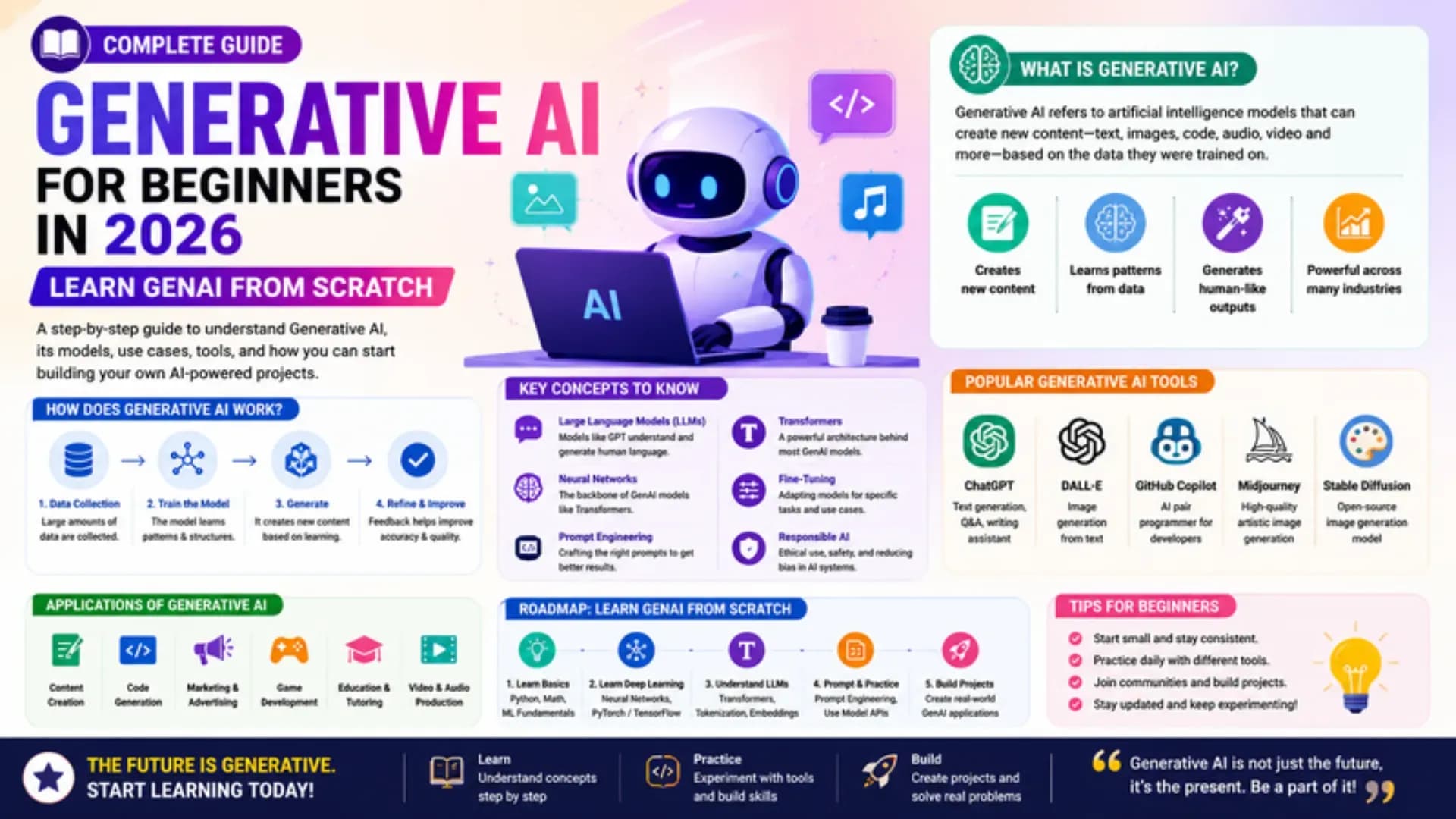
Generative AI is the most consequential technology shift in computing since the internet — and in 2026, understanding it is no longer optional for technology professionals, students, or knowledge workers of any kind. This Generative AI Tutorial 2026 is your complete guide to Learn Generative AI from scratch: covering how Large Language Models work at the conceptual and implementation level, building practical Prompt Engineering Tutorial skills, surveying the AI Tools 2026 landscape across text, image, and code domains, exploring real Generative AI Applications, and laying out a clear AI Learning Roadmap and Generative AI Career Guide for professionals entering or advancing in this field. Whether you are a complete beginner or a developer who has used AI tools without understanding what is happening underneath — this GenAI Guide and GenAI Fundamentals tutorial gives you the depth to be a genuine practitioner rather than a passive user.
Related Article: Top BTech Colleges in India 2026
Table of Contents
- GenAI Fundamentals — What Generative AI Is and How It Works
- Large Language Models — Transformers, Tokens, and How LLMs Generate Text
- Prompt Engineering Tutorial — Techniques That Actually Work
- AI Tools 2026 — The Complete Model and Tool Landscape
- Generative AI Applications — Building Real Things
- RAG and Fine-Tuning — Customising Models for Your Data
- Generative AI Career Guide and AI Learning Roadmap
GenAI Fundamentals — What Generative AI Is and How It Works
GenAI Fundamentals begin with understanding what "generative" means: these are AI systems that generate new content — text, images, code, audio, video — rather than classifying or predicting from existing categories. The shift from discriminative AI (is this email spam?) to generative AI (write me an email) is the paradigm that defines the 2020s technology decade.
# The taxonomy of Generative AI models in 2026:
#
# TEXT GENERATION (Large Language Models):
#   GPT-4o / GPT-4.1 (OpenAI) — most widely used; multimodal
#   Claude Sonnet / Opus (Anthropic) — strong reasoning; long context (200K tokens)
#   Gemini 2.0 / 2.5 (Google) — multimodal; integrated with Google services
#   Llama 3.x (Meta) — open weights; run locally; widely fine-tuned
#   Mistral / Mixtral (Mistral AI) — efficient open models; strong for code
#   DeepSeek V3/R1 — high performance at lower cost; strong in reasoning
#
# IMAGE GENERATION (Diffusion Models):
#   DALL-E 3 (OpenAI) — text-to-image; strong prompt following
#   Midjourney V7 — artistic quality; community-focused
#   Stable Diffusion 3.x (Stability AI) — open weights; run locally; fine-tunable
#   Imagen 3 (Google) — photorealistic; integrated in Workspace
#   Flux (Black Forest Labs) — high quality; open weights
#
# CODE GENERATION:
#   Claude Code (Anthropic) — agentic coding; terminal-based
#   GitHub Copilot (OpenAI / GitHub) — IDE-integrated; most adopted
#   Cursor (Claude/GPT backend) — IDE with agent-mode; multi-file edits
#   DeepSeek Coder — strong on code; open weights
#
# AUDIO / VIDEO:
#   ElevenLabs — voice cloning and TTS
#   Suno / Udio — music generation from text
#   Sora (OpenAI) — video generation from text (limited rollout)
#   Runway Gen-3 — video editing and generation

# The three paradigms of GenAI interaction:
genai_paradigms = {
    "Zero-shot": "Ask the model directly with no examples. Works well for GPT-4+.",
    "Few-shot":  "Provide 2-5 examples in the prompt. Dramatically improves structured output.",
    "Fine-tuned":"Train the model on your domain data. Best quality; highest cost.",
    "RAG":       "Retrieval-Augmented Generation: fetch relevant docs, give to model as context.",
}
for paradigm, description in genai_paradigms.items():
    print(f"  {paradigm:12} → {description}")
# How GenAI differs from traditional ML — the conceptual shift:
#
# TRADITIONAL ML:
# Task-specific models (classifier, regressor, recommender)
# Feature engineering by humans
# Narrow: one model = one task
# Data: labelled datasets needed
# Output: structured (class label, number, recommendation)
#
# GENERATIVE AI (Foundation Models):
# General-purpose; one model = many tasks via prompting
# No feature engineering; natural language is the interface
# Emergent capabilities: tasks the model wasn't explicitly trained for
# Data: self-supervised pre-training on internet-scale text
# Output: open-ended generation (text, code, reasoning)
#
# The training pipeline for a modern LLM:
llm_training_stages = [
("Pre-training", "Self-supervised next-token prediction on trillion+ tokens"),
("SFT", "Supervised Fine-Tuning on curated instruction-following examples"),
("RLHF/RLAIF", "RL from Human/AI Feedback — aligns model to preferences"),
("Constitutional AI", "Anthropic's method: AI critiques and revises own outputs"),
("Red-teaming", "Adversarial testing for harmful outputs before deployment"),
]
for stage, description in llm_training_stages:
print(f" {stage:22} → {description}")Large Language Models — Transformers, Tokens, and How LLMs Generate Text
Understanding Large Language Models at the mechanism level — not just as black boxes — gives you the intuition to use them more effectively and to understand their failure modes.
# The Transformer architecture — the foundation of all modern LLMs:
#
# Key paper: "Attention Is All You Need" (Vaswani et al., Google, 2017)
# Before Transformers: RNNs/LSTMs processed tokens sequentially → slow + short memory
# Transformers: process ALL tokens in parallel → fast + long-range dependencies
#
# The core mechanism: SELF-ATTENTION
# For each token, attention computes: "which other tokens in this sequence
# are most relevant to understanding this token?"
#
# Simplified attention for one token:
# Attention(Q, K, V) = softmax(QK^T / √d_k) × V
#   Q = Query:  "what am I looking for?"
#   K = Key:    "what information do I have?"
#   V = Value:  "what is the actual content?"
#   √d_k:       scaling factor to prevent very small gradients

import math

def simplified_attention(Q: list, K: list, V: list) -> list:
    """
    Conceptual single-head attention on 1D vectors (real: multi-head, matrix ops).
    Q, K, V are lists of token representations.
    """
    d_k = len(Q)
    # Compute dot product scores: how much does each key match the query?
    scores = [sum(q * k for q, k in zip(Q, K)) / math.sqrt(d_k)]
    # Softmax: convert to probabilities (attention weights)
    exp_scores = [math.exp(s) for s in scores]
    total = sum(exp_scores)
    weights = [e / total for e in exp_scores]
    # Weighted sum of values = attended output
    output = [w * v for w, v in zip(weights, V)]
    return output

# What tokens are and why they matter:
tokenisation_facts = {
    "Average English word": "~1.3 tokens (common words = 1 token; rare words = 2-4)",
    "GPT-4 context window": "128K tokens (~96,000 words — about 300 pages)",
    "Claude 3 Sonnet":      "200K token context — ~150,000 words",
    "Gemini 2.0 Flash":     "1M+ token context — entire codebases",
    "Cost implication":     "APIs charge per token — longer context = higher cost",
    "Code is token-dense":  "Python/JS ≈ 1 token per 4 chars; more expensive than prose",
}
for fact, detail in tokenisation_facts.items():
    print(f"  {fact:25} → {detail}")
# How LLMs generate text — the autoregressive loop:
#
# 1. Tokenise input: "The capital of France is" → [464, 3361, 286, 4881, 318]
# 2. Run through transformer layers → probability distribution over ALL vocab tokens
# 3. SAMPLE from that distribution → next token (e.g. "Paris" = token 6342)
# 4. Append to sequence → repeat from step 2 until stop token or max length
#
# KEY INSIGHT: LLMs are fundamentally NEXT-TOKEN PREDICTORS.
# Everything else — reasoning, coding, summarisation — is an emergent behaviour
# of doing next-token prediction at sufficient scale.
#
# Temperature — controls randomness of sampling:
# Temperature 0.0: always pick highest-probability token (deterministic, repetitive)
# Temperature 1.0: sample proportionally to probabilities (default for creative tasks)
# Temperature 2.0: flatten distribution → more random, less coherent
import random, math
def temperature_sampling(logits: dict, temperature: float) -> str:
"""Demonstrate how temperature changes token selection."""
if temperature == 0:
return max(logits, key=logits.get)
# Apply temperature: logit / T, then softmax
scaled = {k: v / temperature for k, v in logits.items()}
exp_vals = {k: math.exp(v) for k, v in scaled.items()}
total = sum(exp_vals.values())
probs = {k: v / total for k, v in exp_vals.items()}
# Sample according to probabilities
tokens, weights = zip(*probs.items())
return random.choices(tokens, weights=weights, k=1)[0]
next_token_logits = {"Paris": 4.8, "London": 1.2, "France": 0.8, "beautiful": 0.3}
random.seed(42)
for temp in [0.0, 0.5, 1.0, 2.0]:
results = [temperature_sampling(next_token_logits, temp) for _ in range(5)]
print(f" T={temp}: {results}")
# T=0: always Paris; T=2: occasional London/France/beautifulPrompt Engineering Tutorial — Techniques That Actually Work in 2026
Prompt Engineering Tutorial skills separate professionals who get reliable, high-quality output from AI from those who get mediocre results. The techniques below are not tricks — they work because of how transformer attention and training work.
# The anatomy of an effective system prompt:
#
# WEAK prompt:
weak_prompt = "Summarise this article."
#
# STRONG prompt (all components present):
strong_prompt = """
You are a senior content editor for a B2B SaaS publication.

Your task: Summarise the following article for a technical audience (software engineers
with 3-8 years of experience). They need to quickly decide whether to read the full piece.

Format your summary as:
- TL;DR (1 sentence, under 25 words)
- Key Points (3-5 bullet points, each under 20 words)
- Why It Matters (1-2 sentences on practical implications for their work)

Constraints:
- Do not use marketing language ("revolutionary", "game-changing")
- Do not repeat information from the TL;DR in the Key Points
- If the article contains code, include one concrete example in Key Points

Article:
{article_text}
"""
#
# What makes it strong:
# 1. Persona:      "senior content editor for B2B SaaS" → sets expertise level and voice
# 2. Audience:     "software engineers 3-8 years" → calibrates complexity and assumptions
# 3. Goal:         "decide whether to read the full piece" → clarifies the purpose
# 4. Format:       explicit sections with length constraints → controls output structure
# 5. Constraints:  what NOT to do → prevents common failures
# 6. Placeholder:  {article_text} → template reuse
# Chain-of-Thought (CoT) prompting — the single biggest quality improvement:
#
# Without CoT: LLM jumps directly to answer → more errors on complex tasks
# With CoT: LLM works through reasoning step-by-step → fewer errors
#
# Why it works: forcing token-by-token reasoning allocates more compute
# to working through the problem rather than retrieving a cached answer pattern
cot_prompts = {
"Zero-shot CoT": "Let's think step by step.",
"Standard CoT": "Work through this problem step by step, showing each step.",
"Self-check": "Solve this, then double-check your answer by working backwards.",
"Debate": "First argue FOR, then AGAINST, then give your balanced conclusion.",
"Socratic": "What questions would a smart skeptic ask about this? Then answer them.",
}
# Structured output prompting — getting JSON/structured data reliably:
json_prompt_template = """
Extract the following information from the job description below.
Return ONLY valid JSON with this exact schema (no markdown, no explanation):
{
"role_title": "string",
"seniority": "junior|mid|senior|lead|principal",
"required_skills": ["string"],
"preferred_skills": ["string"],
"remote_policy": "remote|hybrid|onsite",
"min_experience_years": number or null
}
Job description:
{job_description}
"""
# Note: in production, use model's native JSON mode (OpenAI: response_format=json_object)
# or Anthropic's tool use for guaranteed valid JSON structure# RAG vs Fine-tuning vs Prompting — when to use which:
approach_guide = {
"Better prompts": {
"when": "General tasks; no private data needed; model already knows the domain",
"cost": "Lowest — just inference cost",
"example": "Summarise customer feedback, write marketing copy",
},
"RAG": {
"when": "Need private/recent data the model doesn't know; factual accuracy critical",
"cost": "Medium — embedding + vector DB + inference",
"example": "Answer questions from your company's internal documentation",
},
"Fine-tuning": {
"when": "Specific style/format required; consistent persona; latency-sensitive",
"cost": "Highest — training + inference; requires quality data",
"example": "Customer service bot with your company's voice and product knowledge",
},
}
for approach, details in approach_guide.items():
print(f"\n{approach}:")
for k, v in details.items():
print(f" {k:8}: {v}")AI Tools 2026 — The Complete Model and Tool Landscape
The AI Tools 2026 landscape has consolidated significantly — a small number of foundation models underpin thousands of applications. Understanding the model tier helps you choose the right tool for each task.
# Model selection guide (2026) — matching task to model:
#
# Tier 1 — Frontier models (best quality; highest cost):
#   GPT-4.1          → complex reasoning, multimodal tasks, code generation
#   Claude Opus 4    → long-document analysis, complex writing, extended reasoning
#   Gemini 2.5 Pro   → multimodal, long context, Google ecosystem integration
#
# Tier 2 — Efficient frontier (excellent quality; 10-20x cheaper):
#   GPT-4o-mini      → fast, cheap, good quality; best for high-volume pipelines
#   Claude Sonnet    → balanced quality/cost; recommended default for most tasks
#   Gemini 2.0 Flash → fastest in class; 1M context; best for latency-sensitive
#
# Tier 3 — Open source / self-hosted (no per-token cost; data privacy):
#   Llama 3.3 70B    → best open model for general tasks; run on 2×A100s
#   Mistral 7B       → smallest useful model; runs on consumer GPU
#   CodeLlama 34B    → code generation; fine-tunable for specific languages

# ChatGPT Tutorial — essential features professionals use:
chatgpt_features = {
    "Custom Instructions":  "Set persistent persona/context — don't repeat in every prompt",
    "GPTs (Custom Bots)":   "Build specialised assistants with tools + knowledge files",
    "Code Interpreter":    "Upload data → analyse, visualise, clean in Python sandbox",
    "Canvas":              "Collaborative document editing with inline AI assistance",
    "Projects":            "Persistent context across conversations — files + instructions",
    "Advanced Voice":      "Real-time voice conversation with expression understanding",
    "Image Gen (DALL-E3)": "Text-to-image directly in conversation",
    "Web Search":          "Real-time search integration for current events and facts",
}
for feature, use in chatgpt_features.items():
    print(f"  {feature:24} → {use}")
# Calling LLM APIs — practical implementation with Python:
# pip install anthropic openai
# ── Anthropic Claude API ─────────────────────────────────────────────────────
import anthropic
client = anthropic.Anthropic() # uses ANTHROPIC_API_KEY env variable
message = client.messages.create(
model="claude-sonnet-4-6",
max_tokens=1024,
system="You are a concise technical writer. Use plain language.",
messages=[
{"role": "user", "content": "Explain gradient descent in 3 sentences."}
]
)
print(message.content[0].text)
# ── OpenAI API ───────────────────────────────────────────────────────────────
from openai import OpenAI
oai_client = OpenAI() # uses OPENAI_API_KEY env variable
response = oai_client.chat.completions.create(
model="gpt-4o-mini",
messages=[
{"role": "system", "content": "You are a concise technical writer."},
{"role": "user", "content": "Explain gradient descent in 3 sentences."},
],
response_format={"type": "text"}, # or "json_object" for structured output
temperature=0.3,
max_tokens=300,
)
print(response.choices[0].message.content)Also Read: Top MTech Colleges in India 2026
Generative AI Applications — Building Real Things With LLMs
Generative AI Applications that create genuine value share a common pattern: they use AI for the parts of a task where human-level language understanding adds unique value, and conventional software for the parts that require deterministic behaviour.
# Building a document Q&A pipeline (conceptual walkthrough):
import anthropic, json

client = anthropic.Anthropic()

def analyse_document(document: str, question: str) -> dict:
    """
    Multi-step GenAI pipeline:
    1. Extract key information from document
    2. Answer the specific question using extracted info
    3. Return structured result with confidence and citations
    """
    prompt = f"""You are a document analyst. Analyse the following document and answer the question.

Document:
{document}

Question: {question}

Respond with ONLY valid JSON in this format:
{{
  "answer": "direct answer to the question",
  "confidence": "high|medium|low",
  "supporting_quotes": ["exact quote from document", "another quote"],
  "caveats": "any limitations or uncertainties in your answer"
}}"""

    response = client.messages.create(
        model="claude-sonnet-4-6",
        max_tokens=1000,
        messages=[{"role": "user", "content": prompt}]
    )
    try:
        return json.loads(response.content[0].text)
    except json.JSONDecodeError:
        return {"answer": response.content[0].text, "confidence": "low"}

# The most valuable Generative AI Applications by category in 2026:
applications = {
    "Document Intelligence": "Contract review, legal doc analysis, research summarisation",
    "Code Generation":       "GitHub Copilot, Cursor — write boilerplate, explain, debug",
    "Customer Support":      "RAG-backed bots on company docs — resolve L1/L2 tickets",
    "Content Creation":      "Marketing copy, product descriptions, personalised emails",
    "Data Extraction":       "Structured data from unstructured text (invoices, reports)",
    "Search Enhancement":    "Semantic search, query expansion, result ranking",
    "Agentic Workflows":     "Multi-step autonomous tasks: research + draft + send email",
}
for domain, description in applications.items():
    print(f"  {domain:22} → {description}")
RAG and Fine-Tuning — Customising Models for Your Data
Retrieval-Augmented Generation (RAG) is the dominant pattern for building production Generative AI Applications that need access to private, current, or domain-specific knowledge. It avoids the cost and complexity of fine-tuning while giving the model access to accurate, current information.
# RAG pipeline — step by step:
#
# INDEXING (done once or periodically):
# 1. Load documents (PDFs, web pages, databases, Notion, Confluence)
# 2. Chunk into segments (~500 tokens each with overlap)
# 3. Embed each chunk → dense vector (text-embedding-3-large or Cohere embed)
# 4. Store vectors in vector database (Pinecone, Weaviate, Qdrant, pgvector)
#
# RETRIEVAL (at query time):
# 5. Embed user query → query vector
# 6. Similarity search → top-k most relevant chunks (cosine similarity)
# 7. Optionally: rerank with cross-encoder (Cohere Rerank) for precision
#
# GENERATION (at query time):
# 8. Build prompt: [system] + [retrieved context] + [user question]
# 9. Call LLM → answer grounded in your retrieved documents
# 10. Optionally: return source citations with the answer

from anthropic import Anthropic

def rag_query(user_question: str, retrieved_chunks: list[str]) -> str:
    """Production RAG generation step — grounded answer with hallucination reduction."""
    client = Anthropic()
    context = "\n\n---\n\n".join(
        f"[Source {i+1}]: {chunk}"
        for i, chunk in enumerate(retrieved_chunks)
    )
    system_prompt = """You are a precise assistant that answers questions using ONLY the provided source documents.

Rules:
- Answer only from the provided sources; do not use external knowledge
- If the answer is not in the sources, say "I cannot find this in the provided documents"
- Cite sources with [Source N] format when referencing specific information
- Be concise; do not repeat source text verbatim"""

    response = client.messages.create(
        model="claude-sonnet-4-6",
        max_tokens=1000,
        system=system_prompt,
        messages=[{
            "role": "user",
            "content": f"Sources:\n\n{context}\n\nQuestion: {user_question}"
        }]
    )
    return response.content[0].text

# Vector embedding similarity (conceptual — real uses numpy/scipy):
def cosine_similarity(vec_a: list, vec_b: list) -> float:
    """Measure how similar two embedding vectors are (1.0 = identical, 0 = orthogonal)."""
    dot = sum(a * b for a, b in zip(vec_a, vec_b))
    mag_a = sum(a**2 for a in vec_a) ** 0.5
    mag_b = sum(b**2 for b in vec_b) ** 0.5
    return dot / (mag_a * mag_b) if mag_a * mag_b > 0 else 0.0

# RAG libraries in 2026:
rag_tools = {
    "LangChain":    "Most widely used; chains, agents, many integrations",
    "LlamaIndex":   "Best for document-heavy RAG; strong retrieval features",
    "Haystack":     "Enterprise-focused; strong evaluation pipeline",
    "DSPy":         "Programmatic prompt optimisation; research-grade",
    "Vector DBs":   "Pinecone, Qdrant, Weaviate, pgvector (Postgres extension)",
}
Generative AI Career Guide and AI Learning Roadmap
# Generative AI Career Guide — roles and India salary ranges (2026):
#
# AI/ML Engineer (GenAI focus):
#   Build, fine-tune, and deploy LLM-powered applications
#   Skills: Python, PyTorch/HuggingFace, LangChain, cloud ML platforms
#   Salary: ₹18–60 LPA India; $180–350K USD at top US companies
#   Demand: highest-demand engineering role in 2026; growing fastest
#
# Prompt Engineer / AI Product Specialist:
#   Design prompting systems, evaluate model outputs, build AI workflows
#   Skills: Prompt engineering, evaluation frameworks, product thinking
#   Salary: ₹12–35 LPA India; role evolving rapidly — many absorbed into SWE
#   Note: pure prompt engineering roles are declining; engineer who prompts well is valuable
#
# LLM Research Scientist:
#   Pre-training, RLHF, alignment research, novel architectures
#   Requires: PhD or equivalent research output; strong math background
#   Salary: ₹30–100 LPA India (rare); $250–600K USD at frontier AI labs
#
# AI Infrastructure Engineer:
#   Training clusters, inference optimisation, GPU orchestration
#   Skills: CUDA, distributed training, Kubernetes for ML, MLOps
#   Salary: ₹25–80 LPA India; rapidly growing as model deployment scales
#
# GenAI Product Manager:
#   Define AI-powered products; evaluate model capabilities; GTM
#   Skills: Product management + AI literacy; ability to write effective prompts
#   Salary: ₹20–60 LPA India; 20-30% premium over non-AI PM roles
# AI Learning Roadmap — 12 months from beginner to practitioner:
#
# MONTHS 1–2 — Foundation (no math required to start):
# ✓ Use ChatGPT / Claude daily for real work tasks — deliberately, not casually
# ✓ Course: "ChatGPT Prompt Engineering for Developers" (DeepLearning.AI + OpenAI — free)
# ✓ Python fundamentals if needed: complete one Python course
# ✓ Build: automate one task in your actual job with an LLM API
#
# MONTHS 3–4 — Core Concepts:
# → Course: "LangChain for LLM Application Development" (DeepLearning.AI — free)
# → Understand: transformer architecture (Andrej Karpathy's YouTube series — free)
# → Build: a RAG system on documents you actually own or use
# → Read: "Attention Is All You Need" paper (Vaswani et al.) — read for intuition
#
# MONTHS 5–6 — Applied Building:
# → HuggingFace NLP course (free) — fine-tuning, datasets, model hub
# → Build: fine-tune a small open model (Llama 7B) on domain-specific data
# → Learn: evaluation frameworks (RAGAS for RAG, LLM-as-judge, evals)
# → Deploy: ship one real API-backed AI feature to production
#
# MONTHS 7–9 — Specialisation:
# → Agentic AI: build a multi-step agent with tool use (Claude computer-use or OpenAI Operator)
# → MLOps: model monitoring, prompt versioning, A/B testing prompts
# → Math: linear algebra + probability review if pursuing research (3Blue1Brown — free)
#
# MONTHS 10–12 — Portfolio + Job Search:
# → 3 portfolio projects: one RAG app, one fine-tuned model, one agentic system
# → Write: 3-5 articles on what you built (builds credibility + LinkedIn visibility)
# → Target: AI startups (high growth), established tech (Google, Amazon, Flipkart, Juspay),
# fintech (Razorpay, PhonePe, Setu), edtech (BYJU's, Unacademy, upGrad)
# Evaluation — how to measure LLM output quality:
evaluation_approaches = {
"Human eval": "Ground truth; expensive; slow — use for final validation",
"LLM-as-judge": "Use a strong model to evaluate another model's output",
"RAGAS": "RAG evaluation: faithfulness, answer relevancy, context recall",
"BERTScore": "Semantic similarity between generated and reference text",
"Exact match": "Structured outputs: JSON validity, schema compliance",
}The most important mindset for the AI Learning Roadmap: Use AI tools for your actual work from day one — not in practice exercises, but for real tasks. The professionals who develop the deepest GenAI intuition in 2026 are those who run every non-trivial task through an LLM first and develop a working understanding of what the model does well and where it fails. Deliberate daily use at work is worth more than three months of coursework in isolation.
CHECK OUT: Top Colleges in Ranchi 2026
Explore More
Conclusion
This Generative AI Tutorial 2026 has taken you from GenAI Fundamentals through the complete practitioner landscape: how Large Language Models work at the mechanism level (transformers, attention, temperature sampling), the Prompt Engineering Tutorial techniques that reliably improve output quality, the AI Tools 2026 landscape with working API code for both Anthropic and OpenAI, real Generative AI Applications including a production-ready RAG implementation, and a complete Generative AI Career Guide with the AI Learning Roadmap to get there.
The professionals who will define the next decade of AI applications are not those who passively consume AI output — they are those who understand the mechanisms well enough to know what to ask for, how to structure the ask, what to verify in the output, and when to reach for RAG versus fine-tuning versus a better prompt. This GenAI Guide gives you that foundation. The ChatGPT Tutorial and API examples in this article are starting points — the genuine Learn Generative AI practice happens when you integrate these tools into your real work, build the muscle memory for effective prompting, and develop an honest sense of where Large Language Models add genuine value and where they reliably fail. This Generative AI Tutorial 2026 is your starting point — return to it as each concept becomes live in your work, because a Generative AI Tutorial 2026 is only as valuable as the practice it enables. Learn Generative AI not by reading more articles but by building more things — every project you complete deepens your ability to Learn Generative AI at the next level. The Generative AI for Beginners path is well-marked in 2026 — the resources are free, the APIs are accessible, and the Generative AI for Beginners community of practitioners is enormous and collaborative. This GenAI Guide has covered the complete landscape — revisit each section of the GenAI Guide when the relevant challenge is live in your work, and use the ChatGPT Tutorial section's API patterns alongside the ChatGPT Tutorial prompting techniques as templates for your first builds. Start today: open an API console, call an LLM with a problem you are actually working on, and begin the iteration.