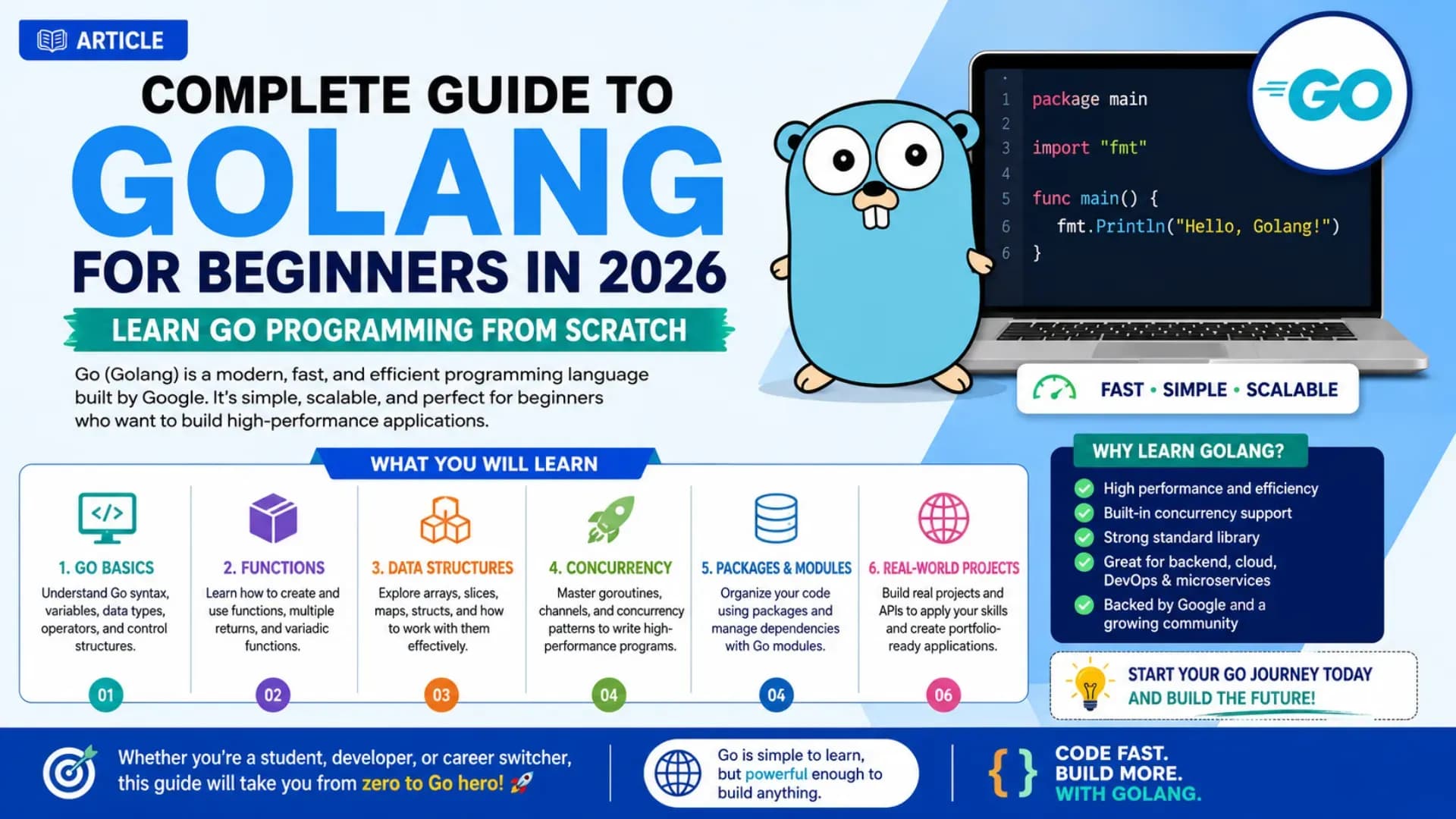
Complete Guide to Golang for Beginners in 2026: Learn Go Programming From Scratch
If you are looking to learn Golang in 2026, you have chosen one of the most strategically valuable programming languages in the current technology landscape. Go — created at Google in 2009 by Robert Griesemer, Rob Pike, and Ken Thompson — was designed specifically to address the performance, scalability, and developer productivity challenges that large-scale software systems face. In 2026, Go has moved well beyond its Google origins to become the language of choice for cloud-native infrastructure, distributed systems, microservices, and high-performance backend APIs — with adoption at companies including Docker, Kubernetes, Cloudflare, Dropbox, Uber, and thousands of startups that need the combination of C-like performance and Python-like development speed that Go uniquely delivers.
This Golang Tutorial 2026 is a complete, structured Go Programming Language Guide for absolute beginners — covering every concept from environment setup and Golang Basics through Golang Syntax, functions, structs, interfaces, error handling, the standard library, and the Golang Concurrency model that makes Go uniquely powerful for modern cloud and systems work. Every concept in this Golang for Beginners guide is accompanied by working, tested code examples that you can copy, run, and modify in your own Go environment. This is not a reference manual — it is a Go Programming Course you can complete in a weekend that will give you everything you need to Learn Go From Scratch and start building real programmes with confidence.
By the end of this Go Language Tutorial, you will understand Go's type system, control flow, functions, structs, interfaces, error handling, goroutines, channels, and the standard library — along with a practical Golang Career Guide that maps what you can build with Go to the professional opportunities this language creates in 2026.
Related Article: Top B.Tech Colleges in India — Fees, Rankings & Placements 2026
Table of Contents
- What Is Golang and Why Learn It in 2026?
- Setting Up Your Go Development Environment
- Golang Basics — Variables, Types, and Control Flow
- Functions, Structs, and Interfaces in Go
- Golang Concurrency — Goroutines and Channels
- Error Handling in Go — The Idiomatic Approach
- Golang Standard Library and Packages
- Golang Career Guide — Roles and the Go Ecosystem in 2026
- Conclusion
What Is Golang and Why Learn It in 2026?
Go is a statically typed, compiled programming language with garbage collection, built-in concurrency support, and a minimalist syntax designed for large-scale software development. The language was built to solve a specific and practical problem: at Google's scale, the existing languages were either too slow (Python, Ruby), too complex for large teams (C++), or unable to handle concurrency elegantly (Java at the time). Go was designed to be all three: fast to compile, simple enough for large teams to reason about, and natively concurrent. In 2026, these properties align perfectly with the demands of cloud computing, container orchestration, and microservices — which is why Go adoption has accelerated significantly in recent years.
Why Go Stands Apart From Other Languages
Go's design philosophy is captured in a famous engineering principle: the language should be learnable in a day and masterable over a career. The syntax is deliberately small — Go has only 25 keywords, compared to Java's 50 and C++'s 80+ — meaning there is almost always exactly one idiomatic way to express any concept. This uniformity produces codebases that are consistently readable across large teams, dramatically reducing the cognitive overhead of code review. The compiler is fast enough that iteration cycles feel interactive. The standard library is comprehensive enough to build production systems without third-party dependencies. And the Golang Concurrency model — based on Communicating Sequential Processes (CSP) theory — makes concurrent and parallel programming conceptually clean in a way that thread-based models in Java and Python cannot match.
Your First Go Programme — Hello, World
Before environment setup, here is the complete structure of a Go programme — every element means something, and understanding the first programme is the first concrete step in your journey to Learn Go From Scratch:
// Every Go file belongs to a package.
// The main package is the entry point of every executable Go programme.
package main

// The import statement brings in external packages.
// fmt (format) is the standard library package for I/O.
import "fmt"

// func main() is the entry point — execution begins here.
// Every executable Go programme must have exactly one main function.
func main() {
    fmt.Println("Hello, World!")
}
Five lines. No class definitions, no public static void, no semicolons, no boilerplate. This is the entirety of the scaffolding Go requires to run a programme — and this minimalism is not a beginner simplification. It is how Go programmes look at every scale. The Golang Syntax you use in your first programme is the same syntax used in production codebases at Kubernetes, Docker, and the Go standard library itself.
Also Read: Top AI Skills Students Must Learn in 2026
Setting Up Your Go Development Environment
Setting up a working Go environment takes under ten minutes. The toolchain is clean and the installation does not require package managers or version conflicts — Go's single binary installer handles everything. Here is the complete setup for all platforms to begin your Go Language Tutorial journey in practice.
Installing Go on Your System
Visit go.dev/dl and download the installer for your operating system — Windows (.msi), macOS (.pkg), or Linux (.tar.gz). After installation, verify Go is correctly installed by running these commands in your terminal:
# Verify Go installation — should print the installed version
go version

# Expected output (version number may differ):
# go version go1.22.0 linux/amd64

# Check the Go environment configuration
go env GOPATH
go env GOROOT
Creating Your First Go Project
Go uses modules for dependency management — every project is a module defined by a go.mod file. Here is how to create and run your first Go project:
# Create a directory for your project
mkdir hello-go
cd hello-go

# Initialise a Go module — creates go.mod
# The module path is typically a URL (your GitHub repo path)
go mod init github.com/yourname/hello-go

# Create your main Go file
# On Linux/macOS:
touch main.go

# Run your programme without compiling to disk
go run main.go

# Compile and create an executable binary
go build -o hello
./hello

# Format your code — Go's standard formatter
go fmt ./...

# Run all tests in your module
go test ./...
Recommended Editor — VS Code with Go Extension
VS Code with the official Go extension (published by Google) is the recommended editor for beginners and professionals alike. Install the extension, open your project folder, and VS Code will automatically install the Go language server (gopls), the debugger (delve), and the formatter. The result is autocomplete, inline error checking, integrated test running, and one-click debugging — all configured automatically. The Go extension is the closest experience to an IDE available in any editor for this language.
Go's Built-in Toolchain: Unlike most languages that require separate tools for formatting, testing, documentation, and dependency management, Go ships with everything built in: go fmt for formatting, go test for testing, go doc for documentation, go build for compilation, and go mod for module management. This means every Go developer uses the same tools with the same defaults — producing a consistency across the ecosystem that is genuinely rare in the programming world.
Golang Basics — Variables, Types, and Control Flow
Golang Basics start with understanding how Go handles the things every programme needs: storing data, making decisions, and repeating operations. Go's approach to all three is deliberate and clean — and understanding the idioms early prevents the confusion that comes from trying to write Python or Java in Go's syntax.
Variables and Type Declarations
Go is statically typed — every variable has a type known at compile time. But Go also has type inference, which means you rarely need to write the type explicitly. Understanding the difference between the two declaration styles is the first Golang Syntax concept every beginner must master:
package main

import "fmt"

func main() {
    // Explicit type declaration — var keyword
    var name string = "Arjun"
    var age  int    = 22
    var score float64 = 95.5
    var passed bool = true

    // Short variable declaration — := operator (type inferred)
    // Only available inside functions, not at package level
    city  := "Jaipur"
    year  := 2026
    grade := "A+"

    // Multiple assignment in one line
    x, y, z := 10, 20, 30

    // Constants — immutable, evaluated at compile time
    const Pi      = 3.14159
    const AppName = "CollegeNirnay"

    fmt.Println(name, age, score, passed)
    fmt.Println(city, year, grade)
    fmt.Println(x, y, z, Pi, AppName)
}
Arrays, Slices, and Maps — Go's Core Data Structures
package main

import "fmt"

func main() {
    // Array — fixed size, rarely used directly in Go
    var marks [5]int = [5]int{85, 92, 78, 96, 88}
    fmt.Println("Array:", marks)

    // Slice — dynamic, flexible, the workhorse of Go collections
    subjects := []string{"Maths", "Physics", "Chemistry"}
    subjects  = append(subjects, "Biology")    // append returns a new slice
    fmt.Println("Subjects:", subjects)
    fmt.Println("Length:", len(subjects))

    // Slice expressions — creating sub-slices
    first2 := subjects[:2]       // ["Maths", "Physics"]
    last2  := subjects[2:]       // ["Chemistry", "Biology"]
    fmt.Println(first2, last2)

    // Map — key-value store, similar to Python dict
    studentScores := map[string]int{
        "Priya":  94,
        "Arjun": 87,
        "Meera": 91,
    }
    studentScores["Rohan"] = 88     // add new key

    // Check if a key exists — the comma-ok idiom
    score, exists := studentScores["Priya"]
    fmt.Println("Priya's score:", score, "Exists:", exists)

    delete(studentScores, "Rohan")  // delete a key
    fmt.Println("Map:", studentScores)
}
Control Flow — If, For, and Switch
Go has only one loop keyword — for — which handles what most languages split across for, while, and do-while. This is a deliberate simplification, and it is one of the reasons Golang Basics are learnable quickly:
package main

import "fmt"

func main() {
    // if-else — no parentheses around condition (Go style)
    score := 87
    if score >= 90 {
        fmt.Println("Grade: A+")
    } else if score >= 80 {
        fmt.Println("Grade: A")
    } else {
        fmt.Println("Grade: B")
    }

    // if with initialisation statement (very idiomatic Go)
    if remainder := score % 10; remainder > 5 {
        fmt.Println("Rounds up")
    }

    // Classic for loop
    for i := 0; i < 5; i++ {
        fmt.Printf("Count: %d\n", i)
    }

    // While-style loop (for with only a condition)
    n := 1
    for n < 16 {
        n *= 2
    }
    fmt.Println("n =", n)    // 16

    // Range-based for loop — iterates over slices, maps, strings, channels
    subjects := []string{"Maths", "Physics", "Chemistry"}
    for index, subject := range subjects {
        fmt.Printf("%d: %s\n", index, subject)
    }

    // Switch — Go's switch does not fall through by default
    day := "Monday"
    switch day {
    case "Saturday", "Sunday":
        fmt.Println("Weekend")
    case "Monday":
        fmt.Println("Start of work week")
    default:
        fmt.Println("Weekday")
    }
}
Functions, Structs, and Interfaces in Go
Go's approach to functions, data structures, and polymorphism is one of the cleanest in any modern language — and mastering these three concepts is what enables you to move from writing simple scripts to building well-structured, maintainable Go programmes. This is the section where the Go Programming Language Guide moves from syntax to design.
Functions — Multiple Return Values and Named Results
Go functions can return multiple values — this is used pervasively, most importantly for returning a result alongside an error value. This pattern is the foundation of Go's error handling approach:
package main

import (
    "errors"
    "fmt"
    "math"
)

// Basic function — takes two int parameters, returns one int
func add(a, b int) int {
    return a + b
}

// Multiple return values — the Go idiom for error propagation
func divide(a, b float64) (float64, error) {
    if b == 0 {
        return 0, errors.New("division by zero")
    }
    return a / b, nil
}

// Variadic function — accepts any number of arguments
func sum(nums ...int) int {
    total := 0
    for _, n := range nums {
        total += n
    }
    return total
}

// First-class function — functions as values
func applyTwice(f func(float64) float64, x float64) float64 {
    return f(f(x))
}

func main() {
    fmt.Println(add(3, 7))   // 10

    result, err := divide(10, 3)
    if err != nil {
        fmt.Println("Error:", err)
    } else {
        fmt.Printf("Result: %.4f\n", result)
    }

    fmt.Println(sum(1, 2, 3, 4, 5))  // 15

    // Closure — function that captures outer variables
    multiplier := func(x float64) float64 { return x * 2 }
    fmt.Println(applyTwice(multiplier, 3))  // 12
    fmt.Println(applyTwice(math.Sqrt, 256))  // sqrt(sqrt(256)) = 4
}
Structs — Go's Way of Modelling Data
Go does not have classes — it has structs with methods. This distinction is important: Go is not an object-oriented language in the traditional sense, but it achieves most of the organisational benefits of OOP through structs and interfaces. Understanding structs is central to Golang for Beginners progressing to real-world code:
package main

import "fmt"

// Struct definition — a named collection of fields
type Student struct {
    Name    string
    Age     int
    Score   float64
    Courses []string
}

// Method on a struct — receiver in parentheses before function name
// (s Student) is a value receiver — gets a copy of the struct
func (s Student) Greet() string {
    return fmt.Sprintf("Hi, I'm %s, age %d", s.Name, s.Age)
}

// Pointer receiver — modifies the original struct value
func (s *Student) UpdateScore(newScore float64) {
    s.Score = newScore
}

// Embedded struct — Go's composition over inheritance model
type Address struct {
    City  string
    State string
}

type Person struct {
    Address    // embedded — Person "inherits" Address fields
    Name    string
}

func main() {
    // Struct literal — create a new instance
    priya := Student{
        Name:    "Priya Sharma",
        Age:     20,
        Score:   91.5,
        Courses: []string{"Go", "Algorithms", "Databases"},
    }

    fmt.Println(priya.Greet())
    priya.UpdateScore(94.0)
    fmt.Printf("Updated score: %.1f\n", priya.Score)

    // Pointer to struct
    arjun := &Student{Name: "Arjun Mehta", Age: 21}
    fmt.Println(arjun.Greet())   // Go auto-dereferences pointers to structs

    p := Person{Name: "Meera", Address: Address{City: "Jaipur", State: "Rajasthan"}}
    fmt.Println(p.City)    // Access embedded field directly — "Jaipur"
}
Interfaces — Implicit Implementation
Go interfaces are satisfied implicitly — a type implements an interface by having the required methods, without any explicit declaration. This "duck typing at compile time" is one of Go's most elegant features:
package main

import (
    "fmt"
    "math"
)

// Interface definition — a set of method signatures
type Shape interface {
    Area()      float64
    Perimeter() float64
}

type Circle struct{ Radius float64 }
type Rectangle struct{ Width, Height float64 }

// Circle implements Shape — no "implements" keyword needed
func (c Circle) Area()      float64 { return math.Pi * c.Radius * c.Radius }
func (c Circle) Perimeter() float64 { return 2 * math.Pi * c.Radius }

// Rectangle also implements Shape
func (r Rectangle) Area()      float64 { return r.Width * r.Height }
func (r Rectangle) Perimeter() float64 { return 2 * (r.Width + r.Height) }

// Function that accepts any Shape — polymorphism via interface
func printShapeInfo(s Shape) {
    fmt.Printf("Area: %.2f  Perimeter: %.2f\n", s.Area(), s.Perimeter())
}

func main() {
    shapes := []Shape{
        Circle{Radius: 5},
        Rectangle{Width: 4, Height: 6},
    }
    for _, s := range shapes {
        printShapeInfo(s)
    }
}
The Empty Interface — interface{} and any: In Go, interface{} (and its alias any introduced in Go 1.18) is the interface that every type satisfies — because every type has at least zero methods. It is used when a function must accept values of any type, similar to Object in Java or object in Python. Use it sparingly — the type safety of Go's static type system is lost when you use any, and type assertions or type switches are required to recover the underlying value. In most cases, a well-designed interface with specific methods is the better choice.
Stop Stressing. Start Applying.
Skip the chaos of filling endless forms. Apply to your dream colleges in one go through the College Nirnay Common Application Form — built for every student navigating India's competitive education landscape.
Fill the Common Application Form →✓ Free to apply · ✓ Takes under 5 minutes · ✓ Trusted by thousands of students
Golang Concurrency — Goroutines and Channels
Golang Concurrency is the single most distinctive and powerful feature of Go — and the primary reason why Go became the language of choice for cloud infrastructure, network services, and distributed systems. The Goroutines Tutorial below covers the core concurrency model that every Go developer must understand before building anything beyond simple scripts.
Goroutines — Lightweight Concurrent Execution
A goroutine is a lightweight thread of execution managed by the Go runtime — not by the operating system. The Go runtime can efficiently schedule thousands of goroutines on a small number of OS threads. Starting a goroutine is as simple as the go keyword before a function call:
package main

import (
    "fmt"
    "sync"
    "time"
)

func fetchData(source string, wg *sync.WaitGroup) {
    defer wg.Done()   // Signal completion when this function returns
    fmt.Printf("Fetching from %s...\n", source)
    time.Sleep(100 * time.Millisecond)  // Simulate I/O delay
    fmt.Printf("Done fetching from %s\n", source)
}

func main() {
    sources := []string{"API-1", "API-2", "API-3", "Database"}
    var wg sync.WaitGroup

    start := time.Now()

    for _, source := range sources {
        wg.Add(1)                      // Increment counter before goroutine
        go fetchData(source, &wg)    // Launch goroutine — runs concurrently
    }

    wg.Wait()    // Block until all goroutines call Done()
    fmt.Printf("All fetches complete in %v\n", time.Since(start))
    // ~100ms instead of ~400ms (sequential) — concurrent I/O
}
Channels — Communicating Between Goroutines
The Go concurrency philosophy is expressed in one memorable line from the Go team: "Do not communicate by sharing memory; instead, share memory by communicating." Channels are the mechanism for this: typed conduits through which goroutines send and receive values:
package main

import "fmt"

// Channel as a pipeline — producer sends, consumer receives
func producer(ch chan<- int) {
    for i := 0; i < 5; i++ {
        ch <- i    // Send i to channel — blocks if channel is full
    }
    close(ch)   // Signal no more values — enables range loop termination
}

func consumer(ch <-chan int) {
    for val := range ch {    // Receives until channel is closed
        fmt.Printf("Received: %d\n", val)
    }
}

func main() {
    // Unbuffered channel — sender blocks until receiver is ready
    ch := make(chan int)
    go producer(ch)
    consumer(ch)

    // Buffered channel — sender can send up to capacity without blocking
    buffered := make(chan string, 3)
    buffered <- "first"
    buffered <- "second"
    buffered <- "third"
    close(buffered)
    for msg := range buffered {
        fmt.Println(msg)
    }

    // Select — multiplex over multiple channels (like a switch for channels)
    ch1 := make(chan string, 1)
    ch2 := make(chan string, 1)
    ch1 <- "from ch1"
    ch2 <- "from ch2"

    select {
    case msg := <-ch1:
        fmt.Println("Received", msg)
    case msg := <-ch2:
        fmt.Println("Received", msg)
    }
}
Goroutines vs Threads — Scale Difference: A goroutine starts with only 2KB of stack space (which grows dynamically), compared to a typical OS thread's 1 to 8MB. This means a Go programme can efficiently run hundreds of thousands of concurrent goroutines on modest hardware — a scale impossible with thread-per-connection models used in Java or Python. This is exactly why Go became the dominant language for writing highly concurrent network services and the infrastructure layer of cloud platforms like Kubernetes.
Error Handling in Go — The Idiomatic Approach
Go does not have exceptions. This is a deliberate design decision — not an oversight. The Go authors concluded that exception-based error handling produces invisible, hard-to-trace error propagation paths. Go's alternative — treating errors as explicit return values — makes every error visible in the code, every error decision deliberate, and every error propagation path traceable by reading the code. This approach feels verbose initially and becomes one of Go's most valued properties as codebases grow.
The Error Interface and Custom Error Types
package main

import (
    "errors"
    "fmt"
)

// Custom error type — implement the error interface
// error interface: { Error() string }
type ValidationError struct {
    Field   string
    Message string
}

func (e *ValidationError) Error() string {
    return fmt.Sprintf("validation error: field '%s' — %s", e.Field, e.Message)
}

// Sentinel errors — predefined error values for comparison
var (
    ErrNotFound   = errors.New("record not found")
    ErrUnauthorised = errors.New("unauthorised access")
)

func validateAge(age int) error {
    if age < 0 {
        return &ValidationError{Field: "age", Message: "must be non-negative"}
    }
    if age > 150 {
        return &ValidationError{Field: "age", Message: "exceeds maximum plausible age"}
    }
    return nil
}

// Error wrapping (Go 1.13+) — add context while preserving original error
func processStudent(id int) error {
    if id <= 0 {
        return fmt.Errorf("processStudent(%d): %w", id, ErrNotFound)
    }
    return nil
}

func main() {
    // Standard error check pattern
    if err := validateAge(-5); err != nil {
        fmt.Println("Error:", err)

        // Type assertion to access custom error fields
        var valErr *ValidationError
        if errors.As(err, &valErr) {
            fmt.Println("Failed field:", valErr.Field)
        }
    }

    // Error unwrapping — check if wrapped error matches sentinel
    err := processStudent(-1)
    if errors.Is(err, ErrNotFound) {
        fmt.Println("Student not found (wrapped error unwrapped correctly)")
    }
    fmt.Println("Full error:", err)
}
Golang Standard Library and Packages
One of Go's most celebrated attributes is its standard library — a comprehensive set of packages that enables production-quality HTTP servers, JSON serialisation, database connectivity, file I/O, cryptography, and more without any third-party dependencies. For anyone working through a Go Programming Course, understanding the standard library is the transition from writing toy programmes to building real systems.
Building an HTTP Server in Under 20 Lines
Go's net/http package is battle-tested and used in production at scale — it powers several of the world's highest-traffic services. Here is a minimal but functional HTTP server:
package main

import (
    "encoding/json"
    "fmt"
    "net/http"
)

type Response struct {
    Status  string `json:"status"`
    Message string `json:"message"`
}

// Handler function — takes ResponseWriter and Request
func helloHandler(w http.ResponseWriter, r *http.Request) {
    w.Header().Set("Content-Type", "application/json")
    w.WriteHeader(http.StatusOK)

    resp := Response{Status: "success", Message: "Hello from Go!"}
    json.NewEncoder(w).Encode(resp)
}

func main() {
    http.HandleFunc("/api/hello", helloHandler)
    fmt.Println("Server running at http://localhost:8080")
    http.ListenAndServe(":8080", nil)
}
JSON Encoding and Decoding
JSON is the universal language of APIs — and Go's encoding/json package makes marshalling and unmarshalling straightforward through struct tags:
package main

import (
    "encoding/json"
    "fmt"
)

type Student struct {
    Name   string   `json:"name"`
    Age    int      `json:"age"`
    Scores []int   `json:"scores"`
    Active bool     `json:"active,omitempty"`  // omit if false/zero
}

func main() {
    // Marshal (struct → JSON string)
    student := Student{
        Name:   "Priya Sharma",
        Age:    22,
        Scores: []int{88, 92, 95},
        Active: true,
    }
    jsonBytes, err := json.MarshalIndent(student, "", "  ")
    if err != nil {
        fmt.Println("Error:", err)
        return
    }
    fmt.Println(string(jsonBytes))

    // Unmarshal (JSON string → struct)
    jsonStr := `{"name":"Arjun Mehta","age":20,"scores":[76,84,91]}`
    var decoded Student
    err = json.Unmarshal([]byte(jsonStr), &decoded)
    if err != nil {
        fmt.Println("Error:", err)
        return
    }
    fmt.Printf("Decoded: %+v\n", decoded)
}Golang Career Guide — Roles, Salaries, and the Go Ecosystem in 2026
The Golang Career Guide for 2026 maps to a professional landscape that is genuinely expanding — Go is not a niche language with limited job market. It is the dominant language for the infrastructure layer of the modern internet, and the demand for engineers who can write production-quality Go is consistently outpacing the supply of qualified candidates.
Where Go is Used in Production — The Professional Landscape
The most important professional context for any Golang Career Guide is understanding where Go is actually used in production. The infrastructure tools that run the modern cloud — Kubernetes, Docker, Terraform, Prometheus, Grafana, etcd, Helm, CockroachDB, and hundreds of CNCF (Cloud Native Computing Foundation) projects — are written entirely in Go. Cloud platform teams at AWS, Google Cloud, and Microsoft Azure write significant Go components. Product companies building highly concurrent backend services — from fintech payment processors to gaming backend servers to real-time analytics platforms — routinely choose Go for its performance, concurrency model, and operational simplicity. This professional breadth is what makes Learn Golang a genuinely high-return skill investment.
Career Roles That Require Golang Skills
- Backend Software Engineer (Go specialisation): The most common Go role — building REST APIs, gRPC services, microservices, and backend systems in Go. Salaries in India range from ₹8 lakh to ₹30+ lakh depending on experience and company tier; globally, Go backend engineers command significant premiums over equivalent-experience Python or Java engineers at the same company
- Site Reliability Engineer (SRE) / Platform Engineer: Go is the primary language for writing infrastructure automation, custom Kubernetes operators, monitoring agents, and deployment tooling. Knowledge of the Kubernetes ecosystem and Go is the most in-demand combination in DevOps and platform engineering roles in 2026
- Cloud Infrastructure Engineer: Engineers who extend cloud platforms, build internal developer tools, or write performance-critical systems in cloud environments routinely require Go. The CNCF ecosystem is almost entirely Go — familiarity with the Go codebases of Kubernetes, Prometheus, and related tools is a significant differentiator for cloud infrastructure roles
- Systems and Network Programmer: Go's C-like performance without C's memory safety issues makes it valuable for network proxies, load balancers, protocol implementations, and systems programming tasks. Companies building networking products — Cloudflare, Fastly, Kong — are prominent Go employers
- Open Source Contributor: The CNCF project ecosystem is one of the most active and visible open source communities in the world — and it is almost entirely Go. Contributing to Kubernetes, Prometheus, Grafana, or other CNCF projects is the fastest path to professional visibility and to high-quality Go code review from world-class engineers
What to Build to Demonstrate Go Competency
Portfolio projects for Go should demonstrate the language's specific strengths — not generic CRUD applications that could be written in any language. Strong Go portfolio projects for a Go Programming Course graduate include: a concurrent web scraper that uses goroutines and channels to fetch multiple URLs simultaneously; a command-line tool that is useful for a specific technical task (file processing, log analysis, API querying) and distributed as a single compiled binary; a simple REST API with middleware, structured logging, graceful shutdown, and context propagation; a custom Kubernetes admission webhook that validates or mutates Kubernetes resources; or a simple distributed key-value store that demonstrates Go's concurrency and networking capabilities. Any of these projects demonstrates Go understanding that goes beyond tutorial completion and shows professional-grade thinking about the language's use cases.
Resources to Continue Learning After This Guide
- go.dev/tour — The official interactive Go tour, browser-based, covering the complete language
- go.dev/doc/effective_go — "Effective Go" — the official style and idiom guide, essential reading after the basics
- github.com/golang/go — The Go standard library source code — reading it is one of the highest-quality Go learning experiences available
- gobyexample.com — Go by Example — annotated code examples for every language concept, excellent reference
- exercism.org/tracks/go — Practice exercises with mentored feedback from experienced Go developers
- github.com/avelino/awesome-go — Curated list of Go frameworks, libraries, and tools — the complete ecosystem reference
Explore More
Conclusion
You have now covered the complete foundational landscape of Go — from environment setup and Golang Basics through Golang Syntax, functions, structs, interfaces, error handling, the Golang Concurrency model with goroutines and channels, and the standard library. This Golang Tutorial 2026 has given you the framework that the most valuable subsequent learning will build on: the Go Programming Language Guide that takes you from your first Hello, World to a working HTTP server with JSON APIs, concurrent goroutines, and idiomatic error handling.
The step that separates developers who complete a Go Programming Course from developers who actually use Go professionally is the same step in every language: building something real. Use the project ideas in the Golang Career Guide section — a concurrent web scraper, a command-line tool, a REST API — and build one completely from scratch. The gap between understanding Go's syntax and being able to architect a working Go system is crossed exclusively through building and debugging real programmes, not through reading one more tutorial.
In 2026, Go is a language that rewards investment from day one — the job market, the open source ecosystem, and the technical community around Go are all strong and growing. If you are serious about backend engineering, cloud infrastructure, or systems programming, Learn Golang is one of the highest-return technical investments you can make. The tools are excellent, the community is helpful, and the language — once you have internalised its idioms — produces some of the most readable and maintainable code you will ever write. Now go build something.