
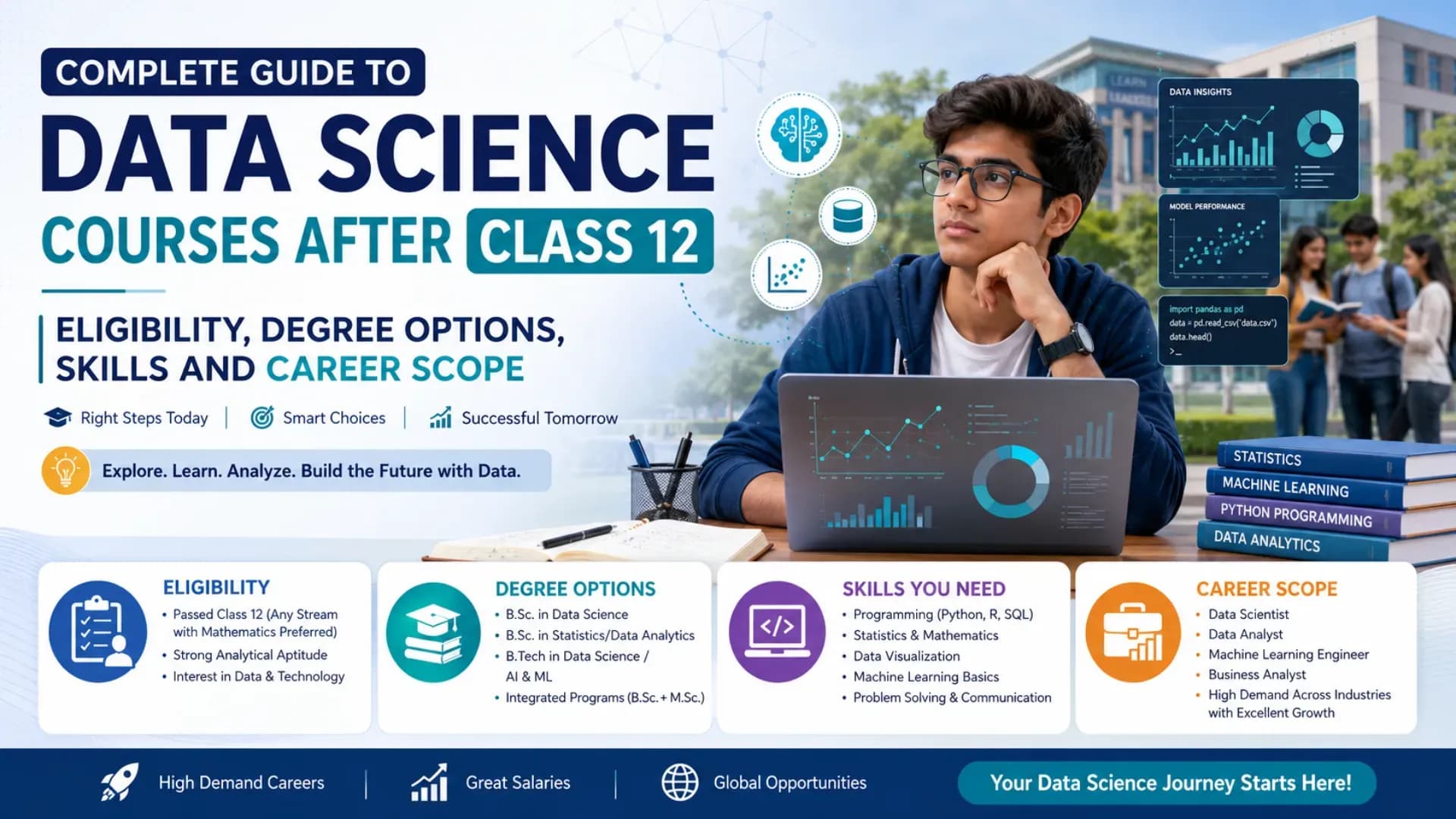
Among Data Science Courses After Class 12, the genuine challenge for most students isn't whether to pursue this field — interest is rarely the bottleneck given how visible data science careers have become — but understanding the actual landscape of degree options, the realistic skill foundation required, and which specific pathway suits their academic background. This guide covers the complete picture: Data Science Course Eligibility, the differences between B.Tech Data Science, B.Sc Data Science, and BCA Data Science, the core Data Science Skills genuinely required, and the honest Data Science Career Scope that follows.
What We Cover
- Data Science Course Eligibility — Who Can Apply
- Data Science Degree After 12th — Comparing the Options
- Data Science Diploma Courses — A Faster Entry Point
- Data Science Subjects — What You'll Actually Study
- Data Science Skills — Beyond the Curriculum
- Data Science Career Scope and Data Scientist Career — What Comes Next
- Artificial Intelligence and Data Science Courses — A Genuinely Distinct Track
Data Science Course Eligibility — Who Can Apply
Data Science Course Eligibility varies meaningfully by degree type, but generally remains accessible to students with a reasonable mathematics foundation:
- B.Tech Data Science: Class 12 pass with Physics, Chemistry, and Mathematics (PCM), typically requiring 55%+ aggregate, with admission via JEE Main, university-specific entrance tests, or merit
- B.Sc Data Science: Class 12 pass with Mathematics as a core subject, typically requiring 50%+ aggregate, admitted largely on merit or CUET score
- BCA Data Science: Class 12 pass from any stream, though Mathematics or Computer Science at the Class 12 level is often preferred, with most institutions admitting on merit
A genuinely important point across all Data Science Course Eligibility routes: a strong mathematics foundation specifically — not just a passing grade — matters considerably more for actual success in this field than the specific degree label, since statistics and applied mathematics form the genuine backbone of data science work regardless of which degree path you choose.
Data Science Degree After 12th — Comparing the Options
Choosing the right Data Science Degree After 12th requires understanding the genuine differences between the three primary undergraduate pathways:
- B.Tech Data Science: A 4-year engineering degree with the deepest technical foundation — covering algorithms, systems, advanced mathematics, and machine learning in genuine depth. The strongest option for students aiming at core technical, research, or engineering-heavy data science roles
- B.Sc Data Science: A 3-year science degree, typically with a stronger statistical and analytical emphasis relative to engineering depth. A genuinely solid option for students interested in the analytical and statistical side of data science without the full engineering curriculum load
- BCA Data Science: A 3-year computer applications degree blending programming fundamentals with data science specialisation — a practical, application-focused route, often with a faster path into industry roles given its applied orientation
The honest comparison: B.Tech Data Science offers the deepest technical foundation and the widest range of future specialisation options (including research and advanced technical roles), while B.Sc Data Science and BCA Data Science offer faster, more application-focused routes that suit students prioritising quicker industry entry over engineering depth.
Data Science Diploma Courses — A Faster Entry Point
For students wanting quicker entry into the field, or those supplementing a different undergraduate degree, Data Science Diploma Courses offer a genuinely useful alternative:
- Duration and format: Typically 6 months to 2 years, available both as standalone diploma programmes after Class 12 and as postgraduate diplomas for graduates from other fields
- Genuine use cases: Particularly valuable for working professionals or graduates from non-technical backgrounds seeking to transition into data science without committing to a full 3-4 year degree
- The honest limitation: Data Science Diploma Courses generally cannot substitute for the depth of a full degree when competing for highly technical or research-oriented roles — they work best as a focused skill-acquisition route rather than a foundational credential
Students choosing between a full degree and a diploma should honestly assess their goal: Data Science Diploma Courses suit candidates prioritising speed and a specific skill set, while a full degree remains the stronger foundation for candidates aiming at long-term technical depth or further postgraduate study.
Data Science Subjects — What You'll Actually Study
Regardless of the specific degree pathway, Data Science Subjects consistently cover a core set of foundational areas:
- Statistics and probability: The genuine mathematical foundation underlying nearly all data science work — hypothesis testing, distributions, and statistical inference
- Programming (Python, R, SQL): Practical coding skills for data manipulation, analysis, and building models — Python specifically has become the dominant language across the field
- Machine learning fundamentals: Supervised and unsupervised learning algorithms, model evaluation, and the practical application of these techniques to real datasets
- Data visualization and communication: Translating analytical findings into clear, actionable insights for non-technical stakeholders — a genuinely underrated skill area
- Database management: Understanding how data is stored, queried, and managed at scale, including both relational and increasingly non-relational database systems
Students evaluating Data Science Subjects across different institutions should specifically check curriculum recency, since this is a genuinely fast-evolving field — a syllabus that hasn't been updated in several years can leave meaningful gaps relative to current industry practice.
Data Science Skills — Beyond the Curriculum
The genuinely important Data Science Skills for actual career success extend meaningfully beyond what any standard curriculum covers:
- Project portfolio building: Genuine, independently completed projects — analysing real datasets, building and deploying models — demonstrate practical competence far more convincingly than coursework alone
- Domain knowledge: Understanding the specific industry context (healthcare, finance, retail, etc.) where data science is applied meaningfully differentiates candidates, since raw technical skill alone is increasingly common
- Business communication: The ability to explain technical findings to non-technical stakeholders is consistently cited by employers as a genuine differentiator between competent technical candidates and those who deliver real organisational impact
- Continuous learning habit: Given how rapidly tools and techniques evolve in this field, candidates who demonstrate genuine, ongoing self-directed learning beyond their formal degree consistently outperform those relying purely on what they were taught in college
Students should treat building these broader Data Science Skills as equally important to formal coursework — internships, personal projects, and genuine domain exploration meaningfully differentiate candidates in an increasingly crowded field.
Data Science Career Scope and Data Scientist Career — What Comes Next
Data Science Career Scope spans genuinely varied roles, and understanding this range helps set realistic expectations beyond the single "data scientist" job title:
- Data Analyst: An entry-level role focused on data cleaning, basic analysis, and reporting — often the realistic starting point for fresh graduates before progressing further
- Data Scientist: A more advanced role involving model building, predictive analytics, and genuine business problem-solving using data — typically requiring deeper technical depth and some practical experience
- Machine Learning Engineer: A role focused specifically on building, deploying, and maintaining machine learning systems in production environments — leaning more toward the engineering side of the field
- Data Engineer: Focused on building and maintaining the data infrastructure and pipelines that other data roles depend on — a genuinely distinct, infrastructure-focused career track
A realistic Data Scientist Career trajectory typically progresses from an analyst-level role toward more advanced data science or specialised engineering positions over several years, rather than starting directly in a senior "data scientist" role straight out of an undergraduate degree — a genuinely important expectation to set correctly before entering the field.
Demand across nearly every sector — not just technology companies — continues to grow as organisations increasingly invest in data-driven decision-making, meaning Data Science Career Scope remains genuinely broad across industries, though competition for the most desirable roles has intensified as more students enter the field.
Also Read: M.Tech Data Science — Postgraduate Pathway
Artificial Intelligence and Data Science Courses — A Genuinely Distinct Track
Many institutions now offer combined Artificial Intelligence and Data Science Courses as a single specialisation, and students should understand this is genuinely a distinct emphasis from pure data science — while data science focuses primarily on extracting insights and building predictive models from existing data, AI specifically emphasises building systems that can learn, reason, and make autonomous decisions, often building on data science foundations but extending further into areas like neural networks, natural language processing, and computer vision. Students choosing between a pure Data Science specialisation and a combined AI and Data Science track should consider their specific interest: those drawn primarily to statistical analysis and predictive modelling may prefer pure Data Science, while those interested in building intelligent, autonomous systems may find the combined AI and Data Science track more aligned with their genuine career direction.
Conclusion
Navigating Data Science Courses After Class 12 well requires the same deliberate research that any serious undergraduate decision deserves — understanding the real Data Science Course Eligibility for your target institutions, comparing B.Tech Data Science, B.Sc Data Science, and BCA Data Science honestly against your own academic background and career direction, and considering Data Science Diploma Courses as a genuine alternative where speed matters more than depth.
Explore the B.Tech CSE Data Science and M.Tech Data Science programme pages directly, and use this guide to approach your Data Science Degree After 12th decision with a complete picture: understand the core Data Science Subjects you'll study, commit to building the broader Data Science Skills that genuinely differentiate candidates beyond coursework, and set realistic expectations for your Data Scientist Career progression across the genuinely wide Data Science Career Scope. Whether you choose a pure data science specialisation or one of the combined Artificial Intelligence and Data Science Courses now widely available, the deliberate planning you invest now shapes whether this genuinely promising field delivers on its potential for you specifically.