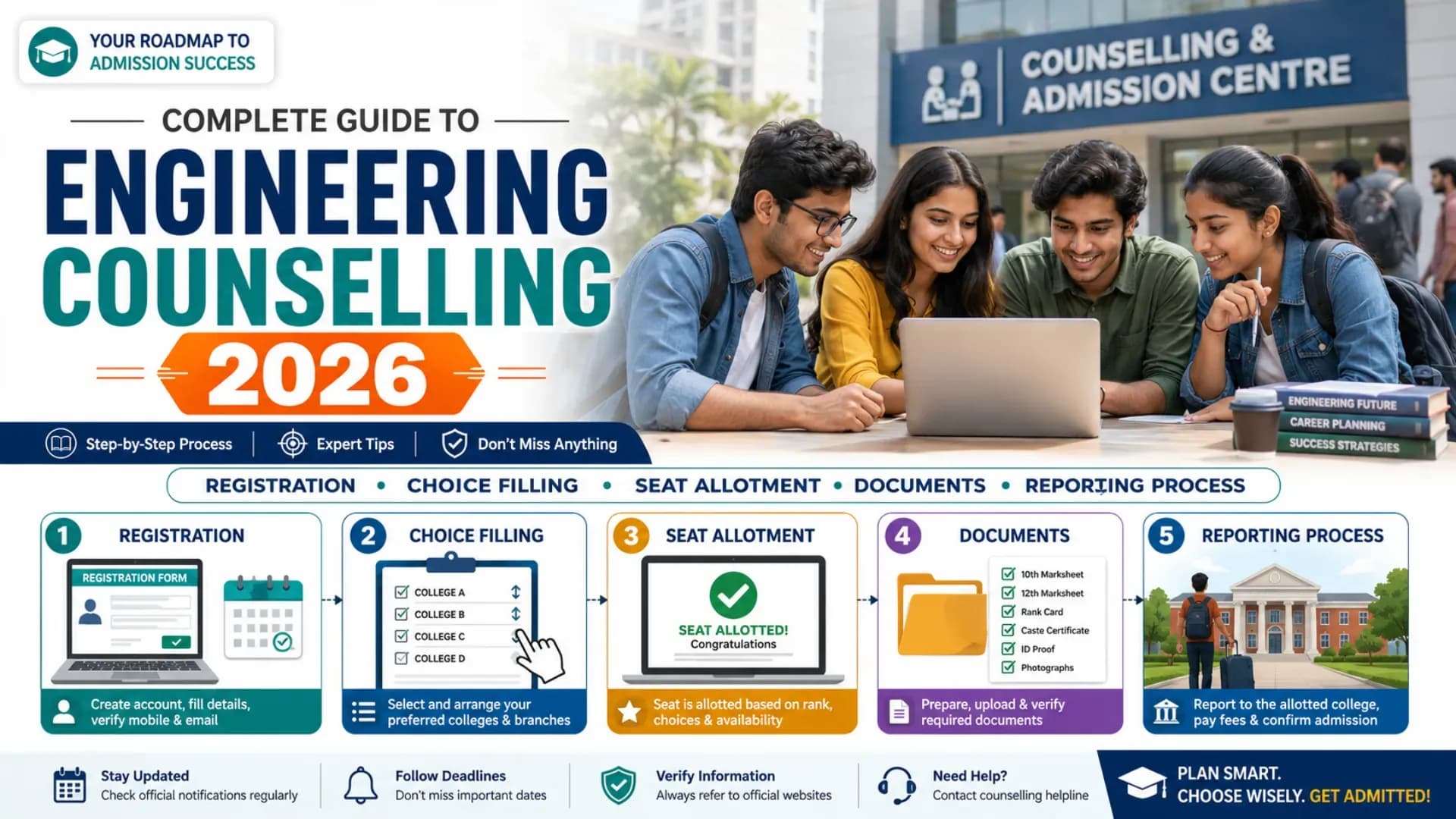
Clearing an engineering entrance exam is only half the journey — what follows is Engineering Counselling 2026, a multi-stage process that determines which specific college and branch a candidate ultimately joins. Many strong-ranking candidates lose out on their genuinely best options not because of their score, but because of avoidable mistakes during B.Tech Counselling 2026 itself — missed deadlines, poorly planned choice lists, or incomplete documents at reporting. This guide walks through the complete Engineering Admission Counselling process end to end — the same fundamental structure applies across nearly every Engineering Admission 2026 and Engineering Admission Counselling system in India, even though specific portal names and dates vary by state, covering every stage from Counselling Registration through final College Reporting Process.
What We Cover
- Counselling Registration — The First Step
- Engineering Choice Filling — Strategy and Common Mistakes
- Choice Locking Process — Why It's Final and Irreversible
- Engineering Seat Allotment 2026 — Understanding Your Result
- Seat Acceptance Process — Freeze, Float, or Upgrade
- Counselling Documents Required — Complete Checklist
- College Reporting Process — The Final Step
Counselling Registration — The First Step
Counselling Registration is a separate, mandatory step that follows your entrance exam result — qualifying the exam alone never automatically enrols you in counselling:
- Register on the official counselling portal: Each Engineering Admission 2026 authority (JoSAA, state-specific boards, or university-specific systems) running their own version of B.Tech Counselling 2026 maintains its own separate counselling registration portal, distinct from the original exam application
- Pay the Counselling Fee Payment: Most authorities charge a registration or processing fee at this stage, typically ranging from ₹500 to ₹2,500 depending on the specific exam and category, payable via net banking, debit/credit card, or UPI
- Create your counselling login credentials: Registration generates a new counselling-specific login (separate from your exam application login in many systems) — keep these credentials secure and accessible throughout the entire process
A critical detail many candidates miss: Counselling Registration deadlines are often tighter than candidates expect, and missing this window — even with an excellent rank — results in losing that specific counselling round entirely, with no exception typically made for late registration.
Engineering Choice Filling — Strategy and Common Mistakes
Engineering Choice Filling is the stage where candidates rank their preferred college-branch combinations — and it is genuinely where many candidates make avoidable, costly mistakes:
- Fill more choices than feels necessary: The allotment algorithm can only allot from among the choices actually submitted — a short preference list, even with a strong rank, frequently results in no allotment or a forced mop-up round, simply because none of the listed choices happened to be available at the candidate's specific rank
- Order choices by genuine preference, not just prestige: List combinations in the order you would genuinely accept them, since the system allots the highest-ranked available choice — candidates who list a college they wouldn't actually attend above one they would, purely for prestige, can end up with an allotment they later regret
- Research previous-year cutoffs before finalising: Use at least 2-3 years of closing-rank data for your specific rank range to build a realistic, well-distributed list spanning safe, moderate, and ambitious options
Engineering Choice Filling windows are typically open for several days but candidates should not wait until the final hours — server load increases significantly close to the deadline, and any last-minute technical issue can mean missing the window entirely.
Choice Locking Process — Why It's Final and Irreversible
The Choice Locking Process is the single most consequential moment in the entire counselling cycle, and candidates should treat it with corresponding seriousness:
- Locking is permanent for that round: Once a candidate confirms or "freezes" their submitted choice list, no further additions, removals, or reordering is possible for that specific counselling round — there is no correction mechanism after locking
- Review every entry carefully before locking: Double-check college names, branch codes, and the overall sequence one final time — a simple ordering mistake at this stage cannot be corrected after locking
- Auto-locking at deadline: Many systems automatically lock whatever choices were last saved if the candidate does not manually lock before the window closes — candidates should not assume an unfinished list will simply be discarded; it may still be submitted as-is
Given the irreversibility of the Choice Locking Process, candidates should complete their full research and preference-ordering well before opening the locking screen itself, rather than finalising decisions in real time under deadline pressure.
Engineering Seat Allotment 2026 — Understanding Your Result
Once Engineering Seat Allotment 2026 results are declared, candidates will see one of several possible outcomes, and understanding what each means is essential for the next decision:
- Allotted: The candidate's rank was sufficient for one of their listed preferences — typically the highest-ranked choice on their list that was available at allotment time, not necessarily their absolute first preference
- Not allotted: No seat was available across the candidate's submitted choices for that specific round — this does not necessarily mean the process has ended, since most systems run multiple rounds
- Waitlisted (where applicable): Some systems explicitly waitlist candidates close to a cutoff, with movement possible in subsequent rounds as allotted candidates upgrade, decline, or withdraw
A single round's Engineering Seat Allotment 2026 outcome rarely represents a candidate's final, fixed status — significant movement typically occurs across multiple rounds as the overall pool of available seats shifts with each round's confirmations and withdrawals.
Also Read: GUJCET 2026 Round 1 Seat Allotment Guide
Seat Acceptance Process — Freeze, Float, or Upgrade
The Seat Acceptance Process following allotment typically presents candidates with two or three distinct choices, and selecting the right one requires honest self-assessment:
- Freeze: Accept the current allotment permanently and exit the counselling process entirely — appropriate when the candidate is genuinely satisfied and does not want to risk losing the seat in pursuit of a marginal upgrade
- Float (or "Upgrade" in some systems): Retain the current seat while remaining eligible for a better allotment in subsequent rounds — the right choice for candidates whose remaining higher preferences are realistically reachable, not simply aspirational
- Withdraw: Exit the counselling process entirely, typically subject to specific fee forfeiture rules depending on the timing
Within the Seat Acceptance Process, candidates choosing Float should complete the corresponding Counselling Fee Payment as required at each step — failing to pay the prescribed fee after allotment typically results in automatic cancellation of that specific allotment, regardless of which option was selected.
Counselling Documents Required — Complete Checklist
While exact requirements vary by specific counselling authority, the following Counselling Documents Required are consistently needed across nearly every engineering counselling system in India:
- Entrance exam rank card / scorecard and admit card
- Class 10 marksheet and passing certificate (for date of birth verification)
- Class 12 marksheet and passing certificate (with required subject combination)
- Transfer Certificate / School Leaving Certificate
- Category certificate (SC/ST/OBC/EWS/PwD) issued by a competent authority, where applicable
- Domicile or residence certificate, where state/regional quota applies
- Income certificate, where required for fee concession or specific category eligibility
- Aadhaar card and valid photo identity proof
- Recent passport-size photographs (multiple copies, as specified)
- Online fee receipt or Demand Draft for the applicable seat acceptance/tuition fee
Missing even a single mandatory document at the verification or reporting stage is one of the most common reasons a seat allotment gets cancelled — confirm your complete document checklist against your specific counselling authority's requirements well before your scheduled verification date.
College Reporting Process — The Final Step
The College Reporting Process is the concluding stage, where the candidate physically confirms admission at their allotted institution:
- Report within the specified window: Each counselling round specifies a strict reporting deadline — missing it, even after successfully completing the Seat Acceptance Process and fee payment, can result in the seat being released back into the pool
- Carry original documents plus photocopies: Most institutions require both originals (for verification) and self-attested photocopies (to be retained by the college) — confirm the exact requirement with your specific allotted institution in advance
- Complete final document verification at the college: This is often the actual final checkpoint where any document discrepancy must be resolved — institutions can decline to confirm admission if a required document is missing or does not match the candidate's submitted profile
Completing the College Reporting Process correctly and on time is what actually finalises your Engineering Admission Counselling journey — every earlier stage, including a successful seat allotment and fee payment, remains provisional until this final reporting step is genuinely completed.
Explore More
Conclusion
Navigating Engineering Counselling 2026 successfully requires treating it as a multi-stage process deserving the same seriousness as the entrance exam itself — completing Counselling Registration early, approaching Engineering Choice Filling with genuine research rather than guesswork, and understanding that the Choice Locking Process offers no second chances within a given round.
Once Engineering Seat Allotment 2026 results arrive, make your Seat Acceptance Process decision deliberately, keep every item from the Counselling Documents Required checklist organised well in advance, complete every Counselling Fee Payment promptly, and follow through with the College Reporting Process precisely within the specified window. Whether you are navigating B.Tech Counselling 2026 specifically or any other broader Engineering Admission 2026 or Engineering Admission Counselling cycle, this same disciplined, stage-by-stage approach is what consistently separates candidates who secure their genuinely best possible outcome from those who lose ground to avoidable procedural mistakes.