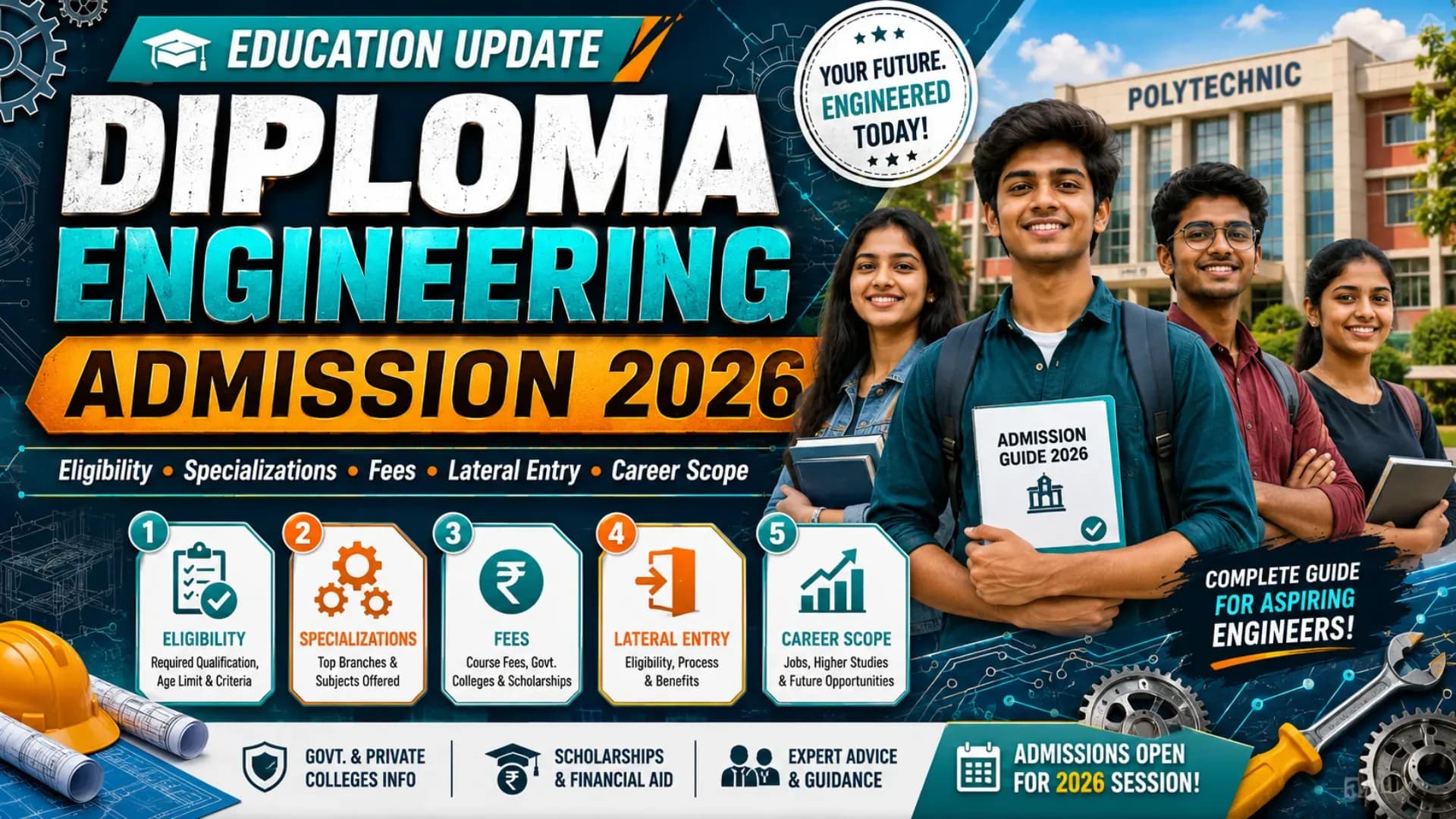
Diploma Engineering Admission 2026 is one of the most practical and financially accessible pathways into technical education available to students after Class 10 or Class 12 in India. Yet it remains one of the most poorly understood options in the broader conversation about career choices after school — overshadowed by the louder marketing of B.Tech programmes and often dismissed without a clear understanding of what it actually offers. This guide changes that. If you are a student or parent evaluating Polytechnic Admission 2026, trying to understand Diploma Engineering Eligibility requirements, comparing Diploma Engineering Specializations, calculating Diploma Engineering Fees across government and private institutions, or planning your path through Diploma Lateral Entry Admission into a B.Tech programme — this is the most complete Diploma Admission Process reference you will find for 2026. We cover every aspect: Polytechnic Entrance Exams 2026 state by state, Diploma Courses After Class 10 and Class 12, the Direct Second Year B.Tech Admission route that diploma holders can access, and the full picture of Diploma Engineering Career Scope in 2026's job market. Polytechnic Colleges Admission 2026 across India offers lakhs of seats — this guide helps you claim the right one.
Diploma Engineering Admission 2026 — Quick Reference
| Parameter | Details |
|---|---|
| Programme Name | Diploma in Engineering / Polytechnic Diploma |
| Duration | 3 years (6 semesters) after Class 10 | 2 years after Class 12 PCM |
| Diploma Engineering Eligibility | Class 10 pass with minimum 35%–50% marks (varies by state); Class 12 PCM for lateral entry |
| Admission Route | State-level Polytechnic Entrance Exams 2026 or merit-based (Class 10 marks) |
| Diploma Engineering Fees (Govt.) | ₹8,000–₹30,000 per year |
| Diploma Engineering Fees (Private) | ₹30,000–₹1,20,000 per year |
| Lateral Entry Option | Direct Second Year B.Tech Admission available in most states after diploma |
| Diploma Engineering Career Scope | Junior Engineer, Technician, Site Supervisor, PSU roles, entrepreneurship |
| Entry Salary Range | ₹1.8–₹4.5 LPA (fresh diploma); ₹4–₹8 LPA after B.Tech via lateral entry |
What This Guide Covers
- Diploma Engineering Eligibility — Who Can Apply
- Polytechnic Entrance Exams 2026 — State-by-State Guide
- Diploma Admission Process — Step-by-Step
- Diploma Engineering Specializations — All Branches Explained
- Diploma Engineering Fees — Government vs Private
- Diploma Lateral Entry Admission & Direct Second Year B.Tech
- Diploma Engineering Career Scope 2026
- Diploma Courses After Class 10 — Is Polytechnic the Right Choice?
Diploma Engineering Eligibility — Who Can Apply
Diploma Engineering Eligibility is broader than most students realise — which is one of the strongest practical advantages of this pathway. Polytechnic Admission 2026 is open to a much wider pool of students than most realise, because unlike B.Tech, which requires Class 12 PCM and a competitive entrance examination, Diploma Engineering Eligibility typically requires only a Class 10 pass certificate. Here is the complete breakdown of Diploma Engineering Eligibility across different entry points for Polytechnic Admission 2026:
After Class 10 — Standard Entry
- Qualification required: Class 10 (SSC / CBSE / ICSE or equivalent state board) pass certificate
- Minimum marks: Typically 35% aggregate (some states and private colleges require 45%–50%). Mathematics and Science are generally mandatory subjects at Class 10
- Age limit: Minimum 14 years as of the date of admission; most states have no upper age limit for regular diploma programmes
- Entrance exam: Most states require qualifying a Polytechnic Entrance Exams 2026 for government polytechnic seats; merit-based admission (Class 10 marks) is common for private polytechnic colleges
After Class 12 — Lateral Entry Eligibility
- Qualification required: Class 12 with Physics, Chemistry, Mathematics (PCM) or relevant vocational stream
- Admission: Direct admission to the second year of the diploma programme (lateral entry), effectively a 2-year diploma instead of 3 years
- This route is relevant for: Students who appeared for Class 12 but did not qualify JEE Main or could not secure an engineering college seat, and want a technical qualification quickly
ITI Pass — Lateral Entry Eligibility
- Students who have completed a 2-year ITI (Industrial Training Institute) certificate in a relevant trade are eligible for Diploma Lateral Entry Admission directly into the second year of a related diploma programme in most states
- This is a particularly valuable pathway for students from economically weaker backgrounds who entered ITI after Class 8 or Class 10 and now want to upgrade their qualification
Polytechnic Entrance Exams 2026 — State-by-State Guide
Polytechnic Entrance Exams 2026 are conducted at the state level — there is no single national entrance test for diploma engineering. Each state runs its own Polytechnic Entrance Exams 2026, and the syllabus, exam pattern, and counselling process differ accordingly. Here is a comprehensive guide to the major Polytechnic Entrance Exams 2026 across India:
| State | Exam Name | Conducting Body | Exam Mode |
|---|---|---|---|
| Uttar Pradesh | JEECUP (Joint Entrance Examination Council UP) | JEECUP Board | Online (CBT) |
| Maharashtra | MHT-CET (Diploma) / MSBTE Merit | DTE Maharashtra | Merit-based + Centralised Admission |
| Delhi | CET Delhi (Polytechnic) | Board of Technical Education, Delhi | Online (CBT) |
| Rajasthan | DOTE Rajasthan Polytechnic Exam | Board of Technical Education, Rajasthan | Online / Offline |
| Karnataka | Karnataka DCET (Diploma CET) | KEA (Karnataka Examinations Authority) | Online (CBT) |
| Tamil Nadu | TNEA Diploma Merit Counselling | DOTE Tamil Nadu | Merit-based (Class 10 marks) |
| West Bengal | JEXPO / VOCLET | WEBSCTE | Offline (OMR) |
| Bihar | Bihar Polytechnic (DCECE) | BCECE Board | Online (CBT) |
| Andhra Pradesh | AP POLYCET | State Board of Technical Education AP | Online (CBT) |
| Telangana | TS POLYCET | State Board of Technical Education TS | Online (CBT) |
| Madhya Pradesh | MP PPT (Pre Polytechnic Test) | MPPEB | Online (CBT) |
| Haryana | Haryana DET (Diploma Entrance Test) | Board of Technical Education Haryana | Online (CBT) |
Syllabus for Polytechnic Entrance Exams 2026: Most Polytechnic Entrance Exams 2026 test Mathematics, Physics, and Chemistry at the Class 10 level. Some states also include general knowledge or reasoning sections. The exam duration is typically 2–3 hours, with 120–150 multiple-choice questions. Preparation using Class 9 and Class 10 NCERT books is sufficient for most state Polytechnic Entrance Exams 2026.
Diploma Admission Process — Step-by-Step
The Diploma Admission Process varies slightly by state but follows a common structure across all government polytechnic admissions. Here is the complete Diploma Admission Process from application to enrolment, applicable to Polytechnic Colleges Admission 2026 across most states:
Step 1 — Register for the State Polytechnic Entrance Exam
The first step in the Diploma Admission Process is registering for your state's polytechnic entrance examination. Registration typically opens February to April 2026. Fill the online application form on the state polytechnic board's official portal, pay the application fee (typically ₹300–₹800), upload required documents (Class 10 marksheet, photo, signature), and download the admit card before the exam date.
Step 2 — Appear for the Polytechnic Entrance Exam
Appear for the Polytechnic Entrance Exams 2026 at the allotted examination centre. Carry your admit card and a valid photo ID. Results for most Polytechnic Entrance Exams 2026 are declared within 30–45 days of the examination.
Step 3 — Counselling and Choice Filling
After results, the state board announces Diploma Admission Process counselling dates. This involves online registration for counselling, choice filling (selecting preferred polytechnic colleges and specialisations in order of preference), document upload, and fee payment. Seat allotment is based on your rank in the entrance exam, your category, and your choice order.
Step 4 — Document Verification
After seat allotment, report to the allotted polytechnic college within the specified window for document verification. Key documents required for Polytechnic Colleges Admission 2026 verification:
- Class 10 marksheet and pass certificate (original + copies)
- Caste / Category certificate (SC/ST/OBC-NCL/EWS) if applicable
- Domicile / Residence certificate
- Transfer certificate from previous school
- Passport-size photographs
- Photo ID proof (Aadhaar card preferred)
- Rank / Allotment letter from the counselling portal
Step 5 — Fee Payment and Enrolment
Pay the Diploma Engineering Fees at the institution as per the fee schedule. Obtain the admission receipt and student ID. The Diploma Admission Process concludes with your enrolment in the first semester of the polytechnic programme. Classes typically begin July–August 2026 for most state polytechnic institutions.
Diploma Engineering Specializations — All Branches Explained
Diploma Engineering Specializations cover a wide range of technical fields — far broader than most students are aware of when first evaluating Polytechnic Admission 2026. Choosing the right specialisation from available Diploma Engineering Specializations is one of the most consequential decisions in this process, as it determines your technical curriculum, job roles, and lateral entry branch for Direct Second Year B.Tech Admission. Here are all major Diploma Engineering Specializations available across India in 2026:
Core Engineering Diploma Specializations
- Civil Engineering: The most widely available of all Diploma Engineering Specializations. Covers construction technology, structural design, surveying, and AutoCAD. High demand in infrastructure, real estate, and government PWD projects. Entry-level roles: Site Supervisor, Junior Engineer, Draftsman.
- Mechanical Engineering: Covers manufacturing, machine design, thermodynamics, and CAD/CAM. One of the broadest Diploma Engineering Specializations in terms of industry application — relevant to automotive, aerospace, manufacturing, and HVAC sectors.
- Electrical Engineering: Covers power systems, electrical machines, control systems, and switchgear. Strong demand in power generation, distribution companies, and manufacturing plants. PSU recruitment (UPPCL, MSEDCL, KSEB) frequently hires diploma electrical engineers directly.
- Electronics & Communication Engineering (ECE): Covers digital electronics, communication systems, microcontrollers, and PCB design. Relevant to telecom, consumer electronics, and defence electronics sectors.
- Computer Science & Engineering / Information Technology: Covers programming, database management, networking, and web development. The fastest-growing of all Diploma Engineering Specializations in terms of private sector hiring, particularly for IT support and junior developer roles.
Emerging and Specialised Diploma Branches
- Automobile Engineering: Covers vehicle design, engine systems, transmission, and automotive electronics. High demand from OEMs (Maruti, Tata Motors, Hero MotoCorp) and dealership networks for service technician roles.
- Chemical Engineering: Covers chemical process technology, industrial chemistry, and plant operations. Relevant to pharmaceutical, fertiliser, and petrochemical industries.
- Metallurgical Engineering: Covers metal processing, materials testing, and foundry technology. Relevant to steel plants, foundries, and defence manufacturing.
- Textile Engineering: Covers fibre technology, textile machinery, and garment manufacturing. Concentrated in states with major textile industries — Gujarat, Tamil Nadu, Maharashtra, Rajasthan.
- Mining Engineering: Covers mine planning, drilling technology, and mine safety. Relevant to coal and mineral extraction industries.
- Instrumentation Engineering: Covers control systems, sensors, and process instrumentation. High demand in oil & gas, pharmaceutical, and chemical process industries.
- Architecture Assistantship / Interior Design: Available at select polytechnics. Covers architectural drawing, building materials, and interior space planning.
Choosing Between Diploma Engineering Specializations: For Direct Second Year B.Tech Admission planning, pick a specialisation that aligns with the B.Tech branch you intend to pursue via lateral entry — most states require the diploma and B.Tech branch to be in the same or closely related field. For direct employment after diploma, Civil, Mechanical, Electrical, and Computer Science are the strongest Diploma Engineering Specializations in terms of job availability across India.
Related Article: B.Tech CSE vs BCA: Complete Comparison 2026
Diploma Engineering Fees — Government vs Private
Diploma Engineering Fees are one of the strongest arguments in favour of this pathway, particularly at government polytechnic institutions. The Diploma Engineering Fees at government polytechnics are among the lowest of any post-Class 10 technical education option in India, and the Diploma Engineering Fees structure across private institutions, while higher, still compares very favourably against private B.Tech costs. Here is the complete picture:
| Institution Type | Annual Diploma Engineering Fees | Total 3-Year Cost |
|---|---|---|
| Government Polytechnic (State) | ₹8,000–₹30,000 per year | ₹24,000–₹90,000 total |
| Government-Aided Polytechnic | ₹15,000–₹45,000 per year | ₹45,000–₹1.35 lakh total |
| Private Polytechnic (Mid-tier) | ₹30,000–₹70,000 per year | ₹90,000–₹2.1 lakh total |
| Private Polytechnic (Premium) | ₹70,000–₹1,20,000 per year | ₹2.1–₹3.6 lakh total |
State-wise Diploma Engineering Fees at Government Polytechnics
| State | Approx. Annual Govt. Polytechnic Fees |
|---|---|
| Uttar Pradesh | ₹10,000–₹18,000 |
| Maharashtra | ₹18,000–₹28,000 |
| Rajasthan | ₹8,000–₹14,000 |
| Tamil Nadu | ₹12,000–₹20,000 |
| Karnataka | ₹15,000–₹25,000 |
| West Bengal | ₹10,000–₹18,000 |
| Delhi | ₹14,000–₹22,000 |
| Bihar | ₹8,000–₹13,000 |
Key insight on Diploma Engineering Fees: A government polytechnic diploma costs ₹24,000–₹90,000 over three years in total. A mid-tier private B.Tech costs ₹12–₹20 lakh over four years. For students from families where the total education investment is a genuine constraint, the government polytechnic pathway followed by Diploma Lateral Entry Admission into a government engineering college for B.Tech is one of the most financially efficient technical education paths available in India.
Diploma Lateral Entry Admission & Direct Second Year B.Tech Admission
Diploma Lateral Entry Admission is the most strategically powerful feature of the diploma engineering pathway — and the least understood. Diploma Lateral Entry Admission allows diploma holders to enter the second year of a B.Tech / B.E. programme directly, skipping the first year entirely. This means a student who completes a 3-year diploma can complete their B.Tech in just 3 additional years — giving them a full B.Tech degree in 6 years from Class 10, the same total time it would take to complete Class 10 → Class 12 → 4-year B.Tech normally. The Direct Second Year B.Tech Admission route is available in most states and is one of the most underutilised smart pathways in Indian technical education.
How Direct Second Year B.Tech Admission Works
- Eligibility: Diploma in Engineering in a relevant branch with a minimum aggregate of 45%–60% (varies by state and institution). Some states use a separate Diploma Lateral Entry Admission entrance test; others use diploma percentage for merit-based allocation
- Seats available: Most state engineering colleges reserve 10%–15% of total seats (supernumerary or reserved) specifically for Direct Second Year B.Tech Admission through lateral entry
- Branch alignment: Direct Second Year B.Tech Admission typically requires the diploma branch to match or be closely related to the B.Tech branch you are entering. A Mechanical Engineering diploma holder enters Mechanical B.Tech; a CS diploma holder enters CS or IT B.Tech
State-wise Diploma Lateral Entry Admission Exams
| State | Lateral Entry Exam / Process |
|---|---|
| Uttar Pradesh | JEECUP Group K (Lateral Entry) — separate exam for Direct Second Year B.Tech Admission |
| Maharashtra | MHT-CET Lateral Entry / DTE Maharashtra merit-based Direct Second Year B.Tech Admission |
| Karnataka | Karnataka DCET — used for Diploma Lateral Entry Admission to B.E. programmes |
| Tamil Nadu | TANCET Lateral Entry / Merit-based TNEA Lateral Entry counselling |
| Andhra Pradesh | AP ECET — separate state exam for Diploma Lateral Entry Admission to B.Tech |
| Telangana | TS ECET — same as AP; primary route for Direct Second Year B.Tech Admission in Telangana |
| West Bengal | WBJEEB JELET — Lateral Entry to Engineering & Technology |
| Rajasthan | Rajasthan LEET (Lateral Entry Entrance Test) for Direct Second Year B.Tech Admission |
Why Diploma Lateral Entry Admission Is a Smart Strategy
- Lower total cost: Government diploma fees + government B.Tech fees (lateral entry) is far less than 4 years of private B.Tech fees — often saving ₹8–₹15 lakh in total
- Stronger foundation: Diploma holders who enter B.Tech via Direct Second Year B.Tech Admission often outperform direct-entry students in practical and workshop subjects because of their hands-on diploma training
- Same final degree: The B.Tech degree obtained through Diploma Lateral Entry Admission is identical to that of a student who entered through JEE — there is no distinction on the degree certificate
- Less competitive entry point: Direct Second Year B.Tech Admission lateral entry exams (ECET, DCET, LEET, JELET) are significantly less competitive than JEE Main, making government engineering college admission accessible to a much larger pool of students
Diploma Engineering Career Scope 2026
Diploma Engineering Career Scope in 2026 is broader than the diploma's public perception suggests. The honest assessment of Diploma Engineering Career Scope depends on which path you take after the diploma — direct employment, government exams, or Diploma Lateral Entry Admission for B.Tech. Here is the complete Diploma Engineering Career Scope picture across each route:
Direct Employment After Diploma
- Junior Engineer (JE): Government departments (PWD, irrigation, electricity boards, railways) recruit Junior Engineers directly from diploma holders. State PSC and SSC JE exams are open to diploma graduates. This is one of the most stable and well-paying career paths in Diploma Engineering Career Scope — SSC JE Grade Pay is ₹2,800–₹3,600 with the 7th Pay Commission
- Technician / Site Supervisor: Manufacturing companies, construction firms, and infrastructure developers hire diploma engineers at the technician and site supervisor level. Entry salary ranges from ₹1.8 LPA to ₹3.5 LPA depending on the company and location
- PSU Apprenticeship: BHEL, SAIL, NTPC, Indian Oil, GAIL, ONGC, and Railways hire diploma engineers as Apprentice Trainees / Diploma Trainees (DT). After the apprenticeship period (1–2 years), many are absorbed as regular employees. This is among the most valued pathways in Diploma Engineering Career Scope for stability-focused students
- Maintenance and Operations: Power plants, manufacturing plants, and process industries employ large numbers of diploma engineers in maintenance and operations roles. Civil, Mechanical, Electrical, and Instrumentation branches have the highest hiring volume
Government Exam Pathways in Diploma Engineering Career Scope
- SSC JE (Staff Selection Commission Junior Engineer): Open to diploma holders in Civil, Mechanical, and Electrical. One of the most accessible and widely attempted government exams in Diploma Engineering Career Scope
- RRB JE (Railway Recruitment Board Junior Engineer): Railways hire diploma engineers for Junior Engineer, Section Engineer, and Depot Material Superintendent roles. High job security, good pay, and nationwide postings
- State PSC Junior Engineer: Every state's Public Service Commission conducts JE exams in Civil, Electrical, and Mechanical for state government departments. These are the most geographically targeted opportunities in Diploma Engineering Career Scope
- Defence Civilian Technician: Indian Army, Navy, and Air Force recruit diploma engineers as Multi-Tasking Staff (MTS) and Civilian Technician roles through various recruitment boards
Salary Benchmarks — Diploma Engineering Career Scope 2026
| Role / Path | Entry Salary Range | 5-Year Salary Range |
|---|---|---|
| Private Sector Technician / Supervisor | ₹1.8–₹3.5 LPA | ₹3–₹6 LPA |
| Government JE (SSC JE / State PSC) | ₹3–₹4.5 LPA + perks | ₹5–₹7 LPA + perks |
| PSU Apprentice / Diploma Trainee | ₹2.5–₹4 LPA (stipend during training) | ₹5–₹8 LPA (post-regularisation) |
| After B.Tech via Lateral Entry | ₹4–₹8 LPA | ₹8–₹20 LPA |
| Diploma CS / IT (Software Support / Junior Dev) | ₹2–₹4 LPA | ₹4–₹10 LPA (skill-dependent) |
Diploma Courses After Class 10 — Is Polytechnic the Right Choice?
Diploma Courses After Class 10 represent a critical fork in the road — and most students default to Class 11–12 without seriously evaluating whether Diploma Courses After Class 10 might serve them better. Here is an honest framework for deciding whether Diploma Courses After Class 10 through a polytechnic is the right path for you:
Choose Diploma Engineering (Polytechnic) After Class 10 If:
- You want to enter the technical workforce faster — a diploma gives you employable qualifications 3 years after Class 10, compared to 6 years if you follow the Class 12 → B.Tech route
- Your family needs you to contribute financially within a shorter timeframe — government polytechnic fees and fast employment make Diploma Courses After Class 10 the most financially practical technical pathway
- You are interested in hands-on, practical engineering work rather than theoretical academic study — polytechnic curriculum is strongly workshop and lab oriented
- You plan to use Diploma Lateral Entry Admission to pursue B.Tech later — the polytechnic + lateral entry route to B.Tech is a legitimate and financially smart alternative to the standard Class 12 + JEE Main path
- Your Class 10 score is strong but you are uncertain about performing in competitive Class 12 PCM board exams and JEE simultaneously — polytechnic removes the JEE bottleneck while keeping the B.Tech door open through Direct Second Year B.Tech Admission
Consider Class 11–12 Instead of Diploma Courses After Class 10 If:
- You have a realistic chance of qualifying JEE Main for an NIT or state government engineering college — the B.Tech from a reputed institution has a higher ceiling for salary and career options than a diploma
- You want to pursue management, law, civil services, or non-engineering fields — Class 12 keeps all these pathways open; Diploma Courses After Class 10 narrows your academic trajectory to technical fields
- You are targeting research, academia, or an MBA — these paths require a degree rather than a diploma as the foundation
The honest verdict on Diploma Courses After Class 10: For students whose goal is a technical career and whose financial situation makes a 4-year private B.Tech a genuine burden, Diploma Courses After Class 10 at a government polytechnic followed by Diploma Lateral Entry Admission to a government engineering college for B.Tech is one of the best financial decisions available in Indian technical education. It is not a consolation path — for the right student with the right plan, it is the optimal path.
Explore More
Conclusion
Diploma Engineering Admission 2026 opens the door to one of the most practical, affordable, and strategically flexible technical education pathways in India. Whether you are evaluating Diploma Courses After Class 10 as a direct entry point into technical education, planning your Diploma Admission Process through your state's Polytechnic Entrance Exams 2026, comparing Diploma Engineering Fees across government and private institutions, selecting from available Diploma Engineering Specializations, or mapping out your Diploma Lateral Entry Admission route to a full B.Tech degree — the decisions you make in Polytechnic Colleges Admission 2026 season have long and positive consequences.
The Diploma Engineering Career Scope in 2026 is real and expanding — particularly for students who combine a strong government polytechnic education with targeted government exam preparation or the Direct Second Year B.Tech Admission route through lateral entry. Diploma Engineering Eligibility is accessible to anyone who has completed Class 10, and the Diploma Engineering Fees at government institutions make this the most financially democratic technical education path in the country.
Use this guide as your complete reference for Diploma Engineering Admission 2026 — from choosing the right specialisation among Diploma Engineering Specializations, to navigating your state's Polytechnic Entrance Exams 2026, to planning the Diploma Lateral Entry Admission step that transforms a diploma into a full engineering degree. The Polytechnic Colleges Admission 2026 season is your starting point — plan it well.