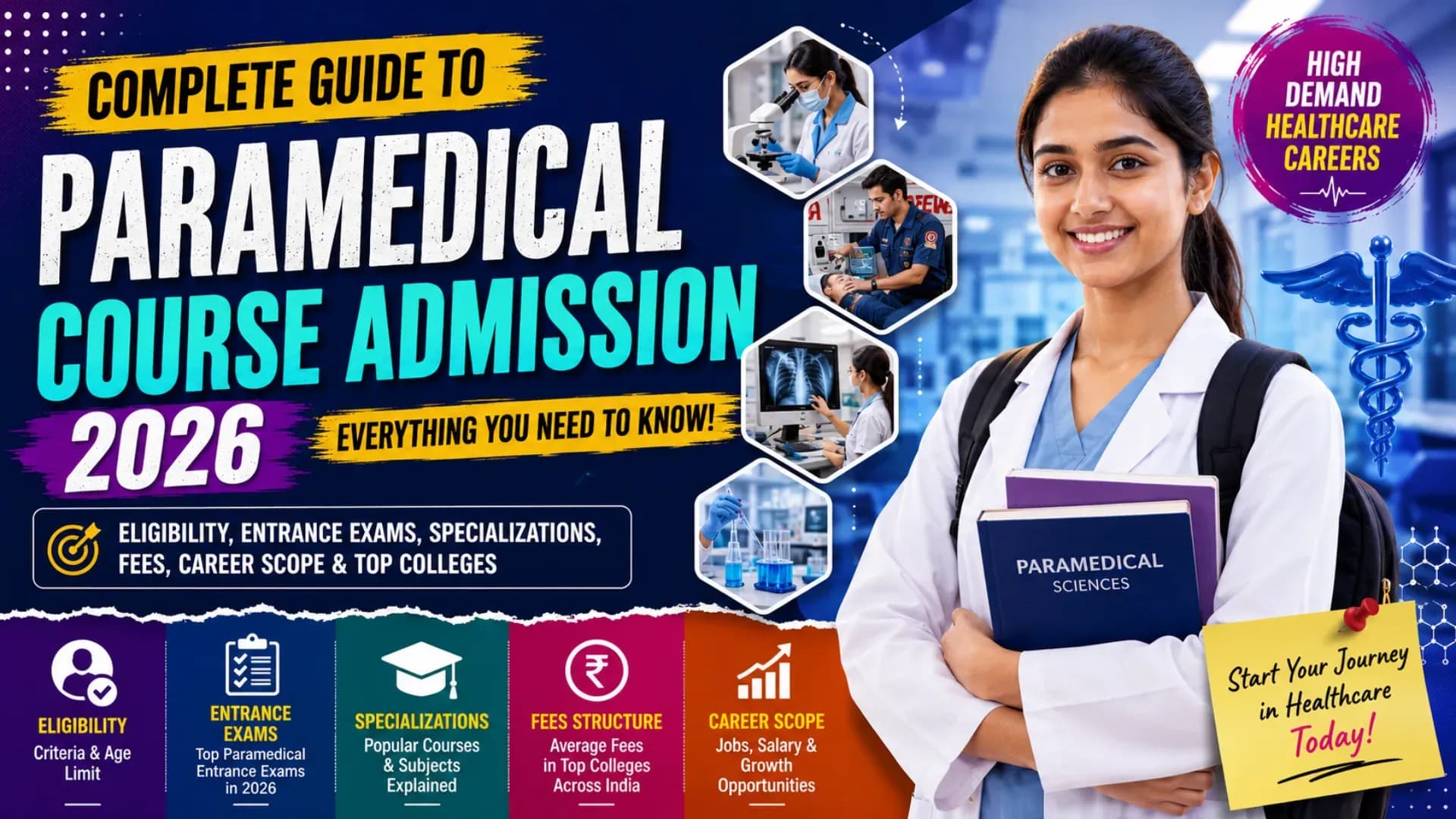
Paramedical Course Admission 2026 remains one of the most underexplored yet genuinely strong healthcare pathways available to Class 12 students who are not pursuing NEET-based medical admission. Paramedical Admission 2026 covers a genuinely wide range of specialised technical and diagnostic roles — far more diverse than most students initially realise — each with distinct training, entrance routes, and career trajectories. This guide covers the complete picture: Paramedical Course Eligibility, the Paramedical Entrance Exams 2026 landscape, the major Paramedical Course Specializations available, realistic Paramedical Course Fees, and the honest Paramedical Career Scope that follows.
What We Cover
- Paramedical Course Eligibility — Who Can Apply
- Paramedical Entrance Exams 2026 — The Current Landscape
- Paramedical Admission Process — Step by Step
- Paramedical Course Fees — Realistic Budgeting
- Paramedical Course Specializations — Choosing Your Track
- Diploma vs B.Sc. Paramedical Courses — Key Differences
- Paramedical Career Scope — What Comes After Graduation
Explore This: Browse All Paramedical & Allied Health Courses
Paramedical Course Eligibility — Who Can Apply
Paramedical Course Eligibility is genuinely accessible compared to NEET-based medical admission, though specific requirements vary by specialisation:
- Academic background: Class 12 pass with Physics, Chemistry, and Biology or Mathematics, depending on the specific course and institution
- Minimum aggregate marks: Typically 45% to 50% for general category candidates, with relaxed thresholds usually available for reserved categories
- Diploma in Paramedical Courses eligibility: Generally requires only a Class 10 pass for entry-level diploma programmes, making this an accessible route even for students who do not complete Class 12 with the specific PCB/PCM combination
- Age requirements: Most paramedical courses require candidates to be at least 17 years old by a specified cutoff date, generally with no upper age limit
Always verify the exact Paramedical Course Eligibility for your specific target specialisation and institution, since requirements can vary meaningfully — for instance, optometry and radiography programmes sometimes have different subject-combination requirements even within the same institution.
Paramedical Entrance Exams 2026 — The Current Landscape
Unlike MBBS, Paramedical Admission 2026 does not rest on a single dominant national entrance exam — the landscape is genuinely fragmented across multiple distinct tests:
- AIIMS Paramedical Entrance Exam: Conducted by AIIMS Delhi for B.Sc. Paramedical admission across AIIMS institutions specifically — a computer-based test covering Physics, Chemistry, and Biology or Mathematics
- State-level Common Paramedical Entrance Tests (CPET): Several states run their own dedicated paramedical entrance exams for admission to state government and affiliated colleges
- University-specific entrance tests: Many private universities and institutions conduct their own paramedical entrance exams or admit purely on Class 12 merit
- CUET: Increasingly accepted by a growing number of universities for various paramedical and allied health programmes
A practical strategy for Paramedical Entrance Exams 2026: research the specific exam accepted by your target institutions early, since unlike NEET (which serves as a near-universal gateway for medical admission), paramedical entrance exams are genuinely institution and state-specific, meaning a single exam rarely opens every door.
Paramedical Admission Process — Step by Step
The Paramedical Admission Process generally follows a consistent sequence regardless of the specific entrance route:
- Application: Register on the relevant institution or state portal, providing academic details and selecting your preferred specialisation
- Entrance exam or merit-based shortlisting: Appear for the relevant entrance test (AIIMS Paramedical, state CPET, or university-specific test), or be shortlisted purely on Class 12 merit depending on the institution
- Document verification: Submit and verify Class 10 and 12 marksheets, category certificate if applicable, and identity proof
- Counselling and seat allotment: Where a centralised process exists, participate in counselling rounds; for direct-admission institutions, simply confirm your seat upon selection
- Fee payment and final confirmation: Complete the admission by paying the requisite fee within the specified deadline
A detail that catches many candidates off guard: because the Paramedical Admission Process varies so significantly between institutions, candidates applying to multiple paramedical colleges should track each one's specific deadline and process separately, rather than assuming a uniform national timeline the way NEET counselling provides.
Also Read: BPT — Sports Physiotherapy
Paramedical Course Fees — Realistic Budgeting
Paramedical Course Fees vary considerably by institution type and specific specialisation:
| Institution Tier | Total Programme Fee (Approx.) |
|---|---|
| Government/AIIMS Institutions | ₹50,000 – ₹2 lakh |
| State Government Colleges | ₹1 lakh – ₹3 lakh |
| Private Institutions | ₹2 lakh – ₹8 lakh |
Government and AIIMS-affiliated paramedical programmes remain among the most financially accessible healthcare degrees available — a genuine structural advantage worth weighing seriously against the convenience or perceived prestige of a private institution, particularly when paired with comparable clinical training infrastructure.
Paramedical Course Specializations — Choosing Your Track
Choosing among the available Paramedical Course Specializations is the single most consequential decision within this admission pathway, since each track trains a genuinely distinct technical skill set:
- B.Sc. Radiology and CT Scan: Trains technologists in diagnostic imaging — X-ray, CT, MRI — a specialisation in consistently high demand as diagnostic centres and hospitals expand across India
- B.Sc. Operation Theatre Technology / Surgical Technology: Trains specialists in surgical assistance, instrument management, and operating room protocols — essential, specialised support roles within every surgical department
- B.Sc. Allied Health Sciences: A broader category covering multiple allied health disciplines, often allowing some flexibility in specific specialisation choice within the programme
- Bachelor of Occupational Therapy: Trains specialists in rehabilitation and therapeutic intervention for patients recovering from injury, illness, or disability — a growing field as awareness of rehabilitation medicine increases
- BPT (Sports Physiotherapy and general Physiotherapy): Trains physiotherapists, with sports physiotherapy specifically focused on athletic injury management and recovery — a specialisation with growing demand as sports medicine gains visibility in India
The honest framework for choosing among Paramedical Course Specializations: pick based on genuine interest in the specific technical or therapeutic domain — diagnostic imaging, surgical support, rehabilitation, or physiotherapy — rather than simply choosing whichever programme is most convenient to access, since these specialisations lead to meaningfully different day-to-day work.
Diploma vs B.Sc. Paramedical Courses — Key Differences
A genuinely important decision within Paramedical Courses After 12th — alongside every other choice in this Paramedical Courses After 12th landscape — is choosing between a Diploma in Paramedical Courses and a full B.Sc. Paramedical Courses degree:
- Diploma in Paramedical Courses: Typically 1-2 years in duration, faster entry into the workforce, generally lower fees, and accessible directly after Class 10 in many cases — a practical option for students wanting quicker employment
- B.Sc. Paramedical Courses: Typically 3-4 years, more comprehensive theoretical and clinical training, generally better long-term career progression and eligibility for postgraduate study, and broader recognition across institutions and employers
For students confident in their specific specialisation choice and financially or time-constrained, a Diploma offers genuine, faster entry into paramedical work. For students seeking stronger long-term career progression, supervisory roles, or the option to pursue postgraduate study later, the full B.Sc. Paramedical Courses route is generally the stronger long-term investment.
CHECK OUT: B.Sc. Allied Health — Course Details
Paramedical Career Scope — What Comes After Graduation
Paramedical Career Scope spans genuinely varied opportunities depending on the specific specialisation chosen:
- Hospital and diagnostic centre roles: Direct employment as a radiographer, OT technologist, lab technologist, or therapist across public and private hospitals, diagnostic chains, and specialised clinics
- Private practice: Particularly relevant for physiotherapists and occupational therapists, who can establish independent practices after gaining sufficient clinical experience
- Higher studies: M.Sc. in the relevant specialisation, or further specialised certifications, opening teaching, research, or senior clinical roles
- Government sector roles: Positions in government hospitals and public health institutions, often offering greater job stability
- Sports and corporate wellness roles: Particularly for sports physiotherapy graduates, opportunities with sports teams, fitness organisations, and corporate wellness programmes
The honest reality of Healthcare Admission 2026 outcomes in paramedical fields, a key part of the broader Healthcare Admission 2026 picture: as India's healthcare infrastructure — particularly diagnostic and rehabilitation services — continues expanding, demand for skilled paramedical professionals is genuinely growing, but outcomes still depend heavily on institution quality, clinical training depth, and the specific specialisation's regional demand.
Conclusion
Navigating Paramedical Course Admission 2026 well requires the same strategic thinking that any serious undergraduate healthcare decision deserves — understanding the real Paramedical Course Eligibility for your target institutions, researching the fragmented Paramedical Entrance Exams 2026 landscape carefully, budgeting honestly against realistic Paramedical Course Fees at each institution tier, and choosing among Paramedical Course Specializations based on genuine interest in the specific technical or therapeutic domain.
Use this guide to approach Paramedical Admission 2026 and the wider Paramedical Courses After 12th landscape with a complete picture: understand the full Paramedical Admission Process for each target institution separately, weigh Diploma in Paramedical Courses against full B.Sc. Paramedical Courses based on your own timeline and goals, and evaluate Paramedical Career Scope honestly for your specific specialisation. Whichever pathway you choose within this broader Healthcare Admission 2026 cycle, the research and deliberate planning you put in beyond the degree itself is what ultimately determines whether your paramedical qualification delivers on its promise.