
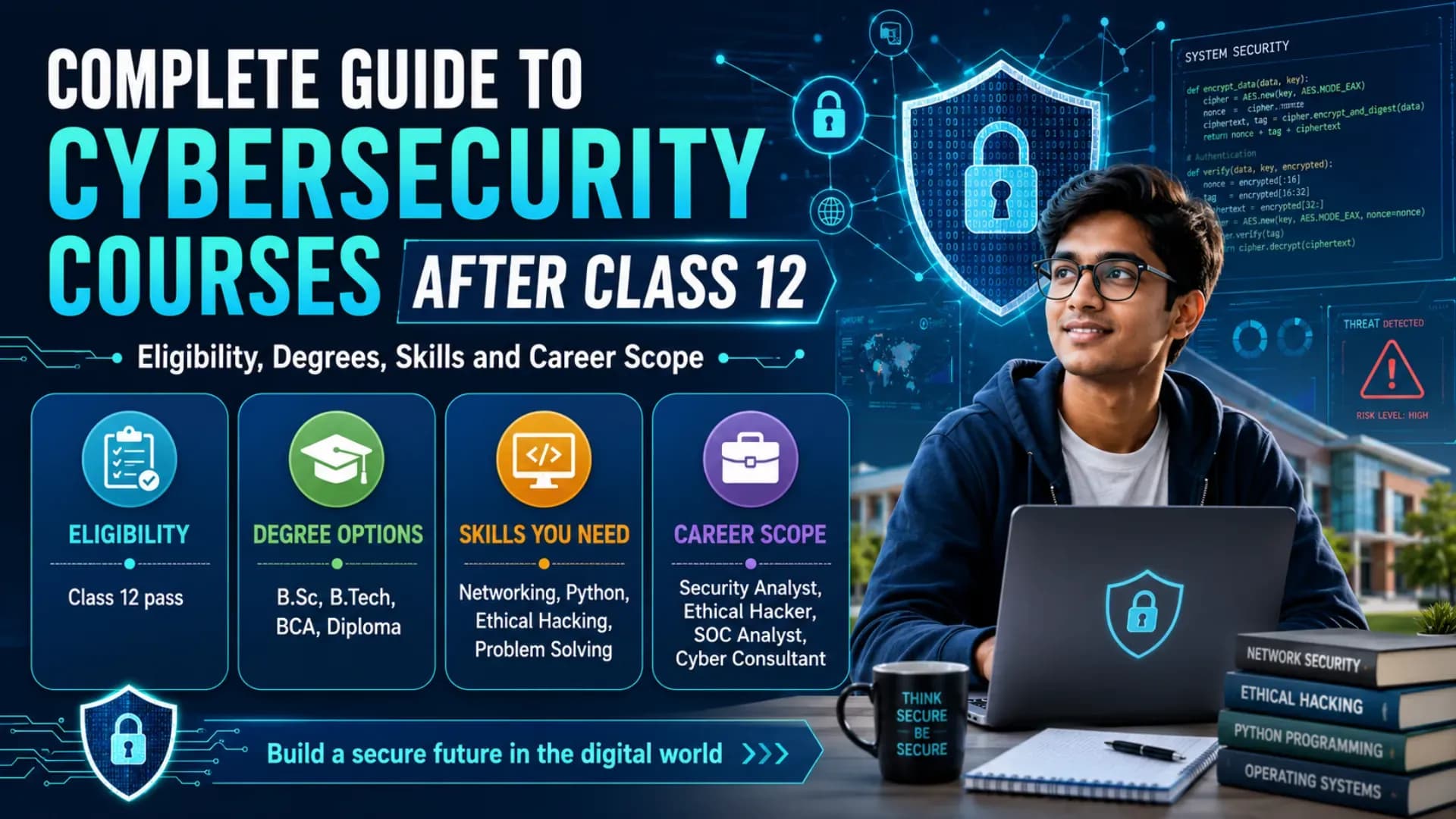
Cybersecurity Courses After Class 12 represent one of the most genuinely in-demand technology career pathways available to students today — and unlike several other technology fields that have become rapidly saturated, the shortage of skilled cybersecurity professionals remains a structural, sustained reality across both the private sector and government institutions. This guide covers the complete landscape of Cyber Security Courses After 12th: the real Cybersecurity Course Eligibility requirements, the meaningful differences between B.Tech Cybersecurity, B.Sc Cybersecurity, and BCA Cybersecurity, the core Cybersecurity Skills that genuinely matter beyond the degree itself, the landscape of Ethical Hacking Courses After 12th and Cybersecurity Certifications, and the honest Cybersecurity Career Scope that follows.
What We Cover
- Cybersecurity Course Eligibility — Who Can Apply
- Cybersecurity Degree After 12th — Comparing the Options
- Cybersecurity Diploma Courses — A Faster Entry Route
- What You'll Actually Study in Cybersecurity
- Cybersecurity Skills — What Genuinely Matters Beyond the Classroom
- Ethical Hacking Courses After 12th — A Distinct Specialisation
- Cybersecurity Certifications — Industry-Recognised Credentials
- Cybersecurity Career Scope — Roles, Salary and Long-Term Outlook
Cybersecurity Course Eligibility — Who Can Apply
Cybersecurity Course Eligibility is broadly accessible to students from the science stream, with requirements varying by specific degree type:
- B.Tech Cybersecurity: Class 12 pass with Physics, Chemistry, and Mathematics (PCM), typically requiring 55%+ aggregate, with admission via JEE Main, university-specific entrance tests, or merit. Confirmed Cybersecurity Course Eligibility at most institutions offering this track
- B.Sc Cybersecurity: Class 12 pass with Mathematics as a core subject, typically 50%+ aggregate, admitted largely on merit or CUET score at affiliated university colleges
- BCA Cybersecurity: Class 12 pass from any stream, though Mathematics or Computer Science at Class 12 level is often preferred; most institutions admit on merit with a basic 50% aggregate threshold
- Diploma programmes: Generally accessible after Class 10 or 12, with minimum marks requirements varying by institution but rarely above 50% aggregate
A genuinely important note on Cybersecurity Course Eligibility: beyond formal academic requirements, an aptitude for logical reasoning, attention to detail, and genuine curiosity about how systems work and can be broken — rather than just how to use them — is practically relevant to success in this field in a way that classroom marks don't always capture.
Cybersecurity Degree After 12th — Comparing the Options
Choosing the right Cybersecurity Degree After 12th requires understanding the genuine differences between the primary undergraduate pathways, since the label "cybersecurity" can cover markedly different academic experiences depending on the degree type:
- B.Tech Cybersecurity (or B.Tech CSE — Cyber Security): A 4-year engineering degree offering the deepest technical foundation — covering network architecture, operating systems security, cryptography, malware analysis, and systems programming with engineering rigour. This is the strongest Cybersecurity Degree After 12th for students aiming at core technical, research, or senior security engineering roles
- B.Sc Cybersecurity: A 3-year science degree with a stronger theoretical and conceptual emphasis, covering security principles, digital forensics, and network security without the full engineering curriculum. A genuinely solid option for students interested in the analytical and policy dimensions of cybersecurity alongside the technical fundamentals
- BCA Cybersecurity: A 3-year computer applications degree blending programming and application development fundamentals with cybersecurity specialisation — a practical, applied route that suits students interested in security within software and application contexts specifically
The honest comparison across these Cybersecurity Courses After Class 12 pathways: B.Tech Cybersecurity offers the deepest technical foundation and the widest future specialisation options, while B.Sc Cybersecurity and BCA Cybersecurity offer faster, more accessible routes that suit students prioritising applied skills and quicker industry entry over engineering depth.
Cybersecurity Diploma Courses — A Faster Entry Route
For students wanting faster entry into the field, or those supplementing a different undergraduate degree, Cybersecurity Diploma Courses offer a genuinely practical alternative:
- Duration and format: Typically 6 months to 2 years, available both as standalone programmes after Class 12 and as postgraduate diplomas for graduates transitioning from other technical fields
- Genuine use cases: Cybersecurity Diploma Courses work particularly well for students in other degree programmes (IT, Computer Science, Engineering) who want to add a focused security credential alongside their primary qualification
- The honest limitation: Diploma credentials generally carry less weight for senior or research-oriented security roles than a full engineering degree — they work best as a supplementary credential or an entry-level skill qualification rather than a standalone foundational degree
Cybersecurity Diploma Courses are often best evaluated alongside the Cybersecurity Certifications landscape (covered separately below), since some industry certifications — despite being shorter than a formal diploma — carry stronger industry recognition for specific roles than many institutional diploma programmes.
What You'll Actually Study in Cybersecurity
Regardless of the specific degree pathway chosen among Cyber Security Courses After 12th — whether B.Tech, B.Sc, or BCA — and whether pursued through dedicated Cyber Security Courses After 12th or broader computer science programmes with a cybersecurity specialisation, the core subject areas consistently covered include:
- Network Security: Understanding how networks function, how attackers exploit them, and how defensive controls — firewalls, intrusion detection systems, VPNs — operate at a technical level
- Cryptography: The mathematical and computational foundations of encryption, key management, and secure communication protocols that underlie nearly all modern digital security
- Operating System Security: How operating systems manage access controls, authentication, and privileges — and how these mechanisms are attacked and hardened
- Digital Forensics: Techniques for investigating security incidents, recovering evidence, and reconstructing attack timelines — a genuinely distinct discipline within the broader field
- Ethical Hacking and Penetration Testing: Structured, authorised methods for identifying vulnerabilities in systems before malicious actors can exploit them — covered in depth within dedicated Ethical Hacking Courses After 12th and as a module within broader security degrees
- Risk Assessment and Compliance: Understanding how organisations evaluate and manage security risk, including the regulatory and compliance frameworks (ISO 27001, GDPR, IT Act) that increasingly govern security practices
Students evaluating cybersecurity programmes should specifically check whether laboratory and hands-on practical components are genuinely integrated into the curriculum, since this is a field where applied, practical experience — particularly in a simulated lab environment — develops competence far more effectively than purely theoretical coursework alone.
Cybersecurity Skills — What Genuinely Matters Beyond the Classroom
The Cybersecurity Skills that genuinely differentiate strong candidates extend well beyond what any standard curriculum covers:
- Hands-on lab practice: Setting up virtual lab environments — using tools like VirtualBox, Kali Linux, Metasploit, and Wireshark — and regularly practising attack and defence techniques on controlled systems is genuinely the most effective way to build applied Cybersecurity Skills outside coursework
- Capture the Flag (CTF) competitions: Participating in online cybersecurity competitions — platforms like HackTheBox, TryHackMe, and PicoCTF — provides structured, progressive exposure to real-world security challenges and builds a demonstrable portfolio of problem-solving ability that employers consistently value
- Programming fluency: Practical Python scripting ability — for automating tasks, writing basic security tools, and parsing logs — is a consistently cited Cybersecurity Skills requirement across entry-level and mid-level roles, even in non-programming-focused tracks
- Security mindset: Perhaps the most genuinely important and least formally teachable skill — the habit of thinking about how systems can be attacked, rather than only how they function normally
Students serious about building genuine Cybersecurity Skills should treat CTF participation, home lab practice, and consistent engagement with security news and research as a natural extension of their formal education rather than optional extras — this combination is what consistently produces candidates who stand out in a field where credentials alone have become table stakes.
Ethical Hacking Courses After 12th — A Distinct Specialisation
Ethical Hacking Courses After 12th represent a specific, applied track within the broader cybersecurity landscape that deserves separate consideration:
- What ethical hacking actually covers: Structured, authorised penetration testing — systematically probing systems, applications, and networks for vulnerabilities using the same techniques that malicious attackers use, but with explicit permission and a formal reporting obligation
- Degree versus specialisation: Ethical Hacking Courses After 12th are available both as standalone diploma/certificate programmes and as specialised modules within broader cybersecurity degrees — the standalone route provides faster entry into penetration testing specifically, while the degree route provides a broader foundation that ethical hacking can build upon
- Legal and ethical boundaries: An important point often understated in marketing for Ethical Hacking Courses After 12th: penetration testing and security research must always be conducted with explicit written authorisation — unauthorised security testing, regardless of intent, constitutes a criminal offence under the Indian IT Act
For students specifically drawn to offensive security and penetration testing, Ethical Hacking Courses After 12th paired with relevant Cybersecurity Certifications (particularly CEH or OSCP, depending on career stage) represent a well-recognised, in-demand career pathway with strong commercial demand from organisations needing continuous vulnerability assessment.
Cybersecurity Certifications — Industry-Recognised Credentials
Cybersecurity Certifications occupy a uniquely important place in this field compared to most others — industry-recognised certifications often carry as much weight as, and sometimes more than, formal academic qualifications with specific employers and for specific roles:
- CompTIA Security+: A widely respected entry-level certification covering foundational security concepts across networks, threats, and compliance — a natural first formal Cybersecurity Certifications target for students completing their undergraduate degree
- CEH (Certified Ethical Hacker): Specifically focused on penetration testing methodologies and offensive security techniques — particularly relevant for students pursuing ethical hacking and red-team career tracks
- OSCP (Offensive Security Certified Professional): A highly rigorous, hands-on penetration testing certification that is widely considered the gold standard for offensive security practitioners — typically pursued after gaining some experience rather than directly after a degree
- CISSP (Certified Information Systems Security Professional): A senior-level certification requiring substantial work experience, covering a broad range of security management domains — relevant as a longer-term career credential rather than an early-career qualification
- AWS/Azure Security Specialisations: Cloud-specific security certifications that are increasingly important as organisations migrate infrastructure to cloud platforms
The strategic value of Cybersecurity Certifications lies in their specificity — unlike a general degree, each certification signals competence in a narrower, immediately applicable skill set that employers can evaluate quickly. Building a combination of a solid foundational degree and well-chosen certifications typically produces stronger outcomes than either alone.
CHECK OUT: Explore B.Tech CSE Cybersecurity Colleges
Cybersecurity Career Scope — Roles, Salary and Long-Term Outlook
Cybersecurity Career Scope spans a genuinely wide range of roles, and understanding this range helps set realistic expectations about career trajectory:
- Security Analyst: A common entry-level role focused on monitoring security events, investigating alerts, and responding to incidents — the realistic starting point for most cybersecurity graduates before specialisation
- Penetration Tester / Ethical Hacker: Conducting authorised security assessments of systems and applications — a highly specialised, well-compensated track with strong demand across consulting firms, financial institutions, and technology companies
- Security Operations Center (SOC) Analyst: Monitoring, detecting, and responding to security threats in real time within an organisation's security operations function — a structured career path with clear progression
- Digital Forensics Investigator: Examining digital evidence following security incidents or for law enforcement — a distinct track with growing demand from both corporate security teams and government agencies
- Chief Information Security Officer (CISO): The senior leadership track, responsible for an organisation's entire security strategy and risk posture — a role typically requiring a decade or more of combined technical and management experience
On compensation, entry-level Security Analyst roles in India typically start in the range of ₹4-7 LPA, with experienced penetration testers and senior security engineers earning ₹15-35+ LPA depending on specialisation, organisation, and certifications. International roles — particularly in the US, UK, and Singapore — offer significantly higher compensation packages, and cybersecurity remains one of the few technical fields where international mobility is genuinely strong for skilled, certified professionals.
The structural outlook for Cybersecurity Career Scope remains genuinely strong: global cybersecurity workforce shortfalls are consistently reported at several million unfilled positions, regulatory requirements around data protection and incident reporting are increasing in India and globally, and the attack surface continues to grow with digital transformation across every sector — making this a field where skilled professionals face meaningfully less competition than in more saturated technology tracks.
Explore the Course
Conclusion
Navigating Cybersecurity Courses After Class 12 well requires the same deliberate research that any serious undergraduate decision deserves — understanding the real Cybersecurity Course Eligibility for your target institutions, comparing B.Tech Cybersecurity, B.Sc Cybersecurity, and BCA Cybersecurity honestly against your own academic background and career direction, and considering Cybersecurity Diploma Courses where speed and supplementary credentials matter more than foundational depth.
Use this guide to choose the right Cybersecurity Degree After 12th with a complete picture: commit to building genuine Cybersecurity Skills through hands-on practice and CTF participation beyond your formal curriculum, explore Ethical Hacking Courses After 12th if offensive security specifically appeals to you, build a targeted plan for Cybersecurity Certifications aligned with your specific role direction, and set realistic expectations for your Cybersecurity Career Scope progression. This is a field where skilled, genuinely competent professionals face real, sustained demand — and the difference between that outcome and a generic technology graduate experience lies almost entirely in the deliberate skill-building choices made during the undergraduate years rather than the degree title alone.