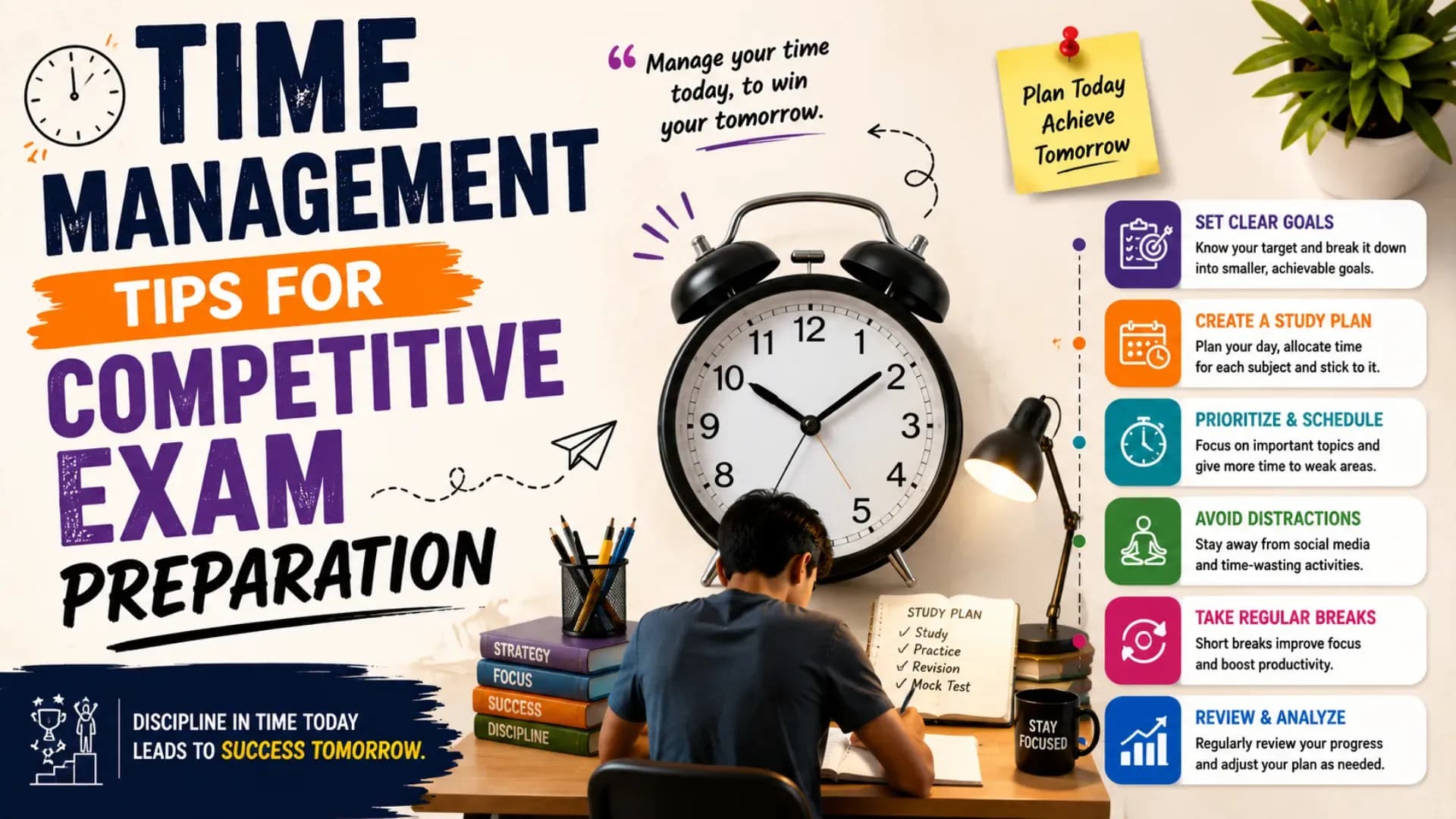
Time Management Tips for Competitive Exam Preparation
Every serious student preparing for a competitive exam has access to roughly the same syllabus, the same textbooks, and the same number of hours in the day. What separates students who achieve the scores they are capable of from those who consistently fall short is rarely raw intelligence or effort — it is time management for students that is structured, honest, and sustainable across the months of preparation that competitive exams demand.
The gap between knowing you need a plan and actually building one that works is where most competitive exam preparation tips fall short — they describe what a perfect study schedule looks like without explaining how to build one around the actual constraints of your life, your energy patterns, and your specific subject weaknesses. This article fills that gap. From building a daily study routine that holds across the pressure of long preparation cycles to designing a revision timetable that addresses your specific weak areas, from applying smart study techniques that compress learning time to building an exam preparation strategy for the critical final month — this is the complete, practical guide to study time management for every serious competitive exam aspirant.
These are not generic productivity tips for exams recycled from motivational content. They are specific, sequenced, and grounded in the actual patterns of preparation that produce exam success tips outcomes across JEE, NEET, CAT, UPSC, GATE, and every major competitive examination in India. Apply them in the order they are presented — the sequence matters as much as the content.
Related Article: Top B.Tech Colleges in India: Fees, Admission & Ranking 2026
Table of Contents
- Why Time Management Is the Real Competitive Advantage
- Building Your Daily Study Routine — The Right Way
- Creating a Revision Timetable That Actually Works
- Smart Study Techniques That Multiply Your Productivity
- The Complete Competitive Exam Study Plan — Week by Week
- Exam Preparation Strategy for the Final Month
- Productivity Tips for Exams — Managing Energy, Not Just Time
- Common Time Management Mistakes That Cost Students Marks
- Conclusion
Why Time Management Is the Real Competitive Advantage
Before any specific technique or timetable, every aspirant needs to understand why study time management is the single most leveraged skill in competitive exam preparation — not because it sounds good, but because the mathematics of competitive exam preparation make it structurally true.
Step 1: Understand the Real Nature of the Preparation Problem
Competitive exams like JEE, NEET, CAT, GATE, and UPSC do not reward the student who studied the most hours in total — they reward the student who built the deepest understanding across the most relevant topics within the available preparation window. An aspirant who spends 14 hours a day studying without a structured competitive exam study plan consistently underperforms compared to one who studies 8 hours with a targeted, audited, well-sequenced preparation system. Volume without structure is the most common and most avoidable waste in competitive exam preparation.
Step 2: Recognise What Time Management for Students Actually Means
Time management for students in the competitive exam context is not about packing every hour with study activity. It is about allocating the right kind of attention — focused, deliberate, active learning — to the right content at the right time in the preparation cycle. This includes protecting recovery time as deliberately as study time, because cognitive performance — the ability to understand, retain, and apply information — degrades rapidly under sustained high-stress, low-recovery conditions. The students who sustain preparation quality across a full 12-month cycle are almost always those whose daily study routine includes structured breaks and sleep protection, not those who sacrifice both in pursuit of maximum study hours.
Step 3: Accept That Your Current Time Use Is Honest Data, Not a Character Judgment
Before building any new system, spend three days tracking your current time use honestly — not what you plan to do, but what you actually do, hour by hour. Most students discover that their actual focused study time is 3 to 4 hours less per day than they believe it is, because passive study activities (re-reading notes, watching YouTube explanations, keeping books open while distracted) register as "studying" in self-assessment but produce little actual learning. This honest audit is the foundation of any effective competitive exam preparation tips system — because it tells you where time is actually going before you decide where it should go.
Also Read: Top AI Skills Students Must Learn in 2026
Building Your Daily Study Routine — The Right Way
The daily study routine is the fundamental unit of competitive exam preparation — and most students build theirs wrong, which is why most students abandon their schedules within two weeks of creating them. A daily study routine that survives contact with the actual pressures of competitive exam preparation is built around principles, not prescriptions.
Step 1: Design Around Your Peak Cognitive Hours
Every person has 2 to 3 hours per day when their cognitive function is at its highest — memory consolidation is strongest, concentration is deepest, and problem-solving is most efficient. For most students, this window falls in the morning (6 AM to 9 AM) or in the late morning (9 AM to 12 PM). Identifying your personal peak hours and protecting them for your most difficult subject — the one where your understanding is weakest or the content is most demanding — is one of the highest-return study time management decisions you can make. Use off-peak hours for review, flashcard drilling, formula revision, and easier practice questions rather than wasting your peak cognitive window on low-demand tasks.
Step 2: Use Time Blocks, Not Subject Hours
The most effective daily study routine structures time in blocks of 50 to 90 minutes of focused activity followed by a 10 to 15 minute genuine break — not a phone check that extends to 45 minutes, but a physical movement, brief walk, or eyes-closed rest that actually resets concentration. This block structure is more sustainable than either the marathon session (3+ hours without a break, which produces diminishing returns after the first hour) or the fragmented approach (switching between subjects every 20 minutes before any topic reaches deep encoding). Each block should have a specific output target — "understand and solve 10 questions on Thermodynamics" rather than "study Chemistry for 90 minutes" — because output targets make the block measurably complete and psychologically satisfying in a way that time targets do not.
Step 3: Build Anchor Points, Not Rigid Timetables
Rigid hour-by-hour timetables fail because life does not conform to them — a single unexpected event (a family commitment, a health issue, a coaching class that runs long) breaks the timetable for the day, which then triggers an all-or-nothing abandonment of the plan. Instead, build your daily study routine around 3 to 4 non-negotiable anchor points per day — fixed time slots with fixed subjects that you protect regardless of what else changes. Everything else in the day is flexible. This anchor-point approach produces significantly better preparation consistency over a 12-month cycle than any tightly scheduled timetable because it tolerates the variability of real life without breaking the preparation habit when variability occurs.
Step 4: Include Sleep as a Non-Negotiable Preparation Activity
The most evidence-backed and most consistently ignored exam success tips in competitive exam preparation is this: 7 to 8 hours of sleep is not a luxury that preparation time competes against — it is when the day's learning is consolidated into long-term memory by the brain. Students who sacrifice sleep for study hours are literally trading memory formation for study time, which is a negative-return transaction from a preparation standpoint. Build sleep into your daily study routine as a fixed, protected anchor point — not as the time that remains after all study commitments are met.
Creating a Revision Timetable That Actually Works
A revision timetable that works is not the same as a revision timetable that looks good on paper. Most students build revision schedules that allocate time evenly across all subjects — which feels fair but is strategically counterproductive, because it gives equal time to areas where you already score well and areas where you most need improvement. An effective revision timetable is weighted, audited, and regularly updated.
Step 1: Weight Your Revision by Weakness and Weightage
The foundation of a strategic revision timetable is a two-axis priority matrix: how weak are you in this topic (assessed honestly through mock test performance), and how much does this topic contribute to the exam's total marks (assessed through previous year paper analysis). Topics in the high-weakness, high-weightage quadrant should dominate your revision time — these are the topics where improvement most directly translates to score improvement. Topics in the low-weakness, low-weightage quadrant get the lightest revision treatment — brief periodic review to maintain what you already know, without consuming time that the high-priority areas need. This matrix-based approach to the revision timetable consistently produces better score improvement per revision hour than any evenly distributed schedule.
Step 2: Build a Three-Tier Revision Cycle
The most effective revision timetable structures revision across three timeframes simultaneously — daily, weekly, and monthly — rather than treating revision as a single, sequential activity. Daily revision covers the content studied that day, using brief active-recall exercises at the end of each study block. Weekly revision covers the week's topics comprehensively — one 2-hour session every Sunday that synthesises the week's learning and identifies gaps for the following week's focus. Monthly revision covers major topic areas across the full syllabus — a full-day session at the end of each month that maintains retention of earlier content while integrating it with newer learning. This three-tier approach is the most consistent differentiator between aspirants whose early preparation translates into exam performance and those who discover in the final month that they have forgotten the first quarter's work.
Step 3: Build Review Dates Into the Timetable in Advance
Every topic in the revision timetable should have a next-review date assigned at the time of initial study — not determined reactively when the timetable needs updating. The spacing of these review dates should follow the spacing effect: first review 24 hours after initial study, second review 1 week later, third review 3 weeks later, and periodic maintenance reviews monthly thereafter. This spaced revision approach, built into the timetable in advance, produces retention curves that are significantly flatter (meaning less forgetting) than mass revision approaches — and it is the specific mechanism behind the most effective smart study techniques used by high-performing competitive exam aspirants across all major examinations.
Smart Study Techniques That Multiply Your Productivity
Smart study techniques are not shortcuts — they are methods of studying that produce deeper understanding and stronger retention per hour of effort than conventional passive reading or note-copying approaches. Every serious competitive exam study plan should incorporate these techniques because they are the difference between studying and learning.
Step 1: Active Recall Over Passive Review
Active recall — attempting to retrieve information from memory before checking the source — is the single most evidence-supported smart study technique available to competitive exam aspirants. After studying a chapter or topic, close the book, take out a blank sheet, and write everything you can remember about the topic from memory. Then compare against the source, identify what was missing, and revisit specifically those gaps. This process of effortful retrieval creates significantly stronger memory traces than re-reading the same material does — because the brain strengthens pathways that are actively used, not those that are merely exposed to information again. Students who replace 30% of their re-reading time with active recall exercises consistently show measurable improvement in mock test retention scores within 2 to 3 weeks of adopting the technique.
Step 2: The Feynman Technique for Conceptual Understanding
The Feynman Technique — explaining a concept in simple language as if teaching it to someone with no background in the subject — is the most powerful diagnostic smart study technique available for identifying gaps in conceptual understanding. Take any concept from your competitive exam study plan and attempt to explain it in plain language without referring to notes. Where the explanation becomes vague, hedged, or circular is precisely where your understanding is incomplete. Return to the source material specifically to resolve those gaps, then attempt the explanation again. A concept you can explain clearly in simple language is a concept you will not lose marks on under examination pressure — which makes the Feynman Technique one of the most direct exam success tips available for conceptual subjects.
Step 3: Previous Year Question Papers as Primary Study Material
The most underutilised resource in most students' competitive exam preparation tips toolkit is the archive of previous year question papers for their target examination. PYQs are not merely practice tests — they are the most precise specification available of exactly what the examining authority tests, at what difficulty level, in what format, and from which subtopics within each chapter. Integrating PYQ analysis into your preparation from early in the cycle — not just in the final month — allows your revision to be calibrated to actual examination priorities rather than to the comprehensive coverage that textbooks and coaching modules require but examinations do not always reward proportionately. For every major topic, solve the last 5 to 7 years of PYQs from that chapter before moving to practice sets — the question pattern knowledge this builds is itself a productivity tips for exams multiplier.
Step 4: Error Logs as a Personalised Study System
An error log is a dedicated notebook or document in which you record every question you answered incorrectly in practice — not just the correct answer, but the specific concept the question tested, why your answer was wrong, and what understanding was missing. Reviewing your error log for 15 minutes before each study session is one of the most targeted smart study techniques available because it directs your attention precisely to the gaps your own performance has identified, rather than the generic weaknesses that a study schedule assumes. Students who maintain consistent error logs typically see their mock test error rate on previously missed question types drop by 40 to 60% within three months of implementation.
Stop Stressing. Start Applying.
Skip the chaos of filling endless forms. Apply to your dream colleges in one go through the College Nirnay Common Application Form — built for every student navigating India's competitive education landscape.
Fill the Common Application Form →✓ Free to apply · ✓ Takes under 5 minutes · ✓ Trusted by thousands of students
The Complete Competitive Exam Study Plan — Week by Week
A competitive exam study plan that spans months needs a phase-based structure — different phases of preparation serve different purposes, and treating all months identically produces a preparation cycle that is neither deep enough early nor sharp enough late. Here is the phase-based competitive exam study plan framework that the most consistent high-performers across major Indian competitive exams use.
Step 1: Phase 1 — Foundation Building (Months 1 to 4)
The foundation phase is where the full syllabus is covered for the first time — systematically, in order, with emphasis on conceptual understanding rather than question-solving speed. The goal of this phase is not to be examination-ready; it is to build the complete knowledge architecture that the remaining phases will refine and sharpen. The daily study routine in Phase 1 should allocate 60% of study time to new content and 40% to daily and weekly revision of covered content. Mock tests in this phase should be chapter-level or topic-level tests — not full-length examinations, which are more useful in later phases.
Step 2: Phase 2 — Practice and Gap Identification (Months 5 to 8)
The practice phase shifts the balance: 40% new content (topics not yet covered or gaps identified in Phase 1), 60% practice and revision. Full-length mock tests should begin in this phase — one per week at minimum, increasing to two per week in the later part of this phase. The revision timetable in Phase 2 should be driven primarily by error log analysis and mock test performance data rather than by the sequential order of the syllabus. The weekly review session in Phase 2 should focus on identifying the 3 to 5 highest-frequency error patterns from that week's practice and targeting them specifically in the following week's preparation.
Step 3: Phase 3 — Consolidation and Mock Integration (Months 9 to 11)
Phase 3 is where the competitive exam study plan shifts entirely to consolidation — no new content is introduced, and all preparation time is allocated to mock tests, PYQ drilling, error log elimination, and intensive high-priority topic revision. Full-length mock tests move to 3 to 4 per week in this phase, with a full day's error analysis session following each test. The exam preparation strategy in Phase 3 is built around a single metric: mock test score trend. If scores are improving week on week, the plan is working. If they plateau or decline, the daily routine and revision timetable need auditing and adjustment — and this adjustment should happen within 7 days, not at the end of the month.
Step 4: Weekly Schedule Template Across All Phases
| Day | Phase 1 Focus | Phase 2 & 3 Focus |
|---|---|---|
| Monday | New content — Subject A (primary) | Mock test analysis + Subject A weak areas |
| Tuesday | New content — Subject B + daily review | Subject B — high-weightage PYQ drilling |
| Wednesday | New content — Subject C + daily review | Subject C — error log priority topics |
| Thursday | Revision — Subject A (week's content) | Full-length mock test (AM) + review (PM) |
| Friday | New content — Subject A (secondary) | Subject A + B — conceptual weak spots |
| Saturday | Chapter-level test + error analysis | Full-length mock test (AM) + review (PM) |
| Sunday | Weekly comprehensive revision (all subjects) | Weekly revision + next week priority planning |
Exam Preparation Strategy for the Final Month
The final month before any competitive examination is simultaneously the most high-stakes and the most commonly mismanaged period in the entire preparation cycle. The exam preparation strategy for this phase is counterintuitive in several critical ways — and understanding those counterintuitions before you reach the final month is one of the most valuable competitive exam preparation tips this guide can offer.
Step 1: No New Topics in the Final Four Weeks
The most damaging final-month exam preparation strategy mistake is introducing new content in the last four weeks — driven by the anxiety that there are chapters you have not yet covered. Any topic that has not been studied and revised through the preparation cycle will not be mastered in the final month — it will be half-learned and confusion-generating in the examination. The final month belongs entirely to consolidation: deepening and sharpening what you know, eliminating the error patterns your mock tests have identified, and building the examination-day execution skills that no amount of content knowledge can replace.
Step 2: Increase Mock Test Frequency and Seriousness
In the final month of your competitive exam study plan, full-length mock tests should be conducted 3 to 4 times per week under exact examination conditions — same time of day as the actual exam, full duration, no interruptions, no reference access. Each test session is followed by a minimum 90-minute error analysis. The goal of mock tests in the final month is not score improvement per se — it is execution quality: practising time allocation across sections, decision-making on difficult questions (attempt or skip), and building the cognitive routine that makes the actual examination feel familiar rather than alien.
Step 3: Build a One-Page Formula and Concept Summary Per Subject
In the final two weeks, compile a single-page condensed reference for each subject — the 20 to 30 most critical formulas, definitions, reaction sequences, or concept summaries that appear most frequently in PYQs and that carry the most risk of forgotten under examination pressure. Review these one-page summaries daily in the final two weeks and on the morning of the examination day. This condensed review practice activates the full knowledge network connected to each summary item in memory — making retrieval significantly faster and more reliable in the examination hall than it would be without this activation practice.
Step 4: Protect the Night Before
The night before the examination is for light review of your one-page summaries only — no new content, no full mock tests, no late-night cramming. Confirm your centre address, travel route, and reporting time. Prepare all documents (admit card, photo ID). Eat a normal dinner and target a 10 PM bedtime. The exam success tips that matter most on examination day are all decided by preparation quality across the preceding months — the night before is for consolidation, logistics, and rest, not for last-minute study that serves anxiety more than preparation.
Productivity Tips for Exams — Managing Energy, Not Just Time
The most sophisticated insight in competitive exam study time management is one that most students do not encounter until their preparation is already suffering from its absence: you cannot manage time effectively if you are not managing energy effectively. Hours on a schedule are fixed; the quality of cognitive work that fills those hours is determined by energy — which fluctuates and depletes in ways that time does not.
Step 1: Treat Physical Activity as a Preparation Asset
Thirty minutes of moderate physical activity daily — running, walking, yoga, or any exercise that elevates heart rate — produces measurable improvements in working memory, concentration span, and stress regulation within 2 to 3 weeks of consistent practice. These are the specific cognitive functions that competitive exam performance depends on. Students who cut physical activity to maximise study hours consistently report declining concentration quality and increasing anxiety across the preparation cycle — the exact opposite of what the study-hour increase was intended to produce. Physical activity is one of the most evidence-supported productivity tips for exams available and one of the most consistently sacrificed in the name of study time.
Step 2: Manage Nutrition and Hydration as Performance Variables
Cognitive performance — specifically concentration and memory consolidation — is directly affected by hydration status and blood glucose stability. Students who skip meals, rely on caffeine for energy, or eat high-glycaemic snacks during study sessions consistently show more variable concentration and more frequent attention lapses than those who maintain regular meal timing and adequate hydration. Keep a water bottle at your study desk, eat at consistent intervals rather than opportunistically, and reduce heavy caffeine dependence — the energy crash that follows caffeine stimulation produces exactly the concentration dip that competitive exam preparation can least afford.
Step 3: Build Psychological Recovery Into the Weekly Schedule
Psychological recovery — time spent genuinely away from study content and academic pressure — is not a reward for completing study targets; it is a maintenance requirement for sustained cognitive performance. Build one half-day per week into your competitive exam study plan that is completely free of academic content — not rescheduled study time, not light revision, but genuine leisure, social connection, or creative activity. Students who protect this weekly psychological recovery window consistently sustain preparation quality and emotional stability across a 12-month cycle better than those who treat every hour as available study time, which produces a burnout trajectory that the final months of the preparation cycle are most vulnerable to.
Step 4: Address Anxiety Directly — Not by Studying More
Examination anxiety is one of the most significant and least directly addressed factors in competitive exam performance — and the most common student response to anxiety (studying more intensively) is also the one most likely to increase it. When anxiety levels are high, the most effective exam success tips are those that target the anxiety directly: structured breathing exercises before study sessions, journalling about specific preparation concerns (which converts abstract dread into specific addressable problems), and honest conversations with a trusted person about the pressure being experienced. If examination anxiety is significantly affecting study quality or daily functioning, speaking to a counsellor or mental health professional is a performance decision as much as a wellbeing one — because unmanaged high anxiety impairs exactly the cognitive functions that competitive exam success requires.
Common Time Management Mistakes That Cost Students Marks
The most important competitive exam preparation tips are sometimes framed most clearly as errors to avoid — because these mistakes are so common and so consequential that recognising and correcting them is worth more than any additional study technique. Every honest exam preparation strategy must confront them directly.
Step 1: Passive Study Mistaken for Active Preparation
Re-reading notes, highlighting textbooks, watching concept videos, and keeping books open while distracted are among the most common activities that students count as study time in their daily study routine but that produce minimal actual learning. Passive exposure to content does not create the retrieval strength that competitive exams demand. Every hour of passive study that is replaced with active recall, problem-solving, or error analysis produces more examination-relevant preparation than the passive alternative — and recognising this distinction is one of the most consequential study time management insights available.
Step 2: Over-Planning and Under-Executing
Spending significant time creating elaborate, colour-coded, multi-page study schedules is a form of preparation avoidance — it feels productive while consuming the hours that actual preparation needs. An effective competitive exam study plan can be created in 30 minutes: identify the subjects and topics, assess your current weaknesses, assign priority weightings, and build your weekly anchor points. The value is in the execution of the plan, not the aesthetic quality of the document. Students who spend 3 hours designing a schedule that they abandon within 10 days have optimised the wrong part of the preparation process.
Step 3: Treating All Subjects as Equal Priorities
An evenly distributed revision timetable is comfortable to design and counterproductive to execute. The mathematics of competitive exam scoring reward disproportionate improvement in your weakest high-weightage areas far more than marginal improvement in your already-strong areas. Students who discover they have spent equal preparation time on a subject they already score 85% in and one they score 45% in have made a strategic error that no amount of additional effort can retrospectively correct. Audit your subject and topic performance data monthly and reweight your preparation accordingly — this is the core discipline of effective time management for students in a competitive exam context.
Step 4: Ignoring Mock Test Feedback
Taking mock tests without thoroughly analysing the results is one of the most common and most damaging study time management errors. A mock test that is not analysed is a performance experience — useful for familiarity but not for improvement. A mock test that is fully analysed — every wrong answer examined for its conceptual gap, every time-management decision reviewed, every high-difficulty question strategised — is a targeted preparation intervention that directly improves the next test's performance. The ratio of analysis time to test time should be at least 1:1 — for every 3-hour mock test, dedicate at least 2 to 3 hours to analysis. Students who skip or abbreviate this analysis consistently plateau in their scores regardless of how many tests they take.
Explore More
Conclusion
The competitive exam preparation tips, techniques, and frameworks in this guide are not separate pieces of advice — they are a sequenced system. Time management for students begins with an honest audit of how time is currently used, builds through a structured daily study routine with anchor points and peak-hour protection, sharpens through a weighted revision timetable driven by weakness and weightage data, compounds through smart study techniques like active recall and error logging, scales through a phase-based competitive exam study plan, and culminates in an exam preparation strategy for the final month that prioritises consolidation over panic-driven new content.
Every productivity tips for exams framework ultimately rests on one insight: the quality of your preparation hours matters more than the quantity. A student who studies 6 hours of genuinely focused, system-driven, error-responsive preparation will outperform a student who studies 12 hours of passive, anxiety-driven, unstructured effort — not just in examination scores, but in the sustainability and sanity of the preparation journey itself. Apply the study time management system in this guide consistently, audit it monthly, adjust it honestly, and trust the process — because the process, done right, is the outcome.
Explore College Nirnay for complete exam guides, college comparisons, career resources, and everything a competitive exam aspirant needs to plan not just the examination — but everything that follows it.