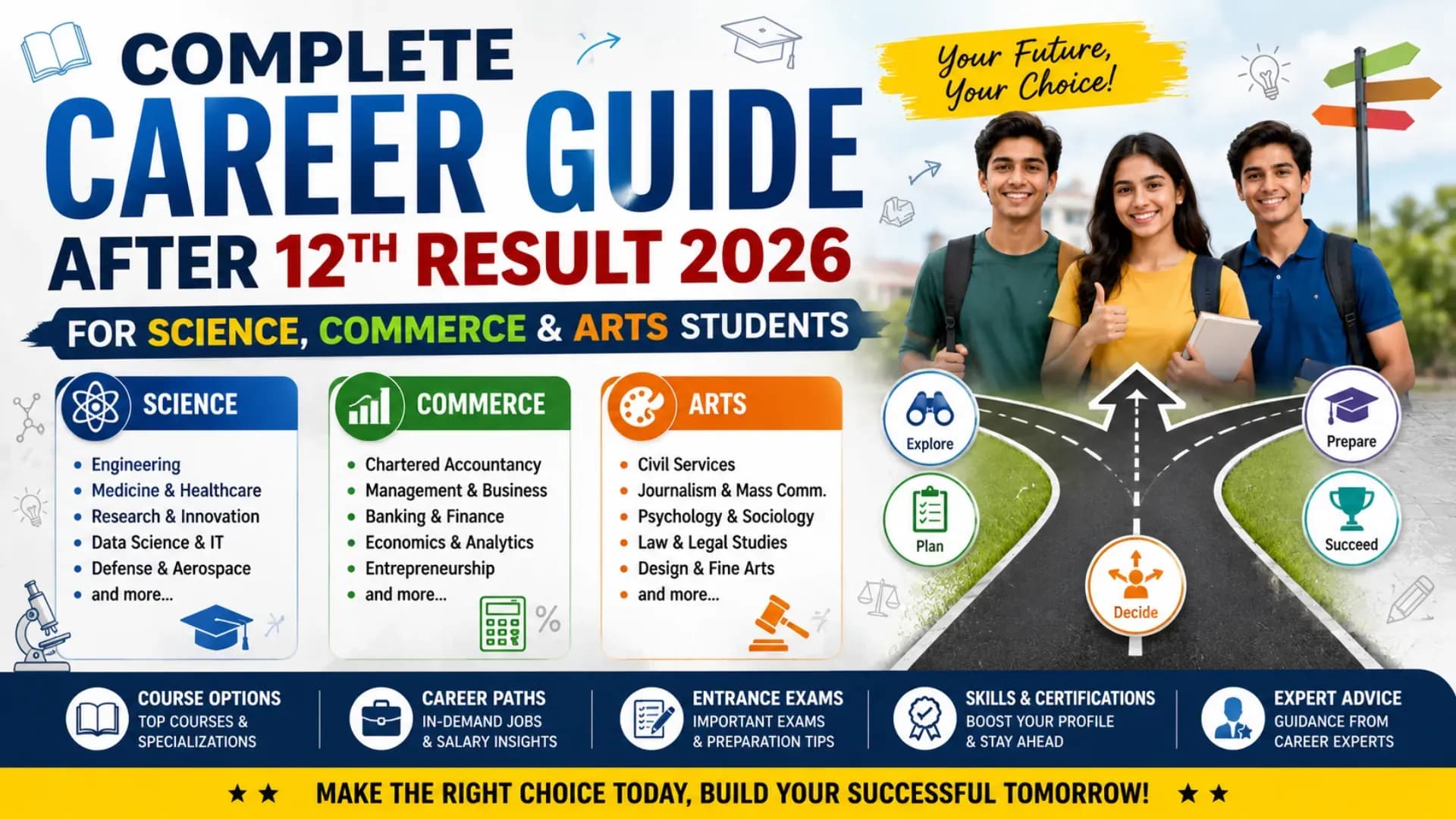
The 12th board result is out — and for millions of students across India, the weeks immediately following that declaration are among the most consequential of their lives. The decisions made in this compressed window determine educational pathways, professional trajectories, and the general shape of the decade ahead. This complete career after 12th 2026 guide is built to serve every student — whether you are from the Science stream weighing Science career options, from Commerce navigating a Commerce career guide, or from Arts or Humanities exploring Arts career opportunities that match your interests and strengths. The landscape of best courses after 12th has expanded dramatically in 2026 — driven by AI, changing employer priorities, and new university programmes that did not exist even five years ago — making genuinely informed student career planning more important, and more possible, than ever before. This guide covers the full picture: stream-wise courses after Class 12, relevant entrance exams after 12th, emerging future careers 2026 that go beyond conventional wisdom, and practical career counseling students guidance to help you make the decision that is right for your specific situation — not just the one that looks best on paper.
Related Article:
Top BTech Colleges in India 2026
Table of Contents
- Science Career Options After 12th 2026
- Commerce Career Guide After 12th 2026
- Arts Career Opportunities After 12th 2026
- Key Entrance Exams After 12th 2026
- Future Careers 2026 — Beyond the Conventional List
- Student Career Planning — How to Decide
- Career Counseling for Students — What It Actually Involves
- Conclusion
Science Career Options After 12th 2026
The Science stream continues to offer the widest range of post-12th pathways of any stream — but the conventional wisdom of "PCM leads to engineering, PCB leads to medicine" dramatically understates the breadth of Science career options now available in 2026. Courses after Class 12 Science have expanded to include Data Science, Artificial Intelligence, Cybersecurity, Biotechnology, Environmental Science, Forensic Science, and a growing range of interdisciplinary programmes that combine Science fundamentals with design, policy, or business — making Science career options far more diverse than the JEE/NEET binary that dominates school-level career conversation.
Option 1: Engineering & Technology (BTech / BE)
The most pursued of all courses after Class 12 for PCM students — BTech remains highly relevant in 2026, with the branch selection now more consequential than the institution tier in many career trajectories. Computer Science, AI & ML, Data Science, Cybersecurity, and Electronics branches offer the strongest 2026 placement outcomes. Access via JEE Main, JEE Advanced, state CETs, and private university entrance processes. Duration: 4 years.
Option 2: Medical & Allied Health Sciences (MBBS, BDS, BAMS, Pharmacy, Nursing)
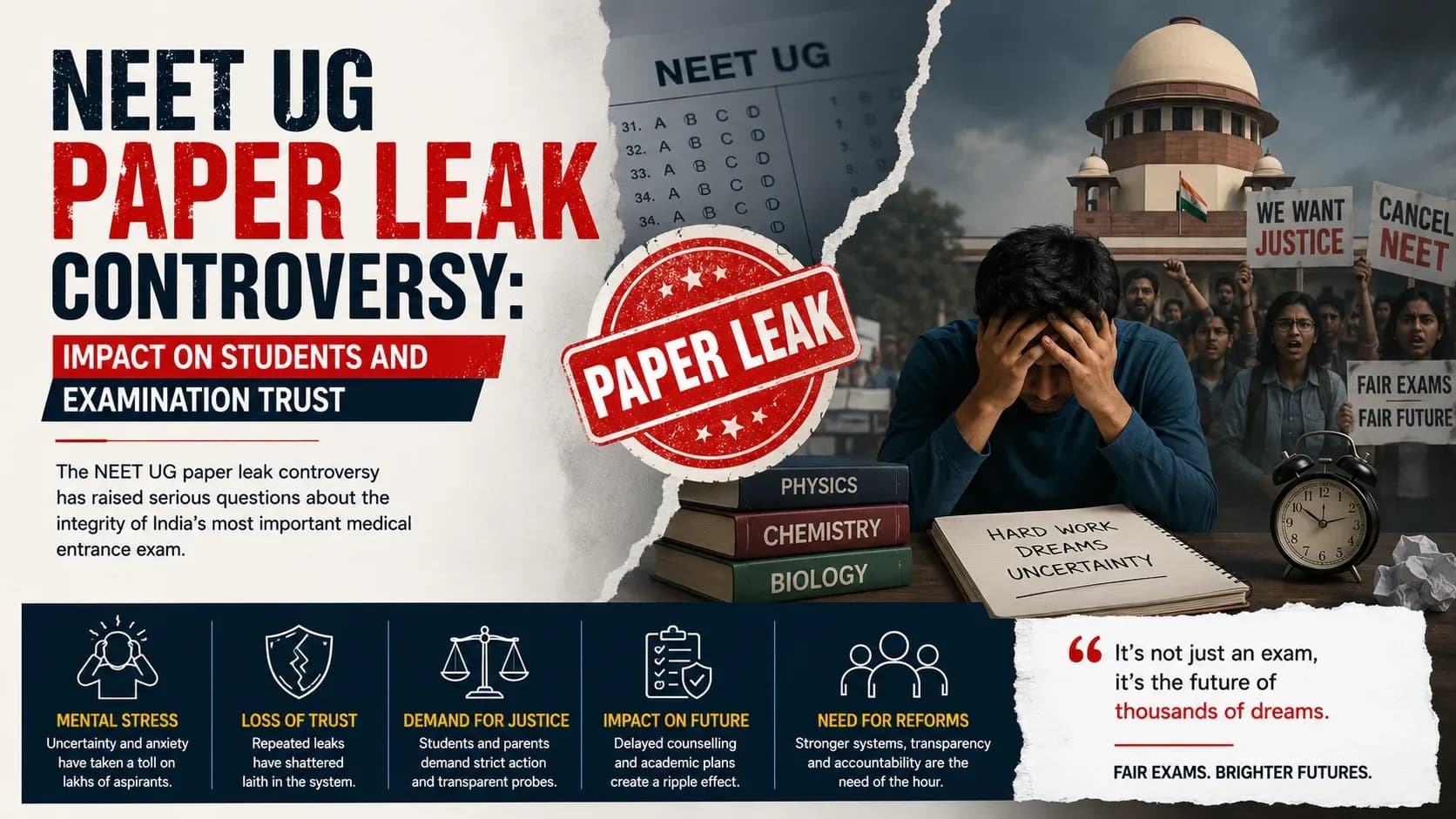
For PCB students, MBBS via NEET UG remains the gold standard — but the allied health sciences pathway (BPharm, BSc Nursing, BSc Medical Laboratory Technology, BSc Radiology, BSc Physiotherapy) is increasingly recognised as a robust and employment-secure set of Science career options for students who want to work in healthcare without the 5.5-year MBBS commitment. These courses after Class 12 also admit through NEET UG scores in many institutions, making the entrance exam preparation investment transferable across multiple pathways.
Option 3: Pure Sciences & Research (BSc)
BSc in Physics, Chemistry, Mathematics, Statistics, Biology, or Computer Science — followed by MSc and PhD — is among the most underrated Science career options for students with genuine intellectual curiosity in foundational disciplines. The research and academia pathway in India has improved meaningfully in terms of fellowship funding and employment opportunities, and BSc graduates from strong institutions increasingly access data science, actuarial science, and quantitative finance roles that previously required engineering degrees. CUET UG is now the primary gateway to BSc admissions at central universities.
Option 4: Data Science, AI & Emerging Technology Programmes
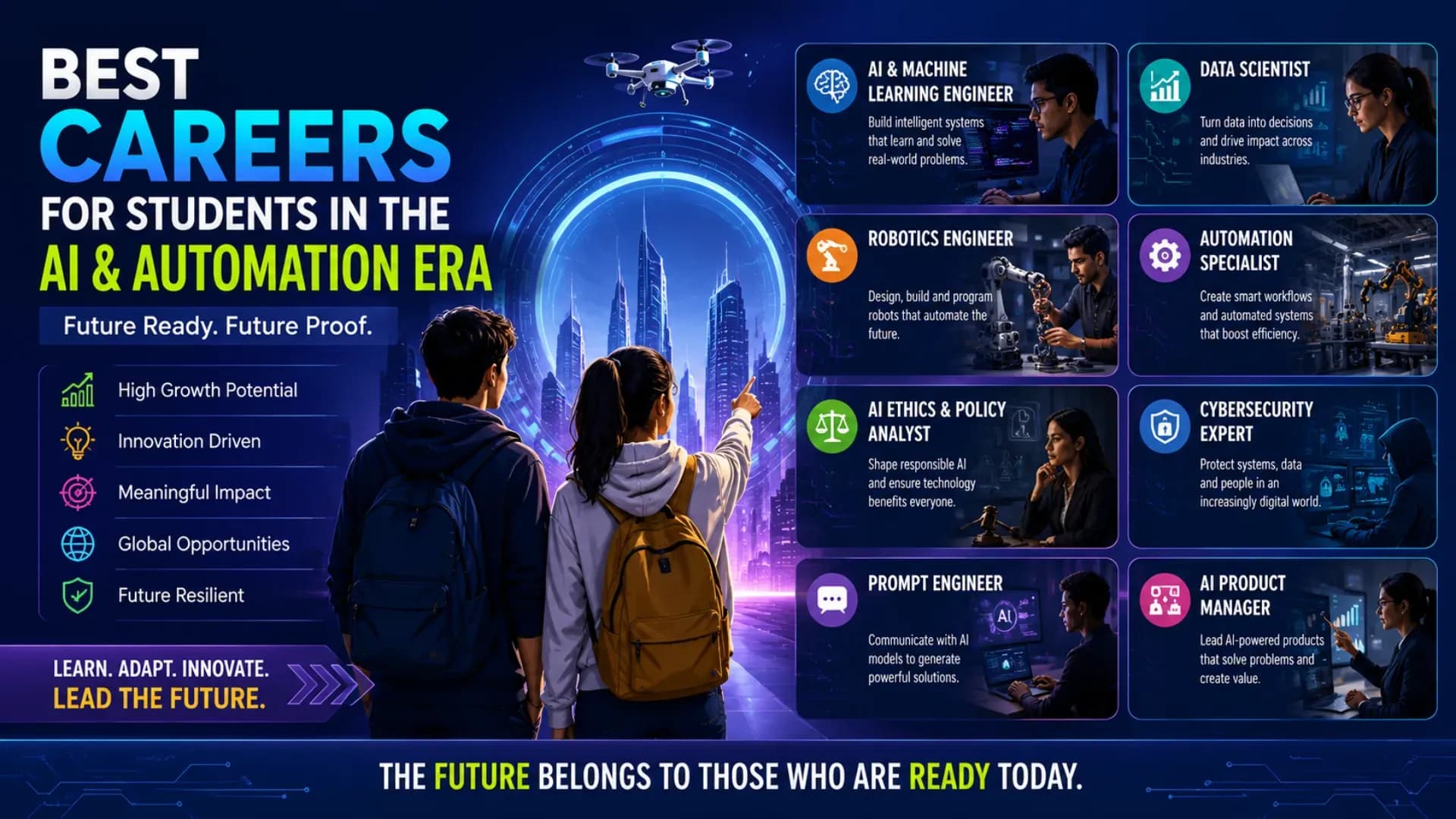
Among the fastest-growing best courses after 12th for Science students in 2026 — dedicated BTech and BSc programmes in Artificial Intelligence, Machine Learning, Data Science, and Cybersecurity are now offered by a wide range of universities and are directly aligned with the highest-demand employer skill sets. These programmes represent the most direct pathway from career after 12th 2026 Science stream to the future careers 2026 job market in technology.
Option 5: Architecture & Design (BArch, BDes)
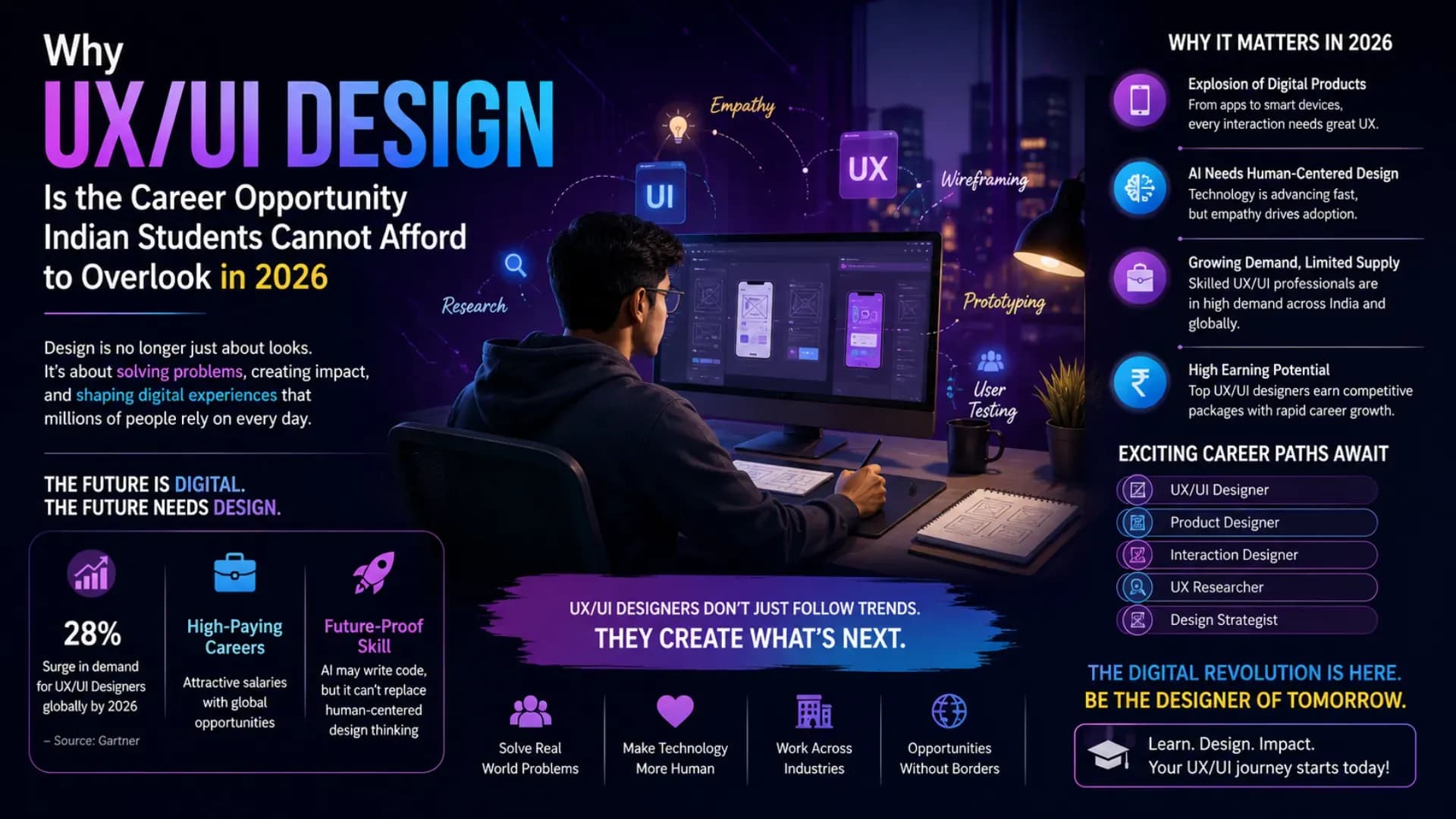
Often overlooked in standard Science career options lists — BArch (via NATA and JEE Paper 2) and BDes (via NID, UCEED, and private university entrance processes) offer creatively oriented Science students a powerful pathway that combines technical rigour with design thinking. Architecture and product design graduates are among the most versatile professionals in the 2026 job market.
Also Read:
Top MTech Colleges in India 2026
Commerce Career Guide After 12th 2026
The Commerce career guide for 2026 is a story of expanding options on top of a strong traditional foundation. Commerce graduates have long had access to clearly defined professional pathways — CA, CMA, CS, BCom, BBA, Economics Honours — and these remain among the most employment-secure courses after Class 12 available. What has changed is the convergence of Finance and Commerce with technology — creating new future careers 2026 pathways in FinTech, Business Analytics, and digital commerce that are now just as accessible from a Commerce background as from an Engineering one.
Option 1: Chartered Accountancy (CA)
The flagship professional qualification in this Commerce career guide — CA remains one of the most powerful credentials in the Indian professional ecosystem, offering high earning potential, clear progression structure, and genuine employer demand across corporate finance, audit, taxation, and consulting. Registered through ICAI after 12th via the CA Foundation examination. The 3 to 4.5 year completion timeline (including articleship) requires sustained commitment — but the career outcomes rank among the strongest of any courses after Class 12 in the Commerce stream.
Option 2: BCom / BCom Honours & Economics Honours
The foundational academic route in any honest Commerce career guide — BCom and BA Economics Honours from strong institutions (Delhi University, Christ University, Loyola, Narsee Monjee) provide the academic platform for CA, MBA, civil services, or direct employment in financial services. Access via CUET UG for central universities and state-level or institutional entrance processes for others. BCom Honours at SRCC and BA Economics at St. Stephen's remain among the most competitive undergraduate admissions in India.
Option 3: BBA & Integrated MBA
For students whose student career planning leads toward management and entrepreneurship rather than accounting or economics — BBA and 5-year Integrated MBA programmes offer a direct management education pathway. Top BBA programmes at NMIMS, Christ, Symbiosis, and Shaheed Sukhdev College (DU) offer both academic rigour and strong placement outcomes. The 5-year Integrated MBA at IIM Indore and other institutions offers an accelerated pathway to the IIM credential for students who are certain of the management direction early.
Option 4: Company Secretaryship (CS) & Cost & Management Accountancy (CMA)
Two professional qualifications that are consistently undervalued in student career counseling conversations — CS (through ICSI) and CMA (through ICMAI) offer strong career trajectories in corporate governance, secretarial practice, and cost management respectively, with lower competition intensity than CA and comparable professional standing for the roles they qualify candidates for.
Option 5: FinTech, Business Analytics & Digital Commerce
Among the most significant additions to the Commerce career guide in 2026 — dedicated BSc and BBA programmes in FinTech, Business Analytics, and Digital Marketing now exist at multiple universities and provide Commerce students with direct access to the highest-growth employment sectors of the current economy. These represent some of the most genuinely aligned future careers 2026 pathways available from the Commerce stream.
CHECK OUT:
Top Colleges in Ranchi 2026
Arts Career Opportunities After 12th 2026
The Arts career opportunities landscape in 2026 has undergone the most dramatic revaluation of any stream — driven by the growing recognition that human communication, critical thinking, storytelling, and cultural understanding are precisely the capabilities that AI cannot easily replicate. Arts career opportunities in 2026 span civil services, law, journalism, design, psychology, social work, international relations, content creation, UX writing, and policy analysis — a breadth that is poorly represented in the "Arts students have fewer options" narrative that persists despite being increasingly inaccurate.
Option 1: Liberal Arts & Social Sciences (BA Honours)
The foundational academic pathway — BA Honours in History, Political Science, Sociology, Psychology, Philosophy, English, or Geography from strong institutions opens doors to civil services, law, journalism, policy research, and international organisations. The depth of analytical and writing skill developed in rigorous Honours programmes is increasingly recognised by employers across sectors that had previously defaulted to engineering graduates — making this one of the most structurally undervalued of all Arts career opportunities.
Option 2: Law (BA LLB / BBA LLB — 5-Year Integrated)
Among the strongest Arts career opportunities in terms of long-term earning potential and professional standing — 5-year integrated law from the National Law Universities (via CLAT) or from strong private law schools offers a clearly defined professional pathway with excellent outcomes in litigation, corporate law, intellectual property, and international arbitration. Law in 2026 is increasingly valued beyond the courtroom — with legal professionals finding roles in FinTech compliance, AI policy, and ESG regulation that represent genuinely new future careers 2026 applications of the legal skill set.
Option 3: Mass Communication, Journalism & Media Studies
For students whose Arts career opportunities interest lies in communication, storytelling, and media — BA Journalism and Mass Communication, BSc Media Studies, and BMM programmes provide direct pathways to journalism, digital content, advertising, public relations, and the growing creator economy. The 2026 media landscape rewards strong writers, skilled video creators, and analytical communicators — all capabilities that well-designed Mass Communication programmes develop directly.
Option 4: Psychology & Counselling
One of the fastest-growing areas of Arts career opportunities in 2026 — BSc or BA Psychology from accredited institutions, followed by MA/MSc and RCI certification, opens pathways in clinical psychology, counselling, organisational behaviour, and human resources. India's growing mental health awareness has created genuine demand growth in this field — and psychology graduates who pursue postgraduate clinical training are among the most employment-secure Arts stream students in the current landscape.
Option 5: Design, Fine Arts & Creative Industries
BDes, BFA, and BA Design programmes — accessed through NID, UCEED, NIFT, and state design school entrance processes — offer Arts students direct pathways to graphic design, fashion, product design, animation, game design, and the broader creative economy. These Arts career opportunities are among the most personally rewarding and — for strong creative professionals — economically substantial pathways available from the Arts stream in 2026.
Key Entrance Exams After 12th 2026 — Stream-wise Reference
Navigating entrance exams after 12th is one of the most practically consequential parts of student career planning in 2026 — because exam registration deadlines, preparation timelines, and score validity windows all interact with the admission calendar in ways that require early, informed action. The table below maps the most important entrance exams after 12th to their target streams, conducting bodies, and key timelines.
| Exam | Stream | Purpose | Conducting Body |
|---|---|---|---|
| JEE Main | Science (PCM) | BTech / BE admissions — NITs, IIITs, GFTIs & private universities | NTA |
| JEE Advanced | Science (PCM) | IIT admissions — top 2.5 lakh JEE Main qualifiers eligible | IIT (rotating) |
| NEET UG | Science (PCB) | MBBS, BDS, BAMS, BPharm, BSc Nursing | NTA |
| CUET UG | All Streams | Central university UG admissions — DU, BHU, JNU, AMU and 250+ others | NTA |
| CLAT | All Streams | 5-year integrated law — all 24 National Law Universities | Consortium of NLUs |
| CA Foundation | Commerce | Entry point to Chartered Accountancy — registered via ICAI | ICAI |
| NATA / JEE Paper 2 | Science / Arts | BArch admissions — Council of Architecture institutions | COA / NTA |
| NID / UCEED | All Streams | BDes admissions — NID, IIT design schools | NID / IITs |
| NIFT Entrance | All Streams | Fashion design, technology, and management programmes | NIFT |
| IPMAT | All Streams | 5-year Integrated MBA at IIM Indore, Rohtak, Ranchi & others | IIMs |
Stop Stressing. Start Applying.
Skip the chaos of filling endless forms. Apply to your dream colleges in one go through the College Nirnay Common Application Form — built for every student navigating India's competitive education landscape.
Fill the Common Application Form →✓ Free to apply · ✓ Takes under 5 minutes · ✓ Trusted by thousands of students
Future Careers 2026 — Beyond the Conventional List
The most important contribution of genuinely current career counseling students guidance is surfacing the future careers 2026 landscape that sits beyond the careers most school-level advisors recommend — because those recommendations are typically 10 to 15 years behind the actual employment market. The following are among the most significant emerging future careers 2026 pathways that students choosing their best courses after 12th should actively consider.
Step 1: AI & Prompt Engineering
One of the genuinely new future careers 2026 categories — AI prompt engineers, AI system designers, and human-AI interaction specialists are among the most rapidly growing roles across technology companies, consulting firms, and creative industries. These roles are accessible from both Science (BTech CS/AI) and increasingly from Arts and Commerce backgrounds through dedicated upskilling programmes — representing a career after 12th 2026 opportunity that crosses traditional stream boundaries.
Step 2: Sustainability & Climate Tech
Environmental Science, Renewable Energy Engineering, Climate Policy, and Sustainability Consulting represent one of the fastest-growing employment sectors globally and domestically in 2026. Courses after Class 12 that align with this sector include BSc Environmental Science, BTech Renewable Energy, and BA Environmental Studies — all of which feed into a future careers 2026 sector that is receiving unprecedented investment and talent demand.
Step 3: Healthcare Technology & MedTech
The intersection of healthcare and technology — covering medical devices, health informatics, telemedicine platforms, AI-driven diagnostics, and digital health products — is one of the most structurally robust future careers 2026 sectors. BTech Biomedical Engineering, BSc Health Informatics, and BPharm with a technology specialisation are among the most directly aligned courses after Class 12 for students whose student career planning points toward this space.
Step 4: Creator Economy & Digital Content
The professionalisation of digital content creation — including video production, podcasting, digital journalism, brand strategy, and UX writing — has created genuine, scalable career pathways that did not exist in their current form even five years ago. Mass Communication, BDes, and even BA English graduates with strong content skills are building careers in this future careers 2026 sector that offer both creative fulfilment and economic viability.
Step 5: Policy, International Relations & Global Governance
As India's global economic and political footprint expands, demand for professionals skilled in policy analysis, international relations, trade law, and global governance is growing in government, multilateral organisations, think tanks, and multinational corporations. BA Political Science, International Relations, and Law graduates with strong analytical and language skills are among the most sought-after entrants to this future careers 2026 sector — making it one of the strongest Arts career opportunities of the decade.
Student Career Planning — How to Actually Decide
Having mapped the full landscape of career after 12th 2026 options, the most important question is the most personal one: how do you decide what is right for you? This student career planning framework is built around four practical inputs that produce better decisions than interest tests, parental expectation, or peer pressure alone.
Step 1: Map What You Are Good At — Not Just What You Like
Interest and ability are related but not identical. The most productive starting point for student career planning is an honest inventory of the activities in which you have consistently performed better than peers without proportionally more effort — the subjects, tasks, and challenges where something in your cognition and temperament produces better-than-average results. These performance signals are more reliable predictors of career success and satisfaction than interest alone — and they point toward the best courses after 12th most likely to lead to genuine flourishing rather than just initial enthusiasm.
Step 2: Understand the Job That the Course Actually Trains You For
A critical gap in most student career planning processes is the failure to research what graduates of a specific course actually do on Day 1 of their careers — not what the brochure promises, but what the LinkedIn profiles of 3rd and 5th year alumni show. Before finalising any of the courses after Class 12 on your list, spend two hours on LinkedIn tracing the actual career trajectories of graduates from your target institution and programme. This exercise produces more useful career counseling students data than any test or advisor conversation.
Step 3: Assess the Entrance Exam Pathway Realistically
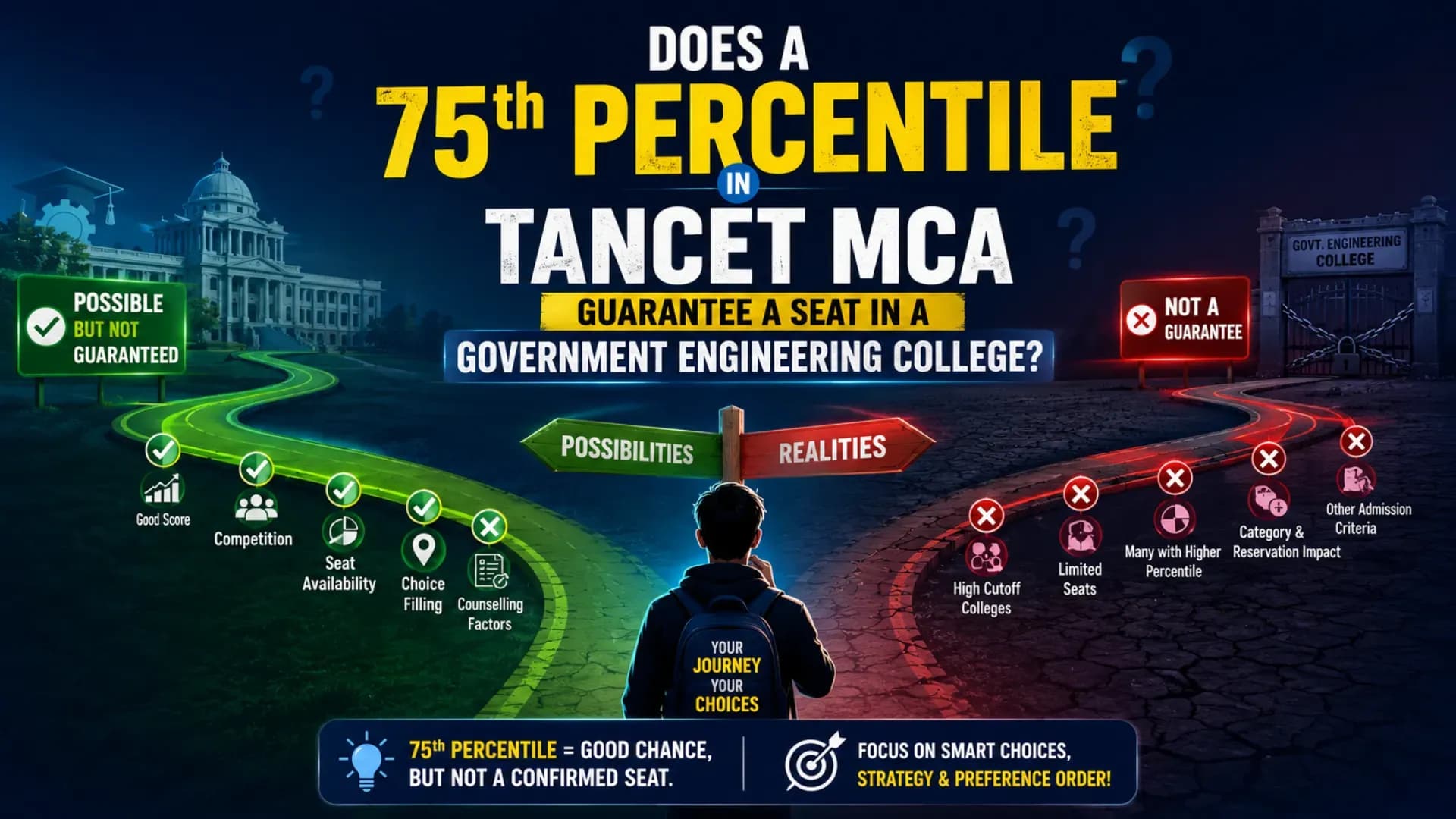
Many of the most desirable courses after Class 12 are gated by highly competitive entrance exams after 12th. Realistic self-assessment of your competitive position — based on mock test performance, coaching feedback, and honest comparison with the score ranges required for your target institutions — is essential to building a student career planning framework that includes both aspirational and realistic options. A plan that has only one outcome scenario is not a plan — it is a bet.
Step 4: Build a Tiered Option List
The most practically useful output of any student career planning process is a tiered option list: 2 to 3 aspirational programme-institution combinations (your first choices if results and admissions align perfectly), 3 to 4 realistic combinations (strong programmes at strong institutions where your profile is genuinely competitive), and 2 to 3 backup combinations (good programmes at accessible institutions that provide a solid foundation for the next step). This tiered structure is what separates effective career counseling students guidance from the paralysis of either over-ambition or under-aspiration.
Career Counseling for Students — What It Actually Involves
The term career counseling students describes a process that, at its best, is systematic, data-informed, and deeply personalised — and at its worst, is a superficial interest-test-plus-generic-recommendation exercise that produces more confusion than clarity. Understanding what effective career counseling students guidance actually involves helps you seek better inputs and make better use of the advice available to you.
Step 1: What Good Career Counseling Actually Does
Effective career counseling students guidance does three things that generic advice fails to do: it surfaces the specific intersection of your demonstrated capabilities, your authentic interests, and the actual career landscape for specific programmes — rather than matching interest test outputs to pre-built career category lists. It tests your assumptions about specific careers against real data — what professionals in those careers actually do, how they actually got there, and what the day-to-day and year-by-year reality of those pathways involves. And it helps you build a decision framework rather than giving you a decision — because only you have the full information needed to make the choice that is right for your specific situation.
Step 2: Where to Access Genuine Career Guidance
The best sources of genuine career counseling students guidance in 2026 include: working professionals in target fields who are willing to speak honestly about their career trajectories (LinkedIn cold outreach to alumni of your school or target university is remarkably effective); verified college review platforms that aggregate real student and graduate experiences; and evidence-based career assessment tools that measure aptitude rather than interest alone. College Nirnay's career after 12th 2026 resources, programme comparison tools, and student review database are built specifically to support this kind of informed, evidence-based student career planning.
Step 3: Questions Every Student Should Ask Before Deciding
- What do graduates of this specific programme at this specific institution do 3 years after graduation — and is that a future I want?
- What entrance exams after 12th does this pathway require, and is my preparation realistically competitive for the institutions I am targeting?
- What are the most important skills for the future careers 2026 I am interested in — and does this programme actually develop them?
- What is my backup plan if my first-choice admission does not materialise — and is that backup plan something I can pursue with genuine commitment?
- Who do I know — or who can I access — who has actually done what I am planning to do, and what do they wish they had known at my stage?
Explore More
Conclusion
The career after 12th 2026 decision is genuinely consequential — but it is also genuinely navigable. The landscape of courses after Class 12, entrance exams after 12th, and future careers 2026 is more diverse, more data-rich, and more accessible to informed exploration than at any previous point in India's educational history. Whether your path runs through Science career options, the Commerce career guide, or the expanding world of Arts career opportunities — there are excellent options available in 2026 that suit different strengths, temperaments, and ambitions.
What this guide ultimately argues is that the quality of the decision depends far more on the quality of the decision-making process than on the specific option chosen. Good student career planning — informed by honest self-assessment, real labour market data, and genuine career counseling students guidance — produces decisions that hold up under pressure, adapt to changing circumstances, and lead to the kind of education and early career experience that compound positively over time.
Explore all best courses after 12th guides, college comparisons, entrance exam resources, and personalised career counseling students tools on College Nirnay — built specifically to support the most important educational decision you will make in 2026.