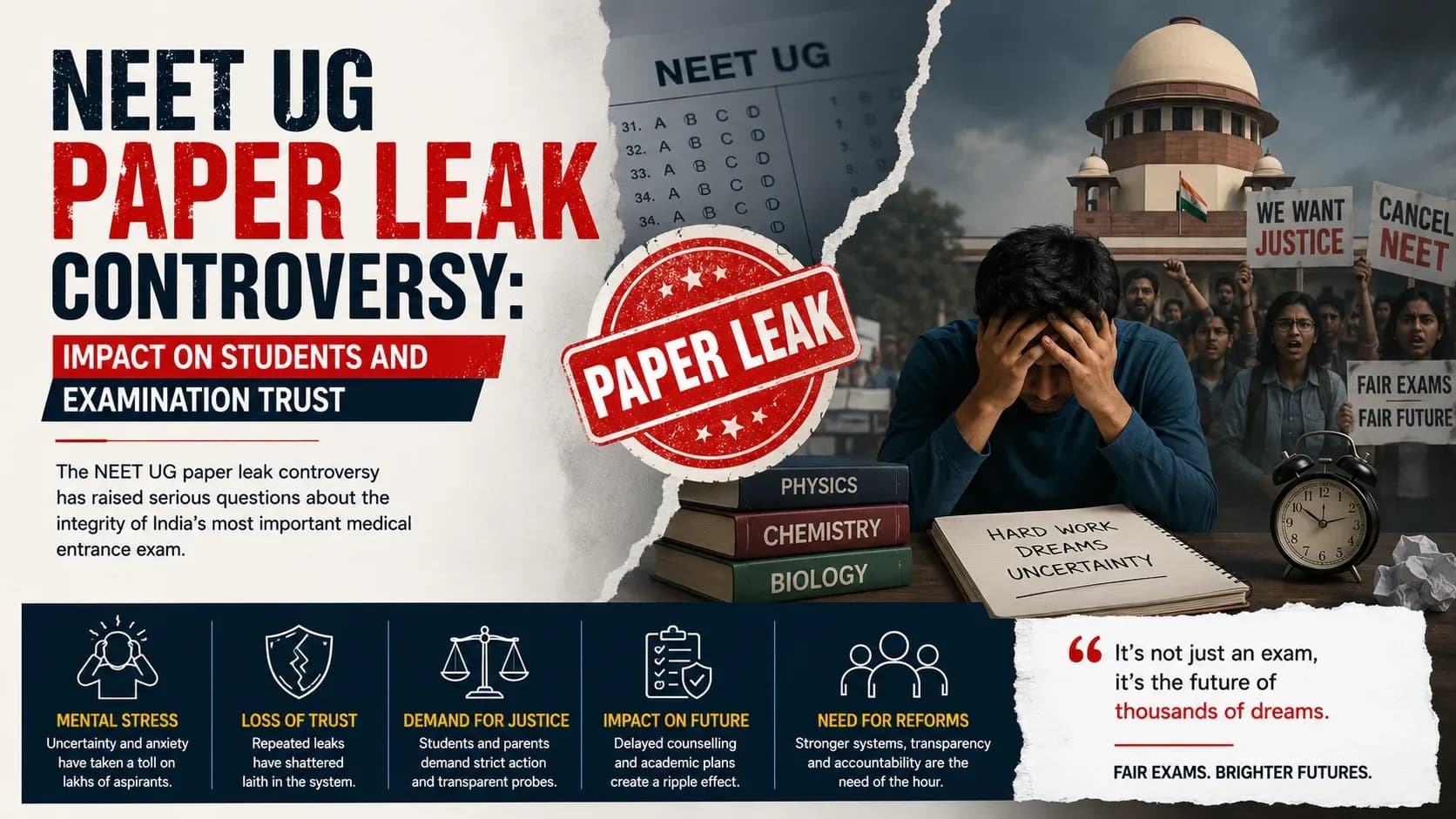
NEET UG Paper Leak Controversy: Impact on Students and Examination Trust
The ongoing NEET UG paper leak controversy has once again triggered nationwide debate around transparency, fairness, and credibility within India’s competitive examination ecosystem. As millions of students continue preparing for high-stakes entrance examinations every year, concerns surrounding competitive exam fairness and institutional accountability are becoming increasingly serious among students, parents, educators, and policymakers alike.
The latest NEET controversy 2026 developments have not only affected admission timelines and examination schedules, but have also deeply influenced student psychology and public confidence in large-scale testing systems. For many aspirants, the issue goes far beyond one examination alone — it raises broader questions related to education system trust, examination integrity, operational transparency, and the future reliability of national entrance assessments.
As ongoing NEET latest news discussions continue dominating public attention, experts are increasingly focusing on the long-term consequences of repeated examination controversies on student mental health, institutional credibility, and public faith in merit-based academic competition. The broader medical entrance controversy surrounding NEET has therefore become one of the most important education discussions in India today.
Table of Contents
- Understanding the NEET UG Paper Leak Controversy
- NEET Student Impact — Psychological and Academic Pressure
- Examination Trust Issues and Public Confidence
- Competitive Exam Fairness Under Scrutiny
- Exam Security Concerns in Large-Scale Testing
- What the Controversy Means for India’s Education System
- Possible Solutions and Reforms
- FAQs
- Conclusion
Understanding the NEET UG Paper Leak Controversy
The recent NEET UG paper leak controversy emerged after allegations surfaced regarding irregularities connected to the conduct of the national medical entrance examination. Reports, investigations, political debates, and public reactions rapidly intensified as concerns regarding examination integrity began dominating national education discussions.
The broader NEET controversy 2026 narrative quickly expanded beyond operational concerns and evolved into a nationwide debate around transparency, accountability, and institutional credibility. Since NEET determines admission into medical programs for lakhs of students every year, any allegation linked to paper leaks or unfair practices immediately creates serious concern regarding competitive exam fairness.
For many students, the ongoing medical entrance controversy has become emotionally exhausting because years of preparation, financial investment, coaching pressure, and personal sacrifice appear vulnerable whenever questions emerge around examination integrity.
NEET Student Impact — Psychological and Academic Pressure
One of the most serious consequences of the NEET UG paper leak issue is the emotional and psychological impact it has created among aspirants. Students preparing for highly competitive examinations already face enormous academic pressure, and controversies surrounding examination credibility often intensify anxiety, uncertainty, and emotional exhaustion.
Major NEET student impact concerns include:
- Loss of confidence — Students begin questioning whether effort alone guarantees fair outcomes
- Emotional exhaustion — Extended uncertainty increases student stress exams related anxiety
- Preparation disruption — Delayed schedules and uncertainty affect study consistency
- Mental health pressure — Repeated controversies contribute to fear and frustration
- Financial burden — Coaching investments and repeated preparation cycles create additional pressure
Experts monitoring NEET student impact trends believe examination controversies affect not only academic outcomes, but also long-term student confidence in the fairness of institutional systems.
Related Article: How Competitive Careers Affect Student Mental Health
Examination Trust Issues and Public Confidence
The ongoing NEET controversy 2026 has significantly intensified public discussion surrounding examination trust issues across India’s competitive testing ecosystem. Since entrance examinations determine access to prestigious academic and professional pathways, students and parents expect these systems to operate with complete fairness and transparency.
Whenever controversies involving leaks, irregularities, or administrative failures emerge, the broader education system trust framework begins weakening. Public confidence in merit-based evaluation systems depends heavily on the belief that all students are competing under equal and secure conditions.
Experts following the latest NEET latest news developments believe repeated examination controversies may gradually create long-term scepticism toward national testing systems unless stronger transparency and accountability measures are implemented consistently.
Competitive Exam Fairness Under Scrutiny
The NEET UG paper leak controversy has once again brought the issue of competitive exam fairness into the national spotlight. For students investing years of disciplined preparation into highly competitive examinations, fairness represents the foundational principle of the entire system.
Educational experts argue that the legitimacy of national entrance systems depends not only on difficulty level or syllabus quality, but also on operational credibility and secure examination management. Whenever irregularities emerge, students begin questioning whether honest preparation alone remains sufficient in high-pressure academic environments.
The broader medical entrance controversy surrounding NEET therefore reflects deeper concerns about maintaining equal opportunity and protecting merit-based selection systems in India’s rapidly expanding education ecosystem.
Exam Security Concerns in Large-Scale Testing
The ongoing NEET UG paper leak controversy has intensified nationwide discussion regarding exam security concerns associated with large-scale entrance examinations. Conducting national-level assessments involving millions of students requires highly coordinated systems covering paper transportation, digital infrastructure, invigilation protocols, centre management, cybersecurity, and operational monitoring.
Experts tracking the latest NEET controversy 2026 developments believe modern competitive examinations now face increasingly complex challenges because technological misuse, organised fraud networks, communication leaks, and operational loopholes can potentially compromise examination integrity if monitoring systems remain weak.
Major exam security concerns discussed publicly include:
- Secure transportation and storage of examination papers
- Digital surveillance and cyber monitoring systems
- Biometric verification and identity authentication
- Real-time examination centre supervision
- Coordination between state authorities and examination agencies
- Prevention of organised cheating networks
- Operational transparency and accountability systems
The broader medical entrance controversy has therefore created renewed pressure on examination authorities to strengthen operational safeguards and improve public confidence in national testing systems.
What the Controversy Means for India’s Education System
The larger significance of the NEET UG paper leak controversy extends beyond a single examination cycle. Experts believe the issue has evolved into a broader discussion about institutional transparency, governance standards, accountability mechanisms, and long-term education system trust across India.
National entrance examinations influence millions of students every year and directly shape professional opportunities in medicine, engineering, management, law, and public service. As a result, controversies surrounding competitive exam fairness affect not only admissions but also public perception of merit-based opportunity itself.
Educational analysts monitoring NEET latest news discussions believe maintaining institutional credibility is now becoming as important as conducting examinations themselves. Without strong public confidence, repeated controversies could gradually weaken student trust in centralised testing systems.
Possible Solutions and Reforms
The ongoing NEET controversy 2026 has triggered increasing discussion regarding structural reforms that could strengthen examination integrity and restore public confidence in national testing systems. Experts believe both technological upgrades and institutional reforms may be necessary to address long-term exam security concerns.
Commonly discussed reform measures include:
- Advanced digital encryption for examination paper management
- AI-powered monitoring and suspicious activity detection systems
- Stronger biometric verification during examinations
- Increased transparency in examination logistics
- Faster investigation mechanisms for irregularities
- Independent audit systems for examination operations
- Improved student communication and crisis management protocols
Experts also believe rebuilding education system trust requires more than operational changes alone. Transparent communication, accountability, and timely action remain equally important in restoring public confidence after large-scale controversies.
The larger goal, according to many education analysts, should be protecting both institutional credibility and the emotional well-being of students affected by repeated examination uncertainty.
Expert Analysis
Education experts believe the NEET UG paper leak issue represents one of the most significant examination credibility challenges India has faced in recent years because of the enormous number of students involved and the central role NEET plays in medical admissions nationwide.
Analysts studying examination trust issues believe the controversy has exposed deeper structural concerns involving operational oversight, security infrastructure, crisis management, and communication systems. The broader medical entrance controversy has therefore become a national conversation about maintaining fairness and accountability in large-scale education systems.
Experts additionally warn that repeated controversies can intensify student stress exams related mental pressure unless authorities actively prioritise transparency, student welfare, and institutional trust restoration measures moving forward.
Stop Stressing. Start Applying.
Skip the chaos of filling endless forms. Apply to your dream colleges in one go through the College Nirnay Common Application Form — built for every student navigating India's competitive education landscape.
Fill the Common Application Form →✓ Free to apply · ✓ Takes under 5 minutes · ✓ Trusted by thousands of students
FAQs
What is the NEET UG paper leak controversy about?
The NEET UG paper leak controversy involves allegations of examination irregularities and security breaches connected to the conduct of the national medical entrance examination.
Why has the NEET controversy 2026 become such a major issue?
The NEET controversy 2026 has become significant because NEET directly affects medical admissions for lakhs of students and raises broader concerns regarding competitive exam fairness and institutional credibility.
How does examination controversy affect students psychologically?
Examination controversies often increase anxiety, uncertainty, frustration, and student stress exams related emotional pressure among aspirants who invest years preparing for competitive entrance tests.
Why are exam security concerns becoming more serious today?
Growing technological misuse, operational complexity, and large-scale testing systems have increased exam security concerns surrounding national entrance examinations across India.
How can education system trust be restored after controversies?
Experts believe restoring education system trust requires stronger transparency, improved security infrastructure, operational accountability, faster investigations, and better communication with students and parents.
Explore More
Conclusion
The ongoing NEET UG paper leak controversy has evolved into far more than a temporary examination dispute. It has become a national discussion surrounding competitive exam fairness, institutional accountability, operational transparency, and the future credibility of India’s entrance examination systems.
For students, the issue highlights the emotional and psychological burden created when years of preparation become overshadowed by uncertainty and examination trust issues. For institutions, it reinforces the urgent need for stronger security systems, transparent communication, and long-term reforms capable of restoring public confidence.
As the broader medical entrance controversy continues shaping public debate, the future of education system trust may ultimately depend on how effectively authorities balance accountability, fairness, technology, and student welfare in the years ahead.