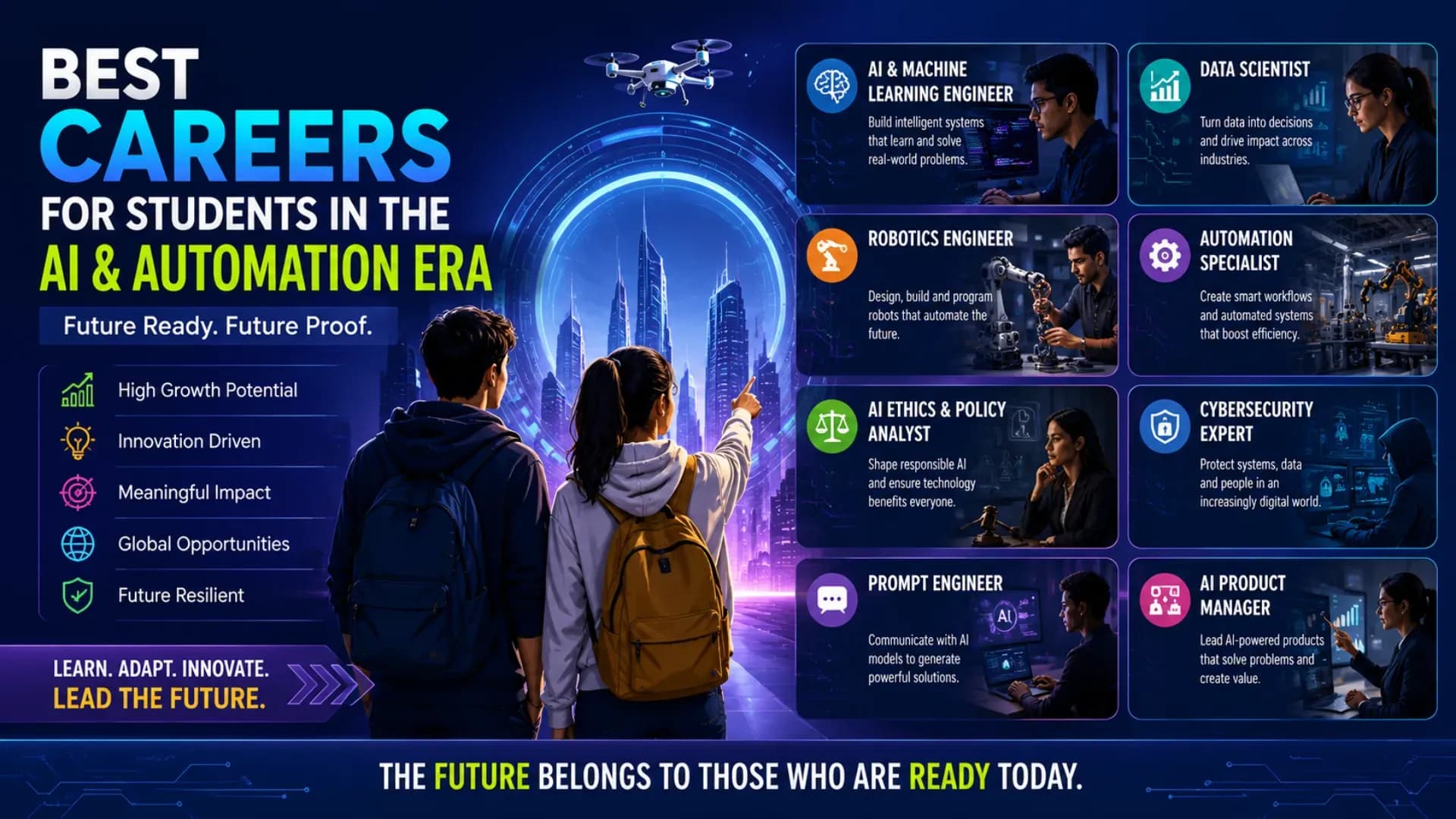
Best Careers for Students in the AI & Automation Era
The world of work is being restructured faster than at any point in modern history. Artificial intelligence and automation are not approaching — they are already here, already reshaping industries, already eliminating certain roles while simultaneously creating entirely new categories of work that did not exist five years ago. For students entering the job market in 2026 and beyond, the single most important career question is not "what job can I get?" — it is "which careers will still matter, grow, and pay well in an AI-transformed economy?" Understanding the landscape of AI era careers is no longer a niche concern. It is a survival skill.
The distinction between automation jobs future (roles that will be disrupted or displaced by automation) and AI and automation careers (roles that leverage AI as a tool and grow because of it) is the most consequential career navigation framework available to students in 2026. Future-proof careers are not the ones that ignore AI — they are the ones that integrate, direct, and add uniquely human value alongside it. This article maps out those careers in detail, covering the high demand jobs 2026 that are growing precisely because of the AI era, not despite it.
This is the most comprehensive guide to best careers for students navigating the AI and automation landscape available in 2026 — covering the emerging careers 2026 with the strongest growth trajectories, the skills that define them, the institutions offering pathways into them, and the honest assessment of what careers after AI disruption will actually look like for Indian students entering a rapidly transformed professional world.
Related Article: Top BTech (Bachelor of Technology) Colleges in India: Fees, Admission & Ranking 2026
Table of Contents
- Understanding the AI & Automation Career Landscape
- Career 1: AI & Machine Learning Engineering
- Career 2: Data Science & AI Analytics
- Career 3: Prompt Engineering & AI Product Management
- Career 4: Cybersecurity in the AI Era
- Career 5: Human-Centred Design & UX for AI Systems
- Career 6: AI Ethics, Policy & Governance
- Career 7: Healthcare AI & Biotech Innovation
- Career 8: Robotics & Automation Engineering
- Core Skills Every Future-Proof Career Requires
- FAQs
Understanding the AI & Automation Career Landscape
Before identifying specific best careers 2026, it is essential to understand the structural logic of how AI and automation are reshaping work — because this logic determines which careers will grow and which will contract. The automation jobs future research consistently shows that it is not entire professions that disappear — it is specific tasks within professions. Careers that consist primarily of repetitive, rule-based, high-volume tasks are most vulnerable to displacement. Careers that require complex judgement, emotional intelligence, creative synthesis, physical dexterity in unpredictable environments, or the direction and interpretation of AI systems are growing.
The three categories of AI era careers that define the 2026 landscape:
- AI-building careers — Roles that create, train, and maintain AI systems (ML engineers, data scientists, AI researchers) — the highest technical demand and compensation in the entire high demand jobs 2026 landscape
- AI-directing careers — Roles that apply AI to specific domain problems and manage its outputs (AI product managers, prompt engineers, AI ethics specialists) — the fastest growing category of emerging careers 2026 globally
- AI-augmented careers — Roles where human expertise is amplified by AI tools (AI-assisted healthcare, AI-assisted legal work, AI-assisted design) — the largest category of future-proof careers in terms of total employment, covering most established professions in their evolved forms
Students who understand this framework are positioned to make career choices that are genuinely forward-looking rather than inadvertently backward-looking. The best careers for students in the AI era are not necessarily the most technical — they are the ones that position the student at the intersection of human capability and AI power, where the work produced exceeds what either humans or machines could achieve independently.
Career 1: AI & Machine Learning Engineering — The Highest-Demand Technical Role
AI and Machine Learning Engineering sits at the absolute apex of high demand jobs 2026 — and is projected to remain there for the next decade at minimum. These professionals build, train, evaluate, and deploy the AI models that power everything from healthcare diagnostics and financial fraud detection to recommendation engines and autonomous vehicles. In India specifically, the demand for ML engineers across fintech, healthtech, e-commerce, and IT services is growing at a rate that significantly outpaces the supply of qualified talent.
Skills & Pathways
Core skills include Python, TensorFlow, PyTorch, statistical mathematics, linear algebra, and cloud platforms (AWS, GCP, Azure). BTech in Computer Science or AI/ML from IITs, NITs, and premier private colleges provides the strongest foundation. MTech in AI/ML or a specialised postgraduate programme significantly improves placement outcomes. This is the most directly technical of all AI and automation careers — and commands the highest starting salaries, with IIT graduates in ML roles regularly receiving packages of ₹15 lakh to ₹50 lakh+ per annum.
Why This Is a Future-Proof Career
ML engineers are the architects of the AI systems that are reshaping every other industry — making this the most structurally secure of all future-proof careers in the technology space. The irony is that AI engineers are among the least replaceable by AI precisely because building and improving AI systems requires the kind of creative, contextual, and adaptive intelligence that current AI cannot replicate. Careers after AI disruption are led by the people who built and are continuing to build the AI systems doing the disrupting.
Career 2: Data Science & AI Analytics — Turning Data into Decisions
Data Science sits alongside ML engineering as one of the most consistently in-demand AI era careers — but with a broader accessibility profile. While ML engineering skews heavily toward computer science graduates, data science draws meaningfully from statistics, economics, mathematics, and even social science backgrounds. In the AI era, every industry generates exponentially more data than it can interpret — and data scientists are the professionals who bridge this gap between raw information and actionable intelligence.
Skills & Pathways
Core skills include Python, R, SQL, Tableau, Power BI, statistical modelling, and increasingly, proficiency with AI-powered analytics tools like AutoML and Copilot for data. Undergraduate pathways include BSc Statistics, BTech CS, B.Math, or BA Economics — all of which provide viable entry points with the right supplementary skill development. Certifications from IIM Calcutta's Business Analytics programme, Google Data Analytics, and IBM Data Science Professional Certificate are strong credentialing options that significantly improve employability in high demand jobs 2026 across banking, FMCG, healthcare, and technology.
India-Specific Demand
India's digital economy — projected to reach $1 trillion by 2030 — is generating data at unprecedented scale, and the demand for professionals who can extract meaningful business intelligence from this data is among the strongest of all emerging careers 2026. Mid-level data scientists in India earn ₹8 lakh to ₹20 lakh per annum, with senior roles at leading technology companies reaching ₹30 lakh to ₹50 lakh — making this one of the most financially rewarding best careers for students with quantitative backgrounds.
Career 3: Prompt Engineering & AI Product Management — The New Creative-Technical Frontier
Prompt engineering and AI product management are the most characteristically new of all emerging careers 2026 — roles that simply did not exist in their current form before the generative AI revolution. Prompt engineers design, optimise, and systematise the instructions given to large language models to produce specific, reliable, high-quality outputs across legal, medical, educational, creative, and technical contexts. AI product managers bridge the gap between the capabilities of AI systems and the specific problems that businesses and users need them to solve.
Why These Are Among the Best AI Era Careers
Both roles are accessible to students from diverse backgrounds — prompt engineering rewards deep domain expertise (a lawyer who can prompt AI legal tools, a doctor who can direct medical AI systems) as much as it does technical skill. AI product management rewards business acumen, communication skills, and user-centred thinking alongside technical literacy. These AI and automation careers are particularly valuable because they sit at the human-AI interface — the boundary where the quality of human direction determines the quality of AI output — making them among the most reliably future-proof careers in the near to medium term.
Compensation & Growth
Prompt engineers at major technology companies globally earn $100,000 to $300,000 per annum — one of the strongest compensation profiles of any best careers 2026. In India, the role is nascent but growing rapidly, with AI-focused product managers at leading startups and technology firms earning ₹15 lakh to ₹40 lakh per annum depending on experience and specialisation. These are the roles most directly created by AI — the truest expression of what careers after AI transformation looks like.
Career 4: Cybersecurity in the AI Era — Protecting the Digital World
Cybersecurity is one of the most robustly future-proof careers in the AI era precisely because AI has dramatically increased both the sophistication of cyber threats and the complexity of the systems that need protecting. As organisations deploy more AI systems across critical infrastructure, healthcare, finance, and government, the attack surface for malicious actors expands proportionally — creating insatiable and growing demand for cybersecurity professionals who understand both traditional security principles and the specific vulnerabilities of AI systems.
Skills & Specialisations
Core cybersecurity skills include network security, penetration testing, cryptography, incident response, and cloud security. AI-era cybersecurity specialists also need proficiency with AI-powered threat detection systems, adversarial ML (understanding how AI can be manipulated), and the specific vulnerabilities of LLMs and generative AI deployments. Certifications like CEH, CISSP, CompTIA Security+, and OSCP are the primary credentialing pathways for AI and automation careers in this space. Starting salaries in India range from ₹5 lakh to ₹12 lakh per annum for entry-level roles, with senior cybersecurity architects earning ₹25 lakh to ₹50 lakh — placing this among the high demand jobs 2026 with the most consistent salary growth trajectory.
Career 5: Human-Centred Design & UX for AI Systems — Making AI Usable
As AI systems become embedded in every product that humans interact with — from healthcare apps and educational platforms to banking interfaces and autonomous vehicles — the demand for designers who can make these systems intuitive, ethical, and genuinely useful has become one of the most consistent signals in the high demand jobs 2026 data. Human-centred design and UX for AI is not just conventional UX applied to new technology — it is a distinct discipline that requires understanding of how human-AI interaction differs from human-computer interaction and what new design principles apply.
Why This Is Among the Best Careers for Students in 2026
This career is accessible from design, psychology, cognitive science, and even communication backgrounds — making it one of the most broadly accessible of all AI era careers for students from non-engineering streams. The role requires a combination of design thinking, psychological insight into human-AI trust, and technical literacy about what AI systems can and cannot do — a combination that is both rare and in increasing demand. Senior UX researchers and interaction designers specialising in AI interfaces earn ₹12 lakh to ₹30 lakh per annum in India, with global roles commanding significantly higher compensation. This is firmly one of the most creative and rewarding future-proof careers in the AI era.
Career 6: AI Ethics, Policy & Governance — The Conscience of the AI Era
AI ethics and policy is one of the most genuinely new categories of emerging careers 2026 — and one of the most consequential. As AI systems make increasingly consequential decisions in healthcare, criminal justice, hiring, lending, and public services, the need for professionals who can identify, analyse, and address the ethical, legal, and societal implications of these systems has become urgent at every level — from individual companies to national governments and international regulatory bodies.
Who This Career Is For
AI ethics is one of the most explicitly interdisciplinary of all AI and automation careers — drawing from philosophy, law, public policy, sociology, computer science, and organisational behaviour. Students from humanities and social science backgrounds who develop technical literacy in AI systems are particularly well-positioned for this field. Roles include AI Ethics Officer, Algorithm Auditor, AI Policy Analyst, and Responsible AI Lead — positions that are being created at technology companies, government agencies, academic institutions, and international organisations at a pace that currently significantly outstrips the supply of qualified candidates. This makes AI ethics and governance one of the most strategically advantageous best careers 2026 for students who combine social science training with genuine technical curiosity about how AI systems work.
Career 7: Healthcare AI & Biotech Innovation — Where AI Meets Human Health
Healthcare is arguably the sector where AI is producing the most profound and consequential transformation — and simultaneously where the demand for professionals who can navigate the intersection of clinical knowledge, AI capability, and regulatory complexity is growing fastest. Healthcare AI encompasses medical imaging analysis, drug discovery acceleration, genomics interpretation, clinical decision support, remote patient monitoring, and the development of AI-powered diagnostics — all of which represent automation jobs future in the sense of automating specific clinical tasks while creating new roles for professionals who direct, validate, and improve these systems.
Career Pathways & Demand in India
Pathways into healthcare AI careers include MBBS or BAMS combined with a postgraduate specialisation in health informatics or biomedical AI, BTech Biomedical Engineering, BSc Bioinformatics with computational biology training, or BSc Life Sciences with data science certification. India's healthtech sector — valued at over $10 billion and growing rapidly — is among the largest generators of AI era careers outside of pure technology. Bioinformaticians, clinical AI specialists, and healthcare data scientists in India earn ₹8 lakh to ₹20 lakh at entry to mid-levels, with research-oriented roles and global opportunities significantly expanding the ceiling. Healthcare AI is among the most purposeful of all future-proof careers — combining financial security with genuine societal impact.
Career 8: Robotics & Automation Engineering — Building the Physical AI World
Robotics and automation engineering is the physical expression of the AI era — translating the intelligence of AI systems into machines that act in the world. From industrial manufacturing robots and surgical assistants to delivery drones, autonomous vehicles, and agricultural automation, robotics engineers design, build, programme, and maintain the physical systems that are increasingly performing tasks previously done by humans. In India specifically, the government's push toward advanced manufacturing, defence technology, and agricultural modernisation has created significant and growing demand for robotics engineering talent.
Skills, Pathways & Salary
Core skills include mechanical engineering fundamentals, embedded systems programming, computer vision, ROS (Robot Operating System), control systems, and sensor integration. BTech in Mechanical, Electronics, or Mechatronics Engineering provides the strongest undergraduate foundation, with specialised postgraduate programmes in robotics available at IITs, IISc, and several premier private engineering colleges. Starting salaries for robotics engineers in India range from ₹5 lakh to ₹10 lakh per annum, with experienced professionals at leading manufacturing, defence, and space technology organisations earning ₹15 lakh to ₹35 lakh — making this one of the most financially solid high demand jobs 2026 within the engineering disciplines most directly aligned with the AI and automation careers landscape.
Core Skills Every Future-Proof Career Requires
Across all eight AI era careers covered in this article, a consistent set of transferable skills distinguishes professionals who thrive from those who struggle in the AI-transformed economy. These skills are not specific to any single career — they are the foundational competencies that make any career genuinely future-proof in an era where the specific technical requirements of roles change faster than educational curricula can track.
The non-negotiable skills for best careers in 2026 and beyond:
- AI Literacy — Understanding what AI systems can and cannot do, how to evaluate their outputs critically, and how to use AI tools productively in your specific domain; this is the baseline competency that all future-proof careers now require regardless of technical specialisation
- Data Fluency — The ability to read, interpret, and communicate with data — even without deep statistical expertise — is increasingly a prerequisite for credibility and effectiveness across all high demand jobs 2026 in every sector
- Critical Thinking & Complex Problem-Solving — The cognitive skills most resistant to automation — the capacity to identify the right problem, evaluate evidence, consider multiple perspectives, and arrive at non-obvious solutions — are the primary source of human competitive advantage in careers after AI transformation
- Communication & Collaboration — The ability to communicate complex ideas clearly across different audiences — technical and non-technical — and to collaborate effectively in interdisciplinary teams is consistently identified as a top deficit in the AI era job market and a primary differentiator among best careers for students who succeed early
- Continuous Learning Orientation — Perhaps the most important single competency for all AI and automation careers — the genuine commitment to continuously updating knowledge and skills in a field that is changing faster than any educational institution can track; the professionals who succeed in emerging careers 2026 treat learning as a permanent professional practice, not a phase that ends at graduation
Stop Stressing. Start Applying.
Skip the chaos of filling endless forms. Apply to your dream colleges in one go through the College Nirnay Common Application Form — built for every student navigating India's competitive education landscape.
Fill the Common Application Form →✓ Free to apply · ✓ Takes under 5 minutes · ✓ Trusted by thousands of students
FAQs
What are the best careers for students in the AI era in 2026?
The best careers for students in the AI era include AI and Machine Learning Engineering, Data Science and AI Analytics, Prompt Engineering and AI Product Management, Cybersecurity in the AI Era, Human-Centred Design for AI, AI Ethics and Policy, Healthcare AI and Biotech, and Robotics and Automation Engineering. All of these are among the strongest high demand jobs 2026 with robust growth trajectories, strong compensation profiles, and genuine future-proof characteristics in an AI-transformed economy.
Which careers will survive automation and AI disruption?
Future-proof careers in the automation jobs future are those that leverage human capabilities that AI cannot replicate — complex judgement, creative synthesis, emotional intelligence, physical adaptability in unpredictable environments, and the direction of AI systems themselves. Careers after AI disruption are defined not by resistance to technology but by integration with it — the most resilient professionals in every field are those who use AI as a powerful tool while contributing uniquely human value that AI augments rather than replaces.
What are the emerging careers in 2026 created by AI?
The most distinctively new emerging careers 2026 that have been directly created by AI include Prompt Engineer, AI Ethics Officer, Algorithm Auditor, AI Product Manager, LLM Fine-Tuning Specialist, AI Safety Researcher, and Conversational AI Designer. These roles represent the leading edge of AI and automation careers — positions that are growing rapidly from a small base and offer exceptional opportunity for students who develop relevant skills now, before the competition for these roles intensifies significantly.
Do all AI era careers require engineering or coding skills?
No — many of the strongest AI era careers do not require deep engineering or coding skills. AI Ethics and Policy, AI Product Management, Healthcare AI (clinical roles), Human-Centred Design for AI, and domain-specific prompt engineering all reward non-technical backgrounds combined with AI literacy. The best careers 2026 in the AI space span a wide range of skill profiles — the common requirement is not coding expertise but genuine understanding of how AI systems work, what they can and cannot do, and how to apply or evaluate them effectively in a specific domain.
What skills should students develop for high demand jobs in 2026?
The core skills for high demand jobs 2026 across all AI and automation careers include AI literacy (understanding AI capabilities and limitations), data fluency (ability to work with and communicate about data), critical thinking and complex problem-solving, communication and interdisciplinary collaboration, and a continuous learning orientation that treats skill development as a permanent professional practice. These transferable competencies complement technical specialisations and are consistently identified as the primary differentiators among high performers across all best careers for students in the AI era.
Explore More
Conclusion
The AI and automation careers landscape of 2026 is not a threat to students who understand it — it is one of the greatest expansions of professional opportunity in modern history. The eight best careers for students in the AI era explored in this article — from ML engineering and data science to AI ethics and healthcare AI — represent the sectors where the combination of technological demand, skills shortage, and sustained growth is creating exceptional conditions for students who choose well and invest seriously in their development.
The key insight that unifies all future-proof careers in this era is simple: the professionals who will thrive are not those who compete with AI but those who direct, augment, and add uniquely human value alongside it. Careers after AI disruption belong to people who are genuinely curious about AI, willing to continuously update their skills, and clear about the specifically human contributions they bring to a world where the machines are getting smarter every day. The best careers 2026 are not the ones that ignore this reality — they are the ones that are built squarely on top of it.