
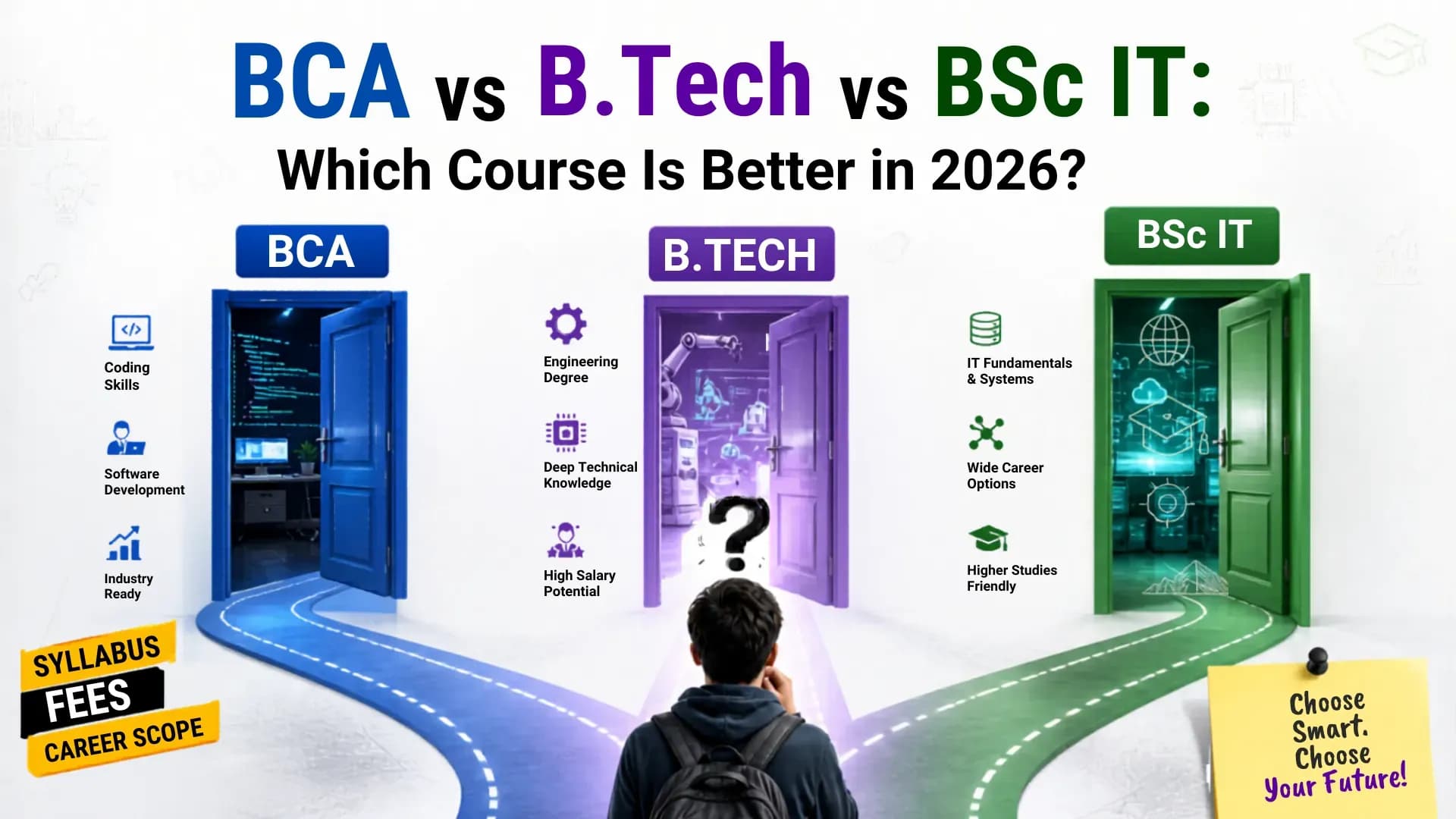
BCA vs BTech vs BSc IT: Which Course Is Better in 2026?
For students who have just completed Class 12 and are passionate about technology, one of the most common and consequential decisions they face is choosing between the three most popular undergraduate IT programmes in India. The debate around BCA vs BTech vs BSc IT is more active than ever in 2026, and for good reason — each course leads to a distinct career trajectory, offers a different academic experience, and comes with a very different set of costs, entry requirements, and long-term opportunities.
Understanding the full picture of IT career options after 12th means going beyond the surface-level comparison of degree names. It means evaluating salary expectations, industry recognition, scope for higher studies, and the quality of practical training each programme provides. The BCA vs BTech salary India gap, for instance, is a key factor for many families — but it is only one part of a much more nuanced decision that also includes BSc IT scope India and individual academic strengths.
This article provides the most comprehensive and up-to-date computer courses comparison India for 2026 — covering all three programmes in detail, analysing the best IT course after 12th for different student profiles, and giving you the specific insights you need to make a confident, well-informed decision about your technology career path.
Related Article: Top BTech (Bachelor of Technology) Colleges in India: Fees, Admission & Ranking 2026
Table of Contents
BCA vs BTech vs BSc IT — A Quick Overview
Before diving deep into the BCA vs BTech vs BSc IT comparison, it helps to understand the fundamental positioning of each course. All three are undergraduate programmes that prepare students for IT career options after 12th, but they differ significantly in their academic structure, depth of technical training, entry requirements, and industry perception. Understanding these differences is the foundation of a smart computer courses comparison India exercise.
At a glance — how the three programmes compare:
- BCA (Bachelor of Computer Applications) — A 3-year programme focused on software development, programming, and application design; accessible without Mathematics in Class 12 at many universities; strong pathway to MCA
- BTech in Computer Science or IT — A 4-year engineering degree with deep technical training in both hardware and software; requires Mathematics and Physics in Class 12; most industry-recognised qualification in the BCA vs BTech vs BSc IT spectrum
- BSc IT (Bachelor of Science in Information Technology) — A 3-year science-based programme covering IT fundamentals, networking, and systems; accessible and affordable; the BSc IT scope India is strong for students targeting IT support, systems administration, and further specialisation
Each programme leads to legitimate and rewarding IT career options after 12th — the key is understanding which one aligns with your academic background, career goals, and financial situation. The following sections break down each course individually before arriving at the final computer courses comparison India and a clear recommendation matrix.
BCA — Bachelor of Computer Applications: Flexible, Fast, and Application-Focused
BCA is one of the most popular IT career options after 12th for students who are passionate about software development and application building but either did not study Mathematics in Class 12 or are looking for a shorter, more affordable path into the IT industry. In the BCA vs BTech vs BSc IT comparison, BCA occupies the sweet spot between accessibility and technical depth.
Step 1: Programme Structure & Curriculum
The three-year BCA curriculum covers programming languages (C, C++, Java, Python), database management, web development, software engineering, and computer networks. Top universities like Delhi University, Christ University, Symbiosis University, and Manipal University offer BCA programmes with strong industry-aligned curricula and placement support. This makes BCA one of the most practically oriented options in the entire computer courses comparison India landscape.
Step 2: Admission Eligibility
BCA admission at most universities requires only Class 12 pass — with or without Mathematics, depending on the institution. This makes it one of the most accessible IT career options after 12th for students from commerce and arts backgrounds who want to transition into technology careers without the engineering entrance exam route.
Step 3: Career Scope & Higher Studies
BCA graduates access roles in software development, web development, mobile app development, and IT support. The most important advantage of BCA in the BCA vs BTech vs BSc IT debate is the clear postgraduate pathway — MCA (Master of Computer Applications) — which has seen significantly upgraded industry recognition after IIT Bombay and other top institutes introduced their MCA programmes. BCA + MCA together often produce outcomes comparable to BTech in terms of IT career options after 12th.
Step 4: Fees
BCA fees range from ₹30,000 to ₹1.5 lakh per annum at government and mid-tier colleges, and ₹1.5 lakh to ₹3 lakh per annum at premium private universities — making it significantly more affordable than BTech in the overall BCA vs BTech salary India cost-benefit equation.
BTech Computer Science — The Engineering Route: Maximum Industry Recognition
BTech in Computer Science or Information Technology remains the most prestigious and widely recognised qualification in the BCA vs BTech vs BSc IT comparison. For students who have studied PCM (Physics, Chemistry, Mathematics) in Class 12 and are targeting top technology companies, IITs, NITs, and premier private engineering colleges, BTech CS is the strongest and most future-proof choice among all IT career options after 12th.
Step 1: Programme Structure & Depth
The four-year BTech curriculum covers data structures, algorithms, operating systems, computer architecture, machine learning, artificial intelligence, cloud computing, and advanced mathematics. The depth of technical training in BTech is significantly greater than in BCA or BSc IT — and this difference directly reflects in the BCA vs BTech salary India gap, particularly at the entry level and at top-tier technology companies.
Step 2: Admission & Competition
BTech admission at top institutions requires JEE Main or JEE Advanced scores, alongside strong Class 12 PCM performance. State-level engineering entrance exams provide access to state government colleges. This competitive entry process is the primary differentiator in the computer courses comparison India — students who clear JEE and secure admission to an NIT or IIT enter a significantly different league of placement outcomes than BCA or BSc IT graduates.
Step 3: Career Scope & Placements
BTech CS graduates from top institutions access roles at FAANG companies, leading Indian unicorns, and top IT services firms at packages ranging from ₹8 lakh to ₹50 lakh+ per annum at the fresher level — making it the clear leader in the BCA vs BTech salary India comparison. The BTech tag also opens doors to MTech, MS abroad, and MBA programmes at the highest tier of Indian and global institutions.
Step 4: Fees
BTech fees range from ₹1 lakh to ₹1.5 lakh per annum at IITs and NITs, to ₹3 lakh to ₹8 lakh per annum at premium private engineering colleges — making total programme costs range from ₹4 lakh to ₹32 lakh, significantly higher than BCA or BSc IT in the overall computer courses comparison India cost structure.
BSc IT — Bachelor of Science in Information Technology: Affordable, Accessible, Versatile
BSc IT is the most underrated option in the BCA vs BTech vs BSc IT debate. While it does not carry the engineering prestige of BTech or the application development focus of BCA, the BSc IT scope India has expanded significantly in recent years — particularly in the areas of networking, cloud computing, cybersecurity, and IT infrastructure management. For students who want a science-backed IT degree at a reasonable cost, BSc IT is a genuinely strong choice.
Step 1: Programme Structure
The three-year BSc IT curriculum typically covers programming fundamentals, database systems, networking, operating systems, web technologies, and IT project management. Unlike BCA's application-development focus, BSc IT places greater emphasis on IT infrastructure and systems — making graduates particularly well-suited for roles in network administration, systems analysis, and cloud operations as part of the broader IT career options after 12th ecosystem.
Step 2: BSc IT Scope India — Industry Demand
The BSc IT scope India is particularly strong in IT services companies, banking technology divisions, government IT projects, and the rapidly growing cybersecurity sector. BSc IT graduates with strong certifications in areas like CompTIA, AWS, or Cisco Networking (CCNA) consistently land competitive roles. In the computer courses comparison India, BSc IT represents the most affordable pathway to a technology career with the broadest range of further specialisation options.
Step 3: Higher Studies & Certifications
BSc IT graduates can pursue MSc IT, MCA, MBA in IT Management, or industry certifications that directly boost their market value. The combination of a BSc IT degree with two or three strong professional certifications is a well-established route to IT career options after 12th that produces excellent outcomes — particularly for students who prefer a more structured, systems-oriented career path than the pure software development route of BCA.
Step 4: Fees
BSc IT is the most affordable option in the BCA vs BTech vs BSc IT comparison, with fees ranging from ₹20,000 to ₹80,000 per annum at government colleges and ₹80,000 to ₹2 lakh per annum at private institutions — making it the most financially accessible of all three IT career options after 12th.
BCA vs BTech Salary India — A Realistic 2026 Comparison
The BCA vs BTech salary India comparison is the most frequently searched aspect of this entire debate — and the answer is more nuanced than most guides acknowledge. Salary outcomes depend not just on the degree but on the institution, individual skill level, specialisation, and the quality of practical experience a student brings to the job market.
Realistic 2026 salary benchmarks across all three programmes:
- BTech CS from IIT/NIT — Starting packages of ₹12 lakh to ₹50 lakh+ per annum at top-tier tech companies; average across all BTech CS graduates nationally is ₹6 lakh to ₹10 lakh per annum — the highest starting point in the BCA vs BTech salary India comparison
- BTech CS from Private Engineering College — Starting packages of ₹3.5 lakh to ₹8 lakh per annum depending on institution quality and student skill set; placement rates and company quality vary significantly
- BCA from Premier University (DU, Christ, Symbiosis) — Starting packages of ₹3 lakh to ₹6 lakh per annum; with MCA, outcomes improve to ₹5 lakh to ₹12 lakh; the BCA vs BTech salary India gap narrows significantly with postgraduate qualifications and strong coding skills
- BSc IT from Government/Premier College — Starting packages of ₹2.5 lakh to ₹5 lakh per annum; the BSc IT scope India grows significantly with cloud, networking, and cybersecurity certifications, pushing mid-career salaries to ₹8 lakh to ₹15 lakh
- The skill equaliser — Across all three programmes, students who develop strong coding skills, build a visible GitHub portfolio, and complete relevant internships consistently earn 30 to 50% more than peers with identical degrees but no practical track record — making skill the most powerful variable in the entire BCA vs BTech vs BSc IT salary equation
The BCA vs BTech salary India gap is real at the entry level — particularly at top-tier companies that exclusively recruit from engineering colleges. However, within 3 to 5 years of work experience, skilled BCA and BSc IT graduates with strong portfolios consistently close the gap in mid-market IT roles, making the long-term computer courses comparison India more balanced than the entry-level data alone suggests.
Which Is the Best IT Course After 12th for You?
The honest answer to which is the best IT course after 12th in 2026 is that it depends entirely on your individual profile, goals, and circumstances. The BCA vs BTech vs BSc IT decision should be based on a clear self-assessment rather than peer pressure or generic rankings. Here is a practical decision framework for the computer courses comparison India that most students need:
Choose BTech if:
- You studied PCM in Class 12 and have a strong Mathematics foundation
- You are targeting top-tier tech companies, product firms, or research roles as your long-term goal
- You have secured or are confident of securing admission to an IIT, NIT, or reputable private engineering college — because the institution matters enormously for BTech outcomes in the BCA vs BTech salary India comparison
- You want to keep the MTech, MS abroad, or top MBA options open with maximum credibility
Choose BCA if:
- You did not study Mathematics in Class 12 or are not targeting the engineering entrance exam route
- You are passionate about software development, app building, or web development specifically
- You plan to pursue MCA after graduation — the BCA + MCA combination is one of the most underrated IT career options after 12th in India today
- You want strong technical training at a significantly lower cost than BTech — making BCA the most efficient best IT course after 12th for budget-conscious students
Choose BSc IT if:
- You are interested in IT infrastructure, networking, cybersecurity, or systems administration rather than pure software development
- You want the most affordable entry point into a technology career with maximum flexibility to specialise later
- You plan to complement your degree with strong industry certifications (AWS, Cisco, CompTIA) — the BSc IT scope India expands dramatically with the right certifications alongside the degree
- You are in a city with strong government IT employment or banking technology opportunities — sectors where BSc IT is well-regarded as a best IT course after 12th qualification
FAQs
Which is better — BCA vs BTech vs BSc IT in 2026?
In the BCA vs BTech vs BSc IT comparison, BTech CS offers the highest industry recognition and starting salaries but requires PCM in Class 12 and JEE preparation. BCA is the best option for students without a Maths background who want strong software development training. BSc IT is the most affordable and flexible path with strong BSc IT scope India when combined with industry certifications. The best IT course after 12th depends on your academic background, budget, and specific career goal.
What is the BCA vs BTech salary India difference in 2026?
The BCA vs BTech salary India gap at entry level is significant at top-tier companies — BTech CS graduates from IITs and NITs earn ₹12 lakh to ₹50 lakh+ as freshers, while BCA graduates from premier colleges earn ₹3 lakh to ₹6 lakh. However, the gap narrows considerably at mid-market IT companies and with 3 to 5 years of experience, particularly for BCA graduates who have pursued MCA or developed strong coding portfolios.
What is the BSc IT scope India in 2026?
The BSc IT scope India in 2026 is strong across IT services, banking technology, cloud computing, networking, and cybersecurity sectors. BSc IT graduates who supplement their degree with cloud certifications (AWS, Azure), networking qualifications (CCNA), or cybersecurity credentials consistently access packages of ₹4 lakh to ₹12 lakh per annum within 2 to 3 years — making this one of the most underrated IT career options after 12th.
What are the best IT career options after 12th in India?
The best IT career options after 12th in India include BTech CS or IT for students with a strong PCM background, BCA for students targeting software development without the engineering route, and BSc IT for students who want an affordable and versatile technology foundation. All three lead to legitimate technology careers, with the computer courses comparison India ultimately favouring the option that aligns best with an individual student's academic strength, career goal, and financial situation.
Which computer courses comparison India shows the best value for money?
In a computer courses comparison India based on value for money, BCA from a reputed university followed by MCA offers one of the strongest cost-to-outcome ratios. BSc IT at a government college with strong certifications is the most cost-efficient entry. BTech from an IIT or top NIT offers the highest absolute returns but also the highest investment — making its value depend entirely on securing a strong institution, which is the most important variable in the entire BCA vs BTech vs BSc IT decision.
Explore More
Conclusion
The BCA vs BTech vs BSc IT decision is one of the most impactful educational choices a technology-aspiring student will make after Class 12. There is no single correct answer — each path is the best IT course after 12th for a specific student profile. BTech wins on industry prestige and entry-level salary when paired with a strong institution. BCA wins on accessibility, cost efficiency, and software development focus. BSc IT wins on affordability and the breadth of BSc IT scope India when paired with the right certifications.
What matters most in this computer courses comparison India is not the label on your degree but the quality of skills you build, the internships you complete, and the portfolio you create during your undergraduate years. The BCA vs BTech salary India gap and the IT career options after 12th you can access are ultimately determined far more by who you become as a professional than by which of these three programmes you enrolled in — so choose thoughtfully, commit fully, and invest in your craft every single day.