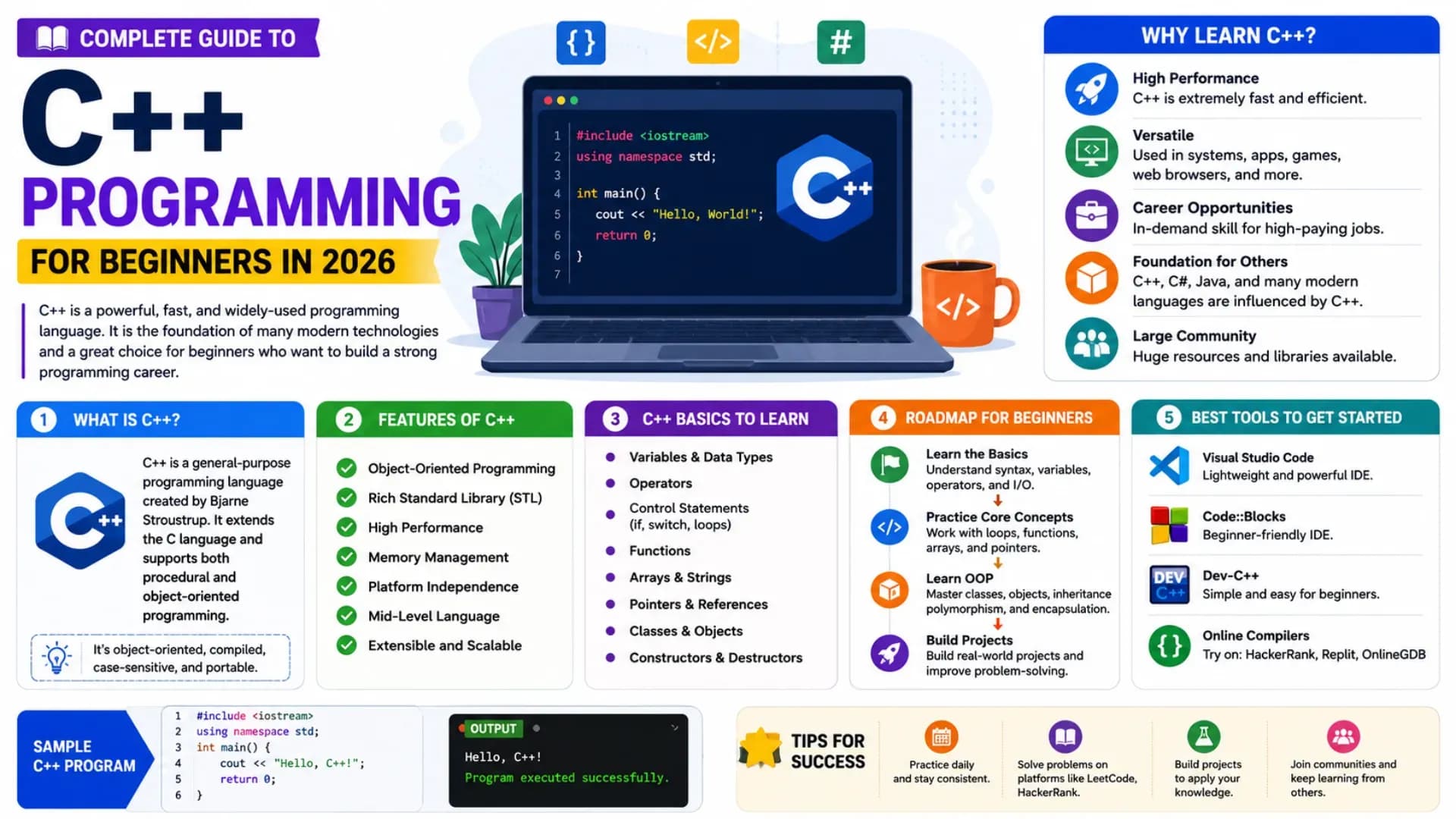
C++ remains one of the most powerful, widely deployed, and career-relevant programming languages in 2026 — and simultaneously one of the most misunderstood. It is the language of operating systems, game engines, high-frequency trading, embedded systems, competitive programming, and every major software platform that cares about raw performance at scale. This C++ Tutorial 2026 is your complete guide to Learn C++ From Scratch: beginning with variables and control flow, building through functions and memory management, covering Object Oriented Programming in C++ in depth, exploring the STL Tutorial for containers and algorithms, introducing Modern C++ Programming features from C++11 through C++23, and closing with a C++ Career Guide and 12-month learning roadmap. Whether you are a true beginner or an experienced programmer in another language — this C++ Programming Guide gives you what you need to Learn C++ Programming with confidence and depth.
Related Article: Top BTech Colleges in India 2026
Table of Contents
- C++ Basics — Syntax, Variables, and Control Flow
- Functions, References, and Pointers
- Object Oriented Programming in C++ — Classes, Inheritance, Polymorphism
- Memory Management — Stack, Heap, and Smart Pointers
- STL Tutorial — Containers, Iterators, and Algorithms
- Modern C++ Programming — C++11 Through C++23 Features
- C++ Career Guide — Domains, Salaries, and 12-Month Roadmap
C++ Basics — Syntax, Variables, and Control Flow
C++ for Beginners starts with understanding what makes C++ different from higher-level languages: you are responsible for memory, performance is explicit, and the type system is strict and expressive. These are features, not limitations — once understood, they give you control that interpreted languages cannot.
#include <iostream>
#include <string>

// C++ Basics: fundamental types and their sizes (platform-dependent)
int main() {
    // Integer types
    int           a = 42;          // 4 bytes, range: -2,147,483,648 to 2,147,483,647
    long long     b = 9223372036854775807LL;  // 8 bytes, use for large counts
    unsigned int  c = 4294967295U; // 4 bytes, no negatives

    // Floating point types
    float  pi_f = 3.14159f;        // 4 bytes, ~7 decimal digits precision
    double pi_d = 3.141592653589793; // 8 bytes, ~15 digits — prefer double

    // Other fundamentals
    char  ch  = 'A';              // 1 byte, stores ASCII character
    bool  flag = true;           // true/false (stored as 1/0)
    auto  x   = 100;             // C++11: compiler deduces type (int)

    // Printing with std::cout
    std::cout << "a = " << a << "\n";
    std::cout << "pi = " << pi_d << "\n";
    std::cout << "sizeof(int) = " << sizeof(int) << " bytes\n";

    return 0;
}
#include <iostream>
#include <vector>
int main() {
// Control flow — all the patterns you need:
// if-else (with modern initialiser syntax C++17):
int score = 72;
if (score >= 90) std::cout << "Grade: A\n";
else if (score >= 75) std::cout << "Grade: B\n";
else if (score >= 60) std::cout << "Grade: C\n";
else std::cout << "Grade: F\n";
// Three loop forms:
for (int i = 0; i < 5; ++i) // counted loop
std::cout << i << " ";
std::cout << "\n";
std::vector<int> nums = {10, 20, 30, 40};
for (int n : nums) // range-based for (C++11)
std::cout << n << " ";
std::cout << "\n";
int count = 0;
while (count < 3) { std::cout << count++ << " "; }
// switch statement:
int day = 3;
switch (day) {
case 1: std::cout << "Monday\n"; break;
case 2: std::cout << "Tuesday\n"; break;
case 3: std::cout << "Wednesday\n"; break;
default: std::cout << "Other\n";
}
return 0;
}Functions, References, and Pointers
Pointers and references are the gateway to understanding how C++ actually works. They are the concept that causes most beginners to stall — and the concept that, once genuinely understood, makes you a significantly better programmer in every language.
#include <iostream>
#include <string>

// Function overloading — same name, different parameter types:
double add(double a, double b) { return a + b; }
int    add(int a,    int b)    { return a + b; }
std::string add(std::string a, std::string b) { return a + b; }

// Pass by value vs pass by reference vs pass by pointer:
void byValue(int x) {
    x = 999;  // changes only the local copy; original unchanged
}

void byReference(int& x) {
    x = 999;  // modifies the original variable directly
}

void byPointer(int* x) {
    *x = 999; // dereference pointer to modify original
}

// const reference — read-only access without copying (efficient for large objects):
void printString(const std::string& s) {
    std::cout << s << "\n";  // no copy made; cannot modify s
}

int main() {
    int val = 10;
    byValue(val);      std::cout << val << "\n";  // prints 10 (unchanged)
    byReference(val);  std::cout << val << "\n";  // prints 999 (modified)
    val = 10;
    byPointer(&val);   std::cout << val << "\n";  // prints 999 (modified)
    return 0;
}
#include <iostream>
// Pointers — demystified:
int main() {
int a = 42;
int* ptr = &a; // ptr stores the memory ADDRESS of a
std::cout << "Value of a: " << a << "\n"; // 42
std::cout << "Address of a: " << &a << "\n"; // e.g. 0x7ffee1234a0c
std::cout << "ptr holds: " << ptr << "\n"; // same address as &a
std::cout << "Value ptr points: " << *ptr << "\n"; // 42 (dereference)
*ptr = 100; // change value via pointer
std::cout << "a is now: " << a << "\n"; // 100
// Pointer arithmetic — how arrays work under the hood:
int arr[5] = {10, 20, 30, 40, 50};
int* p = arr; // points to arr[0]
for (int i = 0; i < 5; ++i)
std::cout << *(p + i) << " "; // same as arr[i]
std::cout << "\n";
return 0;
}Object Oriented Programming in C++ — Classes, Inheritance, and Polymorphism
Object Oriented Programming in C++ is the pillar of the language's design — encapsulation, inheritance, and polymorphism are not add-ons; they are the primary way large C++ programs are structured.
#include <iostream>
#include <string>

// Class definition — the blueprint:
class BankAccount {
private:
    std::string owner;
    double      balance;
    int         accountId;
    static int  nextId;  // shared across all instances

public:
    // Constructor with member initialiser list (preferred over assignment in body):
    BankAccount(std::string name, double initial)
        : owner(name), balance(initial), accountId(++nextId) {
        std::cout << "Account " << accountId << " created for " << owner << "\n";
    }

    // Destructor — called when object goes out of scope:
    ~BankAccount() {
        std::cout << "Account " << accountId << " closed\n";
    }

    // Const member function — guarantees it doesn't modify the object:
    double getBalance() const { return balance; }
    std::string getOwner() const { return owner; }

    bool deposit(double amount) {
        if (amount <= 0) { std::cerr << "Invalid deposit amount\n"; return false; }
        balance += amount;
        return true;
    }

    bool withdraw(double amount) {
        if (amount <= 0 || amount > balance) { return false; }
        balance -= amount;
        return true;
    }

    // Operator overloading — make objects behave like built-in types:
    friend std::ostream& operator<<(std::ostream& os, const BankAccount& acc) {
        return os << "[" << acc.owner << ": ₹" << acc.balance << "]";
    }
};
int BankAccount::nextId = 0;

int main() {
    BankAccount alice("Alice", 10000.0);
    alice.deposit(5000.0);
    alice.withdraw(3000.0);
    std::cout << alice << "\n";  // uses operator<<
    return 0;
}
#include <iostream>
#include <string>
#include <vector>
#include <memory>
// Inheritance and polymorphism:
class Shape {
public:
std::string name;
explicit Shape(std::string n) : name(n) {}
// Pure virtual function — makes Shape an abstract class (cannot be instantiated):
virtual double area() const = 0;
virtual double perimeter() const = 0;
// Virtual destructor — CRITICAL for correct destruction via base pointer:
virtual ~Shape() = default;
void print() const {
std::cout << name << ": area=" << area()
<< ", perimeter=" << perimeter() << "\n";
}
};
class Circle : public Shape {
double radius;
static constexpr double PI = 3.14159265358979;
public:
Circle(double r) : Shape("Circle"), radius(r) {}
double area() const override { return PI * radius * radius; }
double perimeter() const override { return 2 * PI * radius; }
};
class Rectangle : public Shape {
double w, h;
public:
Rectangle(double width, double height)
: Shape("Rectangle"), w(width), h(height) {}
double area() const override { return w * h; }
double perimeter() const override { return 2 * (w + h); }
};
int main() {
// Polymorphism: base class pointer, derived class objects
std::vector<std::unique_ptr<Shape>> shapes;
shapes.push_back(std::make_unique<Circle>(5.0));
shapes.push_back(std::make_unique<Rectangle>(4.0, 6.0));
shapes.push_back(std::make_unique<Circle>(3.0));
for (const auto& shape : shapes)
shape->print(); // virtual dispatch — calls correct derived class method
return 0; // unique_ptrs automatically freed here
}Memory Management — Stack, Heap, and Smart Pointers
Memory management is the concept that separates C++ from most modern languages — and the concept that, when done well, makes C++ programs faster and more predictable than garbage-collected alternatives. Modern C++ Programming largely eliminates manual memory management in favour of smart pointers and RAII.
#include <iostream>
#include <memory>

// Stack vs Heap allocation:
//
// STACK: automatic, fast, limited size (~1-8 MB)
//   Variables declared in functions → automatically freed on return
//
// HEAP: manual, slower, much larger (limited only by RAM)
//   new/delete → must explicitly manage lifetime
//   Modern C++: use smart pointers instead of raw new/delete

int main() {
    // Stack allocation (prefer this when possible):
    int  stack_int  = 42;              // freed automatically
    int  stack_arr[100] = {};          // 400 bytes on stack

    // Heap with raw pointers (C style — AVOID in modern C++):
    int* raw_ptr = new int(100);       // allocates on heap
    delete raw_ptr;                     // must manually free — easy to forget
    raw_ptr = nullptr;                 // good practice: null after delete
    // Risks: memory leaks, dangling pointers, double-free

    // ── SMART POINTERS (use these instead of raw new/delete) ────────────────

    // unique_ptr: sole ownership — automatically freed when out of scope
    std::unique_ptr<int> uptr = std::make_unique<int>(42);
    std::cout << "unique_ptr value: " << *uptr << "\n";
    // No delete needed — freed at end of scope
    // Cannot copy: std::unique_ptr<int> other = uptr;  // ERROR
    std::unique_ptr<int> other = std::move(uptr);    // transfer ownership OK
    // uptr is now null; other owns the resource

    // shared_ptr: shared ownership — freed when last owner goes out of scope
    std::shared_ptr<int> sp1 = std::make_shared<int>(99);
    std::shared_ptr<int> sp2 = sp1;    // reference count: 2
    std::cout << "shared: ref count = " << sp1.use_count() << "\n";  // 2
    {
        std::shared_ptr<int> sp3 = sp1;  // ref count: 3
    }  // sp3 goes out of scope, ref count back to 2
    // Memory freed when sp1 and sp2 both go out of scope

    // weak_ptr: observer — does not own; breaks circular reference cycles
    std::weak_ptr<int> wp = sp1;       // doesn't increase ref count
    if (auto locked = wp.lock())       // check if resource still alive
        std::cout << "weak_ptr value: " << *locked << "\n";

    return 0;  // all smart pointers auto-freed here
}
STL Tutorial — Containers, Iterators, and Algorithms
The Standard Template Library is one of C++'s greatest strengths — a battle-tested, performance-optimised collection of data structures and algorithms that C++ for Beginners should adopt immediately rather than writing their own containers.
#include <iostream>
#include <vector>
#include <map>
#include <unordered_map>
#include <set>
#include <queue>
#include <stack>

int main() {
    // STL Tutorial — choosing the right container:
    //
    // vector<T>          — dynamic array; O(1) access; O(1) amortised push_back
    std::vector<int> v = {5, 2, 8, 1, 9};
    v.push_back(3);
    std::cout << "vector size: " << v.size() << "\n";

    // map<K,V>           — sorted key-value; O(log n) all operations
    std::map<std::string, int> word_count;
    word_count["hello"] = 3;
    word_count["world"] = 1;
    word_count["apple"] = 5;
    for (const auto& [key, val] : word_count)  // C++17 structured bindings
        std::cout << key << ": " << val << "\n";  // sorted alphabetically

    // unordered_map<K,V> — hash map; O(1) average all operations (prefer over map)
    std::unordered_map<std::string, int> freq;
    freq["c++"]++;  freq["c++"]++;  freq["python"]++;
    std::cout << "c++ freq: " << freq["c++"] << "\n";  // 2

    // set<T>             — sorted unique elements; O(log n); duplicate-free
    std::set<int> s = {3, 1, 4, 1, 5, 9, 2, 6};  // {1,2,3,4,5,6,9}
    std::cout << "set size: " << s.size() << "\n";   // 7 (duplicate 1 removed)

    // queue<T>           — FIFO; use for BFS, task queues
    std::queue<int> q;
    q.push(10); q.push(20); q.push(30);
    std::cout << "queue front: " << q.front() << "\n";  // 10

    // stack<T>           — LIFO; use for DFS, expression evaluation
    std::stack<int> stk;
    stk.push(1); stk.push(2); stk.push(3);
    std::cout << "stack top: " << stk.top() << "\n";  // 3

    // priority_queue — max-heap by default; O(log n) push/pop
    std::priority_queue<int> pq;
    for (int x : {5, 2, 8, 1}) pq.push(x);
    std::cout << "max element: " << pq.top() << "\n";  // 8
    return 0;
}
#include <iostream>
#include <vector>
#include <algorithm>
#include <numeric>
int main() {
std::vector<int> v = {5, 2, 8, 1, 9, 3, 7};
// STL algorithms — all work on ranges via iterators:
std::sort(v.begin(), v.end()); // {1,2,3,5,7,8,9}
std::sort(v.begin(), v.end(), std::greater<int>()); // {9,8,7,5,3,2,1}
// Lambda with algorithm (C++11):
std::vector<int> evens;
std::copy_if(v.begin(), v.end(), std::back_inserter(evens),
[](int x) { return x % 2 == 0; });
std::cout << "Evens: ";
for (int e : evens) std::cout << e << " ";
std::cout << "\n";
// Accumulate — sum with fold:
int total = std::accumulate(v.begin(), v.end(), 0);
std::cout << "Sum: " << total << "\n";
// Transform — apply function to every element:
std::vector<int> doubled(v.size());
std::transform(v.begin(), v.end(), doubled.begin(),
[](int x) { return x * 2; });
// Binary search (sorted range only):
std::sort(v.begin(), v.end());
bool found = std::binary_search(v.begin(), v.end(), 7);
std::cout << "7 found: " << std::boolalpha << found << "\n"; // true
// Min/max:
auto [min_val, max_val] = std::minmax_element(v.begin(), v.end());
std::cout << "Range: [" << *min_val << ", " << *max_val << "]\n";
return 0;
}Also Read: Top MTech Colleges in India 2026
Modern C++ Programming — C++11 Through C++23 Features
Modern C++ Programming from C++11 onwards transformed the language — making it significantly safer, more expressive, and more performant without sacrificing the zero-overhead principle. If you are learning from older resources, many of their patterns are now replaced by cleaner modern alternatives.
#include <iostream>
#include <vector>
#include <functional>
#include <optional>
#include <variant>

// C++11: Lambda expressions — anonymous functions as first-class objects:
int main() {
    auto square = [](int x) { return x * x; };
    std::cout << "square(7) = " << square(7) << "\n";  // 49

    // Capture list: [=] captures all by value; [&] by reference; [x, &y] mixed:
    int threshold = 5;
    auto above_threshold = [threshold](int x) { return x > threshold; };
    std::cout << above_threshold(7) << "\n";  // 1 (true)

    // C++11: Move semantics — transfer resources without copying:
    std::vector<int> big_vec(1000000, 1);
    std::vector<int> moved_vec = std::move(big_vec);  // O(1) — no data copied
    std::cout << "big_vec size after move: " << big_vec.size() << "\n";  // 0
    std::cout << "moved_vec size:          " << moved_vec.size() << "\n"; // 1000000

    // C++17: std::optional — value that may or may not exist (replaces -1 or nullptr sentinel):
    auto safe_divide = [](int a, int b) -> std::optional<double> {
        if (b == 0) return std::nullopt;  // no value
        return (double)a / b;
    };
    if (auto result = safe_divide(10, 3))
        std::cout << "10/3 = " << *result << "\n";
    if (!safe_divide(10, 0))
        std::cout << "Division by zero handled safely\n";

    // C++17: std::variant — type-safe union (replaces void* or union hacks):
    std::variant<int, double, std::string> v;
    v = 42;
    std::cout << "int: " << std::get<int>(v) << "\n";
    v = "hello";
    std::cout << "string: " << std::get<std::string>(v) << "\n";
    return 0;
}
#include <iostream>
#include <ranges> // C++20
#include <vector>
#include <concepts> // C++20
// C++20 Concepts — constrained templates (finally readable template errors):
template<std::integral T> // only compiles for integer types
T gcd(T a, T b) {
while (b) { a %= b; std::swap(a, b); }
return a;
}
// C++20 Ranges — composable, lazy pipelines (replaces iterator pair calls):
int main() {
std::vector<int> numbers = {1, 2, 3, 4, 5, 6, 7, 8, 9, 10};
// Take even numbers, square them, show first 3 — lazy, no intermediate copies:
auto pipeline = numbers
| std::views::filter([](int x) { return x % 2 == 0; }) // 2,4,6,8,10
| std::views::transform([](int x) { return x * x; }) // 4,16,36,64,100
| std::views::take(3); // 4,16,36
std::cout << "First 3 even squares: ";
for (int x : pipeline)
std::cout << x << " ";
std::cout << "\n";
// GCD with concepts:
std::cout << "gcd(48, 18) = " << gcd(48, 18) << "\n"; // 6
// gcd(3.14, 1.0); // COMPILE ERROR — floating point excluded by concept
// C++20 designated initialisers:
struct Config { int width; int height; bool fullscreen; };
Config cfg = {.width = 1920, .height = 1080, .fullscreen = true};
std::cout << cfg.width << "x" << cfg.height << "\n";
return 0;
}C++ Career Guide — Domains, Salaries, and 12-Month Roadmap
// C++ Career Guide — domains and India salary ranges (2026):
//
// COMPETITIVE PROGRAMMING / PLACEMENT PREPARATION:
//   CP remains the most efficient way to demonstrate C++ mastery in interviews
//   Top platforms: Codeforces, AtCoder, ICPC, CodeChef, LeetCode
//   Salary impact: Codeforces Candidate Master / LGM → ₹40–120 LPA offers at FAANG
//
// SYSTEMS PROGRAMMING (operating systems, compilers, drivers):
//   Companies: Intel, AMD, Qualcomm, Nvidia, Microsoft, Google (kernel teams)
//   Salary: ₹20–60 LPA India; $200–400K USD at FAANG
//   Requires: deep OS concepts, concurrency, memory models
//
// GAME DEVELOPMENT:
//   Engine: Unreal Engine (C++); also Godot, custom engines
//   Companies: Ubisoft India, nCore Games, SuperGaming, Nazara Technologies
//   Salary: ₹8–25 LPA India; ₹50–100 LPA senior roles at AAA studios
//   Requires: graphics programming, physics, ECS patterns
//
// HIGH-FREQUENCY TRADING (HFT) / FINANCIAL TECHNOLOGY:
//   Companies: Graviton Research, Tower Research, Quadeye, WorldQuant
//   Salary: ₹30–150 LPA (base); performance bonuses make total compensation higher
//   Requires: nanosecond latency, cache-aware programming, lock-free concurrency
//
// EMBEDDED SYSTEMS / IOT:
//   Companies: Bosch, Robert Bosch Engineering, Continental, TCS Embedded
//   Salary: ₹8–30 LPA; AUTOSAR and safety-critical certification premium
//
// MACHINE LEARNING INFRASTRUCTURE:
//   TensorFlow, PyTorch, ONNX Runtime are all written in C++ under the hood
//   Companies: Google Brain, Meta AI, Nvidia (CUDA), Hugging Face (kernels)
//   Salary: ₹25–80 LPA India; $250–500K USD at top AI companies
// 12-month C++ Programming Course / learning roadmap:
//
// MONTHS 1–2 — C++ Basics and OOP:
// ✓ Book: "A Tour of C++" by Bjarne Stroustrup (the language creator)
// ✓ Practice: Write 100 small programs — types, loops, functions, classes
// ✓ Understand: stack/heap, const-correctness, copy vs move
// ✓ Compiler setup: g++ with -std=c++20 -Wall -Wextra -fsanitize=address
//
// MONTHS 3–4 — STL and Modern C++:
// → Book: "Effective Modern C++" by Scott Meyers (items 1-20)
// → Master: vector, map, unordered_map, set, priority_queue usage
// → Understand: smart pointers, RAII, move semantics, lambdas
// → Practice: 50 LeetCode Easy/Medium problems in C++
//
// MONTHS 5–6 — Advanced Topics:
// → Templates, template specialisation, variadic templates
// → Concurrency: std::thread, std::mutex, std::atomic, std::async
// → Exception handling: try-catch, RAII for exception safety
// → Build system: CMake basics for multi-file projects
//
// MONTHS 7–9 — Specialisation (pick your domain):
// CP path: Codeforces Div 3/4 → Div 2; learn graph theory + DP in C++
// Systems path: MIT 6.004, OS Three Easy Pieces book, build a malloc
// Game dev path: Unreal Engine C++ tutorials; build a clone game
// HFT path: "The Art of Writing Efficient Programs" by Pikus
//
// MONTHS 10–12 — Portfolio and Job Search:
// → Build: one significant GitHub project in your chosen domain
// → Competitive: aim for Codeforces 1600+ (Specialist) for good SDE placement
// → Contribute: find a beginner-friendly open source C++ project (LLVM, Godot, OpenCV)
// → Interview: practice system design + data structures in C++
//
// Free online resources for Learn C++ From Scratch:
cpp_resources = {
"learncpp.com": "Best free structured C++ tutorial site — complete curriculum",
"cppreference.com": "Authoritative STL reference — bookmark immediately",
"cppinsights.io": "See what the compiler does to your C++ code — invaluable",
"godbolt.org": "Compiler Explorer — see assembly output; compare compilers",
"Codeforces": "codeforces.com — competitive programming practice",
"Effective Modern C++": "Scott Meyers — must-read for C++11/14 best practices",
"A Tour of C++": "Bjarne Stroustrup — canonical overview by language creator",
}The single most important habit for learning C++: Compile and run every example you encounter — including the ones in this guide. C++ makes much more sense when you see the output, trigger the undefined behaviour intentionally in a safe environment, and read the compiler error messages. The gap between "understanding C++" and "knowing C++" is entirely bridged by the hours spent at a terminal.
CHECK OUT: Top Colleges in Ranchi 2026
Explore More
Conclusion
This C++ Tutorial 2026 has covered the complete path to Learn C++ From Scratch: C++ Basics with types and control flow, functions and the pointer/reference model, Object Oriented Programming in C++ with classes and polymorphism, memory management with smart pointers, the STL Tutorial for containers and algorithms, Modern C++ Programming from lambdas through C++20 Ranges and Concepts, and the complete C++ Career Guide with domain-specific pathways and India salary data.
Learn C++ Programming is a commitment — more than most languages, C++ rewards accumulated understanding rather than surface familiarity. Each concept in this C++ Language Tutorial builds on the previous one, and the payoff for working through all of it is access to a domain of software engineering that genuinely cannot be done as well in any other language. The C++ Programming Guide you have read is comprehensive; the C++ Programming Course that turns it into skill is the hours spent at a compiler. Open a terminal, write #include <iostream>, and begin. This C++ Tutorial 2026 is your reference — return to each section of this C++ Tutorial 2026 as the relevant challenge appears in your practice. The C++ Language Tutorial you have completed is a foundation; a C++ Language Tutorial only becomes skill through compilation. To Learn C++ Programming is to build muscle memory at a compiler — and to Learn C++ Programming well is to understand not just what works but why. Every C++ for Beginners journey starts the same way: one program, one compile, one run. Every C++ for Beginners journey that succeeds continues the same way for the next 12 months. The C++ Programming Guide in this article is complete — and the C++ Programming Guide you carry forward is the one built from your own compiled programs. The C++ Programming Course that builds careers is not a certificate — it is the C++ Programming Course of hours at a terminal, problems solved, and compiler errors understood.