
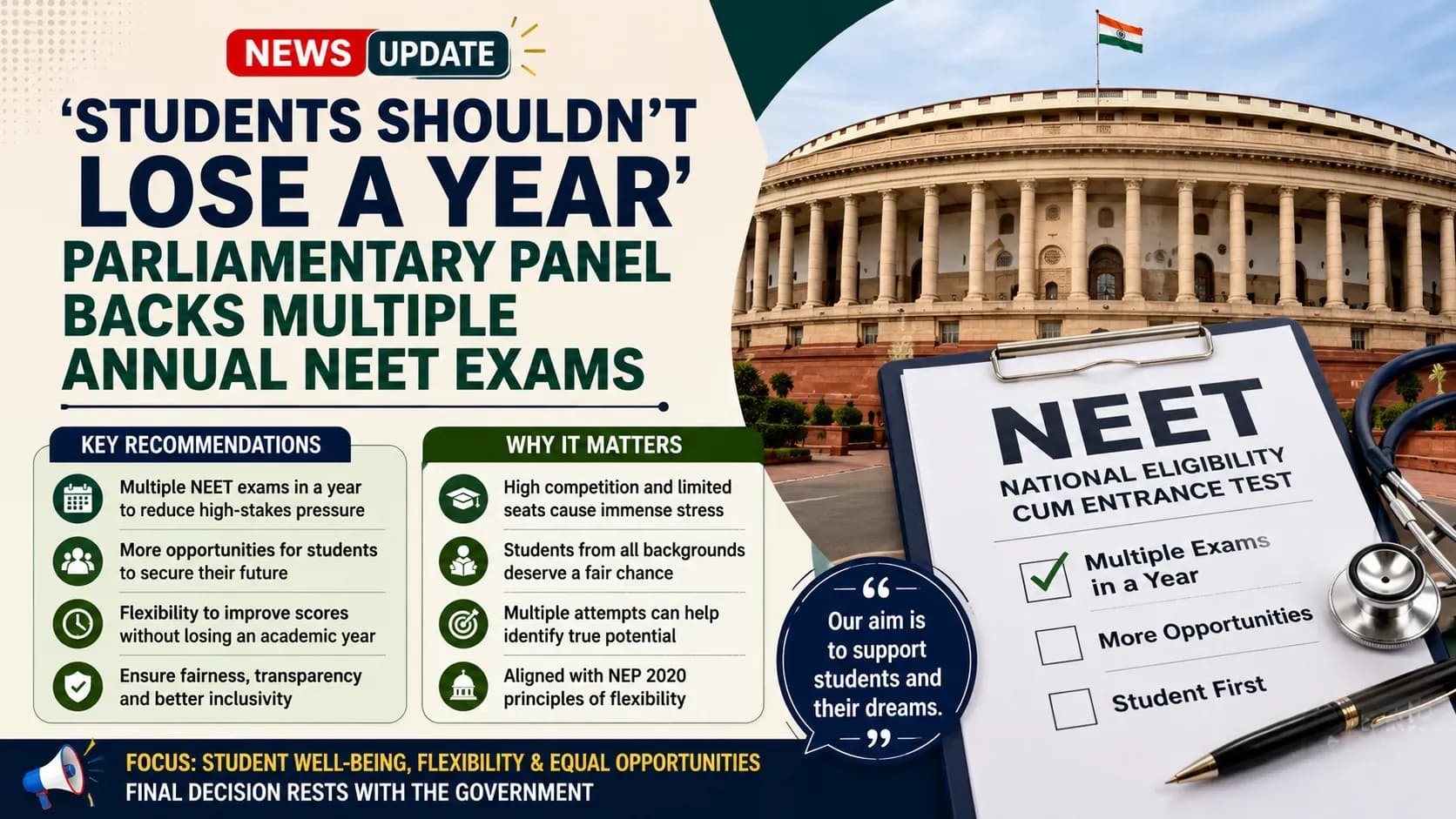
'Students Shouldn't Lose a Year' — Parliamentary Panel Backs Multiple Annual NEET Exams as Major NEET Exam Reforms 2026 Signal
A Parliamentary Standing Committee has formally endorsed the concept of conducting NEET UG 2026 — and future editions of the National Eligibility cum Entrance Test — multiple times per year, citing the foundational principle that NEET Twice a Year or more frequent examination windows would prevent medical aspirants from losing an entire academic year due to a single examination outcome. The recommendation, framed around student welfare and systemic fairness, represents the most significant institutional endorsement of Multiple NEET Exams as policy in the examination's history. The Parliamentary Panel NEET finding builds on earlier recommendations from the National Medical Commission, the High-Level Expert Committee convened after the 2024 NEET controversy, and advocates who have long argued that a once-a-year gate to all MBBS seats across India places disproportionate, life-altering stakes on a single examination sitting. The development is the most consequential piece of NEET Exam Reforms 2026 news and broader NTA NEET Updates for lakhs of aspirants currently preparing for NEET UG 2026. All NEET Latest News on the parliamentary recommendation, NTA's response, and the implementation timeline for Multiple NEET Exams is tracked on this page.
Key Highlights
- Parliamentary Panel NEET — Formal recommendation for Multiple NEET Exams per year; student welfare framing: "students shouldn't lose a year"
- NEET Twice a Year — The specific format most frequently discussed; mirrors JEE Main's multiple-attempt model
- NEET Exam Reforms 2026 — Parliamentary endorsement is the highest-level institutional signal for structural change yet
- NEET UG Reforms — Cover frequency, security, technology, and administrative oversight — not just timing
- National Testing Agency — Responsible for NEET administration; reforms directly affect NTA's examination infrastructure
- NTA NEET Updates — No official NTA confirmation yet on implementation timeline for Multiple NEET Exams
- NEET 2026 Updates — Current NEET UG 2026 cycle is proceeding under the existing single-attempt format
- All NEET Latest News on reform implementation and Medical Entrance Exam News developments tracked here
Explore This: JEE Mains Exam Guide
🔴 NEET Latest News — Parliamentary Panel Recommendation and Reform Updates
✅ Reform Status — Parliamentary Recommendation Issued
Parliamentary Standing Committee has formally recommended Multiple NEET Exams per year. The Parliamentary Panel NEET report endorses conducting the NEET Exam Frequency at least twice annually, citing the "students shouldn't lose a year" principle. This is a formal parliamentary report — it carries institutional weight with the Ministry of Health, Ministry of Education, and the National Testing Agency. All NEET Latest News on government response and NTA implementation announcements posted here.
📋 What the Parliamentary Panel Recommended
The Parliamentary Panel NEET recommendation covers: (1) Conducting Multiple NEET Exams — specifically NEET Twice a Year as the primary model; (2) Adopting best-of-two-attempt scoring — where the higher score from either attempt determines the final merit rank; (3) Using computer-based testing (CBT) infrastructure to enable secure multi-session examination; (4) Addressing the single-examination vulnerability that allowed the 2024 and 2026 paper leak incidents to affect hundreds of thousands of students simultaneously. The NEET UG Reforms package is framed around both fairness and security. All NEET 2026 Updates on NTA's formal response tracked here.
📊 NTA NEET Updates — Current Position
NTA NEET Updates: The National Testing Agency has not yet released an official timeline or implementation plan for Multiple NEET Exams following the parliamentary recommendation. The current NEET UG 2026 cycle is proceeding under the existing once-a-year format. Any change to the NEET Exam Frequency would require statutory amendments (the NMC Act governs NEET's regulatory framework), gazette notification, and NTA infrastructure scaling. All NTA NEET Updates on the official government and NTA response tracked here.
📅 What This Means for NEET UG 2026 Aspirants
NEET UG 2026 aspirants should note: the parliamentary recommendation does not change the current examination cycle. NEET UG 2026 is conducting under the existing format. The NEET Exam Reforms 2026 arising from this recommendation — if implemented — would most likely apply to NEET UG 2027 or later cycles, depending on the statutory amendment timeline. Prepare for NEET UG 2026 under current rules; monitor NEET Latest News for any official announcement of NEET Twice a Year implementation. All NEET 2026 Updates tracked here.
Related News: CUET UG Exam Guide
Key Details — Parliamentary Panel NEET Recommendation
| Particulars | Details |
|---|---|
| Recommending Body | Parliamentary Standing Committee on Education, Women, Children, Youth and Sports |
| Recommendation Status | ISSUED — Multiple NEET Exams per year endorsed |
| Core Recommendation | NEET Twice a Year (minimum); best-of-two scoring; CBT format migration |
| Principle Cited | "Students shouldn't lose a year" — preventing academic year loss from single-attempt failure |
| Governing Legislation | National Medical Commission Act — requires statutory amendment for NEET frequency change |
| NTA Response | No official timeline announced — confirm at nta.ac.in |
| Impact on NEET UG 2026 | None — current cycle proceeds under existing once-a-year format |
| Earliest Likely Implementation | NEET UG 2027 or later — subject to statutory amendment and NTA readiness |
| JEE Main Precedent | JEE Main already conducts 2 sessions/year with best-score operative — model being cited for NEET |
| NEET Exam Frequency (Current) | Once a year (single attempt) — proposed change to minimum twice a year |
📋 Why Multiple NEET Exams — Context and the JEE Main Precedent
The Problem the Reform Addresses
The argument for Multiple NEET Exams rests on a fundamental structural critique of the current once-a-year, single-attempt model. Approximately 22 to 24 lakh candidates appear in NEET each year for approximately 1 lakh MBBS seats. For the 20+ lakh candidates who do not qualify or do not achieve a competitive rank in a given year, the next opportunity is 365 days away. A student who was ill on examination day, experienced family bereavement, had a paper that happened to be harder than expected due to question selection variance, or was affected by external events (including paper leaks) — all face the same full-year loss. The Parliamentary Panel NEET recommendation crystallises what medical education reformers and student groups have argued for years: a high-stakes, once-a-year gate to all medical seats is a structurally disproportionate design for a qualification examination.
The JEE Main Model — Evidence That Multiple Attempts Work
JEE Main — the engineering entrance examination administered by the National Testing Agency — shifted to two sessions per year in 2019. The outcome has been broadly positive: candidates get a second attempt if they underperform in the first, the best-of-two score is used for ranking and admission eligibility, and the psychological pressure on any single session is reduced. The administrative infrastructure — multiple examination windows, multiple question sets, percentile normalisation across sessions — has been demonstrated to work at the 12–15 lakh candidate scale. The NEET Exam Reforms 2026 recommendation to adopt a similar model for NEET Exam Frequency is therefore not a theoretical proposal; it is a request to extend to medical admissions what engineering admissions have already implemented.
Challenges in Implementing NEET Twice a Year
The path from Parliamentary Panel NEET recommendation to implemented policy involves several significant hurdles. The National Medical Commission Act, which provides the statutory basis for NEET, requires legislative amendment to change the examination structure. The National Testing Agency would need to scale examination infrastructure significantly — 22+ lakh candidates taking a secure examination twice a year requires double the examination centres, question paper security protocols, and evaluation bandwidth. The question normalisation methodology between two sessions (as used in JEE Main) would need to be established for NEET by NTA. The NEET Exam Frequency change would also affect the medical admissions calendar — MBBS seat counselling through MCC and state authorities is built around a single annual NEET result; a two-session model would require significant counselling calendar restructuring. None of these challenges are insurmountable — but each requires time and coordinated action.
What's Next — NEET Exam Reforms 2026 Implementation Path
Following the Parliamentary Panel NEET recommendation: the Ministry of Health and Family Welfare and the Ministry of Education are expected to formally respond to the parliamentary report. The National Medical Commission will be consulted on the regulatory changes required. If the Government accepts the recommendation, a statutory amendment to the NMC Act and a gazette notification would be required before the National Testing Agency can implement Multiple NEET Exams. NTA would then need a preparation period — typically 12 to 18 months for a structural change of this scale — to build the infrastructure for secure NEET Twice a Year examination. The earliest realistic implementation window for NEET UG Reforms of this nature is the 2027 or 2028 cycle. All NTA NEET Updates, government response statements, and NEET 2026 Updates on the reform timeline tracked here as they are confirmed.
📌 Expert Analysis
Medical education policy analysts tracking the NEET Exam Reforms 2026 landscape note that the Parliamentary Panel NEET recommendation is the most consequential formal signal for Multiple NEET Exams reform yet — but formal signals have existed before without producing implementation. The High-Level Expert Committee report after the 2024 NEET controversy made similar recommendations; the NMC had expressed openness to the concept; individual ministers had endorsed the idea publicly. The distinguishing factor this time is the parliamentary route — a formal committee report creates an accountability structure that individual ministerial statements do not.
For the 2026 aspirant cohort specifically: do not factor the Multiple NEET Exams reform into your preparation strategy for NEET UG 2026. The current cycle operates under the existing single-attempt format, and the reform timeline makes it virtually certain that 2026 will proceed as designed. Prepare with full intensity for one examination, one date, one attempt. The NEET UG Reforms you read about today may benefit the 2027 cohort — not the 2026 cohort. The single most useful response to NEET Latest News about potential future reforms is to not allow them to reduce your preparation urgency for the examination you are actually taking. All Medical Entrance Exam News on NEET reform developments tracked here.
FAQs
Q1. Will NEET UG 2026 be conducted twice this year?
No — NEET UG 2026 is proceeding under the existing single-attempt format. The Parliamentary Panel NEET recommendation for Multiple NEET Exams is a policy recommendation; it has not been enacted into law or operationalised by the National Testing Agency as of the current cycle. The NEET Exam Frequency change requires statutory amendment and NTA infrastructure preparation — the earliest implementation is likely NEET 2027 or later. All NTA NEET Updates on any change to the current cycle will be posted here immediately if announced.
Q2. What exactly did the Parliamentary Panel recommend for NEET?
The Parliamentary Panel NEET Standing Committee formally recommended: conducting Multiple NEET Exams — at minimum NEET Twice a Year; adopting a best-of-multiple-attempts scoring model (the higher score counts for merit ranking); transitioning to computer-based testing to enable secure multi-session examination; and addressing the structural vulnerability of a single annual examination sitting. The report is a formal parliamentary document — it carries institutional weight with the Ministry of Health, Ministry of Education, and the National Testing Agency. All NEET UG Reforms details from the report tracked here.
Q3. How does JEE Main's two-session model compare to the proposed NEET Twice a Year model?
JEE Main — administered by the National Testing Agency — has conducted two sessions per year since 2019. Candidates appear in Session 1 (January) and Session 2 (April); the best of the two percentile scores is the operative figure for JEE Advanced eligibility and engineering admissions. The proposed NEET Twice a Year model mirrors this structure for medical admissions. The JEE Main precedent demonstrates that the NEET Exam Frequency change is administratively feasible at scale — but NEET at 22+ lakh candidates is larger than JEE Main, and the paper security requirements are more stringent given the historical context. NTA NEET Updates on the specific implementation model will be tracked here.
Q4. How soon can NEET UG Reforms be implemented after the Parliamentary recommendation?
NEET UG Reforms arising from the Parliamentary Panel NEET recommendation require: government acceptance of the recommendation, statutory amendment to the NMC Act, gazette notification, and NTA preparation period for infrastructure scaling. The full legislative and implementation cycle typically takes 12 to 24 months from recommendation acceptance. The earliest realistic implementation window is NEET UG 2027 — and only if the government moves quickly on legislation. The current NEET UG 2026 cycle and the NEET Exam Frequency for 2026 are unaffected. All NEET 2026 Updates on the legislative timeline tracked here.
Q5. Should I change my NEET preparation strategy based on these reform announcements?
No — do not change your NEET UG 2026 preparation strategy based on reform announcements. The current cycle proceeds under the existing single-attempt format regardless of any reform recommendation. Prepare for one examination, one date, one attempt — with full urgency. The NEET Exam Reforms 2026 being discussed will most likely benefit aspirants who appear in 2027 or later cycles — not the current 2026 cohort. The most useful response to NEET Latest News about multiple attempts is to note it, understand the policy direction, and return to your preparation. Medical Entrance Exam News about future reforms should not reduce present preparation intensity.
Explore More
Stay with College Nirnay for all NEET Latest News and NEET 2026 Updates — Parliamentary Panel NEET follow-up government response, Multiple NEET Exams implementation timeline, NTA NEET Updates on CBT infrastructure and examination frequency, NEET Exam Reforms 2026 legislative developments, and all NEET UG 2026, NEET Twice a Year, NEET UG Reforms, and Medical Entrance Exam News developments from the National Testing Agency.