JoSAA Counselling Seat Matrix 2026: Check Total Number of Branch-wise Seats Available across IITs, NITs and other GFTIs B.Tech Programs
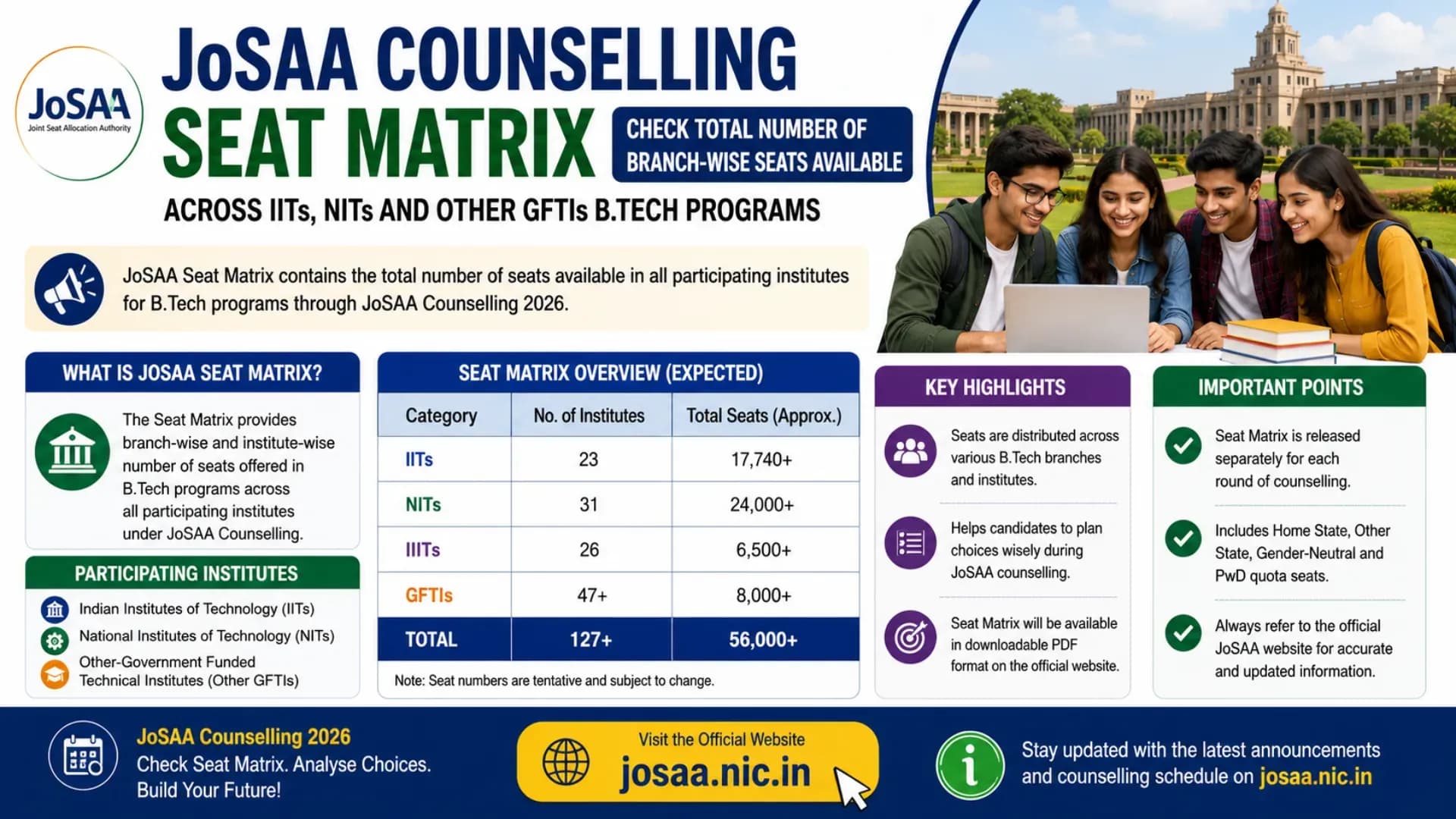
The JoSAA Seat Matrix 2026 has been published on the official Joint Seat Allocation Authority portal — providing the complete, institute-wise and branch-wise total seat count across all 23 IITs, 31 NITs, 26 IIITs, and 26 GFTIs participating in JoSAA Counselling 2026 for undergraduate engineering admissions. The IIT Seat Matrix 2026, NIT Seat Matrix 2026, IIIT Seat Matrix, and GFTI Seat Matrix are the foundational data sets that every JoSAA Choice Filling preference list must be built against — because understanding how many seats exist in each programme, at each institute, across each category, is what separates a strategically built preference list from a wishlist. The JoSAA Seat Matrix 2026 is available at josaa.nic.in for all Engineering Admission 2026 candidates — JEE Advanced qualified students for IIT seats and JEE Mains qualified students for NIT, IIIT, and GFTI seats — and must be read alongside previous years' opening and closing rank data for the JoSAA Choice Filling process to be genuinely effective.
Key Highlights
- JoSAA Seat Matrix 2026 released at josaa.nic.in — complete branch-wise seat data across all participating institutes
- IIT Seat Matrix 2026 covers 23 IITs — approximately 17,000+ B.Tech seats across all programmes and categories including IIT Bombay, Delhi, Madras, Kanpur, Kharagpur, and newer IITs
- NIT Seat Matrix 2026 covers 31 NITs — approximately 23,000+ B.Tech seats across states including top NITs like Trichy, Warangal, Surathkal, Calicut, and Rourkela
- IIIT Seat Matrix covers 26 IIITs — approximately 7,000+ seats predominantly in CSE, IT, Electronics, and Data Science branches
- GFTI Seat Matrix covers 26 Government Funded Technical Institutes — offering additional BTech Seats in IITs-equivalent quality programmes in specialised domains
- Branch Wise Seats IIT data shows CSE remaining the most competitive — with the lowest seat count relative to demand across all IITs combined
- Category-wise seat breakdown — Open, EWS, OBC-NCL, SC, ST, PwD — published for every programme at every institute in the JoSAA Seat Matrix 2026
- All JoSAA Counselling 2026 seat data and choice filling guidance tracked on this page for Engineering Admission 2026
Why It Matters
The JoSAA Seat Matrix 2026 is not simply a list of numbers — it is the structural reality of Engineering Admission 2026 that every candidate's preference list must be anchored to. A candidate who builds a JoSAA Choice Filling preference list without knowing how many seats exist in each programme risks listing combinations that are statistically inaccessible at their rank while missing realistic options that could be captured with a better-informed list. The IIT Seat Matrix 2026 data, for example, reveals that the total number of BTech Seats in IITs in CSE across all 23 IITs combined is significantly lower than most candidates assume — meaning the effective competition for IIT CSE seats is far more concentrated than the total JEE Advanced qualifier pool suggests. Similarly, the NIT Seat Matrix 2026 shows significant seat count variation between programmes and institutes that makes the difference between a realistic and an unrealistic preference at any given JEE Mains rank. Reading the JoSAA Seat Matrix 2026 is the first and most important act of JoSAA Counselling 2026 preparation.
🔴 JoSAA Counselling 2026 — Seat Matrix LIVE Tracker
📅 JoSAA Seat Matrix 2026 Published at josaa.nic.in
JoSAA Seat Matrix 2026 is officially published at josaa.nic.in — the complete institute and branch-wise seat count for all participating institutions is live. The seat matrix is available in filterable format — candidates can filter by institute type (IIT/NIT/IIIT/GFTI), institute name, programme, and category to see exactly how many seats are available in any specific programme at any specific institute for their applicable category. Download the complete JoSAA Seat Matrix 2026 PDF from josaa.nic.in for offline reference during the JoSAA Choice Filling preference building process — the PDF version allows annotation and comparison against opening and closing rank data from previous years.
🏛 IIT Seat Matrix 2026 — BTech Seats Across 23 IITs
The IIT Seat Matrix 2026 covers all 23 IITs — IIT Bombay, IIT Delhi, IIT Madras, IIT Kanpur, IIT Kharagpur, IIT Roorkee, IIT Hyderabad, IIT Guwahati, IIT BHU, IIT Dhanbad (ISM), IIT Indore, IIT Jodhpur, IIT Gandhinagar, IIT Bhubaneswar, IIT Patna, IIT Ropar, IIT Mandi, IIT Tirupati, IIT Palakkad, IIT Jammu, IIT Goa, IIT Dharwad, and IIT Bhilai. The total BTech Seats in IITs across all institutes and all programmes is approximately 17,000+ for the 2026 cycle. The Branch Wise Seats IIT breakdown reveals that CSE carries the fewest Open category seats relative to total qualified candidates, while Mechanical, Civil, Chemical, and Metallurgy branches carry significantly more seats across newer IITs. This seat scarcity data is essential context for JoSAA Choice Filling strategy.
🏫 NIT Seat Matrix 2026 & IIIT Seat Matrix — NITs and IIITs
The NIT Seat Matrix 2026 covers all 31 NITs with approximately 23,000+ total B.Tech seats — the largest block of centrally funded engineering seats in India. NIT Trichy, NIT Warangal, NIT Surathkal, NIT Calicut, NIT Rourkela, MNIT Allahabad, and NIT Silchar are among the most competitive NITs in the seat matrix for CSE and ECE. The IIIT Seat Matrix covers 26 IIITs — primarily offering Computer Science, Information Technology, Electronics and Communication, and Data Science programmes — with approximately 7,000+ total seats. IIITs are exclusively technology-focused institutions; the IIIT Seat Matrix shows a higher proportion of CSE and allied seats relative to institute size compared to NITs, making IIIT seat data particularly relevant for candidates whose preference centres on software and computing programmes.
🏢 GFTI Seat Matrix — Government Funded Technical Institutes
The GFTI Seat Matrix for JoSAA Counselling 2026 covers 26 Government Funded Technical Institutes — including institutions like IIEST Shibpur, Assam University, BIT Mesra, SLIET Punjab, SPA Bhopal, PEC Chandigarh, and others. GFTIs offer an important alternative for candidates whose JEE Mains rank falls outside the NIT range for their preferred branch — several GFTIs have strong domain-specific reputations (IIEST Shibpur for core engineering, BIT Mesra for mining and petroleum, SLIET for engineering technology) that make them compelling choices for the right candidate. The GFTI Seat Matrix at josaa.nic.in shows the complete programme and seat count for all 26 institutions — review it carefully before finalising the lower tiers of your JoSAA Choice Filling preference list.
Related News: JEE Mains Exam Guide 2026
Key Details — JoSAA Seat Matrix 2026 Overview
| Particulars | Details |
|---|---|
| Process Name | Joint Seat Allocation Authority (JoSAA) Counselling 2026 — B.Tech Admissions |
| Conducting Body | JoSAA — Joint Committee of IITs and NITs under MoE, Government of India |
| JoSAA Seat Matrix 2026 Status | Published — Available at josaa.nic.in — Filter by Institute, Branch, Category |
| IIT Seat Matrix 2026 | 23 IITs — ~17,000+ Total B.Tech Seats — JEE Advanced Qualified Candidates Only |
| NIT Seat Matrix 2026 | 31 NITs — ~23,000+ Total B.Tech Seats — JEE Mains Qualified Candidates |
| IIIT Seat Matrix | 26 IIITs — ~7,000+ Total Seats — Predominantly CS/IT/Electronics/Data Science |
| GFTI Seat Matrix | 26 GFTIs — Domain-specialised Government Technical Institutes — JEE Mains Qualified |
| Category Breakdown | Open · EWS · OBC-NCL · SC · ST · PwD (Each Category Listed Per Programme Per Institute) |
| Gender Pool Seats | Supernumerary Female Seats (Gender Pool) Published Separately in JoSAA Seat Matrix 2026 |
| Official Seat Matrix Source | josaa.nic.in — Seat Matrix Section — Filterable Online + PDF Download Available |
| JoSAA Choice Filling | Opens with Counselling Registration — Seat Matrix is the Foundation Document for Preference List |
How to Access & Use JoSAA Seat Matrix 2026 for Strategic Choice Filling
- Step 1 — Access josaa.nic.in and navigate to the Seat Matrix section: Visit the official JoSAA portal at josaa.nic.in and locate the "Seat Matrix" link in the main navigation or the counselling information section. The JoSAA Seat Matrix 2026 is publicly accessible — no login required to view seat data. Download the complete PDF for all institute types to use as an offline reference during your JoSAA Choice Filling research
- Step 2 — Filter by institute type to understand the total seat landscape: Use the online filter at josaa.nic.in to view the IIT Seat Matrix 2026, NIT Seat Matrix 2026, IIIT Seat Matrix, and GFTI Seat Matrix separately. Note the total seat counts for each institute type — this calibrates your expectation about competition intensity and seat accessibility across different rank ranges
- Step 3 — Filter by your target branch to see Branch Wise Seats IIT and NIT: Enter your target branch (CSE, ECE, Mechanical, Civil, Chemical, etc.) in the filter to see the Branch Wise Seats IIT count across all IITs and the equivalent NIT data across all NITs. This immediately shows you which branches are genuinely competitive (few seats, high demand) versus which have more available capacity (larger seat counts relative to qualified candidate pool)
- Step 4 — Check your applicable category seat count for each programme: Every programme in the JoSAA Seat Matrix 2026 lists separate seat counts for Open, EWS, OBC-NCL, SC, ST, and PwD categories. Check the seat count in your specific category — not just the total — because this is the number that determines the actual competition you face. An OBC-NCL candidate competing for 8 OBC-NCL seats in a programme is in a very different competitive situation than an Open candidate competing for 25 Open seats in the same programme
- Step 5 — Note Gender Pool (supernumerary) seats for female candidates: JoSAA includes supernumerary Gender Pool seats at IITs — additional seats for female candidates that are over and above the regular seat count. The IIT Seat Matrix 2026 lists these separately. Female candidates should specifically check Gender Pool seat availability in their target programmes, as these seats significantly expand access compared to the regular seat count alone
- Step 6 — Cross-reference seat count against previous year closing ranks at josaa.nic.in: A programme with 5 Open category seats and a previous year closing rank of 500 is dramatically different from a programme with 5 Open category seats and a previous year closing rank of 8,000 — even though the seat count is identical. Access the 2024 and 2025 round-wise opening and closing rank data at josaa.nic.in and cross-reference every programme in your preference list. The closing rank from the final round of the previous year is the most reliable predictor of accessibility for your rank
- Step 7 — Build your JoSAA Choice Filling preference list from this data: Using the seat count, previous year closing ranks, and your own rank, build your JoSAA Choice Filling preference list with genuinely preferred options at the top — not just the most prestigious. List 20 to 30 options across aspirational, realistic, and secure tiers. The JoSAA allotment algorithm always gives you the best available option from your list — so a comprehensive list protects you from leaving accessible seats unclaimed
- Step 8 — Update your preference list as JoSAA rounds progress: The JoSAA Counselling 2026 process runs 6 rounds — after each allotment round, you can upgrade your preference list for the next round if you are not satisfied with your current allotment. Track seat availability updates and round-wise closing rank data at josaa.nic.in after each round to refine your choices with real-time data from the current cycle
⚠️ Never Use Seat Matrix Alone Without Previous Year Closing Ranks: The JoSAA Seat Matrix 2026 tells you how many seats exist — not whether those seats are accessible at your rank. A programme with 10 seats that closed at Rank 500 last year is not accessible at Rank 5,000, regardless of how many seats it has. Always combine the Branch Wise Seats IIT, NIT Seat Matrix 2026, and IIIT Seat Matrix data with the previous year's opening and closing rank data — both available at josaa.nic.in — before making any preference list decision. The seat matrix without rank data is half the picture. The rank data without seat matrix context is the other half. Effective JoSAA Choice Filling requires both.
Complete Guide — JoSAA Seat Matrix 2026: IIT vs NIT vs IIIT vs GFTI, Category Strategy & Choice Filling Framework
The JoSAA Seat Matrix 2026 data, correctly interpreted, answers three of the most critical questions in Engineering Admission 2026 planning: which institute type gives me the best seat accessibility at my rank, which branches have realistic seat availability in my category, and how should I structure my preference list to maximise my outcome. Here is the complete analytical framework.
IIT vs NIT vs IIIT vs GFTI — Understanding What the Seat Matrix Reveals About Each Tier
- IIT Seat Matrix 2026 — The Most Competitive Tier: The 23 IITs collectively offer approximately 17,000+ B.Tech seats — but this number is distributed across a very large number of programmes and locations, making individual programme-campus seat counts small. A typical IIT programme at an older IIT (Bombay, Delhi, Madras, Kanpur, Kharagpur, Roorkee) offers 50 to 120 seats in CSE, ECE, and Mechanical — with Open category seats comprising approximately 50 to 55% of each programme total. BTech Seats in IITs at newer IITs (Tirupati, Palakkad, Goa, Jammu, Dharwad, Bhilai) are more accessible at higher rank numbers — worth listing in the middle tiers of your JoSAA Choice Filling preference list if an IIT environment and degree is a priority above branch specificity
- NIT Seat Matrix 2026 — The Broadest Seat Pool: The 31 NITs offer the largest single block of centrally funded engineering seats at approximately 23,000+. NIT seat distribution is more uniform across branches than IITs — with larger cohorts in core engineering branches (Mechanical, Civil, Electrical) alongside competitive CSE and ECE programmes. The NIT Seat Matrix 2026 also shows significant Home State Quota differentiation — 50% of NIT seats are reserved for candidates from the home state of each NIT, which dramatically changes the competitive landscape for state-specific versus all-India quota seats. Candidates from Rajasthan applying to MNIT Jaipur, or from Tamil Nadu applying to NIT Trichy, access a significantly smaller competitive pool under Home State Quota than candidates from other states competing for Other State Quota seats
- IIIT Seat Matrix — Technology-Specialised with Strong CSE Focus: The 26 IIITs covered in JoSAA Counselling 2026 offer approximately 7,000+ seats — the overwhelming majority in CSE, IT, ECE, and Data Science. The IIIT Seat Matrix shows the highest proportional concentration of computing seats of any institute type in JoSAA. For candidates whose target is a software or computing career and who are choosing between an older IIIT and a newer NIT, the IIIT's specialisation in computing produces graduates with more focused technical depth — while the NIT's broader engineering environment may suit candidates whose career direction is less definitively in software
- GFTI Seat Matrix — Domain-Specialised with Niche Strengths: The 26 GFTIs in JoSAA Counselling 2026 cover a wide range of specialised institutions — IIEST Shibpur (one of India's oldest engineering colleges with strong core engineering), BIT Mesra (petroleum and mining), SLIET Punjab (engineering technology programmes), SPA Bhopal (architecture), PEC Chandigarh (strong placement record in northern India), and others. The GFTI Seat Matrix should not be dismissed as a fallback — for the right candidate, a GFTI with a specific domain strength is a better outcome than a generic NIT branch that does not match their career direction
Category-wise Seat Strategy — How to Maximise Your Reservation Benefit
- Always check your category's actual seat count — not just the total: In every programme in the JoSAA Seat Matrix 2026, the Open category typically comprises 40 to 45% of total seats (20% reserved for EWS), OBC-NCL 27%, SC 15%, ST 7.5%, with PwD horizontal reservation of 5% across categories. For a programme with 60 total seats, an OBC-NCL candidate competes for approximately 16 OBC-NCL seats — not 60. This smaller competitive pool significantly changes the rank accessibility calculation compared to the total seat figure
- EWS category — significant and often overlooked: The 10% EWS (Economically Weaker Section) reservation is visible in the JoSAA Seat Matrix 2026 as a distinct category. Candidates who hold a valid EWS certificate compete against a significantly smaller pool than Open category candidates — the EWS category closing rank is consistently higher (numerically) than the Open category closing rank for the same programme. If you hold a valid EWS certificate, always check EWS-category closing ranks from previous years alongside Open category data when assessing accessibility
- Home State vs Other State Quota for NITs — the most under-researched seat category: The NIT Seat Matrix 2026 shows each NIT's seat split between Home State Quota (50%) and Other State Quota (50%). A candidate from Karnataka applying to NIT Karnataka (Surathkal) under Home State Quota faces dramatically less competition than an out-of-state candidate applying under Other State Quota for the same programme — with correspondingly higher (numerically) closing ranks under HS Quota. This distinction is one of the most practically significant pieces of information in the NIT seat matrix and one of the least carefully researched in most candidates' JoSAA Choice Filling processes
- Gender Pool (supernumerary) seats at IITs — a significant opening for female candidates: The IIT Seat Matrix 2026 includes supernumerary Gender Pool seats at all IITs — seats that are over and above the regular seat count and available exclusively to female candidates. These seats increase the total seats accessible to female candidates by approximately 20% above the regular count at each IIT programme. Female JEE Advanced candidates should specifically identify Gender Pool seat availability in target IIT programmes — the Gender Pool closing rank is typically higher (numerically) than the regular seat closing rank, making programmes accessible to female candidates at ranks that would not be sufficient for the regular seat pool
Building Your JoSAA Choice Filling Preference List From the Seat Matrix Data
The most effective JoSAA Choice Filling preference list built from the JoSAA Seat Matrix 2026 has three tiers: aspirational choices (programmes where your rank is within 10 to 20% above last year's closing rank — worth listing because seat pool fluctuations between years occasionally make these accessible), realistic choices (programmes where your rank is within the previous year's round 1 to round 6 closing rank range — highest probability of allotment), and secure choices (programmes where your rank is comfortably better than last year's final closing rank — guaranteed allocation protection at the bottom of your list). The ratio should be approximately 20% aspirational, 60% realistic, and 20% secure — covering 20 to 30 total preferences. The JoSAA Gale-Shapley algorithm always gives you the best available option from your preference list — so listing a realistic option before a secure one never costs you the realistic option if it's accessible. The only mistake is listing an aspirational option where a realistic one should be — building hope into the wrong preference position. Use the JoSAA Seat Matrix 2026 and previous year closing ranks from josaa.nic.in to place every preference in the correct tier.
What's Next — JoSAA Counselling 2026 Timeline & Choice Filling Schedule
The JoSAA Counselling 2026 process runs across 6 allotment rounds between June and July 2026. The seat matrix publication at josaa.nic.in is the preparatory phase — candidates should use it to build their preference lists before the JoSAA Choice Filling window opens. Once the choice filling window opens, candidates have a specific window (typically 5 to 7 days for Round 1 choice filling) to submit and lock their complete institute-branch preference list at josaa.nic.in. Round 1 allotment results are then published, after which candidates can upgrade their preferences for Round 2, and this cycle continues through 6 rounds.
After the 6 allotment rounds, JoSAA runs a Spot Admission round for remaining vacant seats — candidates who were not allotted a seat through the main rounds or who declined their allotment can participate. The complete JoSAA Counselling 2026 schedule — including choice filling opening date, round-wise allotment dates, confirmation windows, and document verification schedule — will be published at josaa.nic.in. All Engineering Admission 2026 guidance and JoSAA Counselling 2026 updates will be tracked on this page.
📌 Expert Analysis
JoSAA counselling experts and IIT-NIT admission analysts consistently identify the misreading of the JoSAA Seat Matrix 2026 as one of the primary drivers of suboptimal preference list building — specifically, the tendency to treat total seat count as a measure of accessibility rather than treating seat count in the candidate's applicable category cross-referenced against closing ranks as the correct metric. A candidate who sees that IIT Bombay CSE has 100 total seats might assume that 100 students will be admitted to that programme — when in fact, if they are an Open category candidate, only approximately 40 to 45 of those seats are in the Open category, and the closing rank for those 40 seats might be 50 in JEE Advanced. The Branch Wise Seats IIT data, read correctly, produces a far more realistic picture of what is achievable at any given rank.
The second most common analytical error is ignoring Home State Quota in the NIT Seat Matrix 2026 — which produces dramatically incorrect accessibility estimates for candidates applying to their home-state NIT under Home State Quota (where they compete with a much smaller pool) versus candidates from other states competing for Other State Quota seats. An NIT Trichy CSE seat under Home State Quota from Tamil Nadu closes at a rank that is often 3,000 to 5,000 numbers higher than the Other State Quota closing rank for the same programme — a difference so large that it changes the entire preference list strategy for Tamil Nadu candidates with ranks in the 10,000 to 20,000 range. Read the JoSAA Seat Matrix 2026 at josaa.nic.in carefully, in all its category and quota detail, and your JoSAA Choice Filling list will be significantly stronger for it.
Stop Stressing. Start Applying.
Skip the chaos of filling endless forms. Apply to your dream colleges in one go through the College Nirnay Common Application Form — built for every student navigating India's competitive education landscape.
Fill the Common Application Form →✓ Free to apply · ✓ Takes under 5 minutes · ✓ Trusted by thousands of students
FAQs
Q1. What is the JoSAA Seat Matrix 2026 and where can I access it?
The JoSAA Seat Matrix 2026 is the official document published by the Joint Seat Allocation Authority at josaa.nic.in that lists the total number of seats available in every programme at every participating institute — all 23 IITs, 31 NITs, 26 IIITs, and 26 GFTIs — broken down by category (Open, EWS, OBC-NCL, SC, ST, PwD) and, for NITs, by Home State and Other State Quota. Access the seat matrix at josaa.nic.in under the Seat Matrix or Information Bulletin section — it is publicly accessible without login and is available both as an interactive online filter and a downloadable PDF for offline reference during JoSAA Choice Filling.
Q2. How many total BTech seats are available in IITs, NITs, IIITs, and GFTIs through JoSAA Counselling 2026?
BTech Seats in IITs across all 23 IITs total approximately 17,000+ for the 2026 cycle. The NIT Seat Matrix 2026 covers approximately 23,000+ seats across 31 NITs. The IIIT Seat Matrix offers approximately 7,000+ seats across 26 IIITs. The GFTI Seat Matrix adds additional seats across 26 Government Funded Technical Institutes. The combined total available through JoSAA Counselling 2026 across all institute types is approximately 50,000+ B.Tech seats — of which IIT seats are accessible only to JEE Advanced qualified candidates, while NIT, IIIT, and GFTI seats are accessible to JEE Mains qualified candidates. Confirm exact 2026 seat counts from the official JoSAA Seat Matrix 2026 at josaa.nic.in.
Q3. What is Home State Quota in the NIT Seat Matrix 2026 and how does it affect my JoSAA Choice Filling?
Home State Quota (HS Quota) in the NIT Seat Matrix 2026 reserves 50% of each NIT's seats for candidates from the state in which the NIT is located. The remaining 50% is Other State Quota (OS Quota) for candidates from all other states. HS Quota candidates compete against a much smaller pool than OS Quota candidates, resulting in significantly higher (numerically) closing ranks for HS Quota. A Tamil Nadu candidate applying to NIT Trichy under HS Quota will find it accessible at a rank thousands of positions higher than an out-of-state candidate competing for the same programme under OS Quota. When building your JoSAA Choice Filling list for NITs, always check the HS Quota and OS Quota closing ranks separately from josaa.nic.in — using the wrong quota's closing rank for your accessibility estimate is one of the most common and costly preference list errors in Engineering Admission 2026.
Q4. What are Gender Pool seats in the IIT Seat Matrix 2026?
Gender Pool seats in the IIT Seat Matrix 2026 are supernumerary seats — seats added over and above the regular programme seat count — available exclusively to female candidates at IITs. These seats were introduced to improve gender diversity at IITs and are listed separately in the JoSAA Seat Matrix 2026. Gender Pool seats at each IIT programme are approximately 20% of the regular seat count (i.e., for a programme with 50 regular seats, approximately 10 additional Gender Pool seats exist). Female JEE Advanced qualified candidates should specifically check Gender Pool seat availability in target IIT programmes at josaa.nic.in — the Gender Pool closing rank is typically higher numerically than the regular seat closing rank, making certain IIT programmes accessible to female candidates at ranks that would not qualify for the regular seat pool.
Q5. How many JoSAA counselling rounds are there in 2026 and can I change preferences between rounds?
JoSAA Counselling 2026 runs 6 allotment rounds. After Round 1 allotment, candidates can modify their preference order for Round 2 — but only to upgrade (add higher preferences above their current allotment). You cannot add preferences below your current allotment level in subsequent rounds, which prevents candidates from downgrading their existing allotment inadvertently. This means the Round 1 preference list is the most important — it should include every combination you would genuinely accept from top to bottom. Subsequent rounds allow you to refine and upgrade. All round-wise seat allotment schedules and preference modification windows are published at josaa.nic.in as part of the JoSAA Counselling 2026 schedule.
Explore More
Stay with College Nirnay for complete JoSAA Counselling 2026 guidance — including JoSAA Choice Filling strategy, round-wise allotment analysis, IIT Seat Matrix 2026 and NIT Seat Matrix 2026 deep dives, opening and closing rank data, and all Engineering Admission 2026 updates — as your definitive resource for making the best possible decision from the JoSAA Seat Matrix 2026 at josaa.nic.in.