
CBSE Class 12 Result 2026: North-South Gap Widens — Key Metrics & Analysis
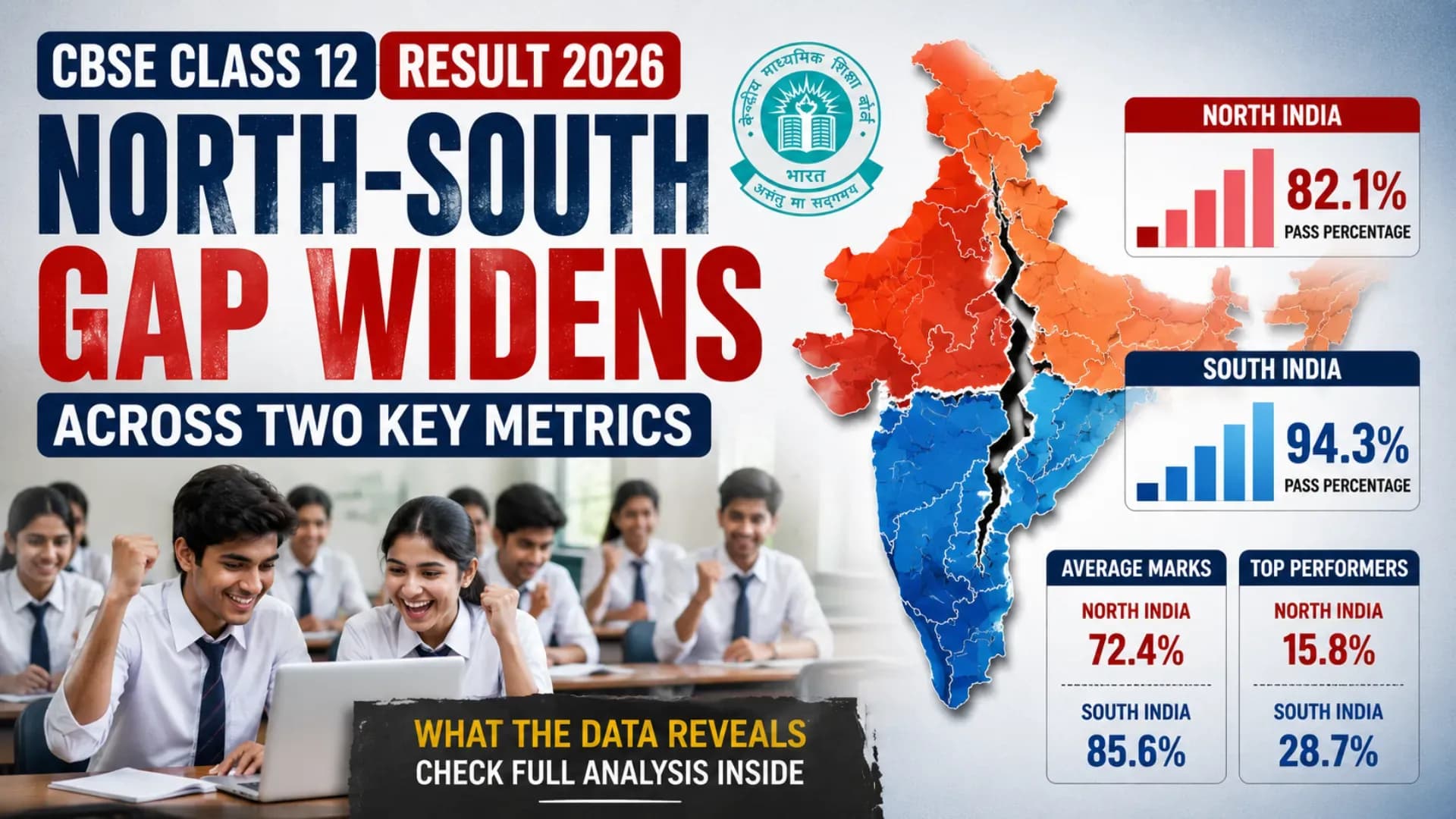
The CBSE Class 12 result 2026 has revealed a striking and deepening divergence between northern and southern states across two critical performance metrics — overall pass percentage and average aggregate scores. A detailed CBSE result analysis of the region-wise data released by the Central Board of Secondary Education shows that the CBSE North South gap has widened compared to the previous three examination cycles, raising urgent questions about the structural factors driving education inequality India's most-tracked board exam is now documenting with increasing clarity. The CBSE academic data 2026 places southern states — particularly Kerala, Tamil Nadu, Andhra Pradesh, and Telangana — significantly ahead of several northern states in both pass percentage and top-scorer concentration, a trend that board exam trends researchers have been tracking with growing concern for the past five years. Full CBSE statistics and the complete Class 12 board analysis are available through the official board portal, with regional breakdowns forming a critical part of the 2026 result documentation.
Key Highlights
- CBSE Class 12 result 2026 data reveals widening CBSE North South gap in two key performance metrics
- Southern states lead significantly in pass percentage — confirmed in official CBSE academic data 2026
- CBSE result analysis shows top-scorer concentration is markedly higher in Kerala, Tamil Nadu, and Andhra Pradesh
- CBSE performance comparison across regions exposes structural education inequality that three consecutive cycles have now documented
- Regional education trends India experts flag infrastructure, teacher quality, and coaching culture as primary drivers
- CBSE statistics also show girls outperforming boys nationally — a trend that holds across both northern and southern regions
- Board exam trends analysis calls for policy intervention to address the widening gap before the next academic cycle
Explore This: JEE Mains Exam Guide
Why It Matters
The CBSE North South gap documented in the CBSE Class 12 result 2026 is not merely a statistical curiosity — it has direct and consequential implications for higher education access, competitive examination outcomes, and the life trajectories of millions of students. When southern states consistently produce significantly higher pass percentages and top-scorer concentrations, their students arrive at undergraduate admissions — particularly merit-based processes like CUET — with a structural advantage that compounds over time. The CBSE performance comparison data points to systemic factors in regional education trends India that require policy-level responses rather than individual student-level interventions — making this analysis one of the most important outputs of the CBSE academic data 2026 release.
What Happened: CBSE Class 12 Result 2026 — North-South Gap Analysis
The official CBSE Class 12 result 2026 release included regional and state-wise performance breakdowns that education researchers have used to conduct a detailed CBSE result analysis of north-south performance differentials. The data shows that southern states have recorded an average pass percentage significantly above the national mean, while several northern and central states — including Uttar Pradesh, Bihar, Rajasthan, and Madhya Pradesh — have recorded pass percentages below the national average for the third consecutive cycle. The CBSE North South gap in the top-scorer bracket (students scoring above 90%) is even more pronounced, with southern states producing a disproportionately large share of the national high-scorer pool relative to their total candidate numbers.
The CBSE performance comparison across the eight regional boards reveals that the Thiruvananthapuram, Chennai, and Hyderabad regions have consistently outperformed the Prayagraj, Patna, and Ajmer regions across all five major subjects — a pattern that CBSE statistics researchers note has been strengthening rather than stabilising over the past five years. This Class 12 board analysis also identifies Mathematics and Science as the subjects where the north-south differential is most acute — with southern region students averaging significantly higher scores in these high-weightage subjects that are most consequential for competitive entrance exam performance.
Education policy analysts examining the CBSE academic data 2026 point to several structural factors as primary drivers of the CBSE North South gap — including significant differences in state-level investment in school infrastructure, teacher qualification and retention rates, the quality and density of supplementary educational support available outside the classroom, and the cultural prioritisation of academic achievement that varies meaningfully across regional education trends India research has consistently documented. The board exam trends emerging from this cycle strongly suggest that addressing education inequality India's board examination system is producing requires intervention at the structural and systemic level — particularly in teacher training, school infrastructure, and learning support access in underperforming northern states.
Related News: CUET UG Exam Guide
Key Details Table
| Particulars | Details |
|---|---|
| Data Source | CBSE Class 12 Result 2026 — Official Regional Breakdown |
| CBSE North South Gap — Metric 1 | Overall Pass Percentage — Southern States Significantly Above National Average |
| CBSE North South Gap — Metric 2 | Top Scorer Concentration (90%+) — Disproportionately High in South |
| Top Performing Regions | Thiruvananthapuram, Chennai, Hyderabad CBSE Regions |
| Below Average Regions | Prayagraj, Patna, Ajmer CBSE Regions — 3rd Consecutive Cycle |
| Subject Gap | Most Acute in Mathematics & Science — CBSE Academic Data 2026 |
| Gender Trend | Girls Outperform Boys Nationally — Consistent Across Both Regions |
| Education Inequality Driver | Infrastructure, Teacher Quality, Supplementary Support Access |
How to Access CBSE Class 12 Result 2026 Regional Data
- Visit the official CBSE portal at cbseresults.nic.in for individual student results
- Access the official CBSE press release at cbse.gov.in for full regional CBSE statistics and CBSE academic data 2026
- The CBSE performance comparison data by region and state is available in the result notification document
- Individual student scorecards for Class 12 board analysis reference can be downloaded via DigiLocker
- Re-evaluation and compartment exam notifications will be published at cbse.gov.in within 48 to 72 hours of result declaration
What's Next
Following the release of the CBSE Class 12 result 2026 regional data, education policy bodies are expected to commission detailed CBSE result analysis reports examining the structural drivers of the CBSE North South gap. The National Education Policy 2020 framework specifically addresses regional education trends India has documented across consecutive board cycles — and the CBSE academic data 2026 provides new and urgent evidence for the implementation of its equity-focused recommendations. Monitoring the response of state education departments to this board exam trends data will be critical to assessing whether the policy conversation produces concrete interventions or remains at the level of observation. Track all CBSE statistics and education inequality India policy developments on College Nirnay for ongoing coverage.
📌 Expert Analysis
Education researchers reviewing the CBSE Class 12 result 2026 regional data note that the CBSE North South gap is not primarily a reflection of student capability differences — it is a reflection of the dramatically unequal resource and support environments in which students across different regions prepare for the same examination. The CBSE performance comparison data is most accurately read as a measurement of systemic educational investment rather than individual student potential. Experts in regional education trends India call for three specific interventions: equalising teacher qualification standards across states, increasing access to quality supplementary learning support in underperforming districts, and revising the CBSE statistics reporting format to track cohort-level progress rather than only point-in-time examination outcomes. The board exam trends data from 2026 makes a compelling case that education inequality India cannot be addressed by improving examination administration alone — it requires sustained, targeted investment in the conditions under which students prepare.
Stop Stressing. Start Applying.
Skip the chaos of filling endless forms. Apply to your dream colleges in one go through the College Nirnay Common Application Form — built for every student navigating India's competitive education landscape.
Fill the Common Application Form →✓ Free to apply · ✓ Takes under 5 minutes · ✓ Trusted by thousands of students
FAQs
Q1. What does the CBSE North South gap in the 2026 result mean?
The CBSE North South gap in the CBSE Class 12 result 2026 refers to the documented difference between the pass percentage and top-scorer concentration of southern states compared to northern and central states. This CBSE result analysis shows southern CBSE regions consistently outperforming northern ones across multiple metrics — a trend that three consecutive cycles of CBSE academic data have now confirmed and that education inequality India researchers identify as a structural rather than cyclical phenomenon.
Q2. Which regions performed best in CBSE Class 12 result 2026?
According to the CBSE performance comparison data in the CBSE academic data 2026, the Thiruvananthapuram, Chennai, and Hyderabad CBSE regional offices recorded the highest overall pass percentages and top-scorer concentrations. The Prayagraj, Patna, and Ajmer regions recorded below-average outcomes for the third consecutive cycle — a board exam trends pattern that education policy researchers are calling for urgent intervention to address.
Q3. What are the key board exam trends revealed by the 2026 CBSE result analysis?
The key board exam trends from the CBSE result analysis include: a widening CBSE North South gap in pass percentage and top-scorer data; girls outperforming boys nationally for a consecutive cycle; the Mathematics and Science score differential being the largest across all subjects; and the structural factors driving education inequality India remaining unaddressed despite three consecutive cycles of CBSE statistics documenting them.
Q4. Where can I access the full CBSE academic data 2026 regional breakdown?
The complete CBSE academic data 2026 regional breakdown, including the CBSE performance comparison by state and region, is available in the official CBSE press release published on cbse.gov.in alongside the CBSE Class 12 result 2026 declaration. The CBSE statistics document includes state-wise pass percentage, subject-wise averages, and category and gender performance breakdowns for all eight CBSE regional offices.
Explore More
Stay updated with the latest CBSE Class 12 result 2026 analysis, CBSE statistics, regional performance data, and all board exam trends coverage on College Nirnay — India's most reliable source for educational news and analysis.