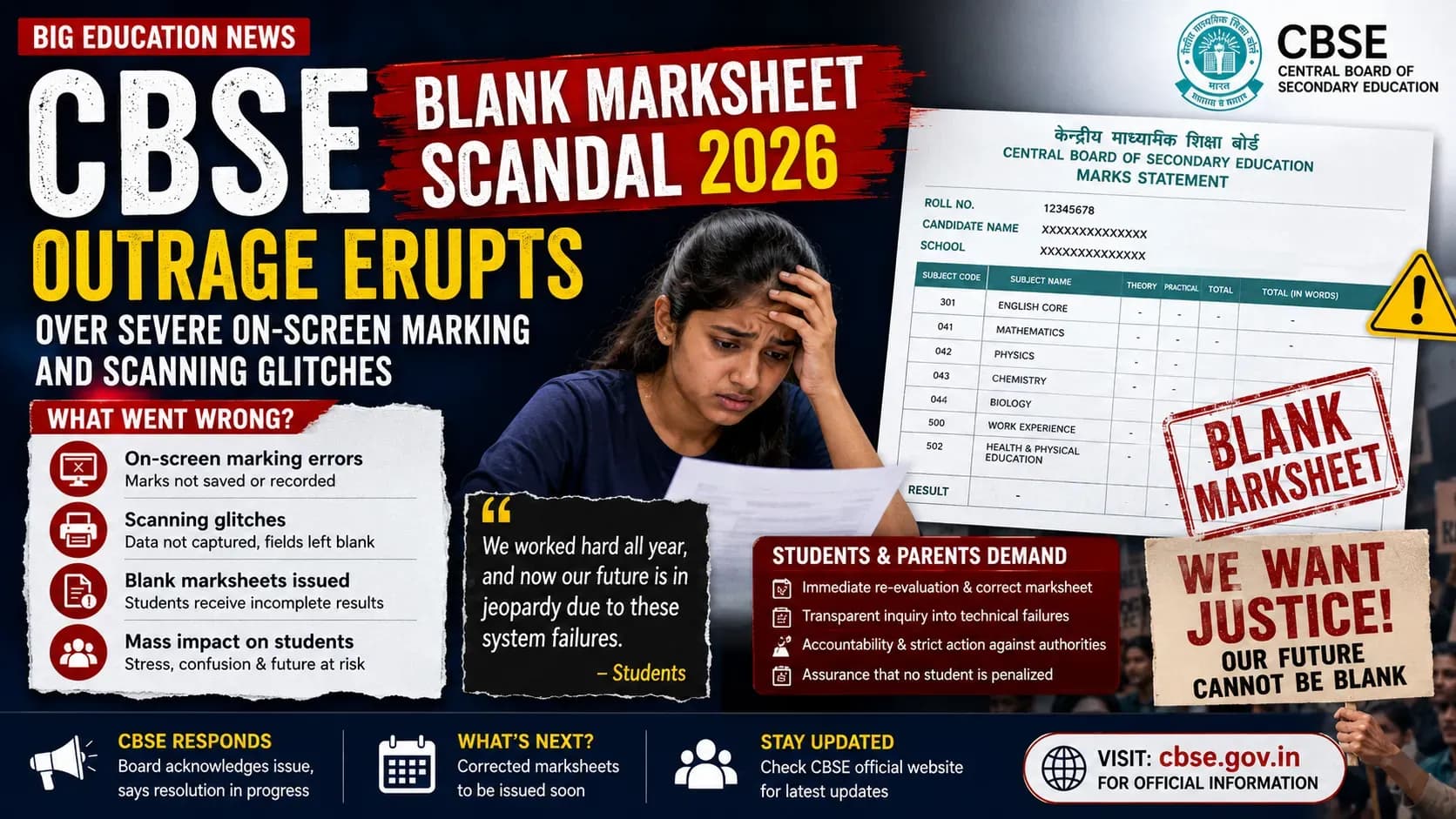
CBSE Blank Marksheet Scandal 2026 — Outrage Erupts Over On-Screen Marking Failures and Scanning Glitches Affecting Hundreds of Students
A serious CBSE OSM Controversy has erupted in 2026 following reports from multiple states that students received CBSE Blank Marksheet 2026 documents — marksheets with one or more subjects showing zero marks not because the student failed to answer, but because a CBSE Scanning Glitch or On Screen Marking CBSE system failure resulted in the answer sheet being either unreadable by the evaluation software, partially scanned, or not transferred correctly to the examiner. The CBSE Evaluation Error has triggered widespread anger among students and parents, with several social media campaigns, school-level complaints, and formal representations to CBSE's regional offices demanding immediate correction. For many students, the CBSE Result Issue 2026 has directly affected their ability to apply for college admissions, CUET-based university applications, and competitive exam eligibility — making this not merely an administrative error but a life-affecting outcome. This CBSE Latest News page covers the full scope of the CBSE Blank Marksheet 2026 issue, what the CBSE OSM Controversy reveals about the On Screen Marking system, what affected students must do urgently, and the status of CBSE Revaluation 2026 as the primary corrective pathway.
Key Highlights
- CBSE Blank Marksheet 2026 — students receiving zero marks in subjects they wrote due to OSM and scanning failures
- CBSE OSM Controversy — On Screen Marking system failures: scanning glitches, unreadable answer sheets, partial scanning
- CBSE Scanning Glitch — answer sheets scanned incorrectly or incompletely; examiner receives blank or corrupted digital file
- CBSE Evaluation Error affects Class 10 and Class 12 students across multiple states — result directly impacted
- CBSE Result Issue 2026 — admission eligibility, CUET applications, and scholarship access disrupted for affected students
- On Screen Marking CBSE — the centralised digital evaluation system now under scrutiny for systemic quality gaps
- CBSE Revaluation 2026 is the primary corrective pathway — affected students must apply immediately at cbse.gov.in
- CBSE Student Protest — organised demands for emergency correction outside the standard revaluation timeline
Explore This: JEE Mains Exam Guide
What Happened — The CBSE Scanning Glitch and OSM Failure Explained
The CBSE Scanning Glitch at the centre of the CBSE OSM Controversy relates to the board's centralised On Screen Marking system — the digital evaluation infrastructure introduced by CBSE to modernise and standardise the marking of Class 10 and Class 12 answer sheets. Under On Screen Marking CBSE, physical answer sheets are scanned at centralised scanning centres, the digital files are uploaded to the OSM portal, and qualified examiners evaluate the scanned images on screen rather than marking physical papers directly.
The CBSE Evaluation Error in 2026 appears to have occurred at multiple stages of this digital pipeline. In several documented cases, answer sheets were scanned with technical defects — pages missing from the scan, ink not registering on the digital copy due to light-coloured writing or scanner calibration failures, or entire answer sheets being assigned to the wrong registration number in the upload process. In other cases, the CBSE Scanning Glitch resulted in a blank or illegible digital file being presented to the examiner — who, following protocol, could not award marks for content they could not see. The student's physical answers existed, were written, and were present in the answer booklet — but the On Screen Marking CBSE system failed to accurately digitise and transmit them.
The result: students received a CBSE Blank Marksheet 2026 with zero in one or more subjects — a score that in the physical answer sheet would correspond to a student who had not written a single word. The disconnection between the physical reality (a completed answer booklet) and the digital record (a blank or corrupted scan) is the core of the CBSE OSM Controversy — and the source of the outrage driving the CBSE Student Protest movement.
🔴 CBSE Latest News — OSM Controversy Live Updates
📋 Scale of the Issue
Reports of CBSE Blank Marksheet 2026 cases have emerged from multiple states including Delhi, Uttar Pradesh, Rajasthan, Maharashtra, and Tamil Nadu. The reported cases span both Class 10 and Class 12 — and multiple subjects including Mathematics, Science, English, and Social Science. The exact number of affected students has not been officially confirmed by CBSE. Affected students and parents are encouraged to document their complaint formally through CBSE's regional office and the cbse.gov.in grievance portal.
📣 CBSE Student Protest
The CBSE Student Protest has taken several forms — organised demonstrations at CBSE regional offices, social media campaigns (#CBSEBlankMarksheet, #CBSEScanningGlitch trending nationally), and formal written representations from school principals and parent associations to CBSE headquarters and the Ministry of Education. Students and families have demanded: (1) emergency out-of-cycle correction for scanning glitch cases without requiring the standard revaluation process; (2) CBSE to conduct a physical answer sheet audit for all zero-mark cases; (3) admission deadlines to be extended for affected students while corrections are pending.
📊 CBSE's Response
CBSE has acknowledged receiving complaints about CBSE Evaluation Error cases related to the On Screen Marking CBSE system and has indicated that cases where scanning failures are verified through physical answer sheet inspection will be corrected. CBSE has directed affected students to apply for CBSE Revaluation 2026 — which includes the photocopy of answer sheet request — at cbse.gov.in as the immediate corrective pathway. The board has also stated that physical answer sheets are retained for a specified period after results and can be retrieved for verification. All CBSE Latest News on CBSE's official response and correction timelines tracked here.
⏰ Admission Impact
The CBSE Result Issue 2026 is particularly severe for students whose zero-mark subject directly affects their qualifying aggregate for college admissions. Students applying through CUET for central university undergraduate programmes, state university direct admissions, and board-percentage-based admissions at private institutions are all directly impacted — the CBSE Blank Marksheet 2026 creates an incorrect academic record that must be corrected before any admission can be finalised on legitimate marks. CBSE and the Ministry of Education have been urged to issue a notification to universities and colleges to hold admission decisions for students with verified scanning error complaints.
Related News: CUET UG Exam Guide
📋 What Affected Students Must Do — Urgent Action Guide
Step 1 — Apply for Photocopy of Answer Sheet at cbse.gov.in IMMEDIATELY
The most important immediate action for any student who received a CBSE Blank Marksheet 2026 or a zero in a subject they know they wrote: apply for the photocopy of the evaluated answer sheet at cbse.gov.in within the CBSE Revaluation 2026 application window. The photocopy request gives you access to the scanned digital file that the examiner received — and if that file is blank, partially scanned, or shows your answer sheet with someone else's registration number, it provides physical evidence of the CBSE Scanning Glitch. This documented proof is the foundation of any subsequent correction claim.
Step 2 — Apply for CBSE Revaluation 2026 Simultaneously
Apply for CBSE Revaluation 2026 (Re-evaluation of answers) for the affected subject at cbse.gov.in. For scanning glitch cases, re-evaluation triggers a physical answer sheet retrieval and re-marking — the examiner should be presented with the original physical booklet (not the defective scan) for re-evaluation. This is the pathway through which scanning errors are most likely to be corrected, because it requires the physical answer sheet to be retrieved and evaluated by a fresh examiner. The risk of marks decreasing (applicable to normal revaluation) may be lower in verified scanning glitch cases — but this is subject to CBSE's discretion and the specific case. Apply regardless.
Step 3 — File a Formal Complaint at the CBSE Regional Office
In addition to the cbse.gov.in portal application, file a written formal complaint at your CBSE regional office — in person if possible, by registered post otherwise. The complaint should include: your name, roll number, school code, subject and question paper code of the affected subject, the marks received (zero), a statement that you completed the answer sheet, and a request for physical answer sheet retrieval and emergency correction outside the normal revaluation timeline given the documented scanning failure. Keep all receipts and acknowledgements.
Step 4 — Contact Your School's Principal for Institutional Support
School principals can file institutional-level representations to CBSE on behalf of affected students — and institutional complaints carry more weight in CBSE's regional review process than individual student complaints. Request your school principal to formally notify CBSE of the CBSE Evaluation Error and seek expedited review. Schools that have multiple affected students (indicating a centre-level scanning failure rather than an individual case) should present this as a collective complaint — centre-level scanning failures are more readily acknowledged and corrected by CBSE.
Step 5 — Notify Target Colleges and Universities of the Pending Correction
If you have applied or are applying to colleges and universities, notify their admissions office of the CBSE Result Issue 2026 affecting your marksheet and that a formal correction application is pending at CBSE. Provide a copy of your cbse.gov.in application confirmation as documentation. Most institutions — particularly central universities and larger private universities — have provisions for admissions on provisional basis pending board correction of documented errors. Escalate to the Ministry of Education or the CBSE helpdesk (1800 11 7002) if institutions refuse to engage with your pending correction status.
🚨 Time is critical: Both the CBSE Revaluation 2026 application window and admission deadlines are running simultaneously. Apply for photocopy and revaluation at cbse.gov.in today. Do not wait for one process to complete before beginning the other. Every day of delay reduces the time available for correction before admissions close.
What Is the CBSE OSM System and Why Did It Fail?
The On Screen Marking CBSE system was designed to modernise CBSE's answer sheet evaluation by centralising the marking process digitally. Under OSM: answer booklets written by students during the board examination are collected and transported to designated scanning centres; trained scanning operators digitise every page of every booklet; the digital files are uploaded to CBSE's secure OSM server; qualified examiners log in from anywhere in the country and evaluate the scanned images on screen; marks are directly entered into the digital system and aggregated automatically; and the final marks are transferred to the result database. The advantages of OSM — reduced physical handling, geographic flexibility for examiners, standardised interface — are genuine. So are the risks: every step in the digital pipeline is a potential point of failure that did not exist when physical markbooks were handled directly.
The CBSE OSM Controversy in 2026 reveals that quality control at the scanning stage — the most hardware-dependent and operator-dependent stage in the entire chain — was insufficient for the scale of CBSE's operations. With approximately 35 lakh students appearing in Class 10 and Class 12 combined, even a 0.01% scanning failure rate would affect 3,500 students. The CBSE Scanning Glitch reports suggest the failure rate may have been higher in specific scanning centres — raising questions about scanner maintenance, operator training, quality verification protocols (was each scanned file cross-checked against the physical booklet page count?), and escalation mechanisms when technical errors were detected.
The CBSE OSM Controversy also highlights a structural accountability gap: when physical marking occurs, the examiner's handwriting on the physical answer sheet is a direct record of what was evaluated. When On Screen Marking CBSE occurs, the examiner's marks are entered digitally against a digital file — and if that digital file was defective, there is no easy way for the examiner to know that the student wrote content that failed to scan. Examiners seeing a blank scan have no independent way to verify whether the blank scan represents a student who wrote nothing or a scanning failure. This is the system-level design gap that the CBSE Blank Marksheet 2026 scandal has exposed.
What's Next — CBSE's Path Forward on OSM Reform
Following the CBSE OSM Controversy: CBSE is expected to conduct an internal audit of scanning centre operations, review quality control protocols for the On Screen Marking CBSE system, and implement corrective measures for affected students through the CBSE Revaluation 2026 pathway. Long-term systemic responses — mandatory cross-verification of page counts between physical booklets and digital scans, automated blank-page detection that flags suspected scanning errors before evaluation, and a dedicated rapid-correction pathway for documented scanning failures — have been demanded by education bodies and the CBSE Student Protest movement. All CBSE Latest News on CBSE's official response, correction outcomes for affected students, and OSM system reform will be published on this page as confirmed by CBSE at cbse.gov.in.
📌 Expert Analysis
Education policy analysts examining the CBSE Blank Marksheet 2026 issue identify it as a systemic risk that was predictable — and preventable. The transition from physical to digital evaluation is irreversible and broadly beneficial. But the CBSE OSM Controversy demonstrates that CBSE did not implement adequate quality assurance at the scanning stage — the single most critical point in the OSM chain where a failure has downstream consequences across the entire evaluation pipeline. A mandatory post-scan verification step — confirming that the page count of the scanned file matches the physical booklet, and that the registered number on the scan matches the booklet — would catch the majority of CBSE Scanning Glitch cases before they reach examiners.
For affected students, the most important observation: the CBSE Revaluation 2026 pathway exists and will — in verified scanning failure cases — result in correction. The process takes time, and the collision of correction timelines with admission deadlines is a genuine hardship. But the corrective mechanism is there. The CBSE Result Issue 2026 is not permanent — it is a documented error in a traceable system with a physical answer sheet that can be retrieved, re-evaluated, and corrected. The urgency is real; the permanence of the error is not. Apply through cbse.gov.in, document everything, and engage your school, CBSE regional office, and target institutions simultaneously. All CBSE Latest News on correction outcomes tracked here.
FAQs
Q1. I received a blank marksheet with zero in a subject I wrote — what is my immediate next step?
Apply for both (a) the Photocopy of Answer Sheet and (b) CBSE Revaluation 2026 at cbse.gov.in today. Do both simultaneously — do not wait for one to complete before applying for the other. The photocopy gives you the scanned file evidence; the revaluation triggers retrieval of the physical answer sheet for re-evaluation. Simultaneously file a written complaint at your CBSE regional office and request your school principal to send an institutional complaint to CBSE. Notify your target colleges of the pending CBSE Result Issue 2026 correction. Call CBSE's helpdesk at 1800 11 7002 to register your case verbally. Do all of this today — the CBSE Blank Marksheet 2026 correction process requires simultaneous action on multiple fronts.
Q2. How does the CBSE OSM Controversy affect my admission to college?
The CBSE OSM Controversy and resulting CBSE Blank Marksheet 2026 can directly affect your college admission if the zero mark reduces your aggregate below eligibility thresholds — for CUET, state board admissions, or private college percentage-based cutoffs. Notify your target institutions of the pending CBSE Revaluation 2026 application and the documented CBSE Scanning Glitch affecting your result. Provide your cbse.gov.in application confirmation as documentation. Most institutions have provisional admission provisions for documented board-side errors. The Ministry of Education and UGC have been urged by education bodies to issue guidance to universities to hold admissions for verified scanning error cases — follow all CBSE Latest News on this here.
Q3. What is the CBSE OSM system and why did the scanning glitch happen?
On Screen Marking CBSE is the board's centralised digital evaluation system — answer sheets are scanned and evaluated by examiners on screen rather than physically. The CBSE Scanning Glitch in 2026 occurred when answer booklets were scanned with technical defects at centralised scanning centres — resulting in blank, incomplete, or incorrectly registered digital files being presented to examiners. Examiners evaluating a blank or corrupted scan cannot award marks for content they cannot see — producing a zero in the digital record even when the student wrote a complete answer. The CBSE Evaluation Error is a technology infrastructure failure, not an examiner error. The physical answer sheet exists and can be retrieved for re-evaluation through the CBSE Revaluation 2026 process.
Q4. Will CBSE correct the blank marksheet error without requiring revaluation?
CBSE has indicated that verified scanning failure cases will be corrected — but the correction pathway is through the formal CBSE Revaluation 2026 process at cbse.gov.in, not through an automatic administrative correction. This means affected students must apply and document their case. The CBSE Student Protest movement has demanded an emergency correction pathway outside the standard revaluation timeline for documented scanning failures — CBSE's response to this demand is being tracked. Whether CBSE will create a separate fast-track mechanism or require affected students to go through the standard revaluation process is a key CBSE Latest News development. Apply through the existing pathway at cbse.gov.in now and follow developments here.
Q5. Can my marks decrease through the CBSE Revaluation 2026 process for a scanning glitch case?
The CBSE Revaluation 2026 process normally carries the risk of marks either increasing or decreasing — because a second examiner independently marks all answers. However, for a CBSE Blank Marksheet 2026 case caused by a CBSE Scanning Glitch — where the current mark is zero due to an unreadable scan, not due to the student writing nothing — the physical answer sheet re-evaluation should result in the student receiving marks for what they actually wrote. Starting from zero, the outcome of re-evaluation is almost certain to be higher than the current mark. The risk of marks decreasing below the current zero is essentially absent in a genuine scanning failure case. Apply for CBSE Revaluation 2026 through cbse.gov.in and pursue the photocopy application simultaneously as documented evidence.
Explore More
The CBSE Marksheet Error at the heart of this crisis is a CBSE Marksheet Error caused by systemic scanning failure — not by examiner discretion. Documenting and reporting each CBSE Marksheet Error case through the formal pathway is the only route to correction. Stay with College Nirnay for all CBSE Latest News — CBSE Blank Marksheet 2026 correction updates, CBSE OSM Controversy investigation outcomes, CBSE Revaluation 2026 correction timelines, CBSE Student Protest developments, and all CBSE Result Issue 2026 and CBSE Evaluation Error resolution news from CBSE at cbse.gov.in.