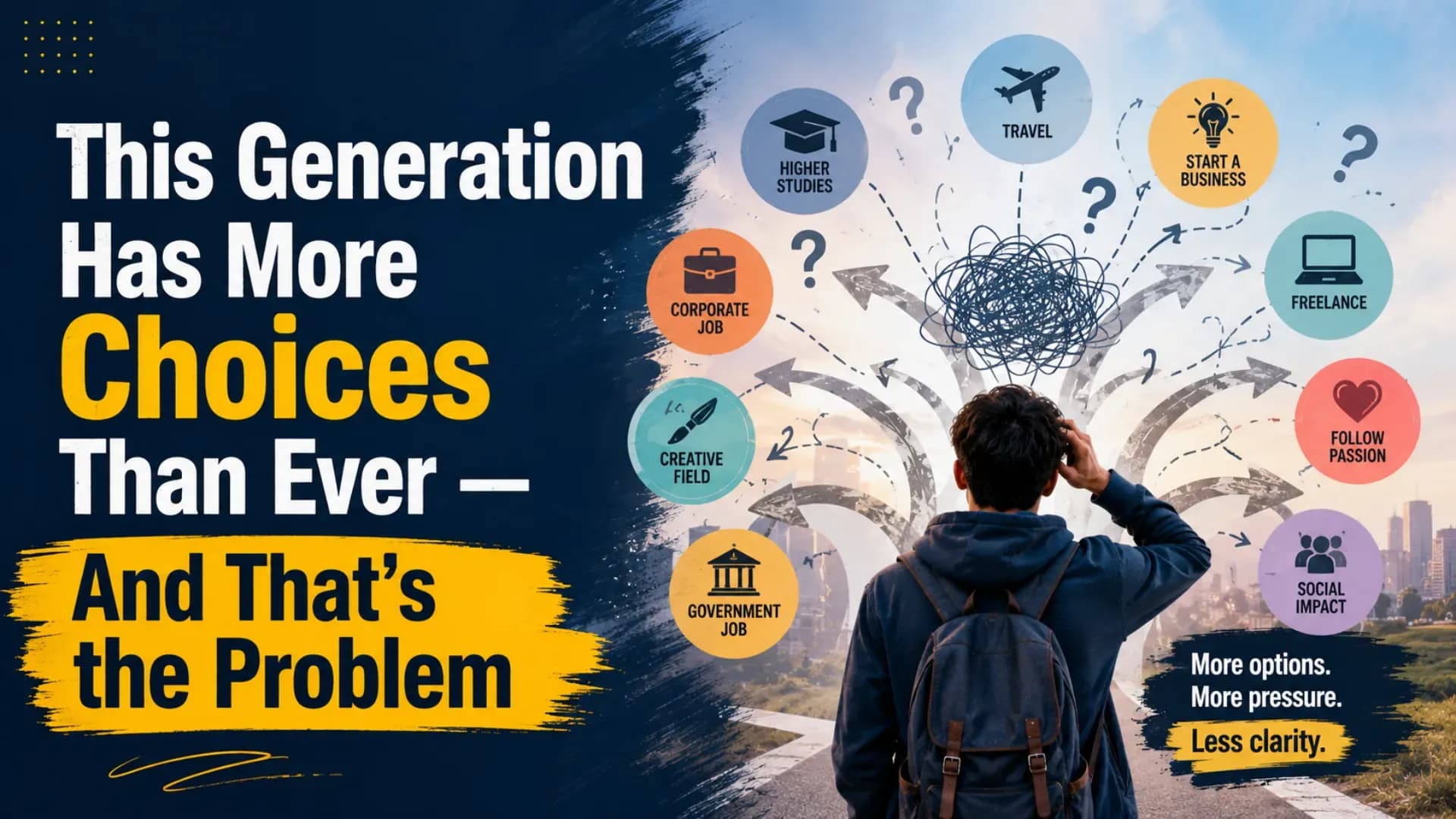
This Generation Has More Choices Than Ever — And That's the Problem
Introduction
There is a quiet crisis happening among young people in India — and it is not caused by too few opportunities. It is caused by too many. Too many career choices, too many platforms, too many versions of success being presented simultaneously, and absolutely no framework for deciding between them. The result is a generation experiencing student decision fatigue on a scale that has no real historical precedent — and a level of career confusion 2026 that is being pathologised as personal weakness when it is actually a structural problem created by the information environment these students were handed.
The psychology of choices is unambiguous on one fundamental point — beyond a certain threshold, more options do not produce more freedom. They produce more anxiety, more paralysis, and more dissatisfaction with whatever you eventually choose. This is not a fringe theory. It is one of the most replicated findings in cognitive and behavioural psychology, and it describes the lived experience of Gen Z career confusion with remarkable accuracy. The choice overload psychology that researchers have documented in consumer behaviour studies applies with equal force — perhaps greater force — to the most consequential decisions young people make: what to study, what career to pursue, and who they want to become.
This blog is an honest examination of why abundance of choice has become a source of student anxiety and student mental stress rather than liberation — and what the modern student problems created by choice overload actually look like in the daily lives of students navigating career pressure students face in India in 2026. If you have ever felt more stuck the more you researched, more anxious the more you explored, more confused the harder you tried to decide — this blog explains why, and what you can actually do about it.
Quick Highlights
| Key Aspect | Details |
| Who This Is For | Students experiencing student decision fatigue and career confusion 2026 |
| Core Insight | Choice overload psychology — more options create more anxiety, not more freedom |
| Psychological Framework | Barry Schwartz's Paradox of Choice + Gen Z career confusion research |
| Modern Student Problems | Information overload, social comparison, algorithm-driven anxiety |
| Career Pressure Students Face | Unprecedented — multiple choices, no framework, maximum consequence |
| Solution Direction | Deliberate constraint, values-based filtering, structured elimination |
Table of Contents
- The Paradox of Choice — Why Abundance Creates Paralysis
- How Algorithms Made Career Confusion Worse
- The Social Comparison Engine — Everyone Else Seems to Know
- Gen Z Career Confusion — A Uniquely Modern Problem
- Decision Fatigue Is Real — And It Gets Worse With Time
- From Student Anxiety to Student Mental Stress — When Confusion Becomes Chronic
- The Counter-Intuitive Solution — Choose Less, Commit More
- FAQs
- Conclusion
The Paradox of Choice — Why Abundance Creates Paralysis
In 2004, psychologist Barry Schwartz published a book that named something millions of people were already experiencing without knowing what to call it. The paradox of choice — the finding that more options reliably produce more anxiety, more decision paralysis, and more dissatisfaction with final choices — has since been replicated across dozens of research contexts. And while the original research focused on consumer decisions (jam varieties, mutual funds, medical treatments), the choice overload psychology it describes applies with particular intensity to too many career choices — which are arguably the highest-stakes decisions most young people will ever make.
The mechanism behind choice overload is well understood. When options are few, the mind can evaluate them systematically and arrive at a decision with reasonable confidence. When options multiply beyond a cognitive threshold — researchers suggest this is approximately 7 to 12 meaningful alternatives — the evaluation process breaks down. The mind cannot hold all options in working memory simultaneously, cannot reliably compare them, and experiences the decision as overwhelming rather than empowering. The result is either impulsive selection (choosing quickly to escape the discomfort) or avoidant non-decision (indefinitely deferring the choice) — neither of which produces good outcomes for students navigating career confusion 2026.
For Indian students in 2026, the relevant choice set is not 12 options — it is hundreds. Hundreds of degree programmes, thousands of job titles, dozens of industries, and an entire internet presenting every single one of them as equally viable, equally important, and equally worthy of serious consideration. The student decision fatigue this produces is not a character flaw — it is the mathematically predictable outcome of asking a human cognitive system to perform an evaluation task that exceeds its architectural capacity. The career pressure students feel is real, and its root cause is not their inability to decide — it is the volume and structure of what they are being asked to decide between.
Related Article: Best Free AI Tools for Students in 2026
How Algorithms Made Career Confusion Worse
The problem of too many career choices existed before social media — but algorithms made it dramatically worse. The recommendation engines that power YouTube, Instagram, LinkedIn, and every major content platform are not designed to help users make better decisions. They are designed to maximise engagement — which means they actively surface content that creates emotional responses, including excitement, aspiration, and anxiety. For students already experiencing career confusion 2026, the algorithm is reliably making things worse.
Exactly how algorithms amplify student decision fatigue and career pressure:
- Every time a student watches a video about a career option, the algorithm shows them three more — expanding rather than narrowing the choice set with every interaction, producing a spiral of too many career choices that is specifically designed never to resolve
- The content that performs best on career-adjacent platforms is aspirational and exceptional — the 22-year-old making ₹10 lakh per month, the student who got into IIT despite "everything against them" — which creates a severely distorted picture of what is typical and what is achievable, compounding student anxiety about one's own trajectory
- Career content algorithms do not distinguish between relevant and irrelevant options for a specific user — a student who has expressed interest in medicine will be shown content about law, design, data science, and entrepreneurship within the same session, actively working against any narrowing of focus
- The infinite scroll design of every major platform eliminates the natural stopping points that human decision-making processes require — producing the chronic, unresolved student decision fatigue that students describe as feeling like they can always find one more thing to consider before deciding
- For Gen Z career confusion specifically, algorithms have created a form of ambient career anxiety that previous generations did not experience — a constant background noise of other people's career choices, successes, and pivots that makes any individual's own path feel perpetually uncertain by comparison
The most important and most counter-intuitive piece of advice for students experiencing algorithm-driven career confusion 2026 is to actively consume less career content — not more. Every additional video about a career option expands the problem. What resolves it is not more content about more options but structured engagement with fewer, more carefully selected options through real-world experience.
The Social Comparison Engine — Everyone Else Seems to Know
One of the most specific and painful dimensions of modern student problems around career choice is the experience of watching everyone else appear to have it figured out while you remain uncertain. Social media has created a permanent social comparison engine that runs continuously in the background of every student's cognitive life — and it is almost entirely responsible for converting normal career uncertainty into student anxiety and shame.
Why the social comparison engine is particularly damaging for students facing too many career choices:
- Social media presents exclusively the committed, successful version of everyone else's career journey — the internship accepted, the college admitted to, the startup launched — while the uncertainty, doubt, and false starts that preceded these moments are entirely invisible; this creates the false impression that everyone else moved directly from intention to achievement without the confusion that is actually universal
- LinkedIn's design is particularly problematic for Gen Z career confusion — it is an achievement amplification machine that makes every peer's career milestone visible while creating no visibility for the periods of uncertainty and exploration between those milestones
- The social comparison produced by this dynamic is not just emotionally painful — it is cognitively disorienting; when a student believes (incorrectly) that everyone else has chosen their career direction confidently while they remain uncertain, they interpret their own normal developmental uncertainty as personal pathology rather than normal experience
- This misinterpretation directly increases student mental stress and career pressure students self-impose — because the student now has not just the original career decision to make but also the additional burden of "catching up" to peers who appear to be further ahead on a path the student has not yet defined
The statistical reality — which social media makes invisible — is that the vast majority of students are experiencing the same uncertainty, the same comparison anxiety, and the same student decision fatigue that you are. The confident career certainty visible on social media is a carefully curated performance, not an accurate representation of the internal state of the people presenting it.
Gen Z Career Confusion — A Uniquely Modern Problem
Gen Z career confusion is qualitatively different from the career uncertainty experienced by previous generations — not because Gen Z is less capable or less motivated, but because the information environment they inhabit is categorically different. A student making career decisions in 1995 had access to perhaps 20 to 30 career options visible in their immediate social environment. A student making career decisions in 2026 has access to thousands — delivered through devices they carry at all times, curated by algorithms designed to maximise engagement rather than clarity, and framed within a social comparison context that makes every choice feel simultaneously inadequate and unreversible.
What makes Gen Z career confusion structurally unique:
- The volume problem — Gen Z students must evaluate a larger choice set with the same cognitive architecture as every previous generation; the human capacity for decision-making has not evolved to accommodate the information density of 2026, producing choice overload psychology as a structural baseline rather than an occasional experience
- The permanence illusion — Social media career content is dominated by success stories that appear permanent and definitive — "I left engineering to become a YouTuber and now I earn ₹40 lakh a year" — creating the impression that career choices are irreversible commitments rather than revisable decisions, which amplifies student mental stress around the initial choice
- The comparison speed — Previous generations compared themselves to their immediate social circle (perhaps 50 to 100 people). Gen Z students compare themselves simultaneously to thousands of curated profiles, a cognitive experience with no historical precedent and significant negative consequences for wellbeing and career confusion 2026
- The validation deficit — Every career choice a Gen Z student makes can instantly be shown, via a quick social media search, to be simultaneously validated and contradicted by different voices with equal apparent authority — making the experience of receiving useful guidance from the information environment nearly impossible
- The FOMO dimension — The visibility of every alternative career simultaneously creates the specific fear-of-missing-out that is one of the most consistent drivers of too many career choices paralysis in Gen Z — the sense that committing to any option means definitively losing access to all others
Decision Fatigue Is Real — And It Gets Worse With Time
Student decision fatigue is not a metaphor — it is a documented cognitive phenomenon with measurable effects on the quality of decisions made after extended periods of choice. Research consistently shows that the quality of decisions degrades progressively with the number of decisions made — meaning that students who have spent hours, days, or weeks researching career options without reaching a conclusion are making their career decisions in a state of severely compromised cognitive capacity.
How decision fatigue compounds career pressure for students in 2026:
- Each time a student evaluates and rejects a career option, the cognitive resources available for the next evaluation are slightly depleted — meaning that the student who has been "researching" for three months is making their final career decision with significantly fewer cognitive resources than they had at the beginning of the process
- Decision fatigue produces a specific pattern of decision-making shortcuts — either impulsive choices (accepting whatever feels easiest in the moment) or avoidance (defaulting to the most familiar or socially safe option regardless of genuine fit) — both of which are common outcomes of career confusion 2026 in its most prolonged forms
- The infinite information environment actively worsens student decision fatigue because it removes the natural stopping points that signal "enough information to decide" — making it technically possible to always research more, always find one more perspective, always encounter one more voice claiming that the currently favoured option is actually the wrong one
- Modern student problems around decision fatigue are compounded by the fact that career decisions do not exist in isolation — they must be made alongside equally consequential decisions about college, location, finances, and relationships, all of which draw on the same finite cognitive resource pool
From Student Anxiety to Student Mental Stress — When Confusion Becomes Chronic
There is an important distinction between temporary career uncertainty — which is normal, developmentally appropriate, and manageable — and the chronic, sustained state of student anxiety that prolonged choice overload produces. When career confusion 2026 becomes chronic rather than episodic, it crosses from a decision-making challenge into a mental health challenge — and the student mental stress that results is qualitatively different from ordinary uncertainty.
- Chronic student anxiety around career choices typically manifests as persistent low-level dread, difficulty concentrating on current academic work (because the future feels so unsettled), social withdrawal (avoiding conversations about careers and futures), and a generalised sense of inadequacy that extends beyond the career question itself
- The career pressure students feel from family compounds this anxiety by adding a social deadline to what is already a cognitively overwhelming decision — creating the specific combination of internal overload and external pressure that psychologists identify as among the most reliable producers of student mental stress
- When student decision fatigue reaches a severe level, the cognitive and emotional resources needed to engage productively with career exploration are precisely the ones that have been depleted — creating a self-perpetuating cycle in which the attempt to research and decide produces the exhaustion that makes further research and decision-making impossible
- Gen Z career confusion that has reached the level of chronic anxiety requires a different response than strategic career guidance — it requires acknowledgement of the psychological dimension, reduction of the information load, restoration of cognitive resources through rest and structure, and in many cases professional support before productive career exploration can resume
If you are experiencing persistent student mental stress related to career choices that feels beyond ordinary uncertainty, please consider speaking to a qualified counsellor or mental health professional. iCall (TISS) is available at 9152987821, and the Vandrevala Foundation helpline is reachable at 1860-2662-345.
The Counter-Intuitive Solution — Choose Less, Commit More
The solution to too many career choices is not to become better at evaluating all of them. It is to deliberately and aggressively reduce how many you are actively considering at any given time. This is the most counter-intuitive but also the most psychologically sound response to choice overload psychology — and it is the foundation of every effective approach to resolving career confusion 2026 that does not simply replace one form of overload with another.
Practical strategies for resolving choice overload and student decision fatigue:
- Implement a hard cap on your option set — Decide right now that you will evaluate a maximum of 3 to 5 career directions — and eliminate everything else from active consideration immediately; the psychological relief of this single act is immediate and significant; this is the most direct application of choice overload psychology research to career pressure students face
- Stop consuming career content for a defined period — Declare a 2-week moratorium on career-related YouTube videos, LinkedIn scrolling, and research deep-dives; the cognitive resources that currently go into processing an infinite stream of career information will become available for actual decision-making; this is the most effective immediate intervention for student decision fatigue
- Replace comparison with conversation — Instead of watching other people's curated career journeys on social media, speak directly to 3 to 5 real professionals in fields you are considering; unmediated, honest conversations about what work actually involves is incomparably more useful than any amount of social media career content for resolving Gen Z career confusion
- Use values as filters, not interest as a driver — Interests are highly susceptible to too many career choices overload because almost any career can be made to sound interesting in a well-produced video; values (autonomy, stability, creativity, impact, connection) are more durable filters that significantly narrow the relevant choice set when applied honestly
- Make a time-bounded commitment, not a permanent one — The fear of making the "wrong" permanent career choice is a primary driver of choice avoidance; committing to explore a specific direction for 6 months removes the permanence anxiety while producing the real-world experience needed to make genuinely informed choices about what comes next
The generation that has more choices than any before it needs not more tools for evaluating choices — it needs permission to choose fewer of them. The path through career confusion 2026 is not wider. It is narrower, clearer, and bounded by the honest recognition that human beings are simply not built to decide well between unlimited options, no matter how much information they have access to or how intelligent they are.
FAQs
Why do too many career choices cause student anxiety?
Too many career choices cause student anxiety through a well-documented psychological mechanism called choice overload — where the number of options exceeds the brain's capacity for systematic evaluation, producing decision paralysis, chronic uncertainty, and persistent dissatisfaction with whatever is eventually chosen. The choice overload psychology research of Barry Schwartz and subsequent researchers demonstrates this effect across multiple decision contexts, and it applies with particular force to career decisions because of their high stakes, perceived irreversibility, and the social comparison context created by social media.
What is student decision fatigue and how does it affect career choices?
Student decision fatigue is the cognitive depletion that results from extended exposure to a large number of choices without reaching a resolution. It progressively degrades decision quality — meaning that students who have been researching career options for months without deciding are making their eventual career choices with significantly impaired cognitive resources. This is a primary driver of career confusion 2026, particularly among students who believe that more research will eventually produce the clarity that structured elimination and real-world experience would produce far more reliably.
Is Gen Z career confusion different from previous generations?
Yes — qualitatively different. Gen Z career confusion occurs within an information environment that presents thousands of career options simultaneously through algorithm-driven platforms, creates continuous social comparison through LinkedIn and Instagram, and removes the natural stopping points that decision-making processes require. Previous generations navigated career decisions with a smaller, more manageable choice set and without the constant social comparison made possible by social media — making the modern student problems around career choice genuinely unprecedented in scale and intensity.
How can students overcome choice overload in career planning?
The most effective approaches to overcoming choice overload psychology in career planning involve deliberate reduction of the option set (hard cap of 3 to 5 active directions), temporary moratorium on career content consumption, values-based filtering (which narrows options more reliably than interest-based filtering), direct professional conversations instead of social media research, and time-bounded commitment to exploration. These strategies address the structural causes of too many career choices paralysis rather than simply encouraging more or better evaluation of the same overwhelming option set.
When does career confusion become a mental health concern for students?
Career confusion 2026 transitions from a decision-making challenge to a mental health concern when it becomes chronic rather than episodic — producing persistent student anxiety, difficulty functioning in current academic work, social withdrawal, and a generalised sense of inadequacy that extends beyond the career question. When student mental stress related to too many career choices reaches this level, professional mental health support — not more career guidance — is the appropriate first response. iCall (9152987821) and the Vandrevala Foundation helpline (1860-2662-345) provide accessible support for students in India.
Explore More
Conclusion
This generation has more choices than any before it — and that is genuinely both a privilege and a problem. The choice overload psychology is real, the student decision fatigue is real, and the Gen Z career confusion that results is not evidence of a generation that cannot commit — it is evidence of a generation navigating an information environment that was not designed for human decision-making and a social comparison context that makes normal uncertainty feel like exceptional failure.
The path through too many career choices is not to evaluate more carefully — it is to choose deliberately and aggressively less. Cap your options. Stop consuming career content for a defined period. Talk to real professionals instead of watching curated success stories. Filter by values rather than interests. Commit to exploration within a time boundary rather than seeking certainty before you begin. These are not simplistic suggestions — they are the specific, evidence-based responses to career confusion 2026 that the psychology of choices research actually supports. The student anxiety and student mental stress that choice overload produces are real — but so is the relief of deciding to decide, committing to a direction, and discovering that the clarity you were waiting for was available all along on the other side of a deliberate choice.