



Vivekananda Global University
97 Courses

Discover excellence across India's most prestigious universities. Find your perfect institutional match and start your journey toward a successful career today.
Discover top programs across Engineering, Management, and more to ensure success.
How We Help
Evaluate fees, rankings, and infrastructure side-by-side to find the institution that perfectly aligns with your goals.
Get personalized 1-on-1 guidance from Highly Experienced Mentors to navigate your admission journey and career roadmap.
Secure your future with specialized job assistance, interview preparation, and access to our global recruiter network.
Watch our informative videos to understand how we simplify your admission journey. Discover the tools and expert services designed to fuel your academic success.
Bridge the gap between education and industry. Connect with professionals to build a personalized career roadmap and gain insights that books can't teach.
Fuel your ambition with research-backed articles. Explore our library of course guides, exam strategies, and expert insights to shape your future.

Explore the complete KCET Counselling 2026 process, including registration, document verification, option entry, mock allotment, preference editing, final seat allotment, choice selection, fee payment, admission-order download and college reporting.

Explore Apex University Jaipur Admission 2026 details, including undergraduate, postgraduate, diploma and doctoral courses. Check programme-wise eligibility, fee structure, scholarship opportunities, entrance requirements, selection criteria, required documents and the complete application process.

Explore Parul University Vadodara Admission 2026 details for undergraduate, postgraduate and diploma programmes. Check available courses, programme-wise eligibility, fee structure, scholarship opportunities, selection requirements, required documents and the complete online application process.

Explore Banasthali Vidyapith Admission 2026 details for undergraduate and postgraduate programmes. Check available courses, programme-wise eligibility, fee structure, scholarship opportunities, entrance or aptitude-test requirements, selection process, required documents and application steps.
Be part of India's fastest-growing student network. Connect with a thriving community of learners and alumni who have successfully reached their career milestones at top global organizations.
Catch up on trending stories, exam updates, and expert insights shaping the future of education.
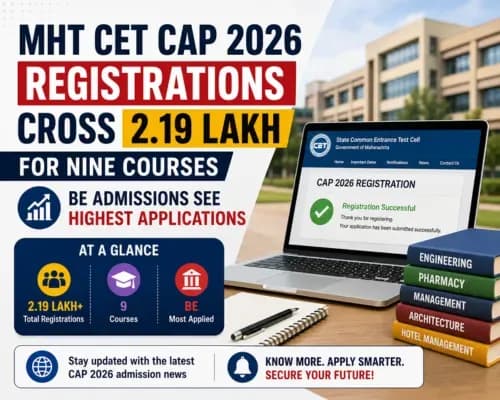
MHT CET CAP 2026 Registrations Cross 2.19 Lakh for Nine Courses; B.E. Admissions Receive the Highest Applications html{scroll-behavior:smooth;}summary::-webkit-details-marker{display:none;} MHT CET CAP 2026 Registrations Cross 2.19 Lakh for Nine Courses — B.E. Admissions Receive the Highest Applications The State Common Entrance Test Cell, Maharashtra, has reported that MHT CET CAP 2026 Registrations have crossed 2,19,000 across nine programmes covered under the Centralised Admission Process (CAP) for the 2026-27 academic year. The MHT CET 2.19 Lakh Registrations milestone was reported as of early July 2026, with the CAP registration window having opened July 2, 2026. Among all courses, Maharashtra B.E. Admission 2026 has received the highest number of applications — reflecting sustained demand for engineering at Maharashtra's government-aided and government autonomous institutions. Key Highlights MHT CET CAP 2026 Registrations — Crossed 2,19,000 across nine courses as of early July 2026 MHT CET CAP Counselling 2026 — CAP registration opened July 2, 2026; document verification at Facilitation Centres ongoing MHT CET 2.19 Lakh Registrations — Total registrations across all nine CAP courses; B.E./B.Tech highest; MBA/MMS next Maharashtra B.E. Admission 2026 — Highest application volume among all nine courses; driven by strong BTech demand across Maharashtra engineering colleges MHT CET B.Tech Admission — Based on MHT CET PCM percentile or JEE Main score; best of two MHT CET attempts used Maharashtra CAP Registration — Online at cetcell.mahacet.org; no registration fee; document verification mandatory at Facilitation Centre MHT CET Course-Wise Applications — Nine courses: B.E./B.Tech, MBA/MMS, MCA, M.E./M.Tech, B.Pharm, M.Pharm, B.HMCT, B.Arch, and Direct Second Year (Lateral Entry) MHT CET Merit List 2026 — Provisional merit list to be published after registration and document verification; grievance window precedes final merit list MHT CET Document Verification — At designated Facilitation Centres (FCs); required before provisional merit list generation; bring all originals + self-attested photocopies Maharashtra Engineering Counselling — Multiple rounds of seat allotment; freeze vs float option after each round cetcell.mahacet.org Admission — Official portal for all CAP-related activities: registration, document verification scheduling, merit list access, option entry All CAP Admission 2026 schedule and milestone updates tracked here Explore This: MHT CET 2026 — Full Exam Profile 🟢 MHT CET CAP Latest Updates — Registration Milestone Tracking ✅ Registration Milestone — 2.19 LAKH REGISTRATIONS CONFIRMED The MHT CET CAP 2026 Registrations figure of 2,19,000-plus across nine courses represents a significant volume within the first week of the CAP registration window that opened July 2, 2026. CET Cell Maharashtra reported this milestone as part of its regular administrative communication. The MHT CET 2.19 Lakh Registrations figure covers all candidates who completed the online CAP registration form at cetcell.mahacet.org — which does not require any registration fee and is separate from appearing for the MHT CET exam itself. The registration count will continue to rise as the window remains open. Candidates who have registered but not yet completed document verification at a Facilitation Centre must do so promptly, as merit list generation depends on verified registrations. All MHT CET CAP 2026 Registrations milestone tracking here. 📋 MHT CET Course-Wise Applications — Nine Courses Covered MHT CET Course-Wise Applications across the nine CAP courses show B.E./B.Tech at the top, confirming that Maharashtra B.E. Admission 2026 continues to dominate Maharashtra engineering aspirant interest. The nine courses covered by CAP: B.E./B.Tech (4-year and 5-year Integrated), MBA/MMS, MCA (both 2-year and integrated), M.E./M.Tech, B.Pharm, M.Pharm, B.HMCT (Hotel Management), B.Arch, and Direct Second Year B.E./B.Tech (Lateral Entry). For MHT CET B.Tech Admission, approximately 1.4 lakh engineering seats are available across Maharashtra's government, government-aided, and private unaided engineering colleges, making B.E./B.Tech by far the highest-volume course in the system. All MHT CET Course-Wise Applications breakdown updates tracked here. 📊 MHT CET Document Verification — What to Bring to the FC MHT CET Document Verification at a Facilitation Centre (FC) is mandatory for all CAP-registered candidates before their record is included in the provisional merit list. Documents required: Class 10 marksheet + passing certificate; Class 12 marksheet + passing certificate; MHT CET 2026 scorecard (PCM for B.E./B.Tech or JEE Main scorecard for All India Quota); Maharashtra domicile certificate (or parent's school leaving certificate from a Maharashtra institution, where applicable); category certificate (SC/ST/OBC/SBC/NT/EWS) from a competent authority; income certificate (for minority/EWS); Aadhar card; passport-size photographs (at least 3). Failure to complete MHT CET Document Verification within the designated window results in the registration being treated as invalid and the candidate being excluded from the merit list. All MHT CET Document Verification guidance tracked here. 📅 MHT CET Merit List 2026 and CAP Admission 2026 Timeline Following the close of the Maharashtra CAP Registration window and completion of document verification, CET Cell Maharashtra will publish the provisional MHT CET Merit List 2026 — a ranked list of all eligible candidates based on their MHT CET percentile or JEE Main score, category, and domicile. After a grievance window, the final merit list is published and option entry (choice filling) begins. Maharashtra Engineering Counselling typically runs three to four rounds, with each round consisting of option entry, seat allotment, and a Freeze/Float/Slide decision period. Seats at autonomous institutes like COEP Pune, VJTI Mumbai, and ICT Mumbai operate through separate parallel processes — candidates targeting these should verify their specific requirements independently. All CAP Admission 2026 milestone dates at cetcell.mahacet.org Admission portal tracked here. MHT CET CAP 2026 — Nine Courses at a Glance CourseAdmission Based OnApprox. Seats (Maharashtra) B.E./B.Tech ★ Highest ApplicationsMHT CET PCM / JEE Main~1.4 lakh MBA/MMSMAH-MBA CET / CAT / MAT / XAT / CMAT / ATMA / GMAT / NMAT~55,000+ MCAMAH-MCA CET / CUET-PG~15,000+ M.E./M.TechGATE / MAH-M.E./M.Tech CET~10,000+ B.PharmMHT CET PCB~30,000+ M.PharmGPAT / MAH-M.Pharm CET~5,000+ B.HMCTMAH-BHMCT CET / NCHMCT JEE~3,000+ B.ArchNATA / JEE Main Paper II~5,000+ Direct Second Year B.E./B.Tech (Lateral Entry)MHT CET (Engineering Diploma holders)~25,000+ 📌 Expert Analysis Maharashtra engineering counselling advisors tracking the MHT CET CAP Counselling 2026 cycle note that 2.19 lakh registrations within the first week places this cycle broadly on par with 2025 participation levels, confirming that Maharashtra's B.E./B.Tech seat pool remains the most sought-after state-level engineering admission in India by raw volume. Candidates who have registered but not yet scheduled their MHT CET Document Verification appointment at a Facilitation Centre should treat this as urgent — FCs operate on a first-come-first-served appointment basis, and the queue grows rapidly in the final week before the window closes. The MHT CET Merit List 2026 is generated only for verified registrations. FAQs Q1. How many registrations have been received for MHT CET CAP 2026?MHT CET CAP 2026 Registrations have crossed 2,19,000 across nine courses as of early July 2026. The MHT CET 2.19 Lakh Registrations figure continues to grow as the registration window remains open. Maharashtra B.E. Admission 2026 has received the highest share of applications. Q2. Which course has the highest applications in MHT CET CAP Counselling 2026?MHT CET B.Tech Admission / B.E. has received the highest number of applications among all nine courses covered under MHT CET CAP Counselling 2026. MBA/MMS is the second highest category by application volume. Q3. Is there a fee for Maharashtra CAP Registration?No. Maharashtra CAP Registration at cetcell.mahacet.org has no registration fee. The cetcell.mahacet.org Admission process is free to register; candidates only pay at the seat acceptance stage after allotment. Q4. What is MHT CET Document Verification and why is it mandatory?MHT CET Document Verification at a designated Facilitation Centre is mandatory for generating the MHT CET Merit List 2026. Candidates who do not complete verification are excluded from the merit list and cannot participate in Maharashtra Engineering Counselling. Q5. What is the best of two MHT CET attempts rule for B.E. admission?For MHT CET B.Tech Admission and Maharashtra B.E. Admission 2026, candidates who appeared in both MHT CET PCM sessions in 2026 have the higher of their two percentile scores considered for merit. Candidates with only one attempt are evaluated on that attempt alone. Related News / Articles Best Free AI Tools for Students in 2026 High-Income Tech Skills Without Programming Top AI Skills Students Must Learn in 2026 CUET UG Result 2026: How to Check Scorecard, Expected Cutoffs CHECK OUT: MHT CET Full Highlights Explore More Karnataka 2nd PUC Result Date TS INTER RESULT DATE KEAM ADMIT CARD 2026 JEE Advanced 2026 Registration GPAT Result 2026 LIVE CUET PG Response Sheet Rajasthan BSTC 2026 Notification UGC Releases New Guidelines Stay with College Nirnay at collegenirnay.com for all updates on MHT CET CAP 2026 Registrations — MHT CET CAP Counselling 2026 schedule, MHT CET 2.19 Lakh Registrations milestone tracking, Maharashtra B.E. Admission 2026 merit list, MHT CET B.Tech Admission seat matrix, Maharashtra CAP Registration window updates, MHT CET Course-Wise Applications data, MHT CET Merit List 2026 publication, MHT CET Document Verification FC guidance, Maharashtra Engineering Counselling round-wise allotment, cetcell.mahacet.org Admission portal updates, and all CAP Admission 2026 developments.

KCET Mock Seat Allotment 2026 Round 1 Result Today: Check Provisional Allocation at cetonline.karnataka.gov.in html{scroll-behavior:smooth;}summary::-webkit-details-marker{display:none;} KCET Mock Seat Allotment 2026 Round 1 Result Today — Check Provisional Allocation at cetonline.karnataka.gov.in The Karnataka Examinations Authority (KEA) is releasing the KCET Mock Seat Allotment 2026 for Round 1 today at cetonline.karnataka.gov.in. The KCET Round 1 Mock Allotment is a provisional, non-binding preview of the seat each candidate would receive based on their rank, category, and the options submitted so far — it is not a confirmed seat offer. After viewing the Karnataka CET Mock Allotment Result, candidates have a defined window to revise their option order before the Round 1 Final Seat Allotment. Key Highlights KCET Mock Seat Allotment 2026 — Round 1 result RELEASING TODAY at cetonline.karnataka.gov.in KCET Round 1 Mock Allotment — Provisional only; not a confirmed seat; shows probable college + branch based on current option order Karnataka CET Mock Allotment Result — Login required: Application Number + Date of Birth at cetonline.karnataka.gov.in KCET Provisional Allocation — Trial allocation; use it to review and revise your option order before the window closes KCET Counselling 2026 — Multi-round process; Round 1 final allotment expected within a few days of mock allotment KCET Candidate Login — cetonline.karnataka.gov.in using Application Number and Date of Birth KCET Option Entry 2026 — Option entry window for Round 1 was previously open; modification window opens after mock allotment KCET Option Editing Window — Opens after mock allotment release; candidates can rearrange, add, or delete options; closes before final allotment KCET Round 1 Seat Allotment — Final Round 1 allotment expected within days of mock; candidates must report to allotted college or exercise upgrade option KEA Mock Allotment Result — Released by Karnataka Examinations Authority; displayed on candidate portal Karnataka Engineering Admission 2026 — Approx. 70,000+ BTech seats across 200+ engineering colleges in Karnataka All cetonline.karnataka.gov.in Allotment updates tracked here Explore This: KCET 2026 — Full Exam Profile 🟢 KCET Mock Allotment 2026 — Live Tracking ✅ Status — KCET ROUND 1 MOCK ALLOTMENT RELEASING TODAY KEA is releasing the KCET Mock Seat Allotment 2026 for Round 1 today at cetonline.karnataka.gov.in. The KEA Mock Allotment Result is typically made available on the portal in the afternoon or evening — candidates should monitor the site through the day. The Karnataka CET Mock Allotment Result is generated based on each candidate's KCET rank, category, and the option list they submitted during the option entry window. This is a provisional allocation — it does not confirm or reserve any seat, and candidates will have a modification window to revise their choices after viewing this result. All KCET Mock Seat Allotment 2026 declaration updates tracked here. 📋 KCET Provisional Allocation — What It Means and What to Do The KCET Provisional Allocation for Round 1 shows candidates the college and branch they would currently receive based on their option list — it is the most useful data point in the entire counselling process because it is the only feedback mechanism before choices are locked. After viewing the KCET Round 1 Mock Allotment: if the allocation is at or above expectation, confirm your option order is prioritised correctly (your most preferred option first); if you see a college or branch ranked lower than expected, assess whether moving higher-preference options up will improve the outcome — but do not delete realistic fallback options purely out of dissatisfaction. The KCET Option Editing Window opens after mock allotment release and candidates should use this window strategically, not reactively. All KCET Provisional Allocation guidance tracked here. 📊 KCET Option Entry 2026 — How to Revise Your Options The KCET Option Entry 2026 modification window — which opens after the mock allotment is released — allows candidates to change the order of their option list, add new college-branch combinations, or delete existing options before the window closes ahead of the final allotment. Key rules: options must be arranged with your most preferred choice at the top and least preferred at the bottom — KEA allocates the highest option in your list for which you are eligible by rank and category; there is no limit on the number of options you can enter; and once the KCET Option Editing Window closes, no further changes are permitted. The KCET Candidate Login at cetonline.karnataka.gov.in (Application Number + Date of Birth) provides access to both the mock result and the option editing interface. All KCET Option Entry 2026 strategy guidance tracked here. 📅 KCET Round 1 Seat Allotment — Final Allotment Timeline KCET Round 1 Seat Allotment (final) is expected within a few days of the mock allotment — KEA's timeline typically allows 2-4 days after the mock for the option editing window to close and the final allotment to be computed. Once the KCET Round 1 Seat Allotment is declared, candidates must complete fee payment and report to the allotted college within the stipulated window. Candidates who want to try for a better allotment in Round 2 must exercise the "Slide" option instead of fully accepting the Round 1 seat — "Freeze" locks the seat and removes the candidate from further rounds; "Float" accepts the seat but keeps the candidate in the pool for upgradation in higher-ranked options. How to Check KCET Mock Allotment at cetonline.karnataka.gov.in Visit cetonline.karnataka.gov.in — the official KEA portal Click on the "KCET 2026 Round 1 Mock Allotment Result" link when it appears on the homepage Complete the KCET Candidate Login by entering your Application Number and Date of Birth The Karnataka CET Mock Allotment Result will display your allotted college, branch, category, and allotment rank Download or print the mock allotment document for reference Compare the allotment against your option list and decide whether to revise during the KCET Option Editing Window Make revisions through the same KCET Candidate Login portal before the editing window closes 📌 Expert Analysis Karnataka Engineering Admission 2026 counselling advisors note that the KCET mock allotment is the single most strategically important release in the counselling cycle — candidates who use the option editing window well typically improve their final allotment. The most common mistake: candidates see an unexpected (lower-ranked) college in the mock and immediately delete their entire option list and rebuild it. This approach reduces your total options, which reduces your safety net. The correct approach: identify specifically which options above your current mock allotment you want to prioritise higher, move those up, confirm the rest of your list is sequenced by genuine preference, and keep your fallback options intact. FAQs Q1. Is the KCET Mock Seat Allotment 2026 a confirmed seat?No. The KCET Mock Seat Allotment 2026 is a provisional, non-binding preview — it does not confirm or reserve any seat. Only the KCET Round 1 Seat Allotment (final) after the option editing window closes is official. Q2. How do I check the KCET Round 1 Mock Allotment?Visit cetonline.karnataka.gov.in and complete the KCET Candidate Login using your Application Number and Date of Birth. Click on the "KCET 2026 Round 1 Mock Allotment Result" link to view your KCET Provisional Allocation. Q3. Can I change my option list after viewing the mock allotment?Yes. The KCET Option Editing Window opens after the mock allotment is released and allows candidates to revise, rearrange, add, or delete options. After this window closes, no further changes are permitted before the KCET Round 1 Seat Allotment final result. Q4. What is the difference between Freeze and Float in KCET Counselling 2026?In KCET Counselling 2026: "Freeze" accepts the allotted seat permanently and removes the candidate from further rounds; "Float" accepts the seat for now but keeps the candidate in the pool for upgradation in higher-ranked options in the next round; "Slide" does not accept the current seat and keeps the candidate available for any option in the next round. Q5. How many KCET counselling rounds are conducted?KCET Counselling 2026 typically runs three main rounds followed by a special round for vacant seats. Each round involves option entry/editing, seat allotment, and Freeze/Float/Slide decision period before the next round opens. Related News / Articles Best Free AI Tools for Students in 2026 High-Income Tech Skills Without Programming Top AI Skills Students Must Learn in 2026 CUET UG Result 2026: How to Check Scorecard, Expected Cutoffs CHECK OUT: KCET Exam Highlights Explore More Karnataka 2nd PUC Result Date TS INTER RESULT DATE KEAM ADMIT CARD 2026 JEE Advanced 2026 Registration GPAT Result 2026 LIVE CUET PG Response Sheet Rajasthan BSTC 2026 Notification UGC Releases New Guidelines Stay with College Nirnay for all updates on KCET Mock Seat Allotment 2026 — KCET Round 1 Mock Allotment live tracking, Karnataka CET Mock Allotment Result login guidance, KCET Provisional Allocation analysis, KCET Counselling 2026 schedule, KCET Candidate Login access at cetonline.karnataka.gov.in, KCET Option Entry 2026 strategy, KCET Option Editing Window dates, KCET Round 1 Seat Allotment final result, KEA Mock Allotment Result declaration, Karnataka Engineering Admission 2026 seat matrix, and all cetonline.karnataka.gov.in Allotment portal updates — including the cetonline.karnataka.gov.in Allotment result link when released.
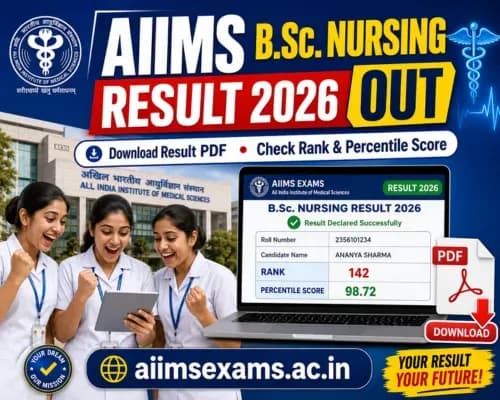
AIIMS B.Sc. Nursing Result 2026 OUT: Download Result PDF and Check Rank and Percentile Score at aiimsexams.ac.in html{scroll-behavior:smooth;}summary::-webkit-details-marker{display:none;} AIIMS B.Sc. Nursing Result 2026 OUT — Download Result PDF and Check Rank and Percentile Score at aiimsexams.ac.in AIIMS New Delhi has declared the AIIMS BSc Nursing Result 2026 at aiimsexams.ac.in. The AIIMS Nursing Result PDF containing the rank list, percentile scores, and qualifying status of all candidates who appeared in the B.Sc. (Hons) Nursing entrance exam is now available for download. The AIIMS BSc Nursing Rank List 2026 covers candidates who appeared for the exam conducted in July 2026. Key Highlights AIIMS BSc Nursing Result 2026 — DECLARED at aiimsexams.ac.in AIIMS Nursing Result PDF — Available for download at aiimsexams.ac.in; contains rank, percentile score, and qualifying status AIIMS BSc Nursing Rank List 2026 — Category-wise rank lists published: General, OBC, SC, ST, EWS, and PwD AIIMS Nursing Percentile Score — Shown against each roll number; used for category-wise rank computation AIIMS BSc Nursing Scorecard — Individual scorecard downloadable via AIIMS Candidate Login at aiimsexams.ac.in AIIMS Nursing Result Download — Via aiimsexams.ac.in; login with Registration ID and password; also available as a PDF rank list on the results page AIIMS BSc Nursing Merit List — Generated from the rank list; top-ranked candidates called for Stage 2 (interview/assessment) before counselling AIIMS Nursing Cutoff 2026 — Minimum qualifying: 50% aggregate for General; 40% for SC/ST; exact cutoff varies by category and depends on number of qualified candidates AIIMS Nursing Counselling 2026 — Expected within 2–3 weeks of result; conducted at AIIMS New Delhi; covers seat allocation across 16 AIIMS campuses AIIMS Candidate Login — aiimsexams.ac.in using Registration ID and password aiimsexams.ac.in Nursing Result — Official portal; check homepage for the result link All AIIMS BSc Hons Nursing Result and counselling updates tracked here Related News: AIIMS BSc Nursing Exam Guidelines — Reporting Time and Documents 🟢 AIIMS BSc Nursing Result 2026 — Latest Updates ✅ Result Status — DECLARED at aiimsexams.ac.in The AIIMS BSc Nursing Result 2026 has been officially declared by AIIMS New Delhi at aiimsexams.ac.in. The AIIMS Nursing Result PDF is available for download from the official results section of the portal. The result is published as a consolidated rank list PDF containing all candidates' roll numbers, category, marks obtained, AIIMS Nursing Percentile Score, and overall rank within their category. Candidates are advised to download the AIIMS Nursing Result PDF immediately and note their rank and percentile score for the counselling process ahead. All AIIMS BSc Nursing Result 2026 confirmation updates tracked here. 📋 AIIMS BSc Nursing Rank List 2026 — How to Interpret Your Result The AIIMS BSc Nursing Rank List 2026 is published category-wise: General (UR), OBC, SC, ST, EWS, and PwD (Person with Disability). Each candidate's rank is computed within their applicable category. The AIIMS Nursing Percentile Score indicates what percentage of candidates scored at or below your score — a percentile of 95 means you scored better than 95% of all candidates who appeared. Candidates whose percentile and marks meet or exceed the AIIMS Nursing Cutoff 2026 for their category are considered qualified and eligible for the Stage 2 selection and AIIMS Nursing Counselling 2026. The AIIMS BSc Nursing Scorecard (individual) can be downloaded via the AIIMS Candidate Login at aiimsexams.ac.in using your Registration ID and password. All AIIMS BSc Nursing Rank List 2026 interpretation guidance tracked here. 📊 AIIMS Nursing Cutoff 2026 — Minimum Qualifying Marks The AIIMS Nursing Cutoff 2026 for the B.Sc. (Hons) Nursing entrance exam is: General/EWS/OBC — minimum 50% aggregate in the qualifying exam (Class 12 PCB with English); SC/ST/PwD — minimum 40%. The AIIMS Nursing Cutoff 2026 for the entrance test itself (Stage 1) is applied as a minimum raw score threshold before percentile ranks are assigned — candidates below the Stage 1 cutoff are not assigned a rank and are ineligible for Stage 2. Historically, competitive ranks for the most sought-after AIIMS Delhi seats in the General category have required scores in the 85th percentile or above, though the exact competitive cutoff varies each year based on difficulty and candidate pool. All AIIMS Nursing Cutoff 2026 category-wise updates tracked here. 📅 AIIMS Nursing Counselling 2026 — What Comes Next AIIMS Nursing Counselling 2026 is expected to be announced within 2–3 weeks of the result declaration. The counselling process for the B.Sc. (Hons) Nursing programme at AIIMS involves: shortlisting of candidates (top-ranked candidates in each category based on the AIIMS BSc Nursing Merit List — typically 3× the number of available seats); a Stage 2 assessment at AIIMS New Delhi; and the final seat allocation across all 16 AIIMS campuses (Delhi, Bathinda, Bilaspur, Bhopal, Bhubaneswar, Bibinagar, Deoghar, Gorakhpur, Jodhpur, Kalyani, Mangalagiri, Nagpur, Patna, Raebareli, Raipur, Rishikesh). All AIIMS Nursing Counselling 2026 dates and documents will be announced at aiimsexams.ac.in. All aiimsexams.ac.in Nursing Result and counselling updates tracked here. How to Download AIIMS BSc Nursing Result 2026 Visit aiimsexams.ac.in — the official AIIMS exam portal On the homepage, find the "AIIMS B.Sc. (Hons) Nursing Result 2026" link under Announcements or Results Click the link to access the AIIMS Nursing Result PDF — this is the consolidated rank list PDF available without login Locate your Roll Number in the category-wise AIIMS BSc Nursing Rank List 2026 to find your marks, percentile, and rank For your individual AIIMS BSc Nursing Scorecard, complete the AIIMS Candidate Login using Registration ID and password Download and save both the rank list PDF and individual scorecard — both will be required during AIIMS Nursing Counselling 2026 Check whether your rank falls within the previous years' counselling range for your preferred AIIMS campus to estimate your chances FAQs Q1. Has the AIIMS BSc Nursing Result 2026 been declared?Yes, the AIIMS BSc Nursing Result 2026 has been declared at aiimsexams.ac.in. The AIIMS Nursing Result PDF and individual AIIMS BSc Nursing Scorecard are available for download at the official portal. Q2. What is the AIIMS Nursing Cutoff 2026?The minimum qualifying AIIMS Nursing Cutoff 2026 is 50% aggregate in Class 12 PCB for General/OBC/EWS candidates and 40% for SC/ST/PwD candidates. The Stage 1 test also has a minimum raw score cutoff — candidates below this are not ranked and are ineligible for Stage 2 and counselling. Q3. How do I download the AIIMS BSc Hons Nursing Result?Visit aiimsexams.ac.in, find the result link under Announcements, and download the AIIMS Nursing Result PDF to check your rank in the AIIMS BSc Nursing Rank List 2026. For your individual scorecard, use the AIIMS Candidate Login with your Registration ID and password. Q4. What does AIIMS Nursing Percentile Score mean?The AIIMS Nursing Percentile Score indicates the percentage of candidates who scored at or below your marks. A percentile of 90 means you scored better than 90% of all candidates. The percentile score, along with raw marks, determines your rank in the AIIMS BSc Nursing Rank List 2026. Q5. When will AIIMS Nursing Counselling 2026 begin?AIIMS Nursing Counselling 2026 is expected to be announced within 2–3 weeks of the result declaration at aiimsexams.ac.in. The counselling involves Stage 2 assessment at AIIMS New Delhi followed by seat allocation across 16 AIIMS campuses. Related News / Articles Best Free AI Tools for Students in 2026 High-Income Tech Skills Without Programming Top AI Skills Students Must Learn in 2026 CUET UG Result 2026: How to Check Scorecard, Expected Cutoffs CHECK OUT: AIIMS Delhi — University Profile Explore More Karnataka 2nd PUC Result Date TS INTER RESULT DATE KEAM ADMIT CARD 2026 JEE Advanced 2026 Registration GPAT Result 2026 LIVE CUET PG Response Sheet Rajasthan BSTC 2026 Notification UGC Releases New Guidelines Stay with College Nirnay for all updates on AIIMS BSc Nursing Result 2026 — AIIMS Nursing Result PDF download guidance at collegenirnay.com, AIIMS BSc Nursing Rank List 2026 category-wise, AIIMS Nursing Percentile Score interpretation, AIIMS BSc Nursing Scorecard individual download, AIIMS Nursing Result Download steps, AIIMS BSc Nursing Merit List shortlisting, AIIMS Nursing Cutoff 2026 category-wise, AIIMS Nursing Counselling 2026 timeline, AIIMS Candidate Login access, aiimsexams.ac.in Nursing Result portal updates, and all AIIMS BSc Hons Nursing Result developments.
Mumbai University Exams Postponed Due to Heavy Rains: Revised Examination Dates to Be Announced Soon html{scroll-behavior:smooth;}summary::-webkit-details-marker{display:none;} Mumbai University Exams Postponed Due to Heavy Rains — Revised Examination Dates to Be Announced Soon The University of Mumbai has officially postponed examinations scheduled across UG and PG programmes due to heavy rainfall in Mumbai and the Mumbai Metropolitan Region. The Mumbai University Exam Postponed 2026 announcement was issued via an official circular — all examinations that were originally scheduled for affected dates stand postponed, and the Mumbai University Revised Exam Dates will be announced separately at mu.ac.in. Key Highlights Mumbai University Exams Postponed — OFFICIAL; all exams on affected dates cancelled due to heavy rain Mumbai University Exam Postponed 2026 — Circular issued by University of Mumbai; applies to UG and PG scheduled examinations MU Exam Postponed Due to Rain — Heavy rainfall and associated transport disruptions in Mumbai and MMR region cited as reason Mumbai University Revised Exam Dates — To be announced separately at mu.ac.in; no new dates confirmed at time of this report Mumbai University Exam News — Official circular available at mu.ac.in; exam controller's office the official contact MU Exam Circular 2026 — Published on mu.ac.in; candidates must monitor the portal for updated timetable Mumbai University Hall Ticket — Already downloaded hall tickets remain valid; no need to re-download until new dates are confirmed Mumbai Heavy Rain Exam Update — IMD has issued weather warnings for the Mumbai region; university acted proactively to prevent student hardship Mumbai University UG Exams — Postponed for affected dates across programmes including BA, BSc, BCom, BMS, BAF, BBI, and others Mumbai University PG Exams — Postponed for affected MA, MCom, MSc, and other PG examinations scheduled on affected dates MU Revised Timetable — Will be published on mu.ac.in; candidates advised to check regularly and note their specific exam dates All University of Mumbai Exam Update developments tracked here Related News: Mumbai University Admissions — UG Registration Deadline 🔴 Mumbai University Exam Update — Live Tracking 🔴 Exam Status — POSTPONED; REVISED DATES AWAITED Mumbai University Exams Postponed — the University of Mumbai has issued an official circular confirming that all examinations scheduled on the affected rain dates are postponed. The MU Exam Circular 2026 specifies that postponement applies to all programmes where exams were scheduled on the impacted date(s) — candidates must verify whether their specific exam falls within the affected schedule by checking mu.ac.in or contacting their college. The Mumbai University Exam Postponed 2026 decision covers both in-semester and end-semester examinations as applicable. All Mumbai University Exams Postponed confirmation tracking here. 📋 MU Exam Postponed Due to Rain — Context The MU Exam Postponed Due to Rain decision follows the pattern established in previous years where the University of Mumbai has proactively postponed exams when the India Meteorological Department (IMD) issues Red or Orange alerts for the Mumbai district. Heavy rain in Mumbai routinely disrupts suburban railway services — the lifeline for most Mumbai students commuting to examination centres — making it operationally impossible for large numbers of students to reach their centres safely. The Mumbai Heavy Rain Exam Update reflects the university's policy of not compelling students to travel during weather emergencies. Historical precedent: Mumbai University has postponed exams during monsoon disruptions multiple times across 2022, 2023, 2024, and 2025 cycles as well. All MU Exam Postponed Due to Rain context updates tracked here. 📊 Mumbai University UG and PG Exams — Which Programmes Are Affected Mumbai University UG Exams affected by the postponement include programmes across all faculties — Arts (BA), Science (BSc), Commerce (BCom), Management Studies (BMS), Accounting and Finance (BAF), Banking and Insurance (BBI), Information Technology (BScIT), and other affiliated UG programmes. Mumbai University PG Exams affected include MA, MCom, MSc, MMS, and other postgraduate programmes scheduled on the impacted dates. Candidates appearing for professional course exams (LLB, B.Pharm, MBBS, BEd) through the University of Mumbai should confirm the postponement status of their specific examination separately, as some professional programme exams are managed by separate exam authorities. All Mumbai University UG Exams and Mumbai University PG Exams postponement status tracked here. 📅 MU Revised Timetable — What to Do While Waiting The MU Revised Timetable and Mumbai University Revised Exam Dates will be published on mu.ac.in. Based on historical practice, the university typically announces new dates within 3–7 days of a postponement, scheduling the postponed paper either at the end of the existing timetable or in a dedicated supplementary window. While waiting: bookmark mu.ac.in and check daily; your Mumbai University Hall Ticket remains valid — do not re-apply for a new hall ticket unless the university specifically instructs candidates to do so; note your subject code and exam roll number so you can quickly locate your revised exam date when the MU Revised Timetable is published. All University of Mumbai Exam Update revised timetable tracking here. What Students Must Do Now Do NOT travel to the exam centre on the postponed date — the exam will not be conducted; you will not be marked absent for a postponed exam Check mu.ac.in daily for the MU Revised Timetable and Mumbai University Revised Exam Dates Your existing Mumbai University Hall Ticket remains valid for the rescheduled date — no reapplication or re-download is needed unless the university specifically directs otherwise Follow your college notice board and official WhatsApp/email communications — affiliated colleges typically forward the official MU Exam Circular 2026 to students quickly Use the postponement window to revise or consolidate your preparation for the rescheduled exam If you have multiple exams affected, list all impacted papers and track revised dates for each separately from the MU Revised Timetable 📌 Important Note The Mumbai University Exam News regarding postponement applies only to the dates specifically cited in the official circular. Exams on subsequent dates remain on schedule as per the original timetable unless a fresh MU Exam Circular 2026 is issued. Candidates should not assume all pending exams are postponed — verify each paper's status specifically against the official postponement notice at mu.ac.in. Any third-party communication (social media, WhatsApp forwards) about exam schedules should be verified against mu.ac.in before acting on it. All University of Mumbai Exam Update developments tracked here. FAQs Q1. Are Mumbai University exams postponed?Yes, Mumbai University Exams Postponed is confirmed via an official circular from the University of Mumbai. The postponement applies to all examinations scheduled on the affected rain dates, covering both Mumbai University UG Exams and Mumbai University PG Exams. Q2. When will the Mumbai University Revised Exam Dates be announced?Mumbai University Revised Exam Dates and the MU Revised Timetable will be announced at mu.ac.in. Based on past practice, the university typically releases rescheduled dates within 3–7 days. Check mu.ac.in regularly for the update. Q3. Is my Mumbai University Hall Ticket still valid?Yes, your Mumbai University Hall Ticket remains valid for the rescheduled date. You do not need to re-apply or re-download your hall ticket unless the University specifically instructs candidates to do so in a new circular. Q4. Will I be marked absent if I don't appear on the postponed date?No. The exam will not be conducted on the postponed date — the Mumbai University Exam Postponed 2026 circular officially cancels the exam on that date. You will only be assessed on the rescheduled date announced in the MU Revised Timetable. Q5. Do all Mumbai University exams stand postponed or only specific dates?Mumbai University Exams Postponed applies only to the specific dates mentioned in the official MU Exam Circular 2026. All other exams on subsequent dates remain on schedule unless a fresh circular is issued. Verify your specific paper's status at mu.ac.in. Related News / Articles Best Free AI Tools for Students in 2026 High-Income Tech Skills Without Programming Top AI Skills Students Must Learn in 2026 CUET UG Result 2026: How to Check Scorecard, Expected Cutoffs CHECK OUT: Mumbai University PG Admission 2026 Explore More Karnataka 2nd PUC Result Date TS INTER RESULT DATE KEAM ADMIT CARD 2026 JEE Advanced 2026 Registration GPAT Result 2026 LIVE CUET PG Response Sheet Rajasthan BSTC 2026 Notification UGC Releases New Guidelines Stay with College Nirnay for all updates on Mumbai University Exams Postponed — Mumbai University Exam Postponed 2026 circular details, MU Exam Postponed Due to Rain context, Mumbai University Revised Exam Dates tracking at collegenirnay.com, Mumbai University Exam News official circular updates, MU Exam Circular 2026 content, Mumbai University Hall Ticket validity guidance, Mumbai Heavy Rain Exam Update, Mumbai University UG Exams and Mumbai University PG Exams postponement scope, MU Revised Timetable publication timeline, and all University of Mumbai Exam Update developments.
Speak with our certified academic advisors who have helped 1 lakh+ students pick the perfect university, course, and career path — completely free of charge.
Free Chat GuidanceFill in your details and our senior counsellors will call you within 24 hours with a personalised admission plan.
Talk to our expert mentors for personalized guidance and clear your doubts instantly.