JEE Advanced 2026: Answer Key, Objection Window, Result Date & Full IIT Admission Process
The post-examination phase of JEE Advance 2026 has officially begun — with the provisional JEE Advanced answer key now released, the JEE Advanced objection window active for candidates who wish to challenge specific answers, and the JEE Advanced result date confirmed in the official examination calendar. This page serves as the complete reference for every candidate who appeared in JEE Advanced 2026 — covering the answer key review process, how to submit objections effectively, the JEE Advanced result date and what to expect from the scoring system, and the full IIT admission process 2026 that follows the result — including the JoSAA counselling timeline, branch and institute preference filling strategy, and the seat allotment process that determines where each qualified candidate will spend the next four to five years. All JEE latest update notifications — including any answer key corrections, result announcement time, and JEE Advanced counselling schedule — are being tracked on this page in real time. Whether you are approaching the objection window with a specific challenge, estimating your rank from the provisional key, or building your IIT admission 2026 preference list strategy, this is the complete engineering entrance exam resource you need for the weeks ahead.
Key Highlights
- Provisional JEE Advanced answer key released — candidates can now estimate scores and identify challenges
- JEE Advanced objection window is open — submit documented challenges at jeeadv.ac.in before deadline
- JEE Advanced result date confirmed in official calendar — final key published before result
- IIT admission process 2026 follows result — JoSAA counselling begins within days of result declaration
- JEE Advanced counselling via JoSAA — institute + branch preference filling is the most critical decision point
- IIT admission 2026 seats across 23 IITs + ISM Dhanbad to be allotted through JoSAA rounds
- All JEE latest update and engineering entrance exam timeline developments tracked here
Explore This: JEE Mains Exam Guide
Why It Matters
The answer key, objection, result, and counselling sequence that follows JEE Advance 2026 is among the most consequential multi-week processes any student navigates — because the decisions made at each stage compound. An accurate score estimate from the provisional JEE Advanced answer key enables realistic rank projection and counselling preparation. A well-documented challenge in the JEE Advanced objection window can correct a wrong answer in the final key and add marks that shift the rank meaningfully. The confirmed JEE Advanced result date sets the countdown for when preference filling begins. And the quality of the preference list submitted during JoSAA counselling — more than any other single factor — determines whether a candidate's JEE Advanced rank translates into their best possible IIT and branch outcome. Every stage of this process deserves the same preparation quality that went into the examination itself — and this page provides the comprehensive JEE latest update coverage to support that preparation.
What Happened: JEE Advanced 2026 — Answer Key, Objections & Result Timeline
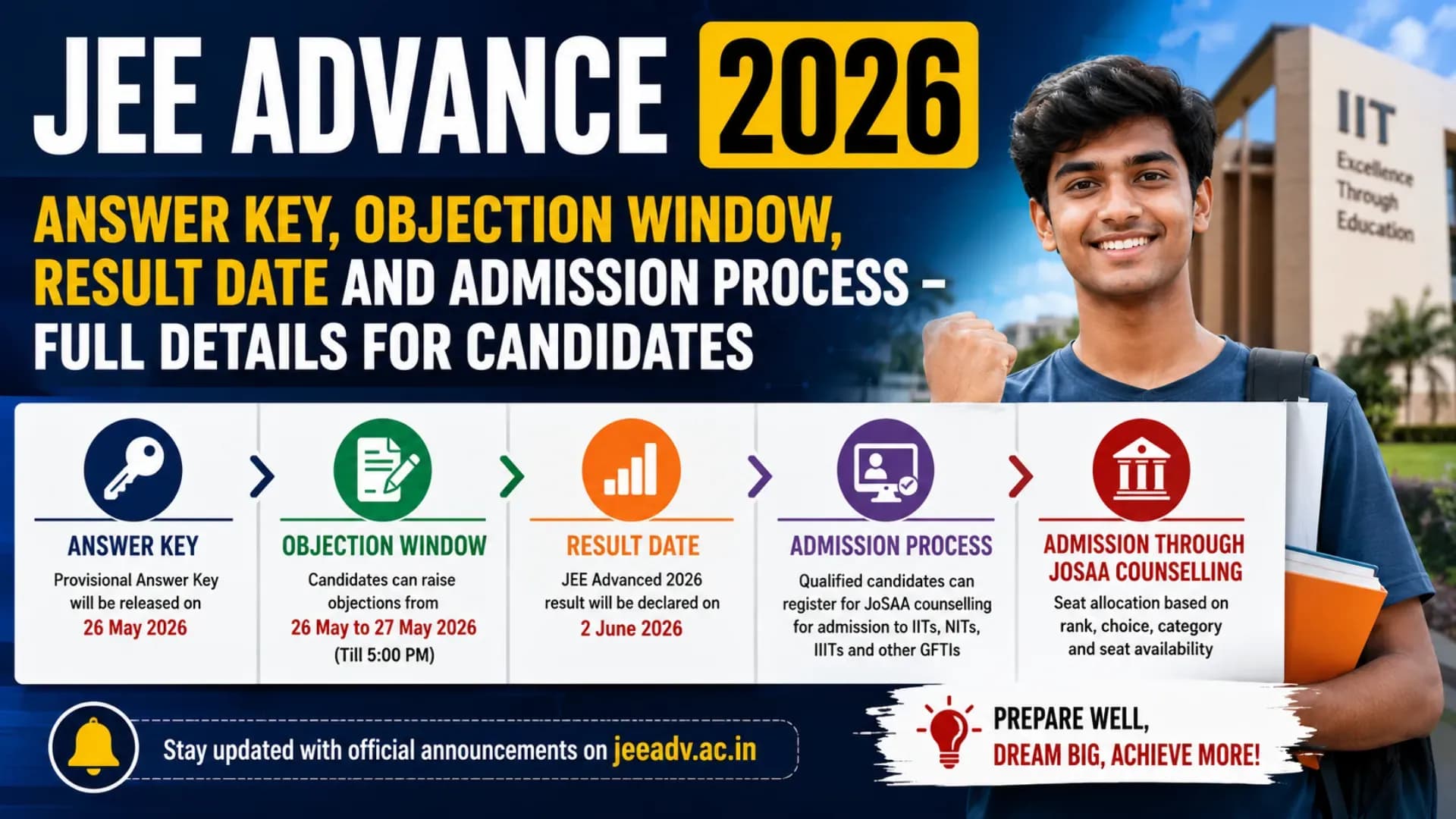
The organising IIT for JEE Advance 2026 has released the provisional JEE Advanced answer key for both Paper 1 and Paper 2 — covering all question types (MCQ single correct, MCQ multiple correct, integer type, and matching type) across Physics, Chemistry, and Mathematics. The provisional key is available at jeeadv.ac.in alongside each candidate's individual recorded response sheet — allowing a direct comparison between what the candidate marked and what the provisional key indicates as correct. This comparison is the basis for a preliminary score estimate and for identifying questions where a candidate believes the provisional key is incorrect and may benefit from a formal challenge through the JEE Advanced objection window.
The JEE Advanced objection window is the mechanism through which candidates can formally challenge any answer in the provisional JEE Advanced answer key that they believe is incorrect, ambiguous, or where multiple answers are defensible. Each challenge must be submitted through the online portal at jeeadv.ac.in within the announced deadline — accompanied by a reference supporting the proposed correct answer (typically a recognised textbook, NCERT, or peer-reviewed academic source). The organising IIT's subject expert committee reviews all submitted challenges and determines whether corrections to the provisional key are warranted — with accepted corrections incorporated into the final JEE Advanced answer key that is published before the result. The JEE latest update from the organising IIT confirms that the objection fee per question is non-refundable regardless of the challenge outcome — making selective, well-researched objection submission the recommended strategy rather than blanket challenges to all questions a candidate found difficult.
The confirmed JEE Advanced result date follows the objection review and final key publication in the official examination calendar. The result declares each qualified candidate's All India Rank (AIR) — computed from the combined Paper 1 and Paper 2 scores using the final JEE Advanced answer key — alongside category ranks (General, OBC-NCL, SC, ST, EWS, and PwD) and the subject-wise marks breakdown. The JEE Advanced result date also triggers the opening of the JoSAA (Joint Seat Allocation Authority) portal for JEE Advanced counselling — which typically commences within 5 to 7 days of the result declaration and manages the entire IIT admission process 2026 through a series of allotment rounds. All engineering entrance exam process updates — including the exact result time, JoSAA registration opening, and round-wise schedule — will be published as JEE latest update on this page as they are confirmed.
Related News: CUET UG Exam Guide
Key Details Table — JEE Advanced 2026 Post-Exam Timeline
| Milestone | Status / Details |
|---|---|
| JEE Advance 2026 Examination | Conducted — Paper 1 & Paper 2 Complete |
| Provisional JEE Advanced Answer Key | Released — Available at jeeadv.ac.in |
| Candidate Response Sheet | Available at jeeadv.ac.in alongside answer key |
| JEE Advanced Objection Window | Open — Submit at jeeadv.ac.in before Deadline |
| Objection Fee | Per Question — Non-Refundable — Confirm Amount at jeeadv.ac.in |
| Final JEE Advanced Answer Key | Published After Objection Review — Before Result Declaration |
| JEE Advanced Result Date | Confirmed in Official Calendar — Check jeeadv.ac.in for Exact Date & Time |
| Rank Declared | AIR + Category Ranks (General, OBC-NCL, SC, ST, EWS, PwD) |
| JoSAA Counselling Opens | 5–7 Days After Result — JEE Advanced Counselling via josaa.nic.in |
| IIT Admission 2026 Seats | 23 IITs + ISM Dhanbad — All via JoSAA Seat Allotment |
| IIT Admission Process 2026 Rounds | JoSAA Rounds 1–6 — Choice Filling, Allotment, Acceptance, Withdrawal |
| Official Portal | jeeadv.ac.in (Exam/Answer Key) · josaa.nic.in (Counselling) |
How to Use the JEE Advanced Answer Key & Submit Objections
- Step 1 — Download response sheet and answer key: Visit jeeadv.ac.in, log in with your JEE Advanced 2026 registration number and date of birth, and download both your individual response sheet and the provisional JEE Advanced answer key for Paper 1 and Paper 2
- Step 2 — Calculate your preliminary score: Cross-reference every question in both papers — use the official marking scheme (confirm on jeeadv.ac.in — JEE Advanced uses varying mark allocations for different question types) to compute your estimated raw score from the provisional JEE Advanced answer key
- Step 3 — Identify challengeable questions: Flag questions where you believe the provisional JEE Advanced answer key is wrong or where multiple answers are correct — focus on questions where you have a specific, source-supported reason to challenge, not merely where you answered differently
- Step 4 — Research your challenge before submitting: For each flagged question in the JEE Advanced objection window, identify the textbook reference (NCERT, H.C. Verma, Morrison Boyd, I.A. Maron, or relevant standard source) with exact page, edition, and publisher details that supports your proposed answer — the committee only considers challenges with documented academic references
- Step 5 — Submit objections at jeeadv.ac.in: Use the official objection portal at jeeadv.ac.in before the JEE Advanced objection window closes — pay the per-question fee, submit your reference, and save the confirmation receipt for each challenge submitted
- Step 6 — Await the final answer key: The organising IIT publishes the final JEE Advanced answer key after reviewing all objections — any accepted corrections will be reflected in this key, which is then used for official score and rank computation
- Step 7 — Prepare for JoSAA on the result date: On the JEE Advanced result date, download your rank card from jeeadv.ac.in immediately — your AIR and category rank will be needed for JoSAA registration and preference filling in the JEE Advanced counselling process
JoSAA Counselling 2026 — Complete Strategy Guide for IIT Admission
The JoSAA counselling process that follows the JEE Advanced result date is the most consequential decision phase in the entire IIT admission process 2026 — and it is the phase where the least preparation is typically invested relative to its importance. Here is a complete strategic framework for every candidate navigating JEE Advanced counselling:
- Understand the JoSAA structure before result day. JoSAA counselling for IIT admission 2026 operates through 6 rounds of seat allotment — each round consists of choice filling/modification, seat allotment, and a response window where candidates accept, withdraw, or float their allotment. Candidates who understand this structure before the JEE Advanced result date are dramatically better prepared to make good decisions in the compressed time windows that each round provides.
- Build your preference list before the result — not after. The most common and most damaging JoSAA mistake is building the preference list in the 48 hours after the JEE Advanced result date — when emotion, parental pressure, and time urgency combine to produce a choice list driven by brand recognition rather than strategic analysis. Build a first-draft preference list now, based on your estimated rank from the provisional JEE Advanced answer key. Use opening and closing rank data from JoSAA 2024 and 2025 (available at josaa.nic.in) to calibrate your list to your actual rank range rather than to a wishlist of names.
- Rank preferences by desirability — not by probability. JoSAA's algorithm is a Gale-Shapley deferred acceptance system — you cannot be allocated to a worse option if a better option is available for your rank. This means it is strategically correct to list your genuinely most preferred option first, regardless of how competitive it seems — the algorithm protects you from being assigned a lower preference when a higher preference is achievable. Candidates who list "safe" options first out of fear of missing higher preferences are systematically disadvantaged by this misunderstanding.
- Branch vs institute — know your priority. One of the most important decisions in the IIT admission process 2026 preference list is how to weigh branch versus institute. Research shows that branch generally matters more than institute tier for career outcomes in most engineering domains — a CSE degree from IIT (BHU) Varanasi produces comparable industry outcomes to a Civil Engineering degree from IIT Bombay in most employment markets. However, research and academia pathways may favour institute prestige differently. Know your own career direction before building your preference list.
- Use the "float" option strategically. When allocated a seat in any JoSAA round, candidates can choose to "float" — meaning they accept the current allotment provisionally while remaining in the pool for a better option in subsequent rounds. This is almost always the correct strategy for candidates who have received an allotment below their first preference — it protects their current allotment while maintaining eligibility for improvement. Withdrawing from JEE Advanced counselling prematurely (by choosing "freeze" before exploring all rounds) is a common and irreversible mistake.
- Prepare all documents in advance of JoSAA registration. The IIT admission 2026 document set required for JoSAA includes: JEE Advanced rank card, Class 10 and 12 marksheets and certificates, category certificates (if applicable — OBC-NCL/SC/ST/EWS/PwD), passport photo, and identity documents. Have all of these scanned, named, and ready before JoSAA registration opens — the registration window is tight and document upload errors under time pressure are a preventable admission risk.
What's Next — JEE Advanced 2026 Full Timeline
The JEE Advance 2026 post-examination timeline unfolds in a defined sequence that every candidate should have clearly mapped: the JEE Advanced objection window closes at the deadline announced on jeeadv.ac.in — submit before that date. The final JEE Advanced answer key incorporating accepted corrections is published before the result. The JEE Advanced result date produces each candidate's AIR and category rank at jeeadv.ac.in. Within 5 to 7 days of the result, JoSAA counselling registration opens at josaa.nic.in — candidates register, verify documents, and access the choice-filling interface. Over the following 4 to 6 weeks, JoSAA Rounds 1 through 6 are conducted — each with a choice modification window, a seat allotment announcement, and a candidate response deadline. The final round produces the definitive seat allotment, following which candidates report to their allotted IIT for document verification and fee payment to confirm the IIT admission 2026 seat. All JEE latest update on each of these milestones — exact dates, portal links, and decision-point guidance — will be published on this page as confirmed.
Expert Analysis
JEE Advanced alumni and academic counsellors who have navigated the IIT admission process 2026 in previous cycles consistently identify the JoSAA preference list as the single most consequential and least carefully prepared part of the entire JEE journey. Students who spend two years in intense engineering entrance exam preparation — and then invest 48 hours in panic-building a JoSAA preference list — are systematically underconverting their JEE Advanced rank into the best available outcome. The provisional JEE Advanced answer key period, which typically spans 5 to 7 days before the result, is not primarily a time for anxiety — it is the most valuable JoSAA preparation window available, because it gives candidates their best rank estimate before the decision pressure of the actual result arrives.
For candidates using the JEE Advanced objection window, the most important expert guidance is selectivity — submit challenges only where you have a specific academic reference supporting a different answer, and resist the temptation to challenge every question you found difficult or answered incorrectly. The subject expert committees that review objections are composed of senior faculty who are unlikely to be persuaded by objections without rigorous academic support — and the time spent on well-researched selective challenges produces better outcomes than the time spent on broad, unsupported ones. The JEE Advanced counselling preparation guidance in this piece, combined with accurate rank estimation from the provisional key, gives every JEE Advance 2026 candidate the analytical foundation to convert their result into the best possible IIT admission 2026 outcome. Follow all JEE latest update on this page for real-time coverage of every stage.
Stop Stressing. Start Applying.
Skip the chaos of filling endless forms. Apply to your dream colleges in one go through the College Nirnay Common Application Form — built for every student navigating India's competitive education landscape.
Fill the Common Application Form →✓ Free to apply · ✓ Takes under 5 minutes · ✓ Trusted by thousands of students
FAQs
Q1. Where can I download the JEE Advanced 2026 answer key and response sheet?
The provisional JEE Advanced answer key for both Paper 1 and Paper 2 is available at jeeadv.ac.in — log in using your JEE Advanced 2026 registration number and date of birth to access both the answer key and your individual response sheet. Download both documents immediately and compare question by question to compute your preliminary score and identify any candidates for the JEE Advanced objection window. All JEE latest update on the final key publication will also be available at jeeadv.ac.in.
Q2. How do I submit an objection in the JEE Advanced objection window?
The JEE Advanced objection window is accessed through the official portal at jeeadv.ac.in. For each question you wish to challenge, you must submit: your proposed correct answer, and a specific academic reference (textbook name, author, edition, publisher, and page number) supporting your answer. Pay the per-question objection fee, submit the challenge, and save the confirmation receipt. Submit challenges only for questions where you have a documented academic basis — unsupported objections are not considered. Submit before the JEE Advanced objection window closing deadline; late submissions are not accepted. Track all JEE latest update on objection outcomes on this page.
Q3. What is the JEE Advanced 2026 result date?
The JEE Advanced result date for 2026 is confirmed in the official JEE Advanced 2026 examination calendar — check jeeadv.ac.in for the exact date and time. The result will be accessible at jeeadv.ac.in using your registration number and will display your AIR, category rank, and subject-wise marks. The JEE Advanced result date also triggers JoSAA counselling registration — which typically opens within 5 to 7 days of the result declaration. All JEE latest update on the result time and post-result process will be tracked on this page.
Q4. How does JoSAA counselling work for IIT admission 2026?
JoSAA counselling for IIT admission 2026 is conducted through the josaa.nic.in portal in 6 rounds. After the JEE Advanced result date, candidates register on JoSAA, verify documents, and fill their ranked preference list of institute-branch combinations. The JoSAA algorithm allocates seats based on AIR, category, and preference ranking. In each round, candidates can accept, float (hold current allotment while seeking a better one), or withdraw. The float option should almost always be exercised over withdrawal until the final round — it protects the current seat while maintaining eligibility for a better allotment. All JEE Advanced counselling round schedules and seat data are published at josaa.nic.in and tracked here as JEE latest update.
Q5. Should I prioritise IIT brand or branch in my JoSAA preference list?
The brand vs branch decision in JEE Advanced counselling depends on your career direction. For technology-focused careers — software engineering, data science, AI, product management — branch (specifically CSE or ECE) tends to matter more than institute tier across most IITs outside the top 3 to 4. For research, academia, or consulting careers, institute prestige carries more weight in the hiring process. For core engineering careers, both branch alignment and institute reputation matter. The IIT admission process 2026 preference list should reflect this analysis as applied to your specific career direction — not a generic ranking of "best to worst" IITs. Use opening and closing rank data from JoSAA 2024 and 2025 at josaa.nic.in to calibrate each combination against your estimated rank from the provisional JEE Advanced answer key.
Explore More
Stay with College Nirnay for all JEE latest update — including the final JEE Advanced answer key, JEE Advanced result date countdown, JoSAA counselling round-wise seat data, and complete IIT admission process 2026 guidance — as your definitive source for JEE Advance 2026 and engineering entrance exam coverage.